

A device ID is an identifier that enables digital systems to identify a device across a customer’s digital sessions, regardless of the account, email address or phone number used. With fraudsters easily changing credentials, creating new email addresses, rotating IP addresses, and even building synthetic identities, device-level visibility is becoming more important for fraud detection.
Identity attributes like email addresses, phone numbers, and even identity documents can be spoofed or manipulated. Devices, however, tend to reveal more persistent signals. These include device fingerprints, device integrity indicators, operating system and browser characteristics, network and location data, behavioural patterns, and others. Such signals are much harder to fake or manipulate, making device identification effective and helping NBFCs, insurers and fintechs detect and prevent fraud in real time.
In this article, we will discuss how device identification works, the different types of device IDs, multiple core elements and how device intelligence fits into a modern BFSI fraud detection strategy.
Key Takeaways
- Device IDs help BFSI fraud teams recognise the device behind an action, not just the identity claimed on it.
- Device recognition works through signal collection, fingerprinting, historical matching, and risk scoring.
- Device ID, device fingerprinting, and device intelligence are related but distinct concepts, with device intelligence offering the deepest risk context.
- Device identifiers help detect account takeover, multi-accounting, promo abuse, synthetic identity fraud, and fraud rings.
- A device identifier alone can be spoofed, reset, or shared across users, so it works best as one signal within a layered fraud detection approach.
- Device intelligence platforms combine device signals with behavioural, network, and identity data to assess whether to trust a device.
What Is Device ID?
A device ID is an identifier used to identify a device across multiple sessions and interactions. It can differentiate one device from another using an operating system, an application, a browser, or a fraud prevention platform. This includes: mobile advertising IDs, vendor-specific identifiers, cookies and platform-generated identifiers.
In fraud detection, device IDs can help organisations monitor device activity over time, identify returning devices, and uncover certain patterns that are not visible through account information alone. For example, the same device may be used for many applications, accounts or transactions, which helps fraud detection teams identify suspicious activity and investigate potential abuse.
What Are the Different Types of Device IDs?
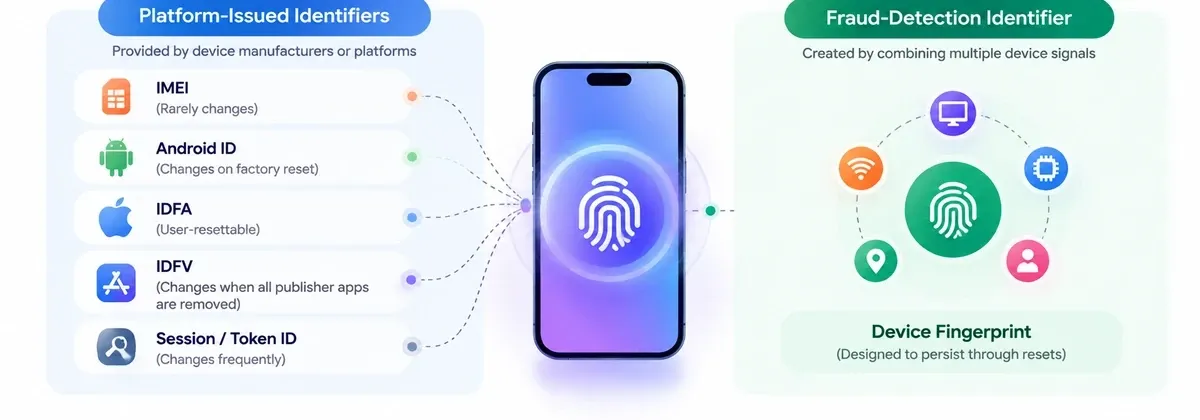
Device IDs are categorised into two main types: platform-issued and fraud-detection identifiers. Platform-issued identifiers such as IMEI, Android ID, IDFA, IDFV, and session tokens are primarily used for device identification, analytics, authentication, or ecosystem management.
However, fraud detection identifiers often use device fingerprints that combine multiple hardware, software and environmental signals to create a more resilient device identifier. Understanding how these identifiers behave is important because some can be reset, rotated, or removed more easily than others.
| Category | Identifier | Changes | Primary Use | Fraud Detection Value |
|---|---|---|---|---|
| Platform-issued Identifier | IMEI | Rarely | Telecom-level device tracking | Limited access at app level |
| Platform-issued Identifier | Android ID | On factory reset | Android app recognition | Moderate |
| Platform issued- Identifier | IDFA | User-resettable | Advertising attribution | Low |
| Platform issued- Identifier | IDFV | On removal of all publisher apps | iOS app ecosystem tracking | Moderate |
| Platform issued- Identifier | Session / Token ID | Frequently, per session | Authentication | Low on its own |
| Fraud-Detection Identifier | Device Fingerprint | Designed to persist through resets | Fraud detection | High |
Swipe the table
Identifiers issued by the platform help recognise devices, but were not designed to make independent fraud decisions. Fraud-detection identifiers provide additional persistence and context so banks and financial institutions can track device activity across multiple applications, accounts and sessions.
Device ID vs Device Fingerprinting vs Device Intelligence
Device ID, device fingerprinting, and device intelligence are often used together in fraud prevention, but they serve different functions. While a device ID helps recognise a device, fingerprinting helps re-identify it using multiple attributes, and device intelligence analyses those signals to assess risk and support fraud decisions. To understand how device fingerprinting combines multiple device attributes to recognise returning devices even when identifiers change, see our guide to device fingerprinting for fraud prevention.
The table below shows the significant differences between these three.
| Key Aspects | Device ID | Device Fingerprinting | Device Intelligence |
|---|---|---|---|
| Definition | A single identifier assigned to or associated with a device. | A device profile created using multiple hardware, software, network, and environment attributes. | A risk assessment approach that analyses device signals alongside behavioural, network, historical, and relationship data. |
| Primary Purpose | Recognise a device. | Re-identify a device across sessions. | Determine whether a device can be trusted. |
| Data Used | One identifier, such as Android ID, IDFA, IDFV, or a platform-generated ID. | Device attributes such as operating system, browser, hardware configuration, network characteristics, and environment signals. | Device fingerprints, behavioural patterns, historical activity, digital footprint, network context, and account relationships. |
| Persistence | Depends on the identifier; some can be reset or rotated. | More resilient because it combines multiple attributes. | Continuously updated as new signals and events are collected. |
| Fraud Detection Capability | Basic device recognition. | Detects returning devices and device reuse. | Identifies suspicious behaviour, fraud patterns, mule activity, account takeover, and coordinated fraud. |
| Example | Android ID associated with a mobile banking user. | A fingerprint linking the same device across multiple loan applications despite identifier changes. | A risk engine identifying a device connected to multiple accounts, suspicious behaviour, and known fraud activity. |
Swipe the table
Device ID, device fingerprinting, and device intelligence represent different layers of device analysis. While device IDs and fingerprints help recognise and track devices, device intelligence adds the behavioural, historical, and contextual insights needed to assess risk and support fraud decisions. For fraud detection teams, the real value lies not only in knowing which device is present, but in understanding whether that device can be trusted.
How Does Device Identification Work?
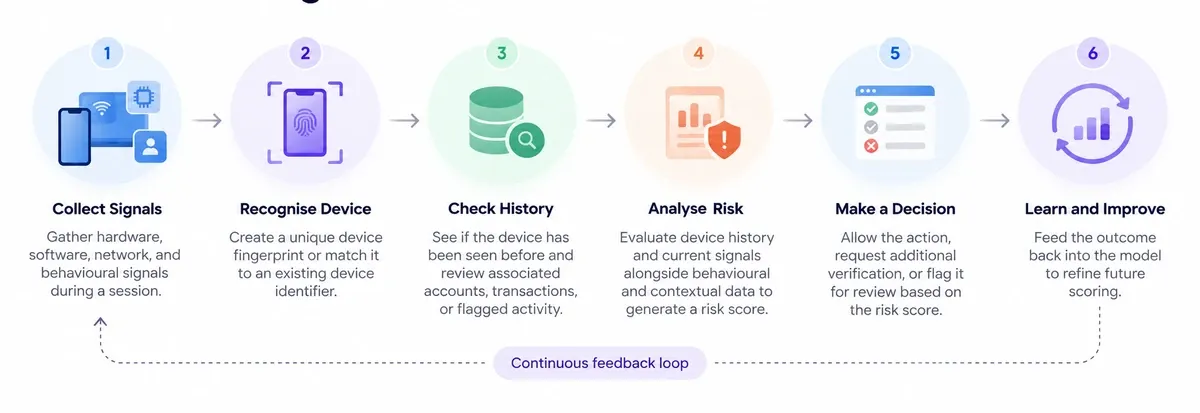
Device identification works through six steps that turn the raw signals into a risk-informed decision: signal collection, device recognition, historical matching, risk analysis, decision, and feedback.
Step 1: Collect Device Signals
The platform gathers several signals from the device and session when a user signs up, logs in or performs a transaction. They can be hardware features, information about the operating system, network information, browser configuration, behavioural patterns, etc.
Step 2: Recognise a Device Fingerprint
The signals are collected and combined to generate a unique fingerprint of the device. If the fingerprint is already in the system, the platform can identify the device and connect it to past activity.
Step 3: Compare Against Historical Activity
The fingerprint is then compared against historical data to see if the device has been seen before. The platform looks at associated accounts, transaction patterns, previous alerts and known fraud indicators associated with that device.
Step 4: Assess Fraud Risk
Current device signals are combined with historical behaviour, user activity and contextual information. This allows the platform to decide whether the interaction looks legitimate, suspicious or consistent with known fraud patterns.
Step 5: Take an Appropriate Action
The platform decides what to do next, based on the level of risk assessed. It can approve the transaction, request additional verification, start a manual review, or block the activity entirely.
Step 6: Learn from the Outcome
When an investigation or transaction is complete, the result is fed back into the fraud intelligence process. Confirmed cases of fraud and legitimate activity both help to improve the accuracy of future risk assessments and detection.
A single static identifier cannot support this fraud detection process alone. Modern fraud detection systems treat device recognition as the first step in a continuous risk evaluation, not the final verdict.
What Signals Are Used to Recognise a Device?
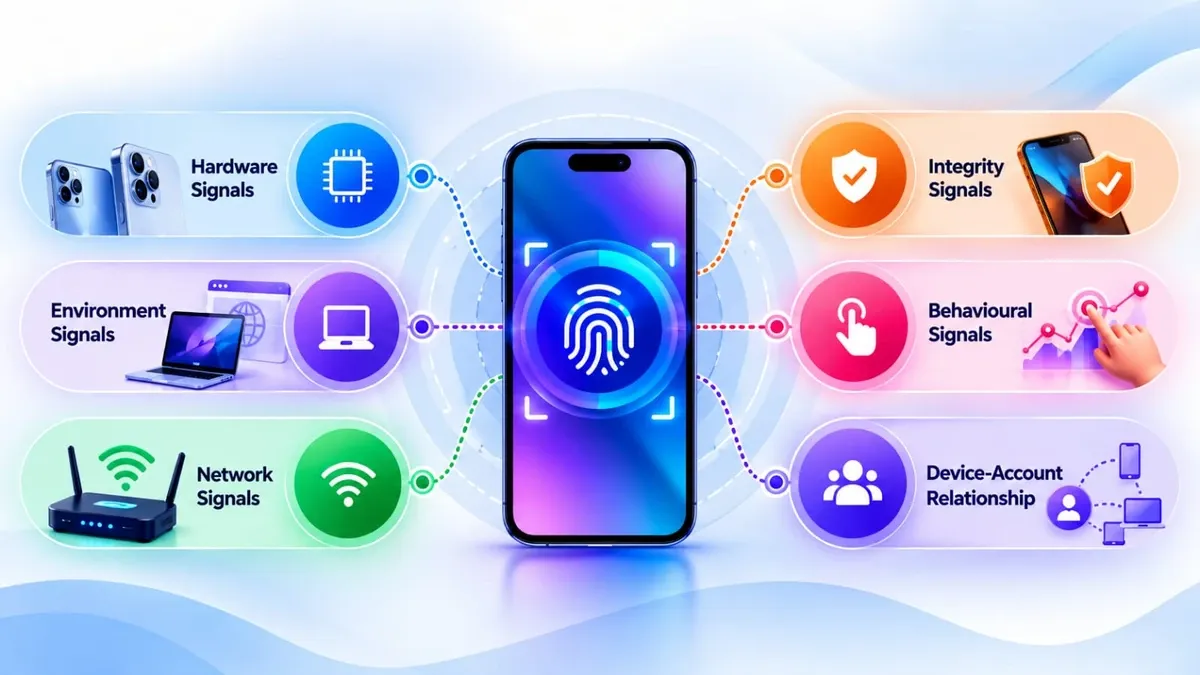
Device recognition draws on six categories of signals: hardware, environment, network, integrity, behavioural, and device-account relationship data. Not every signal is available on every platform, which is one of the prime reasons a mobile device ID rarely carries the same weight across Android and iOS.
-
Hardware signals: device model, manufacturer, and processor characteristics.
-
Environment signals: operating system version, browser type, screen resolution, installed fonts, and language settings.
-
Network signals: IP address, autonomous system number, and indicators of VPN or proxy use.
-
Integrity signals: rooted or jailbroken devices, emulators, and virtual machines, all commonly used to automate or hide fraud.
-
Behavioural signals: interaction patterns such as typing rhythm, touch pressure, and navigation flow, which are harder for automated scripts to replicate convincingly. To understand how these actually work, read this guide on keystroke dynamics in fraud detection.
-
Device-account relationship signals: how many accounts a device has been linked to, and whether that pattern matches normal usage.
iOS restricts certain mobile device identifiers and background access more heavily than Android, and browser-based sessions expose a different set of signals than native apps. A reliable device intelligence system accounts for these platform differences rather than treating every signal as universally available.
How Do Device Signals Help Detect Fraud?
Device signals help detect fraud by flagging patterns that account-level checks alone can miss: new device use, known bad devices, device reuse across accounts, and weak device reputation. The table below maps the major fraud types BFSI teams encounter to the device signal that typically exposes them.
| Fraud Type | Device Signal |
|---|---|
| Account Takeover | Login from a new or high-risk device combined with a credential match |
| New Account / Application Fraud | Device previously linked to rejected applications or fraud flags reused to open new accounts |
| Multi-Accounting | Same device linked to multiple customer accounts or loan applications |
| Promo / Bonus Abuse | Repeated device participation in referral or onboarding offers |
| Bot Attacks/Device Spoofing | Automated scripts running from emulators or virtual devices at volumes no genuine user could match |
| Payment Fraud | Device linked to disputed transactions or suspicious payment activity |
| Synthetic Identity Fraud | Multiple applications sharing device or environment traits despite different claimed identities |
| Credential Stuffing | Same device rapidly testing large volumes of stolen username-password pairs |
| Device spoofing | Declared device attributes inconsistent with observed hardware or software behaviour |
| Fraud Rings | Device-to-account graph showing coordinated activity across many accounts |
Swipe the table
No one device signal should be taken as evidence of fraud. Effective fraud prevention combines device intelligence with identity verification and risk assessment processes. Customer due diligence plays an important role in this process by helping organisations verify identities and assess risk before fraud occurs. Learn more in our guide on customer due diligence. The real value comes from combining device signals with behavioural, historical, and contextual data to build a broader risk picture.
How Fraudsters Spoof Device IDs and How Modern Platforms Detect Them
Fraudsters spoof or evade device detection using techniques such as false hardware attributes, emulators, VPNs, rooted devices, ID resets, and user-agent manipulation, and fraud platforms have corresponding methods to identify each one.
| Fraudster Techniques | Detection Method |
|---|---|
| Device-to-account graph showing coordinated activity across many accounts | Device-to-account graph showing coordinated activity across many accounts |
| Emulators and virtual machines | Emulator and VM detection using sensor data and rendering behaviour |
| VPNs and proxies masking true IP and location | Network consistency checks comparing IP-based location against other signals |
| Rooted, jailbroken, or tampered devices | Integrity checks verifying whether the device or SDK has been modified |
| Device ID resets | Device fingerprinting designed to persist through resets |
| User-agent manipulation | Consistency analysis comparing declared software against actual behaviour |
Swipe the table
These techniques share a common effect: they weaken the reliability of a static device identifier as a standalone signal. Moreover, detecting them requires methods that go beyond basic identification:
-
Emulator and VM detection: analysis of sensor data, rendering behaviour, and hardware features that virtual environments cannot plausibly emulate.
-
Integrity checks: determining whether a device has been rooted, jailbroken or if the OS or SDK has been modified.
-
VPN and proxy inconsistency checks: comparing IP-based location with other location signals, such as GPS or time zone, to detect masked connections.
-
Fingerprint stability analysis: tracking device fingerprints that change too often or in inconsistent patterns with normal hardware or software updates.
-
Behavioural anomaly detection: this involves comparing session behaviour (like navigation speed or interaction patterns) with what a real human user normally produces.
-
Device and linked-account history: checking whether the device or its known associates carry prior fraud flags, chargebacks, or policy violations.
No single signal can reveal a risk story. A device may pass integrity checks but show suspicious behaviour, unusual network characteristics, or links to previously flagged accounts. By looking at these signals together, fraud teams can spot manipulation attempts they would otherwise miss. This layered approach makes device identification and device intelligence more effective and enables more accurate risk assessment across onboarding, authentication, transactions, and payouts.
Where Does Device Intelligence Apply Across the Customer Lifecycle?
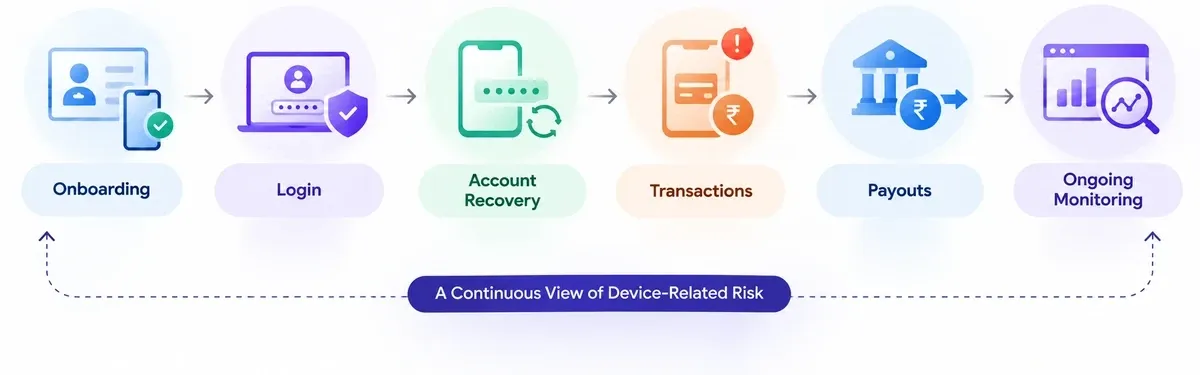
Device intelligence applies at every checkpoint of the customer lifecycle, from onboarding through ongoing monitoring. Applying it consistently across onboarding, login, transactions, and payouts gives BFSI institutions a continuous view of device-related risk rather than a series of disconnected checks. This matters because many fraud patterns only become visible when device activity is analysed across multiple customer touchpoints, not in isolation.
| Stages | Device Intelligence Value |
|---|---|
| Onboarding | Detects synthetic identities and device reuse across multiple applications |
| Login | Detects account takeover through new or high-risk device signals |
| Account Recovery | Verifies that a recovery request originates from a legitimate, recognised device |
| Transactions | Flags anomalies such as high-value transfers from an unfamiliar device |
| Payouts | Helps prevent mule account activity by checking device-account relationships before disbursal |
| Ongoing monitoring | Tracks device reputation over time to identify fraud patterns that develop after onboarding |
Swipe the table
The table above reveals that a legit-looking device during onboarding can reappear during account recovery, transactions, or payouts. By tracking device behaviour across the customer lifecycle, fraud teams can connect these events, uncover hidden relationships, and detect risks that standalone checks can't find.
Privacy Considerations for Device Intelligence
Device intelligence relies on personal and behavioural data, so BFSI institutions must apply it responsibly:
-
Data minimisation: collect only the signals a fraud decision genuinely requires, not every signal a device can expose.
-
Transparency: maintain transparency while collecting device data. Disclose it to customers rather than gathering it silently.
-
Consent: obtain consent where required by law or platform policy before collecting or processing device signals.
-
Regulatory requirements: frameworks such as India's DPDP Act and global equivalents increasingly treat device identifiers as personal data when they can be used, alone or in combination with other information, to identify an individual
Vendors who build privacy safeguards into device intelligence, rather than treating them as an afterthought, give BFSI institutions a stronger foundation for both fraud prevention and regulatory trust.
What Are the Limitations of Device ID?
The main limitations of device ID are shared devices, resets, platform privacy restrictions, spoofing, and false positives. That is why a device identifier is a useful signal, not proof of fraud, and BFSI institutions should treat it accordingly.
-
Shared devices are common in households and small businesses, so flagging every shared device as suspicious would generate excessive false positives.
-
Device resets, whether through a factory reset, app reinstall, or privacy-driven identifier reset, can break the continuity a fraud system relies on.
-
Privacy restrictions on some platforms limit the mobile device identifiers and signals available, so device visibility is not uniform across every operating system.
-
Spoofing can undermine a static identifier when it is used without additional verification layers.
-
False positives remain a real cost because an overly aggressive device-based rule can block legitimate customers on new or shared devices.
For these reasons, device signals should inform a risk decision within a broader fraud detection strategy, not serve as an automatic verdict.
What Are the Best Practices for Using Device Signals in Fraud Detection?
The best practice for using device signals in fraud detection is to treat device identity as one input in a layered, continuously updated risk model rather than a standalone verdict. In practice, this means:
-
Combine multiple signal types: Relying on a single device identifier leaves fraud detection vulnerable to resets and spoofing. Layering hardware, network, behavioural, and integrity signals together gives a more reliable picture of whether a device can be trusted for a given action.
-
Maintain device history: A device, if only evaluated at a single moment, often misses the fraud patterns that emerge over time. That’s why creating a complete history of a device across sessions, accounts, and transactions helps fraud teams to distinguish between a genuine new customer and a device with a bad history.
-
Monitor device-account relationships: A single account might look legitimate, but the device behind it might already be connected to dozens of other devices. Tracking device counts per account helps detect multi-account and fraud-ring behaviour before losses happen.
-
Detect spoofing and emulators: Fraudsters increasingly use emulators, rooted devices and altered hardware attributes to hide their real device as another. Implement specific integrity checks to detect these techniques, so that spoofed devices are not considered trusted.
-
Use risk-based authentication: Not every session carries the same risk, so treating them all the same may create friction for legitimate customers. Reserve step-up verification, such as OTPs or manual review, for higher-risk sessions to balance fraud prevention with a smooth experience.
-
Combine behavioural and network intelligence: Device signals alone cannot detect every fraud pattern. Pairing them with behavioural biometrics, such as typing rhythm, and network context, such as IP reputation, builds a fuller picture of whether a session is genuine or automated.
-
Continuously update models: Fraud techniques evolve constantly, so a static risk model quickly becomes outdated. Feeding confirmed fraud outcomes and false positives back into the system keeps scoring accurate as fraudsters adapt their evasion methods over time.
-
Monitor false positives: An overly aggressive device-based rule can block legitimate customers on new or shared devices. Regularly review outcomes and adjust thresholds to keep fraud prevention effective without unnecessarily frustrating genuine, trustworthy users.
How Sign3 Uses Device Intelligence to Detect Fraud
At Sign3, we use multiple layers of intelligence to build a more complete fraud risk picture for BFSI institutions, rather than relying on a single device signal. These signals include -
-
Device Intelligence flags suspicious, manipulated, emulated or spoofed devices across sessions.
-
Behavioural Biometrics differentiates legitimate users from bots, scripted activity or account takeover attempts by using interaction patterns.
-
Digital Footprint Analysis confirms identity consistency by analysing signals associated with the applicant’s digital presence.
-
Graph Intelligence uncovers previously hidden relationships between devices, accounts, phone numbers, and apps, enabling detection of coordinated fraud rings and mule networks.
By combining these intelligence layers, our fraud intelligence platform helps fraud detection teams to move beyond isolated risk signals and uncover broader fraud patterns across onboarding, login, account recovery, transactions, and payouts. This enables more accurate risk decisions while reducing unnecessary friction for legitimate customers.
Conclusion
Device IDs help organisations identify devices, but to prevent fraud effectively, they need to understand each device's risk. Device IDs can identify a device, and device fingerprinting can recognise a device across sessions, but device intelligence analyses behavioural, network, identity and historical activity signals together to provide the context needed for confident risk decisions.
At Sign3, we help fraud teams uncover hidden relationships, detect coordinated fraud patterns, and mitigate risk without creating unnecessary friction for legitimate users. Using AI-powered fraud detection systems combined with Device Intelligence, Behavioural Biometrics, Digital Footprint Analysis, Graph Intelligence, and Risk Scoring, we help banks, NBFCs, insurers and fintechs manage fraud risk across the entire customer lifecycle: from onboarding and login to transactions, payouts, and ongoing monitoring.
Want to enhance your existing fraud detection strategy? Schedule a demo and see how our fraud intelligence layer provides real-time device intelligence and risk insights throughout the customer journey.
FAQ
What is device ID?
A device ID is a unique identifier to enable a system to identify a device across multiple sessions. It can be generated by the operating system, application or fraud detection platform. It is used to identify associated activity with a specific device over time.
Is a device ID the same as an IMEI number?
No, a device ID is not the same as an IMEI number. IMEI is tied to the physical mobile hardware and rarely changes. A device ID can be one of several types of identifiers, such as advertising IDs, app-specific IDs, or fraud-detection fingerprints.
What is device fingerprinting?
Device fingerprinting is a unique but effective technique for tracking and identification. It gathers information about a user’s device’s hardware, software and network settings to generate a distinctive digital identifier. It is widely used in fraud detection to identify returning devices, detect suspicious activity, and support risk assessment when individual identifiers are not available or have been reset.
Can device identifiers be spoofed?
Yes, device identifiers can be spoofed. Fraudsters can spoof device signals, use emulators or virtual machines, or reset identifiers to hide a device’s true identity. That’s why device intelligence platforms don’t only rely on identifiers but look for a number of manipulation indicators.
How does device intelligence work?
Device intelligence works based on multiple signals, including device attributes, operating system and browser details, network and IP information, location consistency, emulator and tampering flags, behavioural patterns, device reputation, and device-account relationships. These signals are compared against historical activity and risk context to determine if a device can be trusted to perform a specific action, like account creation, login, transaction approval, or payout.
Is a mobile device ID considered personal data?
Yes, a mobile device ID could be considered personal data, but that depends on the privacy and data protection laws of the jurisdiction and how the data is used. That is why transparency, data minimisation and purpose limitation are important when collecting device-related information.
Is Device ID secure and privacy-friendly?
Device ID itself is a data point, not a security control, and its privacy implications depend on how it is collected, stored, and used. Applying data minimisation, transparency, and consent, and complying with applicable regulations, is what makes device identification a privacy-responsible practice.


