

Smurfing in banking is a money laundering technique in which illicit funds are deliberately split into multiple smaller transactions to evade regulatory reporting thresholds and anti-money laundering (AML) controls. Smurfers often route these transactions through different accounts, individuals, or financial institutions to hide the funds' origin and avoid AML detection.
Smurfing works because no single transaction looks unusual enough to trigger a scrutiny report. As each transaction appears low risk, identifying smurfing typically requires behavioural, network, and transaction-level analysis across bank accounts and financial institutions. This guide breaks down how smurfing works, how it differs from structuring and layering, and where device and network intelligence detect what transaction monitoring alone misses.
What Is Smurfing Meaning in Banking?
Smurfing meaning in banking refers to the practice of deliberately splitting large deposits, withdrawals, or transfers into multiple smaller transactions to avoid regulatory scrutiny. The process is carried out by one person who splits the money into a number of transactions, accounts or branches to avoid scrutiny, or it can be done by a network of people who each handle a small part of the total amount, and then the money is put together somewhere else.
The issue with smurfing is that each transaction appears normal on its own and cannot be identified through traditional rule-based monitoring. The risk only becomes visible when institutions link activity across accounts, devices, identities and transaction patterns, making smurfing a persistent challenge for compliance and fraud teams.
Who Is a Smurf?
A smurf is a person who executes a number of smaller financial transactions as part of a larger money-movement scheme. Their role generally involves depositing, withdrawing, or transferring money in amounts below reporting thresholds, making them less likely to draw additional scrutiny from banks and financial institutions.
Some smurfs are paid participants who know exactly what they are doing. Others are recruited without understanding the larger scheme, and a few are victims whose identities are used without their knowledge.
Individually, none of these transactions looks unusual, which is exactly what makes a smurf's role in the scheme so effective. Once you understand smurfing at the transaction level, that role becomes easier to detect, which is the practical meaning of smurfing in banking covered next.
How Smurfing Works in Banking: Step-by-step Process
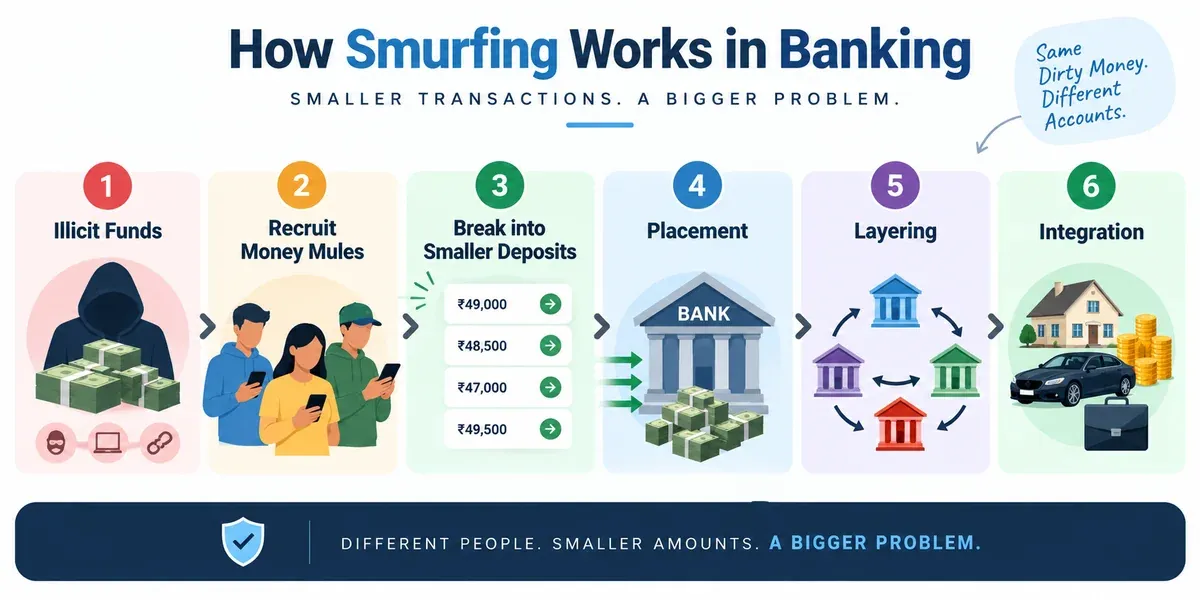
A typical banking smurfing operation follows a structured pattern designed to move large sums of illicit money through the financial system without triggering regulatory scrutiny. Instead of depositing a large amount in a single transaction, criminals divide the funds into multiple smaller transactions and distribute them across different people, accounts, branches, or channels. This makes the activity appear as a routine transaction when viewed at the individual transaction level.
Phase 1: Preparation and Recruitment
- Generate or obtain illicit funds: Fraudsters gather a large amount of funds from multiple fraud activities, including corruption, drug trafficking, cybercrime, illegal gambling, or other predicate offences.
- Recruit smurfs or mule account holders: Fraudsters recruit individuals, knowingly or unknowingly, to receive, deposit, or transfer funds through their accounts.
- Divide the funds: Large sums are divided into multiple smaller transactions, and each of them is sized proportionately to avoid triggering reporting thresholds or heightened scrutiny.
Phase 2: Placement (Execution)
- Spread the deposits: Smurfs deposit funds across different bank branches, separate accounts, or multiple days to avoid drawing attention or raising suspicion of fraud.
- Stay under the radar: Smurfs keep each transaction below the threshold, so banks aren't triggered to file mandatory reports like Currency Transaction Reports (CTRs).
- Enter the financial system: The money is introduced into the banking system through numerous low-value transactions designed to avoid attracting attention.
Phase 3: Layering and Integration
- Move the funds: Funds are transferred across multiple accounts, institutions, or entities to make the money's original source harder to trace.
- Recombine the funds: Once the funds are distributed, the money is pooled back into a central banking account through a smaller number of controlling accounts.
- Final deployment: The now clean-looking funds are used to purchase legitimate assets, real estate, luxury goods, or business investments.
Each step in this sequence protects the operation from a single point of failure. If one smurf is detected or one account is suddenly frozen, the rest of the network typically continues operating undisturbed, which is exactly what makes smurfing so resilient against isolated, transaction-level enforcement.
What Are the Most Common Techniques Used in Smurfing?
Smurfing is often associated with breaking large cash deposits into smaller transactions, but modern fraud operations use a much wider range of techniques. Criminals adapt their methods to the channels available to them, including bank accounts, digital payments, remittances, and fintech platforms. In many cases, criminals use multiple techniques together to avoid detection and move funds through the financial system.
Below are some of the most common smurfing techniques used by fraudsters:
- Cash Deposit Smurfing: The money is divided into smaller sums in cash and deposited into different branches, accounts, locations or on different days so it does not arouse suspicion or reach the reporting limit.
- Money Mule Network Smurfing: Fraudsters distribute their money across multiple mule accounts. Each account receives or sends only relatively small amounts that appear legitimate when viewed in isolation.
- Asset-Based Smurfing: Structured payments are used to purchase assets such as vehicles, luxury goods, precious metals or real estate, which can then be sold to generate apparently legitimate proceeds.
- Casino Smurfing: The funds are used to buy casino chips in smaller conversions, and limited gaming activity takes place before the chips are cashed out. This makes the whole procedure appear to be a part of legitimate gambling.
- Digital Wallet and Crypto Smurfing: The funds are distributed across a number of digital wallets, prepaid instruments, crypto exchanges or blockchain addresses, making the overall transaction pattern harder to spot than a single large transfer.
- Cuckoo Smurfing: Illegal funds are hidden within the legitimate flow of international remittances. A recipient receives money locally from the criminal proceeds, and a corresponding transfer is settled somewhere else, thus hiding the illicit source and reducing the need for a direct cross-border movement.
- Cross-Border Remittance Smurfing: Large sums are divided into several smaller international transfers through different remittance providers, accounts, corridors or beneficiaries so as to bypass transaction monitoring thresholds and sanctions screening triggers.
What Is Cuckoo Smurfing?
Cuckoo smurfing is a sophisticated money laundering operation where criminals use a genuine user’s bank account or a business account, which is expected to receive legitimate payments from abroad, to move illicit money. The criminal network deposits its own fraudulent money into the recipient’s account with the help of a remittance service provider who is involved in the same fraud network. Often, this is done in several structured transactions. At the same time, the sender’s original funds are diverted and deposited in other accounts that are mainly controlled by the criminal network. Thus, the recipient receives the expected amount of payment and does not find any suspicious activity, even if the money credited to the account comes from criminal activity and not from the legitimate sender.
The name originates from the cuckoo bird, which lays its eggs in another bird’s nest. The criminals also deposit the illicit funds into an account of a legitimate customer and use the customer’s authentic remittance or payment transaction to hide the fraud operation.
Since cuckoo smurfing does not take place through traditional smurfing, the procedure often involves known participants, money mules or accounts controlled by the criminals themselves. The account holder generally doesn’t know their account is being used in the scheme, making it much more difficult for banks and financial institutions to consider it fraud.
Smurfing vs Structuring vs Layering: What Are the Key Differences
The terms smurfing, structuring and layering are often used interchangeably, but they are not the same thing. Structuring and smurfing are techniques used to introduce money into the financial system without detection. Layering involves hiding the source of funds once they have entered the financial system. Knowing the differences allows banks to identify the specific risks and behaviours associated with each stage of a money laundering scheme.
| Key Aspects | Smurfing | Structuring | Layering |
|---|---|---|---|
| What It Means | Dividing a large sum and routing it through many people and accounts to avoid detection | Breaking a single large transaction into pieces that fall below a reporting threshold | Moving funds through multiple transactions or entities and hiding the funds' origin once they have entered the banking system |
| Who Is Typically Involved | Multiple coordinated individuals, money mules, or accounts operating as part of a network. | Often a single individual or entity, though multiple accounts may be used. | Multiple accounts, shell companies ( A shell company is a legal corporate entity that exists only on paper and carries out no active business operations), intermediaries, or jurisdictions depending on the scheme. |
| Primary AML Stage | Primarily placement; may contribute to later layering activities. | Placement | Layering |
| Primary Objective | Disguise a large amount of money as many unrelated small transactions. | Avoid triggering reporting thresholds and monitoring rules. | Break the audit trail and make the source of funds difficult to trace. |
| What Detection Looks for | Cross-account links, shared devices, mule account activity, and coordinated transaction patterns. | Repeated transactions just below reporting thresholds or monitoring triggers. | Complex fund flows, rapid account-to-account transfers, and unusual transaction networks. |
Swipe the table
Why Smurfing Pose a Serious Threat to Banks
Smurfing exposes a bank to a specific set of risks due to the following reasons:
- AML compliance risk: Regulators expect banks to identify structuring patterns, not just individual suspicious transactions. A bank that consistently misses some connected small-value activity often gets exposed during audits and examinations. This proves that even if an individual transaction technically stayed under the reporting threshold, that does not mean the transaction is out of risk.
- Regulatory penalties: When structuring patterns go undetected or unreported, institutions can face significant compliance consequences. Regulators and financial intelligence units have repeatedly highlighted cases where suspicious activity was visible in the data but was not escalated through timely STR filings.
- Direct fraud and reputational losses: Smurfing networks frequently rely on mule accounts that are mainly opened to operate with stolen or synthetic identities. Once a bank becomes associated with a money laundering case, the impact often extends beyond immediate compliance failures. This creates financial liabilities and reputational consequences that can often undermine customer and stakeholder trust.
- Mule account networks: Smurfing rarely happens through a single account. It typically depends on multiplemule accounts. However, a bank that cannot detect mule account activity becomes a weak point in a larger criminal network. This is because fraudsters can move illicit funds through seemingly legitimate accounts without triggering scrutiny.
- Financial crime investigations: Once law enforcement or a regulator identifies smurfing activity related to a bank, the bank or financial institution may face long-term investigations from multiple higher authorities. This brings serious doubts about a bank’s regulatory compliance and operational resources.
This is where effective fraud intelligence becomes directly relevant to banks and fintechs, helping financial teams to prevent fraud.
How Sign3 Helps Detect Smurfing Networks
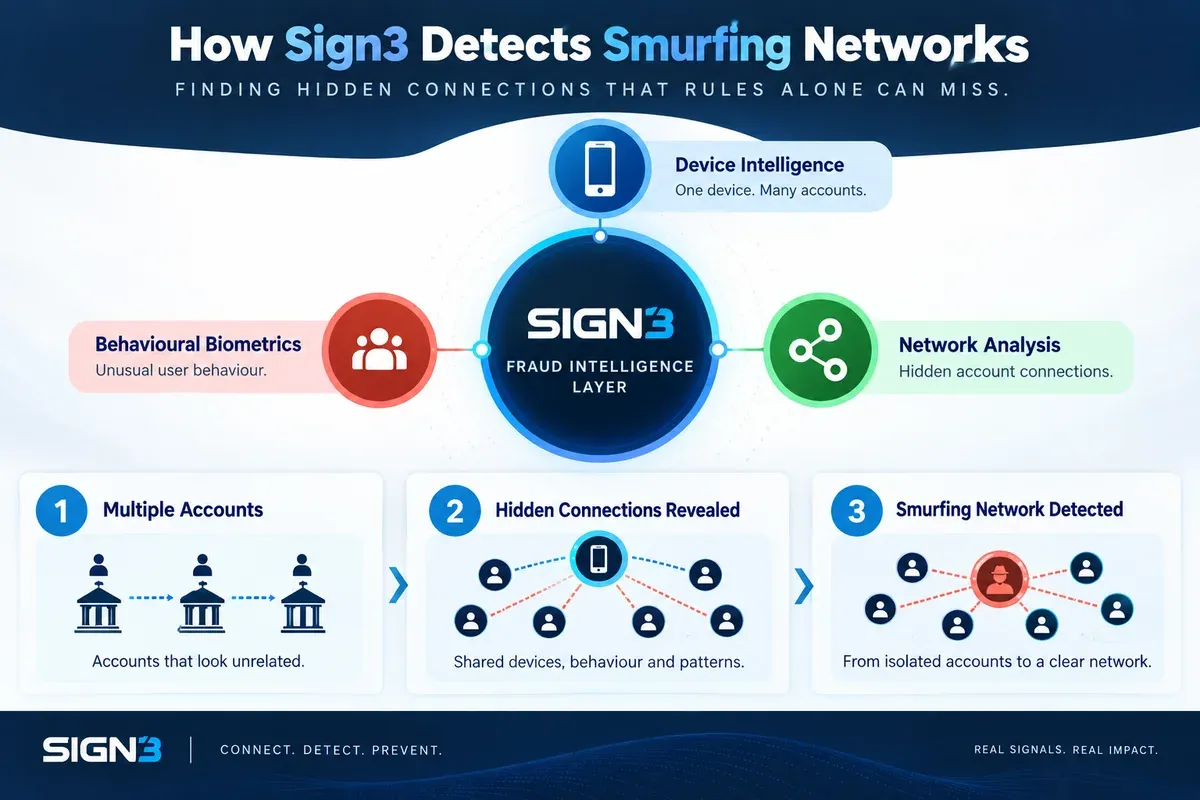
Rule-based, threshold-driven monitoring was designed for the traditional type of financial crime. At the same time, it can look at one account and one transaction, which is exactly the blind spot smurfing exploits. A customer making a handful of small deposits looks unremarkable on its own; but if there is smurfing, only certain patterns together can detect the fraud.
This is the gap that Sign3’s device intelligence, behavioural biometrics, and network analysis are designed to close.
- Device intelligencerecognises the device used in a transaction, not just the account being accessed. Repeated access from a single device or a small group of devices to multiple accounts that appear unrelated may signal coordinated activity. Even if each account has passed KYC checks, these hidden links allow detection of mule networks or synthetic identity operations.
- Behavioural biometricslooks at how a user actually interacts with an app or a banking portal. The biometrics detect typing patterns, navigation habits, and session timing that are much harder to fabricate by fraudsters.
- Network analysis maps the genuine relationships between accounts, devices, contact details, and transaction pathways. It also helps banks and financial institutions to detect the hidden clusters that no single account review would ever reveal.
- Digital footprintchecks compare an account’s onboarding and usage history against known patterns of synthetic identity and mule account behaviour. Thus, it flags multiple accounts that look newly opened rather than organically developed and used over time.
- Mule account detection aims to identify the accounts that enable smurfing networks. Smurfing relies on a pool of mule accounts to move and distribute funds, so early detection and blocking of mule accounts is a crucial way to stop the smurfing money laundering process before suspicious transactions spread across the network.
- Risk scoring brings these signals together into a single and continuously updated view of an account’s risk. This allows the compliance teams to review prioritised and evidence-backed cases rather than assisting with isolated alerts.
Red Flags That Indicate Smurfing Activity
No single indicator confirms smurfing on its own; detection depends on recognising the combination and pattern of activity across time, accounts, and identities.
- Near-threshold deposits: Multiple cash deposits kept just under the reporting threshold, especially within a short time window. Such activity typically suggests the amounts are being sized deliberately to avoid triggering a fraud report.
- Same-day but multi-branch activity: The same individual making deposits at several different branches or ATMs within a single day. This signals a deliberate fraud activity rather than routine banking behaviour.
- Sudden inbound activity on new accounts: New accounts that quickly receive a series of small, similar-value deposits from unrelated sources often trigger a fraud signal. Such activities are not common with organic account growth.
- Threshold-evasion transfers: Transfers consistently appear just below the reporting or monitoring thresholds, often in a predictable pattern over time. Such activity may indicate intentional attempts to evade compliance reviews, transaction monitoring rules, or regulatory reporting requirements.
- Reactivated dormant accounts: Dormant accounts that suddenly become active with a pattern of small and frequent transactions often signal a mule account being used to perform fraud activity.
- Shared KYC details across accounts: Multiple accounts opened around the same time that share similar KYC details despite belonging to different named individuals. This may trigger one fraud network working behind several identities.
- Shared device or location signals: Multiple accounts that are transacting from the same device, the same IP address, or the same physical location are one of the clearest signals of coordination that transaction data alone cannot show.
- Pass-through accounts: These accounts act like a temporary stop for money. Funds come in and are transferred out almost immediately, with little evidence of regular banking activity such as savings, bill payments, or purchases. This pattern can indicate mule account activity or other financial crime.
These signs deserve particular attention, particularly the last two because they highlight where traditional, rule-based AML monitoring tends to fail, reflecting the need to adapt and advance device and behavioural intelligence for success.
How Banks Can Prevent Smurfing
Banks can prevent smurfing money laundering by*deploying AI-driven transaction monitoring, cross-channel aggregation, and rigorous KYC protocols.*Below are certain core prevention strategies that can make fraud prevention work much simpler and more effective.
- KYC and Customer Due Diligence. Verifying who actually opens and controls an account is the first line of defence, and it becomes far more effective when paired with ongoing verification rather than a one-time check during onboarding.
- Transaction Monitoring. Rules that look only for the traditional structuring patterns, near-threshold amounts, and connected transactions across a time window, not just single flagged transactions, detect a meaningfully larger share of smurfing activity than threshold-only rules.
- Device and Behaviour Intelligence. Linking accounts by shared devices, shared behavioural patterns, and shared digital footprints exposes coordination that transaction data alone cannot show. This is the layer that closes the gap left by rule-based monitoring, and it is where fraud intelligence platforms have made the most measurable difference in recent years.
- Employee Training. Front-line staff who understand what smurfing and cuckoo smurfing look like in practice are often the first to notice a pattern that a monitoring system has not yet flagged.
- SAR/STR Filing. A well-run detection programme is only useful if suspicious activity actually gets reported. Consistent, timely filing of Suspicious Activity Reports or Suspicious Transaction Reports is what turns internal detection into a real regulatory and law enforcement outcome.
Conclusion: Detecting and Preventing Smurfing
The concept of smurfing has evolved far beyond the cash carried between multiple bank branches. It now moves through digital wallets, cryptocurrency exchanges, and cross-border networks, often within the same business operation. The reason behind this is that criminal networks know threshold-driven monitoring flags one large transaction, not a thousand small smurfing money laundering transfers that are spread across connected accounts.
That gap is why device, behavioural, and network intelligence have become highly essential for banks and fintechs to stop coordinated laundering schemes. Sign3 closes the gap with device fingerprinting, behavioural intelligence, and network-level risk signals that are built to detect the connections across multiple accounts and help banks and financial institutions actively prevent smurfing. Want to know how we at Sign3 work on these Smurfing Networks? You canbook a demo with usand find out.
Frequently Asked Questions
What is smurfing in banking?
Smurfing in banking splits a large sum of illicit money into smaller transactions across multiple accounts, branches, or people to stay under the reporting thresholds banks and regulators use to flag suspicious activity.
Is smurfing the same as structuring?
No, smurfing is not the same as structuring. All smurfing involves structuring, since dividing funds into threshold-avoiding amounts is the core method, but structuring can be carried out by one person acting alone, without the coordinated network that defines smurfing.
What is cuckoo smurfing?
Cuckoo smurfing substitutes illicit cash for a legitimate international transfer that a genuine, unaware bank customer is expecting, quietly laundering funds through that customer’s own transaction history without their knowledge.
How can banks prevent smurfing money laundering?
Banks can take some steps to prevent smurfing money laundering. This must integrate aggregated transaction monitoring, strong identity verification and collaboration between institutions to identify suspicious patterns that may not be visible when investigating individual accounts or transactions.
Can smurfing involve mule accounts?
Yes, smurfing involves mule accounts. Smurfing networks depend on a steady supply of accounts to route funds through, and mule accounts, whether recruited, coerced, or opened using stolen identities, supply that need.
How do banks detect smurfing?
Banks combine transaction monitoring rules that flag structuring patterns with device intelligence, behavioural analytics, and network analysis that link accounts appearing unrelated on paper but sharing devices or digital footprints.
Is smurfing illegal?
Yes. Smurfing is a criminal offence in virtually every jurisdiction with anti-money laundering laws, and both organisers and smurfs themselves can face prosecution, even when a smurf claims ignorance of the full scheme.


