

Bank and fintech fraud is no longer the same. From using stolen IDs to mule account networks, things have turned awfully sophisticated. The stats speak for themselves.
According to the RBI’s Annual Report 2025-26, banks reported 10,114 fraud cases involving ₹48,021 crore in 2025-26, the highest amount reported in the last three years. These figures reportedly cover cases of ₹1 lakh and above, and the loss reported on paper doesn’t necessarily equal the actual loss.
Meanwhile, attackers continue to use synthetic identities, deepfakes, device spoofing and coordinated fraud rings to evade static rules and standard KYC checks. As digital onboarding expands, banks and fintechs desperately need systems capable of assessing risks before fund approvals, logins or payments, rather than after a loss has occurred. That’s where AI in fraud detection takes centre stage.
This guide explains how AI fraud detection in banking helps identify high-risk activity, bolsters inherent security, and supports more confident decisions across the customer lifecycle.
Key Takeaways:
-
AI fraud detection works best as a layered decision system, not as a replacement for rules, KYC, or human oversight.
-
The strongest approaches for AI fraud detection comprise device protection, digital footprint tracking, and assessing behavioural, transaction, and network signals.
-
Before adopting an AI fraud detection solution, banks should assess explainability, model validation, privacy, latency and false-positive performance and detection rates.
What Is AI Fraud Detection?
AI fraud detection is the use of artificial intelligence and machine-learning models to identify potentially fraudulent activity.
It works by evaluating multiple signals, either real or near-real time. While traditional security systems rely on predefined rules, like flagging high-value transactions, repeated failed login attempts or activity from unfamiliar locations, AI complements them by evaluating a bunch of signals together and analysing whether an application, session or transaction is trustworthy.
Depending on the use case, models may analyse device characteristics, user behaviour, digital identity, transaction context, network relationships, and historical patterns. By combining these signals, artificial intelligence fraud detection helps banks and fintechs identify complex patterns earlier, prioritise investigations and protect customers across the lifecycle. Human oversight, model validation, and regulatory controls remain essential.
Selected outcomes reported by Sign3
| 99% | >90% | <5 sec | 80% |
|---|---|---|---|
| Success identifying fraudulent accounts | Reduction in identity-fraud cases | Risk-assessment time | Reduction in false positives |
Swipe the table
Reported outcomes are based on Sign3 use cases; results vary by implementation, traffic mix and fraud typology.
How AI Fraud Detection Works: A Four-Stage Workflow
Conventional fraud detection systems often flag single events, such as a high-value transfer or location mismatch, but when viewed in isolation, a device, identity or transaction may appear legitimate. However, coordinated attacks exploit the gap by distributing activity across multiple accounts, devices, and interactions.
Fraud detection using AI connects signals across the customer journey, estimates real-time risk and recommends appropriate actions to stop things before they go out of hand. A typical AI fraud detection workflow has four distinct stages.
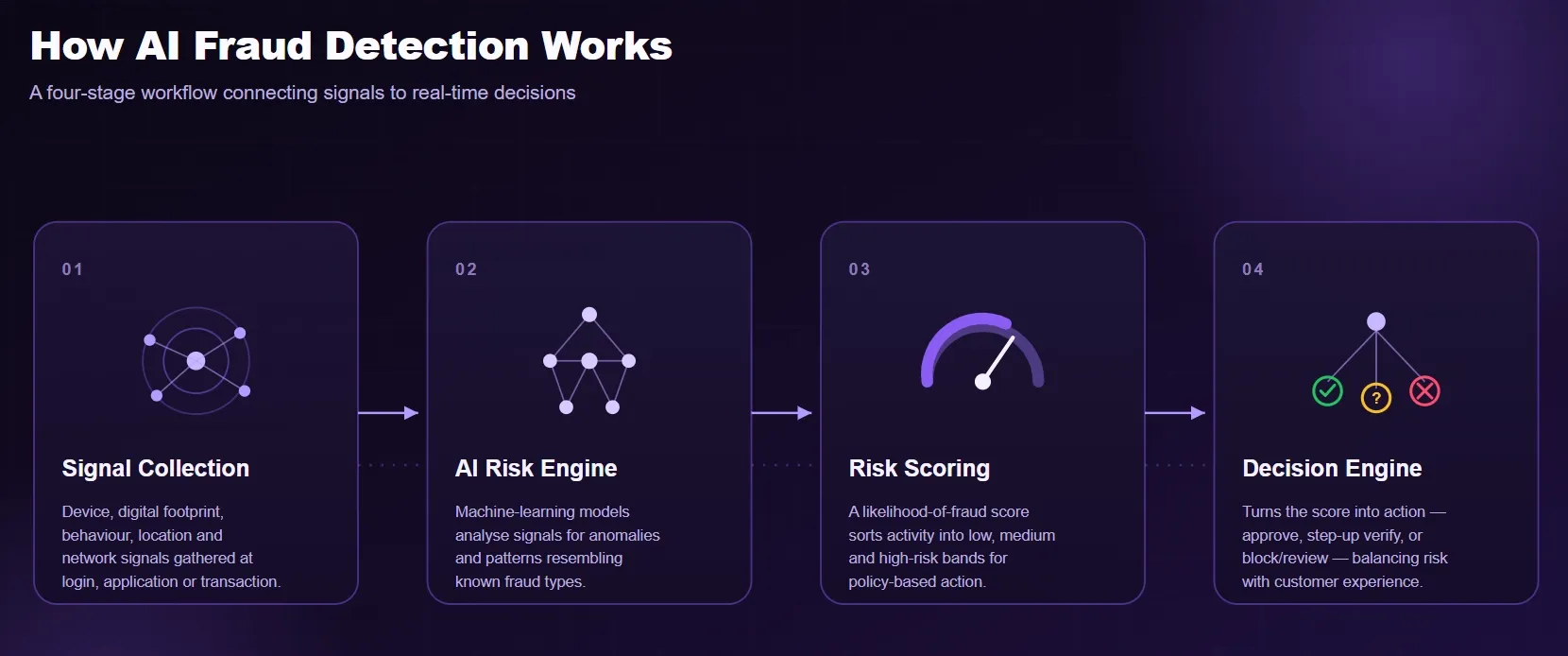
1. Signal Collection
When a customer applies, logs in or initiates a transaction, the platform evaluates permitted signals such as device characteristics, digital footprint, behavioural patterns, transaction history, location, IP intelligence and network relationships. Collection and retention should be limited to what is necessary, lawful and appropriate for the use case. Together, these signals provide more context than any single data point.
2. AI Risk Engine
Machine-learning models analyse the signals to find anomalies and relationships that rules may miss. The model estimates whether behaviour is consistent with a genuine customer or resembles known fraud patterns, such as mule accounts, synthetic identities or account takeover. A high score is an indicator for action or review, not proof of fraud.
3. Risk Scoring
The engine produces a risk score based on the estimated likelihood of fraud. Banks and fintechs can use score bands to prioritise high-risk cases, route medium-risk activity for step-up verification and allow lower-risk activity to proceed, subject to their policies.
4. Decision Engine
The decision engine turns the score and reason codes into an action recommendation. Low-risk users may be approved, medium-risk cases may require additional verification, and high-risk applications or transactions may be paused, blocked or reviewed. This helps balance fraud prevention with customer experience.
As financial institutions adopt more AI in fraud detection, Sign3 can add a fraud-intelligence layer combining device intelligence, digital footprint intelligence, behavioural biometrics and network intelligence. This helps banks and fintechs make faster, more informed decisions across onboarding and the customer lifecycle.
Three AI Signals That Power Modern Fraud Detection
Modern fraud detection platforms combine multiple layers of intelligence to assess who a user appears to be and whether their behaviour is consistent with legitimate intent. Three core layers are device intelligence, digital footprint intelligence and behavioural biometrics. Used together, they provide a fuller view of the customer interaction while helping reduce unnecessary friction for genuine users.
1. Device Intelligence: Detect High-Risk Devices Before Fraud Happens
AI-powered device intelligence evaluates hardware, software, network and app signals to estimate whether a device is trustworthy or associated with suspicious activity. It can surface signals associated with emulators, recent SIM changes, app tampering, screen mirroring, remote-access tools or multiple accounts operating from one device. These patterns can also indicate fraud rings, mule activity or synthetic-identity attacks. Device intelligence should not score one login or transaction in isolation. Used throughout the journey, it provides context that can help institutions intervene before an account is opened or money is moved.
2. Digital Footprint Intelligence: Verify Users Beyond Traditional KYC
Passing KYC means required identity information and documents have been verified. It does not, by itself, establish that the applicant is trustworthy or that a verified identity is not being misused. Digital footprint intelligence adds context by analysing permitted signals linked to a phone number, email address and broader digital presence. Signals may include phone-number tenure, SIM history, consistency between submitted details and activity across trusted digital ecosystems. These indicators can help distinguish an established digital identity from a recently created profile associated with fraud. By evaluating these contextual signals along with verified identity data, AI helps distinguish legitimate customers from synthetic identities, fraudsters, and organised mule networks.
3. Behavioural Biometrics: Identify Fraud Through Human Behaviour
Behavioural biometrics analyses how a user types, swipes, navigates, scrolls and pauses during a session. Rather than treating any characteristic as a permanent identifier, models build a behavioural baseline and look for material deviations. These interaction patterns can provide useful signals for detecting account takeover attempts, bots and remote-access fraud, or for evaluating applicants during onboarding. Unlike passwords or OTPs, behavioural signals can be evaluated continuously during a session. This can help detect suspicious changes after authentication, although decisions should still combine behavioural evidence with other risk signals.
Traditional Fraud Detection vs. AI Fraud Detection vs Sign3
Traditional fraud detection was designed around predictable patterns and fixed thresholds. Today, attackers use automation, generative AI, stolen credentials and social engineering to create more convincing identities and scale attacks, making static rules alone less effective. AI-based fraud detection can analyse large volumes of data in real time, but results depend on signal quality, model governance and implementation. The comparison below shows how rule-based controls, general AI models and Sign3's intelligence-led approach differ.
| Capability | Traditional Fraud Detection | AI Fraud Prevention | Sign3 |
|---|---|---|---|
| Detection approach | Fixed rules and predefined thresholds | Uses machine-learning models to recognise patterns across multiple signals | Applies AI across multiple intelligence layers and assesses linked risk signals |
| Analysed data | Transaction data and KYC records | Behavioural, transactional and historical data | Device intelligence, digital footprint, behavioural biometrics, network relationships, address and image intelligence |
| Fraud adaptability | Requires manual rule updates | Can be retrained and updated as fraud patterns and data change | Combines model updates with real-time contextual intelligence |
| Identity verification | Verifies documents and credentials under defined rules | Evaluates behavioural, identity and transactional anomalies | Adds context beyond KYC to assess whether an applicant appears genuine and whether behaviour is consistent with legitimate intent |
| Detection of sophisticated fraud | Limited against complex or rapidly changing attacks | Can identify patterns that static rules may miss | Helps detect mule accounts, synthetic identities, account takeover, multi-accounting and coordinated fraud rings using linked signals |
| Decision speed | May be delayed when alerts require manual review | Real-time or near-real-time scoring | Real-time intelligence and reason codes to support faster onboarding and fraud decisions |
| False positives | Can be high when rigid rules lack context | Can reduce false positives when models and thresholds are well calibrated | Validates decisions across multiple intelligence layers to help reduce unnecessary alerts and customer friction |
| Best suited for | Basic fraud monitoring and compliance | Large-scale automated fraud detection | Banks and fintechs that need deeper fraud intelligence across the customer lifecycle |
Swipe the table
Modern fraud prevention requires more than an alert: teams need the signals and reason codes behind a score. Sign3's intelligence-led approach connects risk across devices, identities and behaviours to help teams uncover linked fraud and make explainable decisions without adding unnecessary customer friction.
AI Fraud Detection Use Cases Across Banking and Fintech
India's fraud-intelligence ecosystem is also expanding. As of 7 April 2026, MuleHunter.AI, developed by the Reserve Bank Innovation Hub, was live at 26 banks, with wider rollout underway.
The Indian Digital Payment Intelligence Corporation (IDPIC) was incorporated on 16 October 2025 as a Section 8 not-for-profit company. Its mandate includes using AI, machine learning and big-data analytics to strengthen intelligence sharing and fraud detection across India's digital-payments ecosystem. AI fraud detection can support decisions across the customer lifecycle, from onboarding and account access to payments, transaction monitoring and credit assessment.
Common banking and fintech use cases include:
| Use Cases | How Sign3 Supports It |
|---|---|
| Customer Onboarding | AI fraud detection helps identify synthetic identities, mule accounts, fake applicants, and onboarding fraud before an account is created by analysing behavioural, device, and digital risk signals. Sign3 strengthens digital onboarding with real-time intelligence that enables faster approvals for genuine users while identifying high-risk applicants early. |
| Identity Fraud Detection | AI can evaluate identity signals beyond traditional KYC to flag stolen identities, document inconsistencies, impersonation attempts and suspicious digital personas. Sign3 combines identity intelligence with contextual risk signals to help financial institutions detect sophisticated identity fraud with greater confidence. |
| Account Takeover (ATO) Prevention | AI can flag abnormal login behaviour, compromised devices, credential misuse and unusual account activity that may indicate account takeover. Sign3 monitors behavioural and device intelligence in real time to detect account takeover attempts before fraudulent transactions occur. |
| Bonus Abuse Prevention | AI can detect referral fraud, multi-accounting, disposable identities and coordinated promotional abuse by analysing relationships between users, devices and accounts. Sign3 helps businesses prevent incentive abuse without disrupting genuine users or legitimate marketing campaigns. |
| Credit Underwriting | AI can enhance lending decisions by combining traditional credit information with behavioural and alternative risk signals to identify potential fraud before loan approval. Sign3 enriches underwriting workflows with real-time intelligence. This helps lenders improve risk assessment while reducing fraudulent loan applications. |
| User Prospecting & Risk Intelligence | AI helps organisations identify trustworthy users by analysing alternative intelligence signals, enabling higher-quality customer acquisition and reducing fraud risks from the first interaction. Sign3 combines risk intelligence and user prospecting to build richer customer profiles that support better prospecting, smarter acquisition strategies, and stronger fraud prevention. |
Swipe the table
Each use case addresses a different business problem, but the greater value comes from a shared intelligence layer across the customer lifecycle. By connecting onboarding, identity verification, account access, payments and credit assessment, Sign3 can help institutions reduce blind spots and apply risk context consistently.
AI Fraud Detection Vendor Checklist: 10 Questions for Banks Choosing an AI fraud detection platform is not simply a feature comparison. The solution must fit the institution's fraud strategy, data-governance requirements, existing controls and operating model, and support ongoing validation as threats change. Before selecting a vendor, banks and fintechs should test whether the platform can deliver measurable fraud reduction, manageable false-positive rates, explainable decisions and reliable performance at production scale.
| Questions | Why It Matters |
|---|---|
| 1. Does the vendor have proven experience in our product and fraud typologies? | Fraud patterns differ across onboarding, payments and lending. Ask for relevant deployments, measured results, supported fraud typologies and customer references that match your journey. Confirm how the vendor defines detection rate, false positives and prevented loss before comparing claims. |
| 2. How will the platform change manual review and operating costs? | The goal is to prioritise cases, reduce unnecessary alerts and give analysts useful evidence, not remove accountable human review. Model the expected effect on queue size, handling time, staffing, escalation rates and customer friction. Treat promises of fully eliminating review with caution. |
| 3. How will AI coexist with our current rules and controls? | A sound rollout usually begins in shadow mode or alongside existing controls. Agree which rules are regulatory, which can be tuned and which may be retired only after live validation. Define rollback criteria so teams can change thresholds without weakening core safeguards. |
| 4. What will integration cost, require and take? | Review APIs, SDKs, data mapping, security testing, model configuration and workflow changes. Ask which signals are mandatory, how missing data is handled and who owns implementation. Compare the full cost and timeline for pilot, production rollout, maintenance and future use cases. |
| 5. Are decisions explainable and visible in real time? | Investigators need reason codes, contributing signals, audit logs and clear case context. Confirm what appears in the dashboard or API, how quickly it is available and whether explanations are understandable to fraud, compliance, customer-support and model-risk teams. |
| 6. How are new fraud patterns and model drift managed? | Ask how models are monitored, retrained, validated and approved when data or attack patterns change. Automatic adaptation should not mean uncontrolled change. Require performance reporting, feedback loops, version history, champion-challenger testing and defined human approval for material model updates. |
| 7. What data is collected, and how is it protected? | Map each signal to its purpose, legal basis, consent requirements, retention and storage. Review access controls, encryption, deletion, subprocessors and cross-border transfers. Confirm which obligations apply, including India's DPDP framework, GDPR or PCI DSS. |
| 8. Will the service perform reliably at production scale? | Test peak transaction volume, latency, availability, failover and recovery, not only average demo performance. Use representative onboarding surges or seasonal payment spikes. Agree service levels, monitoring, incident response and capacity plans before relying on the platform for real-time decisions. |
| 9. How are trusted customers protected from unnecessary declines? | Allow lists can reduce friction but should be one input, not a blanket bypass. Trusted accounts can be compromised. Ask how the platform combines relationship history with current device, behavioural and contextual signals, and how customers can be reviewed or restored after a false positive. |
| 10. Can the platform see risk beyond our own data? | External device reputation, digital-footprint and network signals can reveal connections that internal records miss. Ask where those signals come from, how fresh and lawful they are, and how coverage varies by market. Validate their incremental value against an internal-data baseline. |
Swipe the table
Vendor selection is a long-term risk decision. Prioritise platforms that combine rich signals with explainable scores, clear data controls, model monitoring, resilient integration and evidence from relevant use cases. No platform should replace accountable human governance.
How Should Banks Pilot AI Fraud Detection?
For fraud detection in banking, a safe pilot starts with one decision point, such as onboarding, account takeover or mule detection, and a pre-agreed baseline. Document the test population, decision rights and escalation path before the pilot begins. Run the model alongside current controls before it affects customers, then expand only after fraud, false-positive, latency and operational metrics meet agreed thresholds. Report pilot results by fraud type, decision stage and customer segment so aggregate accuracy does not hide important weak spots during rollout.
-
Define the outcome and baseline. Measure the current fraud rate, approval rate, false positives, manual-review volume, time to decision and loss. Specify which metric must improve and which customer, compliance or operational guardrails cannot worsen.
-
Validate on representative traffic. Test legitimate, suspicious and edge-case sessions across products, devices and geographies. Separate offline model performance from live workflow results, and confirm that important signals remain useful when some data is missing.
-
Use shadow mode and human review. Compare model recommendations with current decisions before enabling automatic action. Capture investigator feedback, examine false positives and false negatives, and document when step-up verification is safer than rejection.
-
Govern and monitor the rollout. Assign ownership for model validation, threshold changes, incident response and audit evidence. Track drift, bias, service availability and customer friction after launch, and maintain a tested rollback path.
Final Thoughts
Financial fraud is becoming more coordinated and better designed to evade conventional controls. As banks and fintechs accelerate digital growth, effective fraud detection will depend on intelligence that can adapt while remaining explainable, compliant and measurable. Ongoing measurement is as important as initial model selection.
Sign3 provides a fraud intelligence layer that combines AI with contextual signals across devices, digital footprints, behaviour and networks. The aim is to support faster risk decisions, stronger fraud prevention and smoother customer journeys without unnecessary operational complexity.
Ready to strengthen your fraud detection and prevention strategy? See how Sign3 supports secure onboarding, account access, payments, lending and customer journeys with real-time fraud intelligence. Book a personalised demo to discuss your use case.
Frequently Asked Questions
1. What is AI fraud detection in banking?
AI fraud detection in banking uses AI and machine-learning models to analyse device, identity, behavioural, transaction and network signals, estimate fraud risk and recommend an action in real or near-real time. It complements rule-based controls by finding patterns across multiple events and relationships.
2. Does AI fraud detection replace KYC verification?
No. KYC verifies identity information and supports regulatory obligations. AI fraud detection adds risk context by assessing whether a verified identity may be synthetic, stolen or misused, and whether the applicant's device and behaviour are consistent with legitimate activity.
3. Can AI reduce false positives in fraud detection?
AI can reduce false positives by combining contextual signals rather than relying on a single threshold. The outcome depends on data quality, model calibration and review processes, so institutions should validate precision, recall and customer-friction metrics on their own traffic.
4. What types of fraud can AI detect?
Depending on the data and models used, AI can help identify synthetic identity fraud, mule accounts, account takeover (ATO), payment fraud, first-party fraud, bonus abuse, credential compromise, bots and coordinated fraud rings. Detection capability should be validated for each use case.
5. How long does it take to integrate an AI fraud detection platform?
Timelines vary with data availability, integration scope, security review and existing workflows. API-based pilots may be faster than a full production rollout across onboarding, payments, lending and transaction monitoring. Banks should agree phased milestones, testing criteria and ownership before implementation.
6. How does AI support RBI's fraud risk management framework?
AI can support RBI's 2024 Fraud Risk Management Directions through earlier anomaly detection, prioritised investigations, documented reason codes and ongoing monitoring. It does not replace the regulated entity's governance, reporting, natural-justice or audit obligations.
7. Can AI detect fraud in real time?
Yes. Many platforms can score permitted signals in real or near-real time, allowing an institution to approve, pause, block or request additional verification before completing an action. Actual latency depends on the deployment, data sources and service-level design.
8. What should banks look for in an AI fraud detection solution?
When considering an AI fraud detection solution, banks should ideally check its signal coverage, accuracy and false-positive performance, explainability, integration effort, data protection, regulatory fit, model governance, scalability, and resilience. Validate all claims on representative traffic before actual deployment.


