

A mule account is a bank or payment account used to receive, hold, or move money that comes from fraud, scams, or other illegal activity, usually without the account holder ever meeting the fraudster directly. The person who allows their account to be used for this purpose, knowingly or not, is called a money mule. Accounts like these play an important role in many large-scale fraud operations running today, from phishing scams to romance fraud to organised cyber theft, because they give criminals a seemingly legitimate channel to move stolen money while making the funds harder to trace directly to them.
For banks, fintechs, and payment platforms, understanding what is a mule accountand spotting one early is often one of the best opportunities to detect and limit fraud before funds are transferred further or withdrawn. This guide explainsmule account meaningin plain terms, howmoney mule fraudactually works, walks through the warning signs that may indicate that an account is being used as a mule account, and lays out the detection and prevention practices that financial institutions and fintechs rely on in 2026.
Key Takeaways
- A mule account is any bank, wallet, or payment account used to receive and move funds obtained through fraud, scams, or cybercrime, usually on behalf of someone else.
- The term "mule account" covers both accounts opened specifically for fraud and legitimate accounts taken over or misused by a fraud network.
- A money muleis the person, sometimes a willing participant and sometimes an unwitting victim, whose account or identity is used toreceive, move, or transfer illicit funds.
- Common red flags include sudden spikes in transaction volume, rapid pass-through of funds, multiple unrelated senders, and account activity that does not match the holder's stated profile.
- Businesses detect a money mule accountby combining transaction monitoring with device intelligence, behavioural analytics, and network-level signals that reveal coordinatedmoney mule activity across seemingly unrelated accounts.
- Preventing money mule fraudrequires a layered approach: strong KYC at onboarding, ongoing transaction monitoring, and technology that flags fraud rings before losses scale.
What Is a Mule Account?
A mule account is a bank account, digital wallet, or payment account used to receive, hold, or move funds related to fraud, scams, or cybercrime. It is not the end point of stolen money, but a temporary network that allows criminals to move funds before they can be tracked, frozen, or recovered.
A mule account is not defined by its balance, its age, or the profile of its owner, but by its function in moving illicit funds. To understand the money mule meaning, it is important to recognise that the account holder may be either a willing participant or an unwitting victim who is persuaded to receive and transfer money on behalf of someone else.
This is what separates a mule account from a single fraudulent transaction. One fraudulent payment is a risk signal, and a mule account is built, used, or hijacked to be reused across multiple fraud events. That's why financial institutions treat detection as an ongoing priority rather than a one-time investigation.
Mule Account vs. Regular Bank Account
The difference between a mule account and a regular bank account is their function. Both are opened through the same KYC process and can carry an identical balance, but a mule account is used to receive and move illicit funds, while a regular bank account is used to manage legitimate personal or business finances.
| Factors | Mule Account | Regular Bank Account |
|---|---|---|
| Transaction behavior | Rapid, high-volume inflows and outflows | Steady, predictable activity aligned with income and spending habits |
| Account purpose | Moving illicit funds | Everyday banking, savings, and payments |
| Fund movement | Funds leave soon after arrival | Funds are spent or saved over time |
| Transaction velocity | Unusually high activity in a short period | Consistent with normal account use |
| Counterparties | Multiple unrelated senders and receivers | Recurring and known contacts and businesses |
| Account profile fit | Activity does not match the customer's stated profile | Activity generally aligns with customer profile |
| Device & network signals | May share devices, IPs, or identifiers with other suspicious accounts | No unusual connection |
| Risk signals | Device, identity, and network anomalies present | No significant risk anomalies |
Swipe the table
Since these two account types can be indistinguishable on the first transaction, fraud teams weigh the same account against this comparison at several points in its lifecycle, not only when it is opened.
What Is Money Mule Fraud?
Money mule fraud is the broader crime of using mule accounts to move, disguise, or cash out funds that were obtained through an underlying scam or cyberattack. It is rarely a standalone offence. Instead, it is the final and most critical stage of nearly every major fraud type operating today. Money mule fraud is almost never an isolated offence. It is often used to launder proceeds of phishing attacks, account takeover fraud, romance scams, investment scams, and business email compromise scams. Fraudsters make it harder to trace, recover, and link stolen money back to the original crime by routing it through seemingly legitimate accounts.
Read more:What Is a Money Mule? Understanding Mule Accounts in Modern Fraud
What Is the Difference Between a Mule Account and a Money Mule?
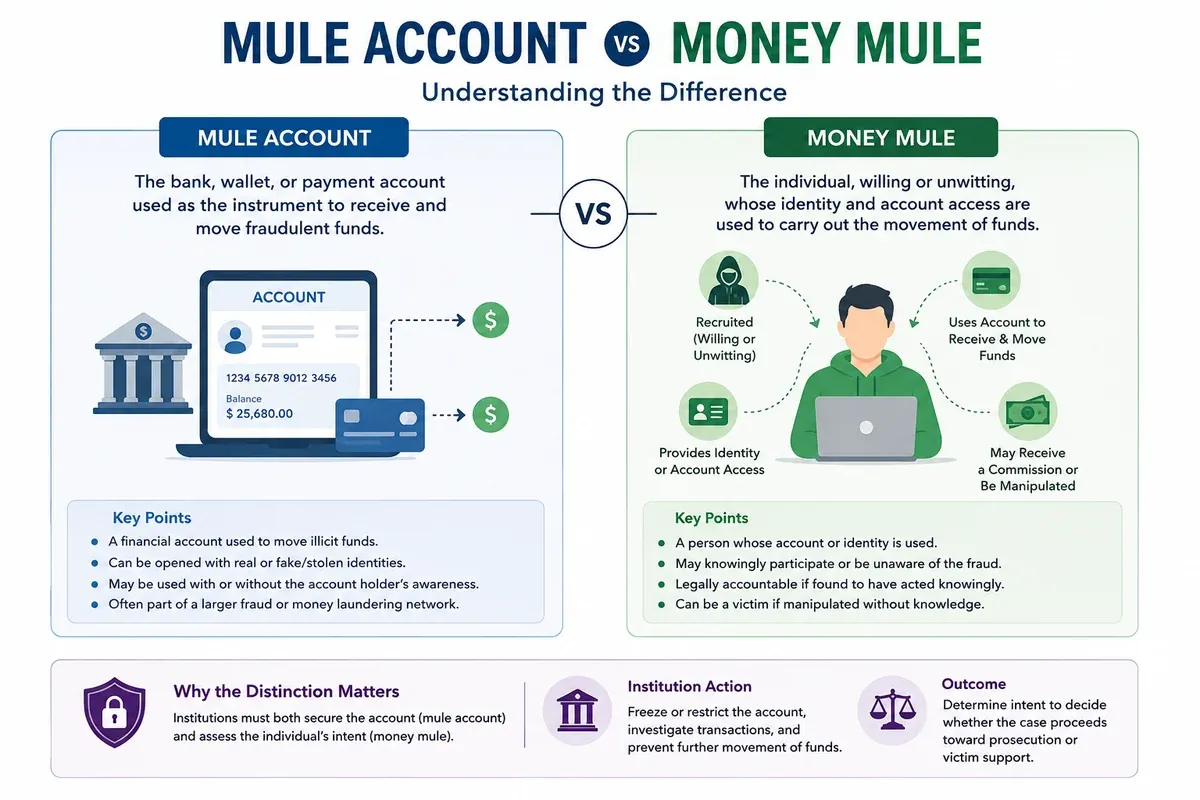
The difference between a money mule accountand a money mule is that both are relevant terms but are often used interchangeably. They describe two different things: one is an account to move illicit funds, and the other is the person associated with the fraudulent activity. A mule account can exist without the account holder's awareness, while themoney mule meaning defines how an individual is connected to that account. The definitions below help clarify the distinction.
| Term | Meaning |
|---|---|
| Mule account | The bank, wallet, or payment account used as the instrument to receive and move fraudulent funds |
| Money mule | The individual, willing or unwitting, whose identity and account access are used to carry out the movement of funds |
Swipe the table
Addressing the mule account and identifying whether the individual acted knowingly in the fraud or was manipulated determines whether the case proceeds toward prosecution or toward victim support.
How Do Mule Accounts Work?
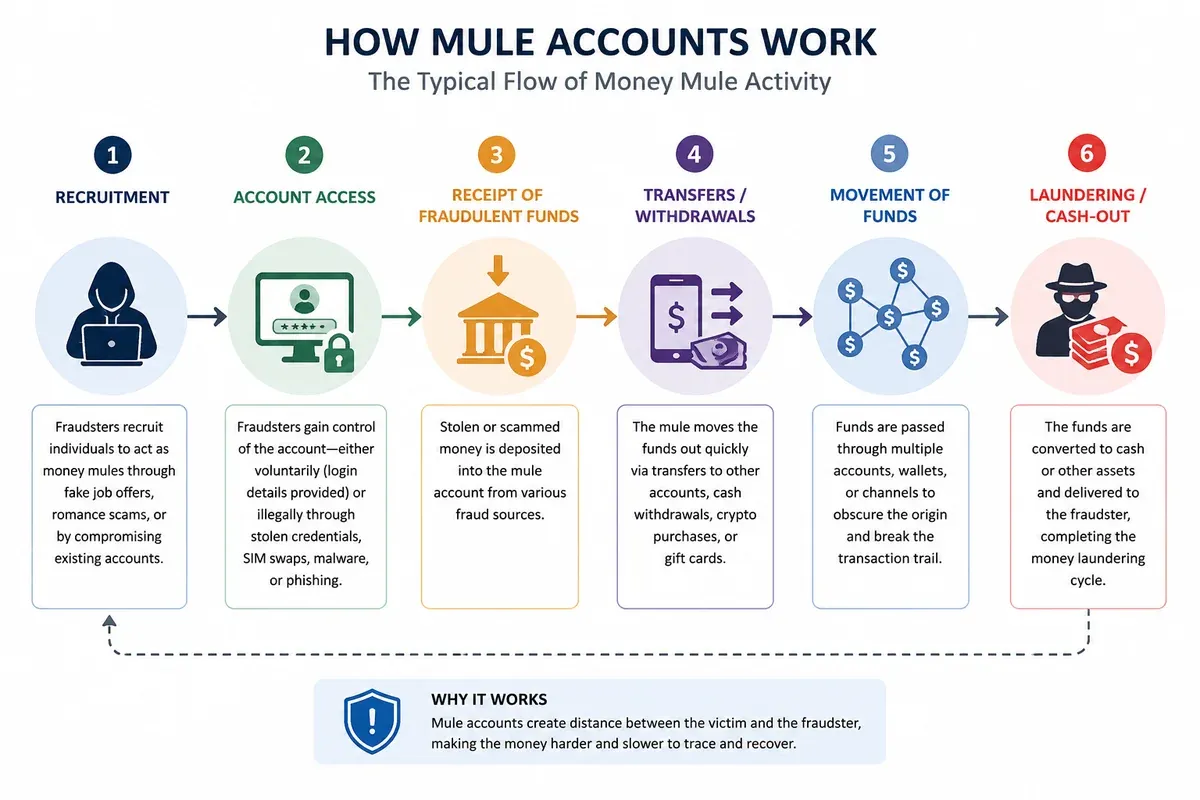
A mule account typically works through six stages. The stages are discussed below:
- Recruitment. The fraudster or fraud network identifies a potential mule, either by advertising a fake job, running a romance scam, or compromising an existing account through phishing or credential theft.
- Account access. The fraudster gains control of an account. This happens either because the recruited mule voluntarily hands over login details or because the account is taken over without the owner's knowledge through stolen credentials, SIM swaps, or malware.
- Receipt of funds. Stolen or scammed money is deposited into the account. This might come from a business email compromise scam, phishing-related fraud, a fraudulent investment scheme, or unauthorised card transactions.
- Transfer and withdrawal. The mule transfers or withdraws the funds quickly, sometimes following instructions and sometimes acting independently if they are a willing participant. This often involves transferring funds to another account, withdrawing cash, or converting proceeds into cryptocurrency or gift cards.
- Layering and cash-out. The funds pass through additional accounts or channels to obscure their origin before reaching the fraudster. Each additional transactional hop makes the money harder to trace and recover.
Many mule accounts move illicit funds within hours of receipt, often before a bank's transaction-monitoring controls can identify the activity, which is why post-event investigations may begin only after the funds have been moved, reducing the likelihood of recovery.
How Are People Recruited as Money Mules?
People are recruited as money mules through fake job offers, romance scams, social engineering and impersonation, and investment and crypto scams. Fraudsters often promise easy income, commissions, or rewards for allowing funds to pass through a personal bank account.
- Fake job offers: Recruits are offered remote “payment processing agent” roles that ask them to receive funds into their personal account and transfer a portion elsewhere, in exchange for a commission. The job rarely involves a real employer.
- Romance scams: A fraudster establishes a relationship with the victim over weeks or months, then asks the victim to receive money on their behalf, claiming it is related to a business deal, an inheritance, or a shared future.
- Social engineering and impersonation: Scammers pose as bank staff or government officials and convince the target that moving money through their own account is necessary to “verify” or “protect” their funds.
- Investment and crypto scams: Victims are told that routing money through their account is part of a legitimate trading strategy or a required step to access purported profits.
- Promises of easy income: Social media ads and messaging app groups advertise quick payments in exchange for access to a bank account for a short period.
What connects these recruitment methods is the use of urgency, social engineering, and plausible pretexts to induce individuals to facilitate transactions. In many cases, individuals may not understand the underlying criminal activity when they first agree to participate. This is why consumer awareness alone cannot eliminate the risk of money mule activity. Financial institutions also need effective onboarding controls, transaction monitoring, and behavioural analytics to identify potentially suspicious activity.
Types of Mule Accounts
Personal bank accounts, business accounts, newly opened accounts, and compromised accounts are the most common types of mule accounts. Not every mule account looks the same, and businesses need to watch for several distinct categories.
- Personal bank accounts: The most common type. An individual's existing checking or savings account is used, either with their knowledge or after it has been compromised.
- Business accounts: Fraudsters sometimes register shell companies or use compromised business accounts, since larger and more varied transaction volumes can make suspicious activity harder to spot at a glance.
- Newly opened accounts: Accounts opened specifically for fraud, often using synthetic or stolen identities, with no genuine banking history. These are frequently used once or twice before being abandoned.
Read more aboutWhat Is Synthetic Identity Fraud? How Fraudsters Create Customers Who Don't Exist
- Compromised accounts: Legitimate, long-standing accounts taken over through phishing, malware, or credential stuffing, then used without the real owner's knowledge until the activity is flagged or the owner notices unauthorised transactions.
- Accounts controlled by recruited mules: Accounts belonging to real people who were persuaded, through a job offer, a romance scam, or another social engineering tactic, to let a fraudster route money through them in exchange for payment.
Each type demands a slightly different detection approach. A newly opened account with immediate high-value inflows behaves very differently from a decade-old account that suddenly starts showing unusual patterns. This is a signal of money mule fraud that detection teams should consider and look for in every illicit fund transfer account. However, not all mule accounts are opened using genuine customer information. In some cases, fraudsters create entirely new identities to establish accounts that appear legitimate during onboarding.
Money Mule Activity: Common Red Flags
Money mule activity involves detecting rapid incoming and outgoing transfers, sudden spikes in transaction volume, multiple unrelated senders, and more. These are common red flags indicating that an account is being used to receive, hold, or transfer funds linked to fraud or other financial crimes. Let’s explore why these red flags matter.
| Red Flag | Why It Matters |
|---|---|
| Rapid incoming and outgoing transfers | Funds that arrive and leave within hours or minutes suggest the account is a pass-through, not a destination for genuine income or savings. |
| Sudden spike in transaction volume | An account with years of low activity that suddenly processes large sums is inconsistent with normal financial behaviour. |
| Multiple unrelated senders | Receiving funds from several people or businesses with no apparent connection to the account holder points to a coordinated scheme. |
| Immediate withdrawal after deposit | Genuine account holders rarely move an entire incoming deposit out within minutes; mules are often instructed to act fast. |
| Geographic inconsistencies | Logins, transfers, or device locations that do not match the account holder's stated address or usual activity area. |
| Round-number or structured transactions | Repeated transfers just under reporting thresholds, or oddly precise round amounts, can indicate deliberate structuring. |
| Mismatched account profile | A student or low-income account suddenly handling business-scale transaction volumes does not fit the stated profile on file. |
| Multiple accounts linked by shared devices | Several accounts logging in from the same device, IP address, or browser fingerprint often point to a single fraud operator. |
Swipe the table
When you consider these individual red flags in isolation, you will learn why manual fraud reviews often fall short. An analyst can spot one obvious red flag, but recognising that ten unrelated accounts share a device fingerprint or a transaction pattern requires automated, always-on monitoring across the entire user base.
Mule Account Detection: How to Identify Suspicious Accounts
Mule account detection means identifying suspicious accounts and fraudulent activities on time. But a single signal cannot detect it reliably. Therefore, a system must combine signals across five categories, including:
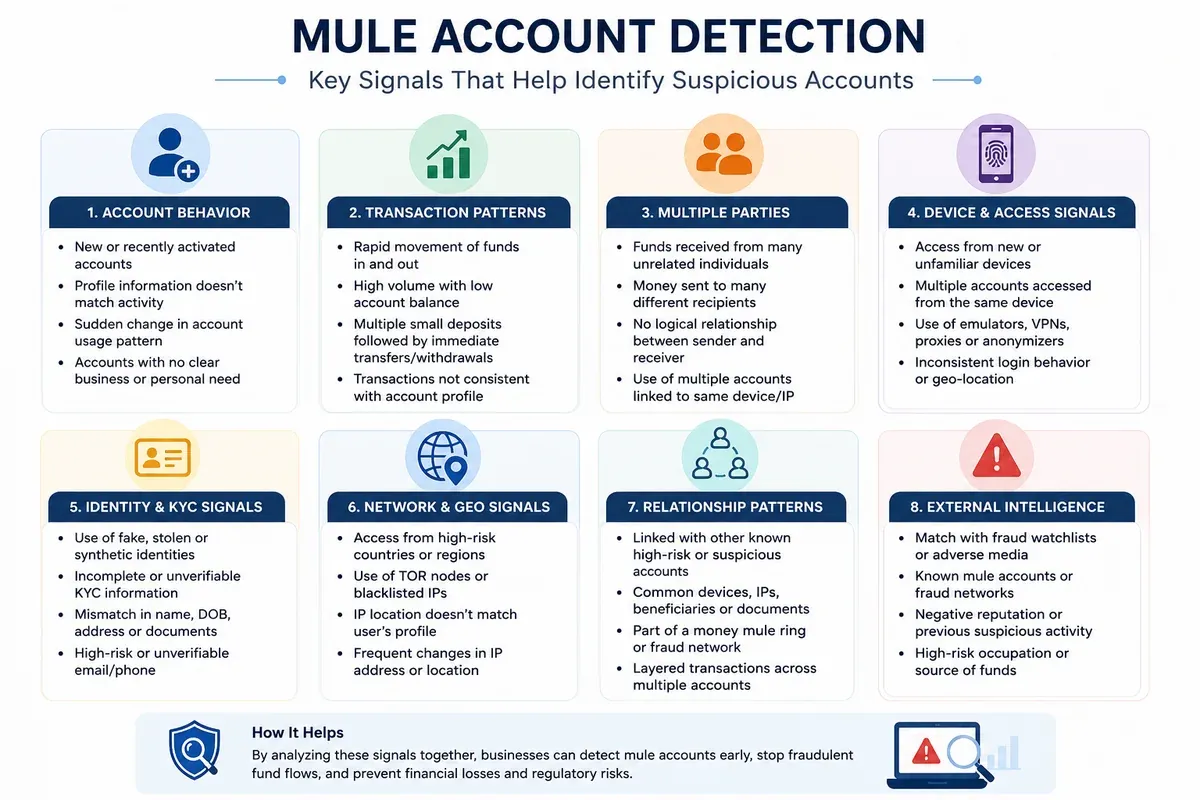
- Behavioural signals: How a user interacts with their account, such as typing patterns, navigation speed, session length, and the sequence of actions taken before a transfer, matters. These often help differentiate a genuine account holder from someone following a fraudster's instructions.
- Transactional signals: The pattern, timing, size, and destination of transactions can reveal a lot. Fraud-linked accounts often show spikes in incoming funds, followed immediately by rapid onward transfers. The pattern may also include transfers to newly added beneficiaries or transaction amounts that do not match the account's usual activity.
- Identity signals: Inconsistencies between the identity documents provided at onboarding and the account activity seen afterwards, such as a stated occupation that does not match transaction volume, can indicate possible identity fraud or money mule activity.
- Device signals: The device, browser, and network used to access an account carry a digital fingerprint. When several accounts that appear unrelated at first but share the same device or network fingerprint, this can indicate that they may be controlled by the same person or linked to the same mule network.
- Network signals: Mapping relationships between accounts, shared beneficiaries, shared devices, overlapping IP ranges, and shared contact details reveals a connected group of accounts that a single-account review would never surface.
These signals become much more effective when analysed together.
- Transactional data shows what happened (e.g. rapid movement of funds, unusual transaction patterns).
- Identity data tells whether the account activity matches the customer’s profile.
- Device data tells you which devices are accessing the account and if they are associated with other suspicious accounts.
- Network data can show relationships between accounts, beneficiaries, devices, and contact details that may indicate a mule network.
- Behavioural data shows how users use the platform and whether their actions are legitimate or suspicious.
These signals also show that identifying mule accounts requires more than verifying customer identity. Businesses must also assess intent, behavioural risk, device reputation, and account relationships throughout the customer lifecycle.
How to Detect Mule Accounts Using Device & Behavioural Intelligence
Mule accounts can be detected by analysing device and behavioural intelliegence that indicate unusual account access, transaction activity, or user behaviour. Transaction monitoring alone can detect mule accounts and identify money mule fraudtransferring money. But when combined with device and behavioural intelligence, a system can catch the fraud promptly while it is still being set up and before real damage happens.
Device fingerprinting creates a consistent profile of the hardware, browser, operating system, and network configuration used to access an account. This can help identify relationships between accounts that seem unrelated. For example, a fraud ring might set up multiple accounts with different names, identities, or contact info, but log into them from the same device or emulator. Even if customer information appears legitimate, device intelligence can reveal these connections. IP intelligence adds another layer by flagging access from high-risk sources like proxy networks, VPN exit nodes, or data centre IP addresses.
Behavioural intelligence is about how users interact with an application or platform. Behaviours such as typing speed, mouse movement, scrolling habits, navigation paths, and onboarding times can help distinguish genuine customers from those following instructions or engaging in organised fraud.
Combined with velocity checks, linked-account analysis, and relationship mapping across shared devices, phone numbers, IP addresses, or payment destinations, these signals can help identify coordinated money mule activity before it becomes evident through transaction monitoring alone.
This is the gap our fraud intelligence platform was built to close. By linking behavioural, device, and network signals in real time, it gives banks, fintechs, and payment platforms the ability to flag a suspected mule account at the point of onboarding, not weeks later when the money is already gone.
How to Prevent Mule Account Fraud
Mule account fraud can be prevented through a multi-layered prevention approach that includes improved identity verification, transaction monitoring, device intelligence, behavioural analytics, and ongoing risk assessment across the entire customer lifecycle.
- Strong KYC and KYB at onboarding: Validating identity documents, cross-checking against government and credit bureau data, and screening for synthetic identity indicators prevents many fraud-linked accounts before they are even approved.
- Continuous transaction monitoring: Rules and models that identify, in real-time, not in a weekly batch review, unusual transaction patterns, structuring, rapid pass-through, and mismatched profiles.
- Real-time risk assessment: Combining onboarding data, transaction activity, behavioural signals, and device intelligence to identify accounts with characteristics typically associated with mule activity.
- Device and network intelligence: Fingerprinting devices and monitoring for known fraud infrastructure, emulators, rooted devices, and proxy networks detects coordinated fraud rings that individual account reviews miss.
- Behavioural analytics: Watching the way users behave on the platform to detect scripted or coached behaviour that is not the behaviour of a real customer.
- Network analysis: Connecting accounts, shared devices, shared beneficiaries, and duplicated contact details to uncover not only an individual account but also a whole network of mules.
- Step-up verification: Implementing additional identity verification or manual review when an account’s behaviour exceeds a risk threshold, instead of using only static rules established at onboarding.
- Ongoing monitoring after onboarding: Fraud does not stop at approval. Accounts need to be re-evaluated continuously, since a clean account today can be recruited or compromised months later.
No single layer here is sufficient on its own. Fraud networks specifically design their operations to easily bypass the weakest fraud control signals. Sign3 combines identity, transaction, device, behavioural, and network intelligence signals into a single fraud prevention system, helping businesses detect mule accounts and coordinated fraud activity more effectively.
How Businesses Can Stop Money Mule Activity
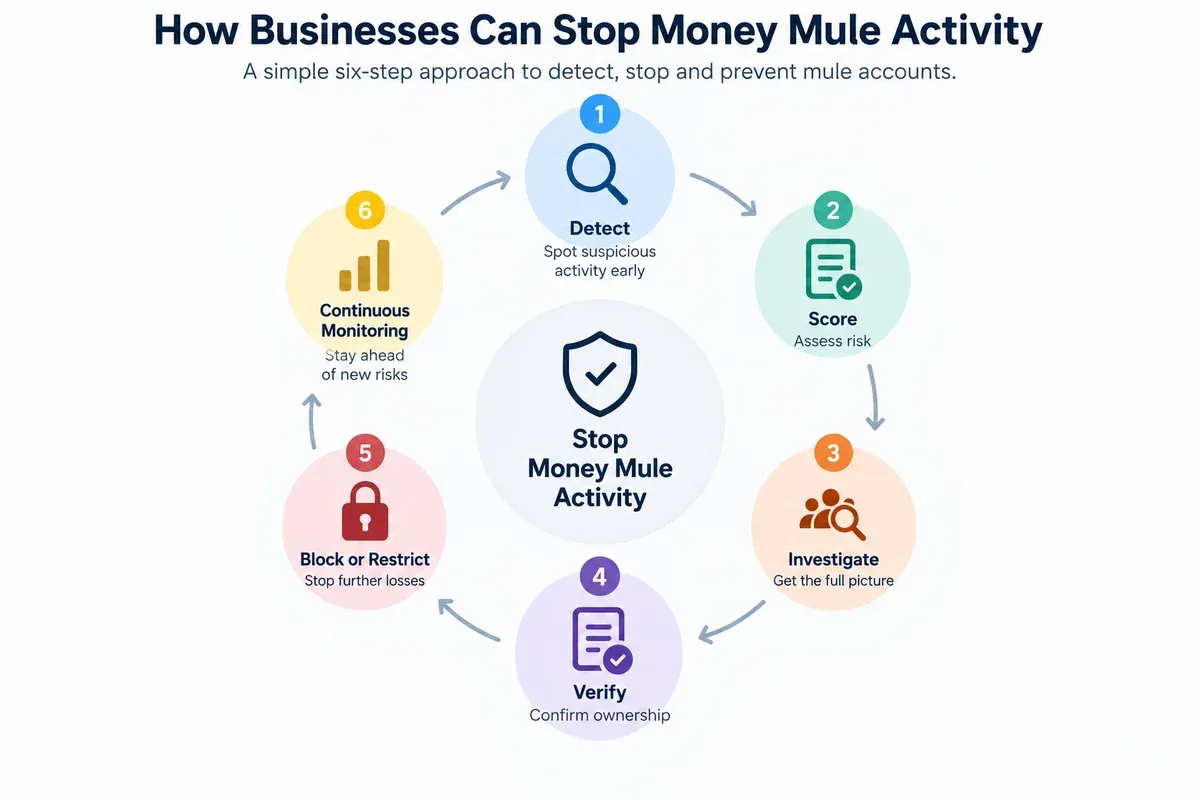
To stop money mule activity, businesses can follow six practical steps, including detection, score analysis, investigation, verification, restriction, and continuous monitoring. These steps help identify suspicious accounts, reduce fraud exposure, and prevent mule networks from operating on their platforms.
| Step | What To Do |
|---|---|
| 1. Detection | Monitor transactions, device signals, and behavioural patterns in real time. |
| 2. Score analysis | Apply risk scoring using transaction, identity, device, and behavioural signals. |
| 3. Investigation | Analyse transaction history, device fingerprints, and network connections. |
| 4. Verification | Request additional documentation or step-up authentication. |
| 5. Block or Restrict | Freeze accounts or limit transactions when fraud is confirmed. |
| 6. Continuous monitoring | Track linked accounts, beneficiaries, devices, and transaction behaviour. |
Swipe the table
Effective mule account prevention requires connecting signals that are often viewed in isolation. By integrating identity verification, transaction monitoring, device intelligence, behavioural analytics, and network-level risk detection, businesses can identify suspicious accounts faster, reduce fraud losses, and uncover coordinated mule networks before they scale.
How Sign3 Detects Money Mules Before Onboarding
Sign3 detects money mules before onboarding by generating a risk analysis score. Most detection methods act after money has already moved. But Sign3's system assesses phone, device, and email signals before user onboarding. The moment an account is opened, the signals begin assessment and alert businesses to stop a mule account from ever becoming active, rather than removing it later.
The score runs on just three inputs a business already collects at onboarding: name, phone number, and email. From these, over 500 risk signals are checked across three categories:
- Phone signals: phone vintage, online presence, prepaid or postpaid status, whether the number is linked to a bank-verified account, location consistency, and results from more than 45 social media checks.
- Device signals: whether the device is new to the platform, proxy and VPN use, emulator and rooting checks, app-cloning checks, and more than 50 additional device-risk checks.
- Email signals: email confidence, temporary or disposable email checks, email vintage, whether the email links to a known phone number, and online presence.
These signals feed into Graph Link Analysis, which maps how a name, phone number, email, and device connect to other identities across Sign3's network, rather than scoring each one in isolation. The output is a single risk score from 0 to 100: 0 to 30 marks a normal user, while 50 to 100 flags a high-risk account that requires manual review before approval.
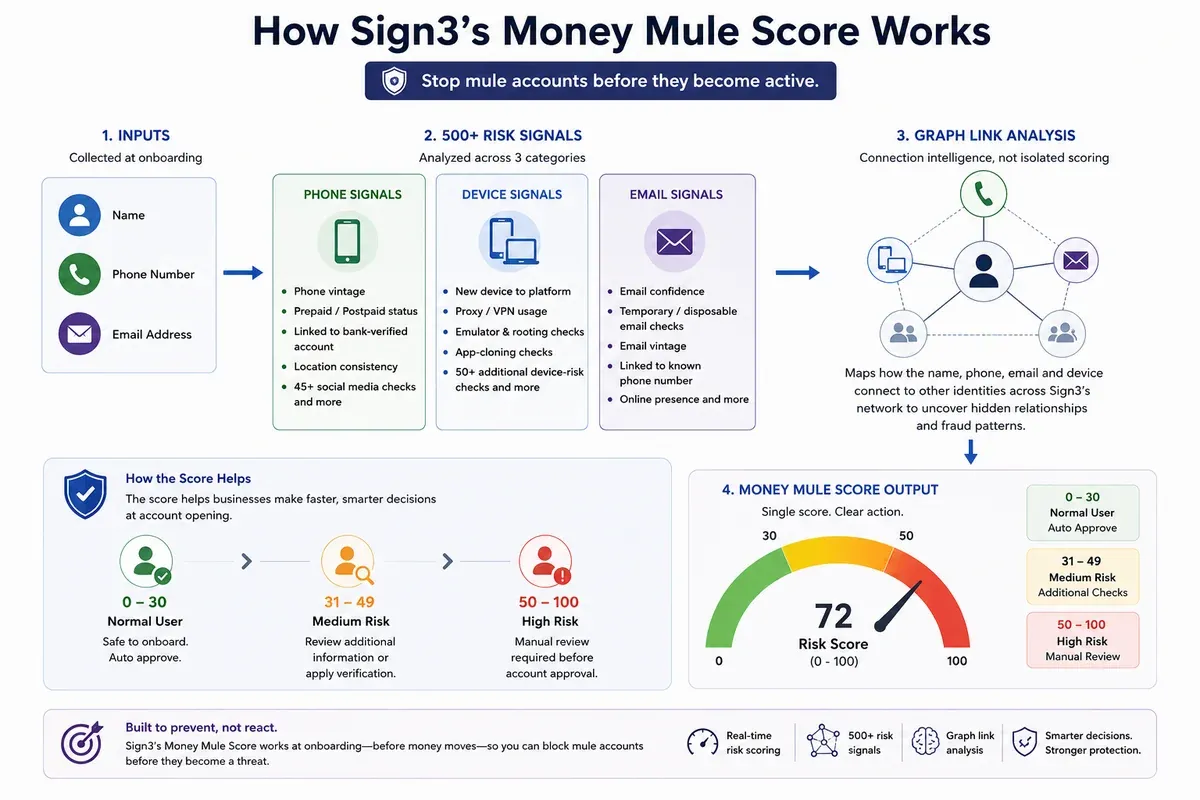
Because the check runs silently before onboarding is complete, it adds no extra steps or friction for genuine customers, and it works alongside a business's existing KYC process rather than replacing it. This pre-onboarding approach matters because most other fraud tools only act after a suspicious transaction has already gone through.
The model weighs both digital footprint and device intelligence to reach its score:
| Signal category | Lower Risk Indicator | Higher Risk Indicator |
|---|---|---|
| Identity & Digital Footprint | Established phone number and email address, strong online presence, consistent identity information | Newly created contact details, limited digital history, identity mismatches across phone, email, and account records |
| Device & SIM Intelligence | Clean device history, low SIM-swap activity, consistent device usage | Frequent SIM swaps, suspicious device activity, disposable or high-risk devices |
| Account & Device Relationships | One account consistently associated with one device and user | Multiple unrelated accounts accessed from the same device, browser, or IP address |
| Network & IP Intelligence | Access from trusted, low-risk IP addresses and locations | Access from blacklisted IPs, proxy networks, VPN exit nodes, or anonymised connections |
Swipe the table
By combining digital footprint analysis, device intelligence, behavioural signals, and network relationships, we help businesses uncover mule accounts and coordinated fraud networks before they can facilitate financial crime.
Challenges in Detecting Mule Accounts
Detecting mule accounts is challenging because a mule banking account often appears legitimate and may initially behave like a normal customer account. Even well-resourced fraud detection teams face real obstacles when trying to separate genuine accounts from a mule banking account.
- Legitimate accounts get misclassified
A small business owner with genuinely unpredictable transaction patterns, or someone who receives a large inheritance, can trigger the same red flags as a mule account. This can create false positives that erode real customers' trust.
- Mule networks change behaviour deliberately
Fraud operators study detection rules and adjust their patterns, spreading transactions across more accounts, slowing transfer speed, or varying amounts to stay under known thresholds.
- Account takeover blurs the picture
When a genuine, long-standing account is compromised, its history looks completely legitimate right up until the moment it is misused, making pattern-based detection alone insufficient.
Read more:Account Takeover (ATO) Fraud: Detection, Prevention, and AI-Powered Solutions
- Synthetic identities pass basic checks
Identities built from a mix of real and fabricated information can pass simple document verification while still being entirely fraudulent.
- Multiple devices and VPN or proxy use
Fraud operators often use device farms, emulators, or residential proxy networks to make each fraud-linked account appear to originate from a different, unrelated location.
- Cross-account coordination is hard to see manually
A fraud analyst reviewing one account in isolation cannot easily detect that it shares a device fingerprint or a beneficiary with fifty other flagged accounts unless the monitoring system is built to surface those connections automatically.
These challenges are exactly why modern fraud prevention has moved away from static, rule-based checks and toward continuous, cross-account intelligence that adapts as fraud tactics evolve.
How Technology Helps Detect Mule Accounts at Scale
Technology helps detect mule accounts at scale by analysing certain risk signals such as transactions, device signals, behavioural patterns, graph and network analysing, and account relationships in real time. Unlike manual reviews, modern fraud detection systems can continuously monitor millions of accounts simultaneously, identify suspicious activity as it occurs, and uncover hidden connections between accounts that may indicate organised money mule networks.
- Risk signals in real time: Current fraud systems don’t do periodic account reviews; instead, they review each transaction and login event as it happens. It immediately shows the risk score instead of days later.
- Behavioural Analytics: Continuously monitor session patterns, navigation speed, and input behaviour to flag accounts that are behaving in ways that are not consistent with a genuine customer.
- Transaction monitoring: Automated systems track velocity, amount patterns, and destination accounts across the entire customer base, catching coordinated activity a manual review would miss.
- Graph and network analysis: Mapping relationships between accounts, shared devices, and overlapping contact information exposes entire fraud rings rather than the single account that happened to get flagged first.
- Automated risk decisions: Combining all of the above signals into a single risk score lets fintechs automatically hold, restrict, or route an account for review the moment it crosses a defined threshold.
Regulators are moving in the same direction. In May 2026, I4C and the Reserve Bank Innovation Hub (RBIH) signed an agreement to share mule-account intelligence from I4C's Suspect Registry and strengthen AI-driven fraud detection across banks and digital payment providers. This signals that cross-institution, technology-led detection is becoming the expected standard rather than a competitive advantage.
Mule Account Detection & Prevention Checklist
Mule account detection and prevention checklist requires to follow multiple aspects. No single signal can reliably identify a mule account. Use the checklist below to assess whether your organisation has implemented the controls needed to detect and prevent mule account activity at each stage of the customer lifecycle.
- Verify identity documents against government and bureau data at onboarding, rather than accepting them at face value.
- Score name, phone, and email signals before approval to detect high-risk applicants that document checks alone miss.
- Screen for synthetic identity indicators, such as a genuine address paired with a fabricated employment history.
- Monitor transaction velocity and flag rapid inflow-outflow patterns, since pass-through behaviour is one of the most consistent mule signals.
- Track device fingerprints across all accounts, not just flagged ones, so connections between unrelated accounts become visible early.
- Check for shared devices, IPs, or contact info amongst accounts.
- Deploy the right behavioural analysis to uncover scripted or coached activity that’s not consistent with true customer behaviour.
- Define risk-based thresholds for automatic step-up verification.
- Look into inactive accounts that suddenly become active.
- Assess current account relationships to identify linked mule networks.
- Don’t make identity verification a ‘one-time’ option. Opt for ongoing surveillance even post-onboarding.
- Fraud networks study the logic of existing rules and adjust their behaviour to keep operating, so review and update detection rules regularly.
Overall, effective prevention requires a proper combination of onboarding controls, transaction monitoring, behavioural analytics, and adaptive fraud detection strategies that evolve alongside emerging threats.
Read more:Fintech Fraud Detection Rules Every Fintech Should Implement
Frequently Asked Questions
What is money mule account?
A mule account is a bank, wallet, or payment account used to receive, hold, or move funds obtained through fraud, scams, or cybercrime, usually on behalf of a fraudster seeking distance from the stolen money.
What is a money mule?
A money mule is the individual whose account or identity is used to carry out this movement of funds. Some know exactly what they are doing and are paid a percentage of the funds moved; others are manipulated into helping through a job offer, romance scam, or impersonation attempt, without realising the money is stolen.
Can a legitimate person become a money mule unknowingly?
Yes. Many money mules are victims themselves, recruited through fake job offers, romance scams, or impersonation tactics, with no idea their account is moving stolen funds until their bank flags the activity or law enforcement makes contact. Recognising these recruitment tactics early is the strongest protection against becoming a mule account unknowingly.
What happens if my account is flagged as a mule account?
Banks typically freeze or restrict the account while they investigate, request supporting documentation, and may report the case to law enforcement or a national fraud registry. Funds linked to the suspicious activity can be held pending further review. Also, the account holder may need to prove they were not a willing participant before the restriction is lifted and normal access is restored.
Is a mule account illegal?
Knowingly using an account to move fraudulent funds is a crime that can carry severe criminal penalties. Institutions and investigators will treat all flagged mule accounts as serious cases, regardless of intention, and even if they don’t realise it, money mules can have their accounts frozen, their own money taken away, and face legal scrutiny.
What are mule account red flags?
Common red flags include rapid incoming and outgoing transfers, sudden spikes in transaction volume, multiple unrelated senders, immediate withdrawal after deposit, and accounts that share a device or network fingerprint with other flagged accounts. A single flag rarely confirms fraud, but several together are a strong warning sign.
How do banks detect mule accounts?
Banks combine transaction monitoring, device intelligence, behavioural analytics, and identity verification to detect a mule account. No single check is usually sufficient; it is the pattern across several signals- unusual transaction velocity, shared device fingerprints, mismatched account behaviour, and inconsistent identity data that leads to a flag and triggers further review.
How can businesses prevent money mule fraud?
Effective prevention layers strong onboarding checks and a pre-onboarding risk score with continuous transaction monitoring, device and behavioural intelligence, and ongoing account review after approval. Fraud networks are built to pass a single verification step, so relying on onboarding checks alone leaves a business exposed.
The Bottom Line
Mule accounts have become a critical enabler of modern financial crime, allowing fraudsters to move and cash out funds from scams, account takeover fraud, phishing attacks, and other illicit activities. Because these accounts often appear legitimate, traditional onboarding checks and rule-based controls alone are not enough to identify them.
Effective, real-time detection requires a layered strategy that combines KYC and KYB controls with signals such as transaction monitoring, device intelligence, behavioural analytics, and network-level risk analysis. Our platform operates based on these signals and helps financial organisations identify suspicious accounts and coordinated fraud networks in real time. Get in touch with us to see how the Money Mule Score and real-time device intelligence can strengthen your fraud detection stack.


