

Anti-money laundering (AML) has become a crucial function for banks and financial institutions as digital payments, online account opening, and instant fund transfers continue to grow. Criminals increasingly use different complex methods to move illicit funds through the financial system, making it much harder for banks and financial institutions to identify suspicious activity in time.
This guide explains the full form of AML in banking, types of anti money laundering, how AML works, the key stages of money laundering, India’s regulatory framework, and the challenges banks face in detecting increasingly sophisticated financial crime.
AML Full Form in Banking and Why Banks Adopt It
AML full form in banking stands for anti-money laundering. It refers to the policies, procedures, technologies, and regulatory controls that help banks detect, prevent, investigate, and report suspicious financial activities that are connected to money laundering and terrorist financing. AML is applicable from customer verification at account opening to ongoing transaction monitoring and mandatory reporting to India's financial intelligence authority.
Overall, the anti-money laundering meaning defines how this practice helps prevent criminals from hiding illegally obtained funds as legitimate income and prevents banks from being used to move and legitimise those illicit funds.
AML in banking serves two distinct purposes:
- The first is regulatory compliance, where banks under the PMLA and RBI directions need to verify customer identity, monitor transactions, and report suspicious activity.
- The second is financial crime prevention, where AML controls exist to protect the bank and its customers from being used as a conduit for criminal proceeds and terror financing.
What is the Anti-Money Laundering Act?
In India, anti-money laundering activities are mainly governed by the Prevention of Money Laundering Act, 2002 (PMLA). The Act enables authorities to investigate money laundering offences, identify and seize proceeds of crime, and take legal action against individuals or entities involved in laundering illicit funds.
The PMLA works alongside RBI's KYC Master Direction, FIU-IND reporting requirements, and other regulatory guidelines to ensure banks and financial institutions can identify suspicious activities, verify customer identities, and report potential financial crimes. Together, these regulations form the foundation of India's Anti-Money Laundering (AML) framework.
What Are the Three Stages of Money Laundering

To clearly understand the meaning of anti-money laundering, you should also understand the three distinct stages: placement, layering, and integration. Understanding each stage helps explain why banks deploy different AML controls to detect suspicious activity at different points in the laundering process.
| Stage | What Happens |
|---|---|
| Placement | Illicit cash or funds first enter the formal financial system, often through bank deposits, business receipts, or third-party accounts. |
| Layering | The funds are then moved through multiple accounts, institutions, or jurisdictions to hide the main criminal origin. |
| Integration | The laundered funds re-enter the financial economy through investments, purchases, or business transactions, appearing to come from a legitimate source. |
Swipe the table
While money laundering is often described as a three-stage process, real-world schemes are usually far more complex and may involve multiple accounts, intermediaries, and jurisdictions. For banks, the challenge is identifying suspicious activity before funds successfully move from placement to integration.
AML in Banking: How It Works in India
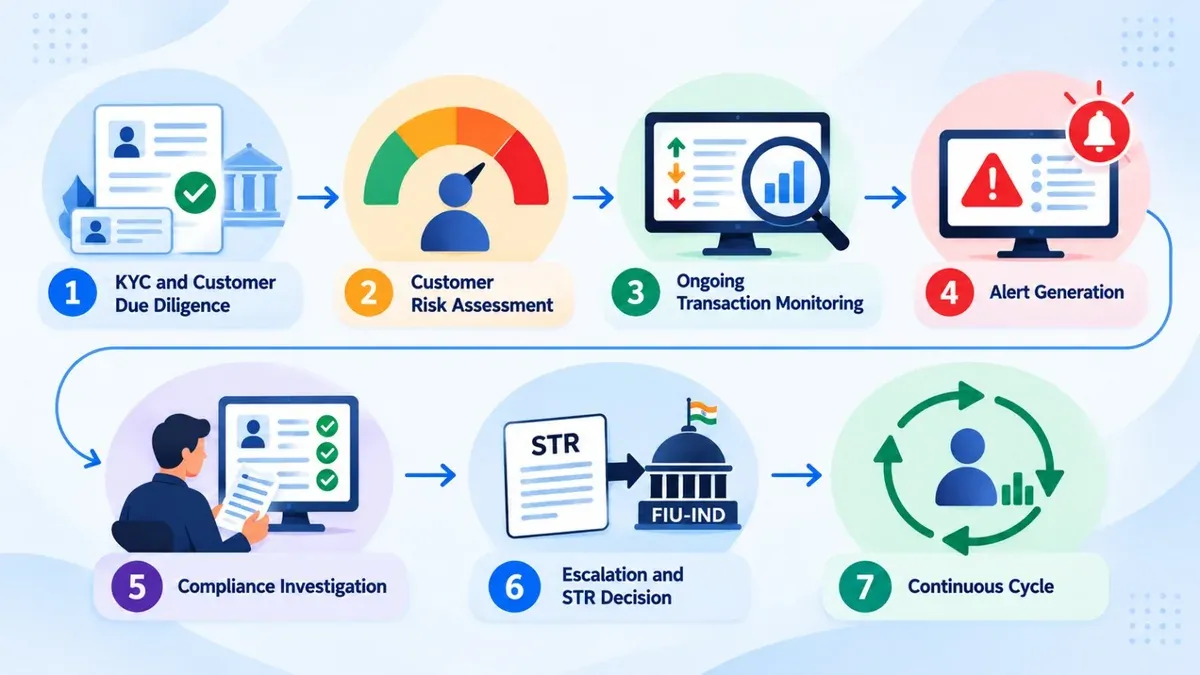
AML in banking is not a one-time compliance check during account opening. Instead, it is an ongoing risk-based approach that starts with customer onboarding and continues throughout the customer relationship. The steps include:
| Steps | What Happens |
|---|---|
| 1. Customer Due Diligence (CDD) and KYC | When a customer opens a bank account, the bank verifies identity documents, proof of address, beneficial ownership information (where applicable), and other customer details required under KYC and AML regulations. |
| 2. Customer Risk Assessment | The bank classifies the customer as low, medium, or high risk based on multiple factors such as occupation, source of funds, geography, transaction expectations, and customer type. |
| 3. Ongoing Transaction Monitoring | After onboarding, the bank continuously monitors a user’s account activity and compares transaction behaviour against the customer's expected profile to identify unusual patterns. |
| 4. Alert Generation | Transactions that breach predefined fraud detection rules or exhibit suspicious behaviour often generate alerts for further review. Examples include sudden spikes in transaction volume, structuring ( multiple small transactions designed to avoid reporting thresholds ), or unusual fund transfers. |
| 5. Compliance Investigation | Compliance analysts investigate alerts, review customer activity, examine supporting information, and determine whether the activity can be reasonably explained. |
| 6. Escalation and STR Decision | If the investigation indicates potential money laundering, terrorist financing, fraud, or other suspicious activity, the case may be escalated, and a Suspicious Transaction Report (STR) may be filed with FIU-IND. |
| 7. Continuous Cycle | This sequence, from onboarding through to reporting, repeats continuously throughout the entire customer lifecycle, since risk profiles and transaction patterns often change over time. |
Swipe the table
While the operational workflow remains broadly similar across institutions, this seven-step cycle illustrates how anti-money laundering (AML) works in practice. Indian banks perform these activities within a regulatory framework defined by the Prevention of Money Laundering Act (PMLA), RBI's KYC Master Direction, and reporting obligations overseen by FIU-IND.
India's AML Framework
India's anti-money laundering framework is built around three core pillars that define how AML in banking functions on a day-to-day basis. Under this framework, banks identify customers, monitor financial activity, and report suspicious transactions. These are explained below.
Prevention of Money Laundering Act (PMLA), 2002
The PMLA is India's primary anti-money laundering legislation. It defines multiple money laundering offences, prescribes penalties, and establishes the legal framework for investigating and prosecuting financial crimes.
RBI KYC Master Direction
The Reserve Bank of India's Know Your Customer (KYC) Master Direction outlines customer due diligence (CDD) requirements that banks and regulated entities must follow during customer onboarding and throughout the customer relationship.
Financial Intelligence Unit–India (FIU-IND)
FIU-IND serves as India's central financial intelligence agency. It receives and analyses reports filed by banks and other regulated entities, including suspicious transaction reports (STRs) and cash transaction reports (CTRs), to identify potential money laundering and terrorist financing activities.
Together, these three pillars define how Indian banks identify, investigate, monitor, and report suspicious financial activity before illicit funds move through the wider economy.
Reports Indian Banks Must File
Under the Prevention of Money Laundering Act (PMLA) and the rules framed under it, banks and other reporting entities are required to submit specific transaction reports to the Financial Intelligence Unit–India (FIU-IND).
Accurate and timely filing of these reports is one of the clearest measures of an institution's anti-money laundering compliance, since it helps authorities identify suspicious activity, monitor high-risk transactions, and detect potential money laundering or terrorist financing activities across the financial system.
| Report | Purpose |
|---|---|
| STR (Suspicious Transaction Report) | Filed when a transaction, or a pattern of transactions, raises reasonable grounds for suspicion of money laundering or terrorist financing, regardless of the amount involved. |
| CTR (Cash Transaction Report) | Filed for cash transactions, or a series of connected cash transactions within a calendar month, that cross the prescribed threshold. |
| CCR (Counterfeit Currency Report) | Filed when counterfeit currency notes are detected or presented at a bank branch. |
| NTR (Non-Profit Organisation Transaction Report) | Filed for transactions involving accounts held by non-profit organisations, given their historical vulnerability to misuse for layering and terror financing. |
Swipe the table
These reports matter well beyond the individual bank that files them. FIU-IND received more than 27 million transaction reports from reporting entities in FY 2024–25, including over 434,000 Suspicious Transaction Reports (STRs). The number highlights the importance of effective monitoring and timely reporting across the financial system.
Types of Money Laundering Banks Commonly Encounter
Money laundering takes many forms, and understanding the schemes criminals use helps banks design and adapt more effective controls. To achieve this, criminals use a variety of techniques that exploit banking channels, payment systems, businesses, and customer accounts. Those include:
1. Structuring (Smurfing)
Structuring is the division of one large transaction into smaller transactions (often across multiple accounts or days). Fraudsters follow this approach just to avoid reporting obligations. It is one of the most common laundering techniques Indian banks encounter because the process is much simpler to execute and difficult to detect without pattern-level monitoring.
2. Mule Accounts
Mule accounts are bank accounts, often opened using a genuine or bribed individual's identity, that are used by criminal networks to receive and move illicit funds on behalf of someone else. The account holder may or may not be aware of the account's true purpose. Mule accounts have become a central concern for Indian regulators, and banks are now expected to take active, ongoing measures to identify them rather than treating them as an occasional exception.
3. Trade-Based Money Laundering
Trade-based money laundering (TBML) conceals the movement of illicit funds through international trade transactions. It typically involves over-invoicing, under-invoicing, or misrepresenting goods and services to transfer value across borders under the appearance of legitimate commercial activity
4. Shell Companies
Shell companies are entities with no genuine business operations, created primarily to hide the identity of the individuals who actually control the funds passing through them. They are frequently used to hide beneficial ownership and create distance between the criminal source of funds and the assets being moved through the financial system.
5. Layering Through Multiple Accounts
Criminal networks often move funds through long chains of accounts, sometimes across several banks, to break the audit trail. Each transfer in the chain adds distance between the illicit source and the final destination, making the funds progressively much harder to trace back to their origin.
As criminals use a variety of laundering techniques, banks cannot rely on a single detection mechanism. Instead, they need to deploy multiple AML controls across the customer lifecycle to identify suspicious activity at different stages of the laundering process.
Types of Anti Money Laundering: Measures & Stages
Rather than relying on a single control, banks and financial institutions deploy multiple types of anti-money laundering controls throughout the customer lifecycle, from onboarding and identity verification to transaction monitoring and regulatory reporting. These controls are as follows:
| AML Control | What It Does |
|---|---|
| Customer Due Diligence (CDD) and KYC | Confirms a customer’s identity, defines beneficial ownership for legal entities, and determines a risk category that serves as a basis for ongoing monitoring. Under current RBI requirements, the beneficial ownership threshold is lower than before, requiring banks to look deeper into layered corporate and trust arrangements. |
| Transaction Monitoring | Assesses transaction size, frequency, velocity, geography, and information provided against the customer's stated profile. Common red flags include large, sudden transfers that don’t match a customer’s known income profile, previously dormant accounts that are now active with high volumes, and repeated small deposits just under reporting thresholds. Coordinated activity across multiple accounts is harder to detect without a clear network-level view. |
| Sanctions and PEP Screening | Screens every customer and counterparty against sanctions watchlists and Politically Exposed Persons lists, on an ongoing basis (not just at onboarding). Enhanced scrutiny applies to customers linked to high-risk jurisdictions regardless of transaction size. |
| Suspicious Transaction Reporting (STR) | The STR process follows a defined sequence: detection through an automated alert or manual observation, review by the compliance team, a formal investigation to establish whether the activity has a legitimate basis, and filing with FIU-IND where suspicion is confirmed. Each stage is documented, since regulators expect banks to show not just that a report was filed, but the reasoning behind it. |
| Enhanced Due Diligence (EDD) | EDD applies to customers identified as being at heightened risk, for example, customers with complex ownership structures, a high volume of cross-border activity, or a history flagged during normal due diligence. EDD involves more than documentation, including frequent account reviews and more detailed scrutiny of the source of funds compared to standard CDD. |
Swipe the table
AML in banking helps detect suspicious activity, but strong AML governance ensures those controls are accurate, aligned to risk, and compliant with changing regulatory requirements. It provides oversight for reviewing monitoring frameworks, validating risk models, and meeting reporting obligations consistently.
AML Compliance for Indian Banks
As financial crime becomes increasingly sophisticated, AML compliance has evolved beyond a regulatory checkbox. Indian banks are expected to adopt a risk-based approach that combines customer due diligence, transaction monitoring, internal controls, and regulatory reporting to identify potential money laundering risks.
Core Components of an AML Compliance Program
AML controls will help identify suspicious activity, but an AML compliance programme provides a strong governance structure that ensures those controls work effectively throughout the organisation.
Typically, this framework in Indian banks includes a board-approved AML policy, a Principal Officer for regulatory reporting, a Designated Director for compliance oversight, a documented risk assessment process, employee training programs, independent audits, and ongoing customer due diligence (CDD) procedures.
Together, these elements help ensure that AML responsibilities are clearly assigned, consistently applied, and regularly reviewed as regulatory requirements and financial crime risks evolve. Strong anti-money laundering compliance requires more than periodic audits; it demands continuous risk assessment across the entire customer lifecycle.
Consequences of Non-Compliance with the AML Act
Regulators expect banks to demonstrate that their AML controls are operating effectively in practice, not merely documented on paper. Weak anti-money laundering compliance can result in supervisory action, monetary penalties, enhanced regulatory scrutiny, and restrictions on certain business activities.
Based on these regulatory consequences, AML controls can even damage customers’ trust and expose banks and financial institutions to the risk of financial crime that could have been prevented through stronger monitoring and improved governance.
With AML regulations continuing to evolve, banks need to regularly review and improve their compliance programs to ensure they are in line with regulatory expectations.
Why Traditional AML Controls Alone May Not Be Enough
- Traditional AML in banking systems focus on monitoring individual transactions and accounts. They are designed to detect suspicious activities that fit predetermined rules or static risk patterns and work in isolation. But today’s fraud networks have evolved, and the fraud patterns have become sophisticated enough to bypass the traditional checks. Some examples include:
- Multiple accounts opened from the same device: A common indicator of coordinated fraud, mule account networks, or attempts that can easily bypass onboarding controls by creating multiple seemingly unrelated accounts.
- Synthetic identities built from fabricated or stolen data: Designed to pass standard KYC checks while concealing the true identity of the individual behind the account.
- Coordinated mule networks operating across seemingly unrelated customers: Individual transactions may appear legitimate, but there could be hidden links between multiple accounts. This pattern reveals organised laundering activity.
- Shared behavioural patterns across accounts that appear unconnected: Similar login, navigation, or transaction behaviours may indicate that the same fraud network controls multiple accounts.
These signals often become visible only when customer identities, devices, behaviours, and account relationships are analysed together rather than in isolation. Adding an advanced and effective fraud intelligence layer into the existing AML frameworks can help banks and financial institutions identify hidden connections earlier, prioritise investigations more effectively, and strengthen their ability to detect complex financial crime before suspicious activity escalates.
How Technology Strengthens Modern AML Programmes
While traditional AML controls remain necessary, the increasingly sophisticated financial crime schemes reveal why banks need to upgrade their AML frameworks with advanced analytics, behavioural intelligence, and network-based risk detection to identify suspicious activity earlier and improve investigation efficiency.
- Device Intelligence helps banks to identify multiple accounts running on the same device, discover hidden relationships between customers, and detect potential mule account activity sooner.
- Behavioural Intelligence analyses how users interact with banking platforms. The signal triggers fraudulent activity based on unusual behaviour, account takeover attempts, and transaction patterns that are not normal for a genuine user’s device activity.
- Network and Graph Analysis exposes hidden links between multiple accounts, devices, contact details, and transactions, helping investigators to uncover coordinated laundering networks and organised financial crime.
- Risk-Based Decisioning uses multiple risk signals to prioritise high-risk alerts, reduce false positives, and improve the efficiency of AML investigations and compliance teams.
Conclusion
AML in banking is evolving from a compliance-driven monitoring exercise into an intelligence-driven approach to risk detection. As digital banking adoption grows and financial crime techniques become more sophisticated, banks that rely solely on transaction-level, rules-based controls will increasingly find themselves reacting to laundering activity after it has already moved through multiple accounts. Strengthening AML programmes and understanding the different types of anti money laundering controls helps explain how banks identify suspicious activity, manage regulatory obligations, and strengthen their financial crime prevention frameworks.
At Sign3, we help banks strengthen financial crime detection through Device Intelligence, Behavioural Biometrics, Digital Footprint Analysis, Graph Intelligence, and Risk Scoring that complement existing AML controls, giving compliance teams visibility into the signals traditional monitoring alone cannot capture. Book a demo with us and find out how this system works for your organisation.
Frequently Asked Questions
What is AML full form in banking?
AML full form in banking stands for Anti-Money Laundering. It is basically the framework of laws, multiple policies, and certain effective controls that banks use to detect and prevent the movement of illicit funds through the financial system.
What are the three stages of money laundering?
The three stages of money laundering are placement, layering, and integration. In the placement stage, the illicit funds first enter the financial system. In the second, layering stage, the funds move through multiple accounts or institutions to hide their origin, and in the third, integration stage, the funds re-enter the economy, appearing legitimate, though they are not.
What are the different types of anti-money laundering controls?
The different types of anti-money laundering controls used by banks include Customer Due Diligence (CDD), transaction monitoring, sanctions screening, Enhanced Due Diligence (EDD), adverse media screening, and Suspicious Transaction Report (STR) filing. Together, these controls help banks to identify high-risk customers, detect unusual activity, and comply with regulatory requirements.
Which authority regulates AML in India?
AML in India is regulated and enforced by multiple authorities under the core framework of the Prevention of Money Laundering Act (PMLA), 2002. The key AML Regulatory and Enforcement Authorities are: Financial Intelligence Unit, India (FIU-IND), Enforcement Directorate (ED), Reserve Bank of India (RBI), Securities and Exchange Board of India (SEBI), Insurance Regulatory and Development Authority of India (IRDAI), and the Ministry of Finance.
What is the difference between AML and KYC?
AML and KYC have a difference in their framework. KYC, or Know Your Customer, is the process of verifying a customer’s identity and risk at the point of onboarding and periodically thereafter. AML, however, is a much bigger framework, of which KYC is one part, including transaction monitoring and suspicious activity reporting.
What is a Suspicious Transaction Report (STR)?
An STR is a report a bank can file with FIU-IND when a transaction, or pattern of transactions, gives some reasonable grounds or proof to suspect a transaction as money laundering or terror financing activity, irrespective of the transaction amount.
Why is transaction monitoring important in AML?
Transaction monitoring is important in AML because it is the primary mechanism through which banks can successfully detect suspicious activity after an account has been opened. Money laundering patterns often become visible only when an account’s behaviour is completely different and unusual compared with a customer's expected genuine profile over time.


