

Traditional fraud detection relies on predefined rules and known patterns, making it harder to catch emerging tactics that evade existing thresholds. Anomaly detection helps identify unusual behaviour across accounts, devices, and channels, even when it does not match known fraud patterns. Instead of searching for known fraud indicators, anomaly detection uses AI and machine learning to identify behaviour that deviates from established norms. By analysing patterns across transactions, devices, user behaviour, and account activity, it can uncover suspicious activity earlier.
In this article, we will discuss how anomaly detection in fraud prevention typically works and how AI is working beyond traditional fraud systems.
Key Takeaways
- Anomaly detection identifies activity that deviates from an established baseline of normal behaviour, rather than matching it against known fraud signatures.
- Common anomaly detection methods and anomaly detection algorithms include statistical models, clustering, isolation-based techniques, and deep learning approaches like autoencoders.
- Modern fraud, such as synthetic identities, mule networks, and account takeover, increasingly relies on staying below individual rule thresholds, which is why anomaly detection in fraud prevention now matters more than ever.
- An anomaly is a signal. It works best when combined with device, behavioural, network, and historical intelligence.
What Is Anomaly Detection?
Anomaly detection identifies behaviour, activity, or events that differ significantly from established patterns or expected norms. Unlike rule-based systems, which look for known fraud indicators, anomaly detection focuses on identifying unexpected patterns that warrant further investigation. This approach, often referred to as anomaly-based detection, is particularly effective against evolving fraud tactics because it can identify suspicious behaviour even when no predefined fraud rule exists. By continuously learning from historical and real-time activity, anomaly detection helps organisations uncover risks that may otherwise remain hidden within normal business operations.
Why Traditional Fraud Rules Are Struggling Against Modern Fraud
Traditional fraud rules are struggling against modern fraud because of the following reasons:
- Synthetic identities: Fabricated identities built from a mix of real and fake data rarely trigger a single rule because no individual attribute appears obviously suspicious.
- Mule account networks: Funds are distributed across multiple low-value transactions, keeping activity within normal limits.
- Account takeover: Fraudsters use valid stolen credentials, making login activity appear legitimate.
- AI-generated fraud: Automated tools can create realistic identities, documents, and behavioural patterns at a speed that outpaces manual rule updates.
- First-party fraud: Genuine customers misusing their own accounts often do not match predefined fraud scenarios because the identity itself is authentic.
These fraud patterns often succeed because they are designed to appear normal when viewed through individual rules or isolated events. The risk only becomes visible when behaviour is analysed in context and compared against expected patterns. An unusual login sequence, a sudden change in transaction behaviour, or a device interacting with multiple accounts may not violate a specific rule, but together they can indicate emerging fraud.
In FY25, the amount involved in bank frauds reported to the Reserve Bank of India reached ₹36,014 crore, up from ₹12,230 crore in the previous year. As fraud becomes more adaptive and harder to define through static rules alone, organisations are increasingly adopting anomaly detection to identify suspicious behaviour outside established norms and uncover threats before significant losses occur.
Read more: Fraud Detection & Prevention: Methods, Techniques & Best Practices
Why Fraud Detection Teams Are Investing in Anomaly Detection
Fraud detection teams are investing in anomaly detection because modern fraud rarely follows predictable patterns. Rule-based systems remain effective for known threats, but they often struggle to identify new fraud tactics because those tactics don't fully align with existing rules. Anomaly detection helps organisations identify unusual behaviour across transactions, devices, accounts, and customer interactions without relying solely on predefined scenarios.
For banks, fintechs, insurers, and lenders, this provides several advantages:
- Earlier detection of emerging fraud patterns before significant losses occur.
- Improved visibility into coordinated fraud activity that spans multiple accounts, devices, or channels.
- Reduced reliance on constant rule updates as fraud tactics evolve.
- Stronger protection against synthetic identities, account takeover, and mule account networks.
- Better prioritisation of high-risk cases for investigation and intervention.
- More adaptive fraud controls that learn from changing customer and fraudster behaviour.
How Anomaly Detection Works
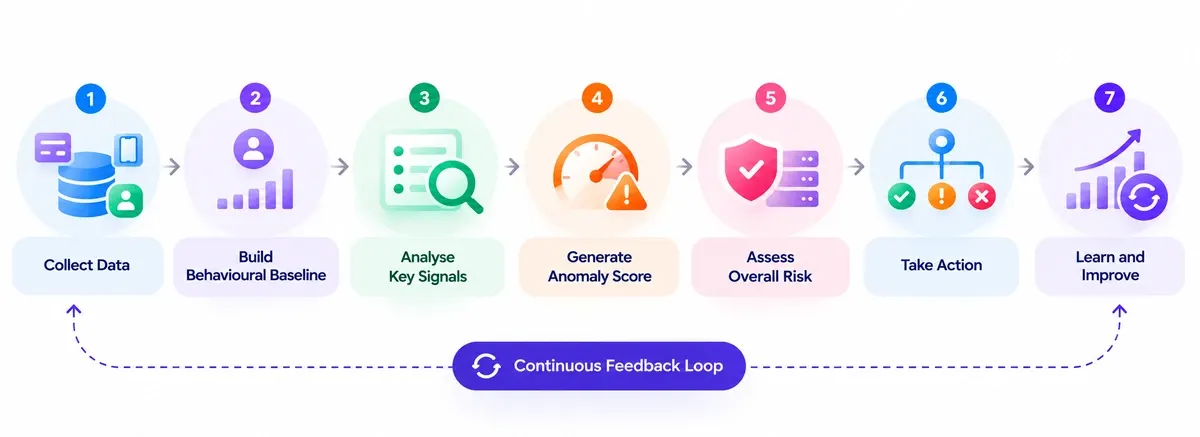
Anomaly detection follows a continuous cycle of monitoring, analysis, risk assessment, and learning. Rather than relying on predefined fraud rules, it evaluates activity against established behavioural patterns to identify unusual events that may require further investigation.
Step 1: Data Collection
The process begins by continuously collecting data from multiple sources, including transactions, logins, devices, customer accounts, and user interactions. The broader the data coverage, the more context the system has for detecting unusual behaviour.
Step 2: Establishing a Behavioural Baseline
The system analyses historical activity to determine what "normal" behaviour looks like for a user, device, account, or customer segment. This baseline serves as the reference point for future comparisons.
Step 3: Signal and Feature Analysis
The system extracts key attributes such as transaction amount, velocity, location, device fingerprint, session activity, and behavioural patterns, then compares them against the established baseline.
Step 4: Anomaly Scoring
Machine learning models or statistical techniques evaluate the event and assign an anomaly score based on how far it deviates from expected behaviour.
Step 5: Risk Assessment
The anomaly score is combined with additional intelligence, such as device, behavioural, identity, and network signals, to determine the overall risk level.
Step 6: Decisioning and Investigation
Based on the assessed risk, the system may allow the activity, trigger additional verification, route it for manual review, or block the action altogether.
Step 7: Continuous Learning and Feedback
Confirmed fraud cases and legitimate activities feed back into the system to refine behavioural baselines and improve future anomaly-detection accuracy.
This continuous feedback loop enables anomaly detection systems to adapt to evolving customer behaviour and emerging fraud tactics, making them more effective than static rule-based approaches that require constant manual updates.
Types of Anomalies in Fraud Detection

In fraud detection, anomalies are typically grouped into three categories: Point anomaly, Contextual Anomaly, and Collective Anomaly, based on how unusual behaviour appears relative to expected patterns.
| Types | Desctription | Fraud Example |
|---|---|---|
| Point anomaly | A point anomaly occurs when a single event is significantly different from normal behaviour. | Unusually large transaction, a login from a high-risk location, or an account suddenly transferring funds far above its typical limits. |
| Contextual anomaly | A contextual anomaly appears normal on its own but becomes suspicious in a specific context. | A transaction amount may be typical for a customer, but occurring at an unusual time, from a new device, or from an unexpected location may increase its risk |
| Collective anomaly | A collective anomaly occurs when a group of activities appears suspicious when analysed together, even though individual events may seem legitimate. | Multiple accounts using the same device, coordinated mule account transactions, or a network of applications exhibiting similar behavioural patterns. |
Swipe the table
Understanding these anomaly types helps fraud detection teams determine whether an unusual event reflects genuine customer behaviour, an isolated risk signal, or part of a larger fraud pattern that requires further investigation.
Anomaly Detection vs Rule-Based Fraud Detection
Fraud detection teams often ask and are in doubt whether anomaly detection is meant to replace their existing rule engine. But the truth is, anomaly detection is not a substitute for rule-based fraud detection; rather, these are two combined approaches that solve different problems and are worth comparing directly.
| Factors | Rule-based Detection | Anomaly Detection |
|---|---|---|
| Basis | Predefined conditions ("if X and Y, flag") | Deviation from a learned behavioural baseline |
| Best at | Known fraud patterns | Previously unseen or evolving fraud |
| Adaptability | Requires manual rule updates | Adjusts as behaviour patterns shift |
| Explainability | High because the rules are transparent | Lower; models need interpretability layers |
| False positives | Can be high for edge cases the rules don't anticipate | Can be reduced with contextual scoring |
Swipe the table
Neither approach replaces the other. Rule-based systems remain fast, explainable, and effective against known fraud typologies, while anomaly detection extends coverage to fraud that hasn't been written into a rulebook yet, which is why most mature fraud-prevention stacks run both in parallel rather than choosing one over the other.
Anomaly Detection Methods and Algorithms
Each fraud scenario requires a different anomaly-detection approach. The choice of technique depends on the type of fraud under investigation, the amount of data available, and the level of explainability required by risk and compliance teams. Anomaly detection methods that are most commonly used include:
- Statistical techniques: Look for events that are significantly outside the normal range, such as large transactions or sudden spikes in account activity.
- Clustering-based approaches: Cluster users, devices, or transactions based on similar features and flag activities that differ from the known as identified patterns.
- Isolation-based approaches: Identify anomalies by isolating observations that are substantially different from the rest of the dataset, making them easier to separate from normal activity.
- One-class models: Learn what normal behaviour looks like and flag activities that differ substantially from the known or learned patterns.
- Deep Learning & Autoencoders: Explore complex behaviour and transaction patterns to discover subtle anomalies that may be hard to detect using traditional statistical techniques.
- Graph-based analysis: Identify coordinated fraud networks and uncover hidden relationships between accounts, devices, phone numbers and transactions.
No single anomaly detection algorithm can detect all types of fraud. Today’s fraud prevention platforms typically combine a range of analytical techniques with device, behavioural, identity and network intelligence to enhance detection accuracy and minimise false positives.
What Are the Signals Used by AI for Anomaly Detection
AI-based anomaly detection works by analysing multiple signal layers rather than relying on a single risk indicator. By combining behavioural, transactional, device, identity, and network signals, fraud detection systems can identify unusual activity that may indicate emerging fraud patterns. The table below outlines the main signal layers used in fraud anomaly detection:
| Signal Layer | What It Reveals |
|---|---|
| Device Intelligence | Device reputation, reuse across accounts, emulator or spoofing indicators |
| Behavioural Biometrics | Typing rhythm, navigation patterns, and session behaviour that differ from the genuine user |
| Transaction Signals | Amount, frequency, velocity, and merchant category patterns |
| Identity Signals | Consistency between stated identity and observed behaviour |
| Digital Footprint | Age and consistency of email, phone, and online presence |
| Location Intelligence | Geographic plausibility and travel-speed anomalies |
| Network/Graph Signals | Shared devices, IPs, or beneficiaries across seemingly unrelated accounts |
| Account History | Deviation from a specific account's own established baseline |
Swipe the table
No single signal layer is sufficient on its own. At Sign3, we combine device intelligence, behavioural biometrics, digital footprint analysis, graph intelligence, and location signals into a unified risk score, rather than relying on any one anomaly signal in isolation.
Anomaly Detection vs Fraud Detection vs Fraud Prevention
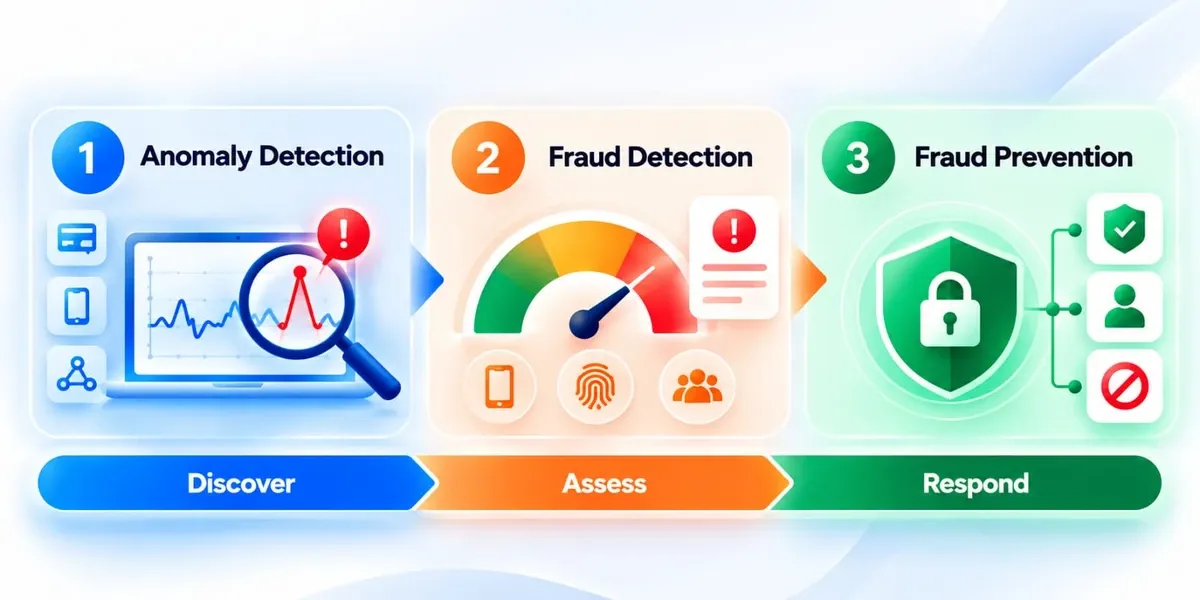
Anomaly detection, fraud detection, and fraud prevention: these three terms are often used interchangeably, but they represent different stages of the fraud management lifecycle. Understanding the distinction helps organisations identify where specific tools and technologies fit within their fraud strategy.
| Key Aspects | Anomaly Detection | Fraud Detection | Fraud Prevention |
|---|---|---|---|
| Primary Purpose | Identifies behaviour that deviates from expected patterns | Determines whether suspicious activity is likely to be fraudulent | Stops, mitigates, or reduces fraud risk |
| Data Analysed | Transactions, devices, behavioural patterns, network activity, account activity | Anomalies combined with device, identity, behavioural, and historical risk signals | Fraud assessments, risk scores, policies, and business rules |
| Output | Anomaly score or alert | Fraud risk assessment or fraud probability | Verification, review, approval, decline, or blocking action |
| Decision Capability | Identifies suspicious activity but does not determine intent | Evaluates the chances of fraud | Executes fraud mitigation actions |
| Example | A customer suddenly logs in from a new device and an unusual location | Multiple risk signals suggest the login may be an account takeover attempt | The system triggers MFA, routes the event for review, or blocks access |
| Role in the Fraud Lifecycle | Discovery | Assessment | Response |
Swipe the table
Together, these capabilities form a complete fraud management workflow, helping organisations move from identifying unusual behaviour to making informed risk decisions and preventing fraud losses.
Benefits of AI-Based Anomaly Detection
When compared with purely rule-based systems, AI-based anomaly detection provides several advantages that help organisations respond to increasingly sophisticated fraud threats:
- Detects emerging fraud patterns: identifies unusual behaviour even when no predefined fraud rule exists, helping organisations uncover new fraud tactics earlier.
- Improves detection accuracy: analyses multiple signals and behavioural patterns simultaneously, enabling more informed risk assessments.
- Strengthens protection against complex fraud: helps identify synthetic identities, mule account networks, account takeover attempts, and coordinated fraud activity that may span multiple accounts or channels.
- Reduces reliance on manual rule updates: continuously adapts to changing customer and fraudster behaviour, reducing the need for constant rule maintenance.
- Provides real-time risk visibility: evaluates activity as it occurs, enabling faster human intervention and additional verification before fraud losses escalate.
- Reduces false positives: uses contextual and behavioural analysis to distinguish genuine customer activity from suspicious behaviour more effectively.
- Supports risk-based decisioning: enables organisations to apply additional verification, manual review, or automated controls based on the level of detected risk.
- Scales with growing transaction volumes: maintains detection effectiveness across large datasets and high-volume digital environments.
As fraud tactics continue to evolve, AI-based anomaly detection helps organisations move beyond static rules and build a more adaptive, intelligence-driven approach to fraud prevention.
Challenges of Anomaly Detection
No fraud-prevention technique comes without challenges, and anomaly detection carries specific operational and technical challenges that fraud detection teams need to fine-tune before deploying it.
False positives
Legitimate but unusual behaviour, such as a high-value transaction, international travel, or a change in spending patterns, may be flagged as suspicious. If not managed carefully, this can create customer friction, increase manual review workloads, and reduce operational efficiency.
Data Quality Challenges
Anomaly detection is only as effective as the data it analyses. Incomplete, inconsistent, inaccurate or delayed data may compromise the accuracy of detection and lead to unreliable risk assessments.
Concept drift
Cbehaviour changes over time, driven by new devices, changes in spending behaviour, seasonal trends and product adoption. Anomaly detection models may become less effective as their understanding of "normal" behaviour becomes outdated.
Explainability and regulatory needs
Financial institutions often need to know and justify why an activity was flagged as a warning. Complex models can be powerful for detection but can pose challenges for investigation, governance and regulatory compliance.
None of these challenges makes anomaly detection ineffective. They explain why it's deployed as one layer within a broader fraud strategy, combined with rules, human review, and other signal sources, rather than as a single automated gatekeeper making unilateral decisions.
How to Reduce False Positives in Anomaly Detection: Best Practices
False positives are the most common operational complaint about anomaly detection, and they're largely manageable with the right approach. The approaches are mentioned below -
- Use risk-based scoring instead of binary decisions: Evaluate the risk level associated with an anomaly rather than treating every deviation from normal behaviour as equally suspicious.
- Analyse multiple signals together: Combine device, behavioural, transactional, identity, and network signals to build a more complete view of risk and reduce reliance on any single indicator.
- Incorporate account-specific context: Compare activity against the customer's historical behaviour rather than relying solely on global thresholds or generic baselines.
- Implement adaptive thresholds: Continuously adjust detection thresholds as legitimate customer behaviour evolves over time.
- Maintain human oversight for borderline cases: Route uncertain alerts to fraud analysts for review, particularly when automated decisions could impact customer experience.
- Create feedback loops: Use confirmed fraud cases and false-positive outcomes to refine models, improve accuracy, and reduce repetitive alerting.
The underlying principle across all of these is simple: unusual does not always mean fraudulent, and a system tuned to treat every anomaly as a hard stop will generate more friction than it prevents fraud.
Conclusion
Fraud tactics now evolve faster than ever, which is why anomaly detection has moved from a supporting technique to a core layer of modern fraud prevention. At Sign3, we combine device intelligence, behavioural signals, and digital footprint analysis into a single, unified risk view rather than scoring each layer separately. Plus, we also add location intelligence to flag geographically implausible activity, impossible travel scenarios, and location inconsistencies that device, identity, or transaction signals alone may not reveal. Want to see how anomaly detection works in action? Book a demo and learn how to integrate fraud intelligence into your existing stack.
FAQs
What is anomaly detection?
Anomaly detection is the process of identifying data points, events, or behaviours that deviate significantly from an expected, historically established pattern. In fraud prevention, it flags activity, such as an unusual transaction or login, that may warrant further review rather than being treated as confirmed fraud outright.
What is anomaly based detection?
Anomaly based detection builds a behavioural or statistical baseline of normal activity for a user, device, or account, then flags meaningful deviations from that baseline. Unlike signature-based approaches, it can flag fraud patterns that haven't been documented or seen before.
How does anomaly detection work?
It follows a continuous cycle: collecting data from transactions, devices, and accounts, establishing a behavioural baseline, analysing signals against that baseline, scoring how anomalous an event is, assessing overall risk, deciding on an action, and feeding confirmed outcomes back in to refine future accuracy.
What are common methods for anomaly detection?
Common anomaly detection methods and algorithms include statistical models, clustering, isolation-based techniques (e.g. isolation forests), one-class models that are trained only on normal behaviour, and deep learning approaches (e.g. autoencoders) that flag high reconstruction error as anomalous.
How does AI detect anomalies in fraud?
AI evaluates multiple signals together, including behavioural, transaction, location and network data. This allows it to detect combinations of activity that appear normal in isolation but, when assessed together, the signals indicate fraud risk.
What are examples of anomalies in fraud detection?
Common examples include an unusually large transaction, a login from a new device or impossible location, sudden account detail changes, unusual transaction velocity, and multiple unrelated accounts sharing the same device.
Can anomaly detection stop fraud in real time?
Yes, when applied at the point of interaction rather than after the fact. Real-time anomaly detection scores transactions, logins, and account changes as they happen, comparing each event against the account's behavioural baseline within milliseconds, and can trigger step-up verification, manual review, or a block before a loss settles.
Is anomaly detection better than rule-based fraud detection?
Neither is strictly better; they solve different problems. Rule-based detection is fast and explainable for known fraud patterns, while anomaly detection detects previously unseen tactics through behavioural deviation. Most effective fraud programmes run both together rather than relying on one alone.
How does anomaly detection reduce fraud?
By surfacing suspicious activity earlier and across a wider range of fraud types than static rules alone can cover, anomaly detection lets fraud detection teams intervene, through additional verification, manual review, or blocking, before a loss occurs rather than only after it's reported.
Does anomaly detection replace the need for fraud analysts?
No. Anomaly detection surfaces and scores unusual activity, but deciding what a borderline case means and confirming outcomes that feed back into the model still depends on human review, particularly for high-value or ambiguous cases.


