

Customer Due Diligence (CDD) is the process by which banks, NBFCs, and other regulated financial institutions identify customers, assess risk, and monitor financial activity before and during a business relationship. In India, CDD is mandated under the Prevention of Money Laundering Act (PMLA), 2002, and the RBI Master Direction on Know Your Customer (KYC), 2016.
Its primary purpose is to prevent money laundering, terrorist financing, identity fraud, and other financial crimes while ensuring institutions understand who their customers are and how they use financial services. This guide covers what is CDD, how CDD in banking actually works, the different types of CDD, the step-by-step process, and how CDD differs from KYC and EDD.
CDD Meaning in Banking
CDD in banking means the process banks use to identify and verify customers, assess their risk profile, understand the purpose of the relationship, and monitor activity to detect and prevent financial crime. For banks, CDD is not a one-time form filled at account opening. It runs through the entire customer lifecycle: identifying and verifying the customer at onboarding, classifying the customer into a risk category, and monitoring transactions against that category.
A person can present a genuine Aadhaar card and pass every identity check, and still be a mule account holder recruited to move stolen funds. CDD is built to detect exactly this gap. It looks beyond the document and asks who the customer really is, how the account will be used, and whether the answers hold up over time.
The RBI's amendment to the Master Direction on KYC, notified on November 6, 2024, made this explicit by requiring regulated entities to carry out CDD at the Unique Customer Identification Code (UCIC) level, so that a customer already verified for one account does not need to repeat full CDD for every new product with the same bank.
Why CDD Matters
CDD in banking is more than a compliance exercise. It helps financial institutions understand who they are onboarding, assess risk before it becomes fraud and maintain trust throughout the customer lifecycle. Effective CDD offers several important benefits in an environment where mule accounts, synthetic identities and organised fraud networks are becoming more sophisticated:
1. Detects High-Risk Customers Earlier
Basic identity verification proves that someone exists. CDD also applies when the customer is considered high risk for fraud or financial crime. This helps institutions to identify suspicious applicants, potential mule accounts, unusual ownership structures or other red flags before the onboarding is completed.
2. Lower Fraud Losses and Operating Costs
Fraud is much more expensive to investigate after an account has opened and money has moved through the system. Detecting risk during onboarding stops fraudulent accounts from entering an institution’s ecosystem and reduces investigation costs, chargebacks, recovery efforts, and manual review workload.
3. Enhances AML and Regulatory Compliance
CDD in banking is a key part of anti-money laundering (AML) and counter-terrorist financing (CTF) frameworks. When customer risk assessment is done properly, it helps institutions meet regulatory expectations, stay audit-ready, and show that reasonable controls are in place to prevent any kind of financial crime.
4. Supports Better Risk-Based Decision-Making
Not every customer presents the same level of risk. CDD enables organisations to segment customers based on risk profiles and apply appropriate controls, monitoring, and review processes. This allows compliance resources to focus on genuinely high-risk relationships.
5. Improves Customer Trust and Platform Integrity
Fraudulent accounts can damage customer confidence and brand reputation. Strong due diligence helps maintain a safer ecosystem for legitimate users by reducing exposure to scams, money laundering activity, and account misuse.
Numbers That Prove Reactive Fraud Controls Are No Longer Enough
A few figures illustrate that reactive fraud controls are no longer enough, and they show the significant challenges financial institutions are facing these days:
-
The Reserve Bank of India's Annual Report for FY 2024-25 recorded 23,953 fraud cases across the banking system, with the amount involved rising to Rs 36,014 crore, up from Rs 12,230 crore the year before.
-
According to the RBI's Annual Report 2024–25, frauds in the advances (loan) portfolio accounted for Rs 33,148 crore, or 92.1% of the total Rs 36,014 crore involved in reported banking frauds, making loans by far the largest source of fraud value.
-
In August 2026, the Supreme Court had directed RBI to prepare a standard operating procedure within four weeks for banks to deal with cyber fraud and mule accounts, including temporary debit holds on suspected accounts, grievance redressal and restoration of defrauded money.
These developments underscore an inconvenient truth: After money has already passed through the financial system, it’s a lot more difficult and costly to stem fraud. This is the point where Customer Due Diligence (CDD) comes into play. Effective CDD helps institutions identify high-risk customers, suspicious ownership structures and potential mule-account indicators before onboarding is complete, rather than waiting for suspicious activity to emerge.
When CDD Fails: The Rs 30,000 Crore Shell Company Case
In August 2026, the Enforcement Directorate arrested two people in Mumbai as part of a money laundering investigation into a pan-India digital arrest racket involving transactions worth roughly Rs 30,000 crore. Investigators found that the funds were routed through shell companies whose listed directors were, in reality, drivers and employees living in single-room accommodations.
Every one of those companies would have passed a basic KYC check, but it cannot catch fraud directly. This is precisely the gap that CDD in banking is designed to address. While identity verification confirms that documents are genuine and belong to a real person, CDD goes further by examining who ultimately owns or controls the account and whether the purpose of the relationship aligns with the customer's stated profile. Its goal is to uncover hidden beneficial ownership, nominee arrangements, shell entities, and business activities that differ from what is declared on paper.
Where CDD Adds Value Beyond KYC
KYC establishes who the customer is, but Customer Due Diligence goes further by assessing the risks associated with that customer and the relationship.
- A genuine Aadhaar, valid PAN, and clean KYC record can confirm that a person exists, but they do not necessarily show whether the account is being opened for a legitimate purpose or who ultimately controls it.
- Effective CDD examines factors such as the customer's risk profile, ownership structure, source of funds, expected account activity, and purpose of the relationship.
Evidence also shows that detecting risk earlier works.
The Department of Telecommunications' Financial Fraud Risk Indicator, which scores mobile numbers for their chances of being linked to fraud and feeds that score to banks at onboarding and during transactions, has prevented more than Rs 5,043 crore in suspected fraud losses as of August 2026, up from just Rs 139 crore a year earlier. In many of these cases, suspicious transactions were identified and stopped before funds could leave the financial system. This reflects the same principle behind CDD: assess risk before money moves, not after.
This is where Customer Due Diligence moves beyond a regulatory requirement and becomes a critical risk assessment function. A genuine Aadhaar, a valid PAN, and a clean KYC record can confirm that a person exists, but they cannot by themselves determine whether the account is being opened for a legitimate purpose. They cannot even reliably identify concealed beneficial owners, nominee directors, mule-account operators, or individuals acting on behalf of someone else.
Effective CDD in banking bridges that gap by assessing the customer's risk profile, ownership structure, source of funds, expected account activity, and the broader context behind the relationship, not just the authenticity of the documents presented.
Types of CDD
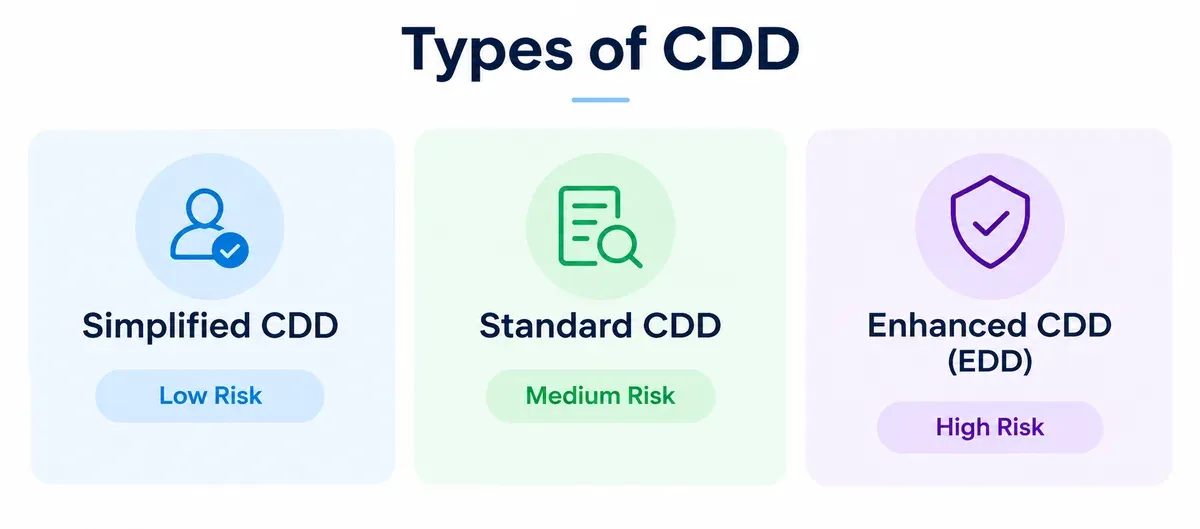
Simplified, Standard, and Enhanced CDD are the three main types of CDD in banking. However, regulated entities do not apply the same depth of CDD to every customer. RBI's risk-based approach groups customers into these three levels, and the table below summarises their differences.
| CDD Type | Risk Level | Typically Applies To | Key Checks |
|---|---|---|---|
| Simplified CDD | Low | Salaried individuals, small savings accounts, government scheme beneficiaries with a transparent income source | Basic Aadhaar/OVD-based identification, minimal ongoing monitoring |
| Standard CDD | Medium (default) | Most individual and business customers opening an account or availing a financial product | Full identity verification, understanding the purpose of the relationship, periodic KYC updates |
| Enhanced CDD (EDD) | High | Politically Exposed Persons (PEPs), NRIs, cash-intensive businesses, customers linked to high-risk jurisdictions | Source-of-wealth verification, senior management approval, closer and more frequent transaction monitoring |
Swipe the table
Getting this classification right at onboarding is what determines how much friction a genuine customer faces and how much scrutiny a risky one gets. This classification also drives the level of monitoring, review frequency, and due diligence required throughout the customer relationship.
How CDD Works: The Process & Steps
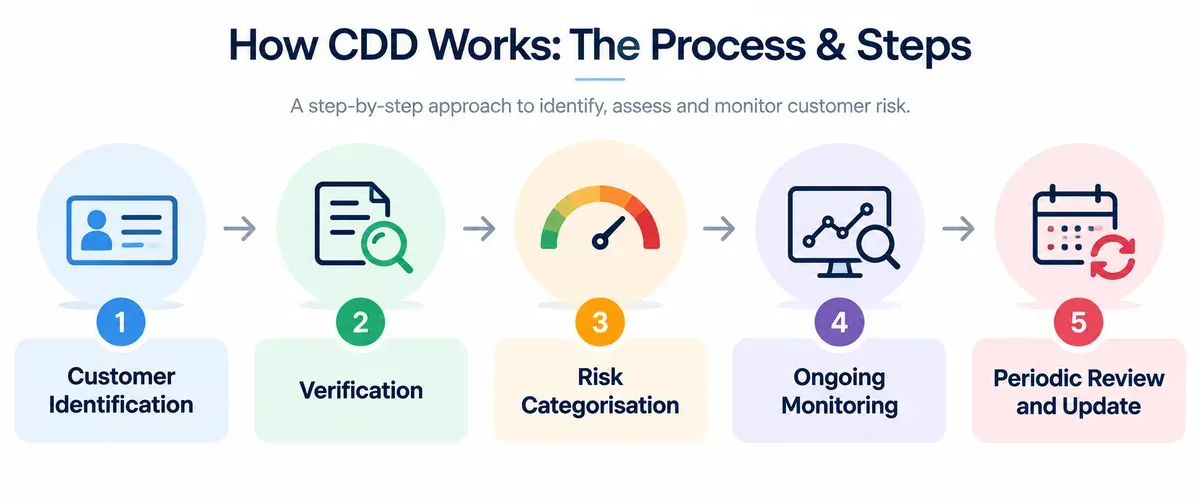
CDD in banking is not a single form. It is a sequence of checks that starts before an account is opened and continues for as long as the relationship lasts. Here is what that sequence looks like in practice:
| Steps | What Happens |
|---|---|
| 1. Customer Identification | The customer’s identity is captured using Aadhaar-based e-KYC, an Officially Valid Document like a passport or driving licence, or PAN, with basic details on occupation and purpose of the account. |
| 2. Verification | The submitted documents are checked against the issuing database and, where required, against independent data sources, so the identity on paper actually matches the person opening the account. |
| 3. Risk Categorisation | Customer is classified as low, medium or high risk, according to profile, occupation, geography, anticipated transaction volume and any link to PEPs or high-risk jurisdictions |
| 4. Ongoing Monitoring | Transactions are compared with the risk category assigned at onboarding. The firm investigates any anomaly, such as a low-risk salaried account suddenly moving large, irregular amounts. |
| 5. Periodic Review and Update | CDD information is refreshed at intervals set by the customer's risk band. RBI's periodicity is roughly every 2 years for high-risk customers, 8 years for medium-risk customers, and 10 years for low-risk customers, or sooner if the profile changes. |
Swipe the table
Steps 1 and 2 are largely document-driven and well understood. Steps 3 and 4 are where most institutions still rely on manual review or bureau data alone, and where device intelligence, digital footprint and behavioural signals add the most value. These additional intelligence layers help institutions assess risk more accurately during onboarding and ongoing monitoring, enabling earlier detection of mule accounts, synthetic identities, and other high-risk behaviour.
CDD vs KYC vs EDD: How Do We At Sign3 Work On These?
These three terms get used interchangeably, but they are not the same thing. The table below lays out where each one starts and ends.
| Key Aspects | KYC | CDD | EDD |
|---|---|---|---|
| Scope | Identifying and verifying who the customer is, using an OVD or Aadhaar | Identifying the customer and understanding the purpose, nature and expected activity of the relationship | Conducting deeper due diligence on high-risk customers, including source of funds, source of wealth, beneficial ownership and enhanced risk assessment |
| When it happens | At onboarding, and again at periodic KYC updation | At onboarding, and on an ongoing basis whenever risk indicators change | When a customer is identified as high risk, either during onboarding or later in the relationship |
| Relationship | KYC is the identification step | CDD includes KYC and adds risk profiling, source of funds checks and continuous monitoring | EDD is a subset of CDD, applied only to customers who require enhanced scrutiny |
| Depth | Standard for every customer | Standard for most, enhanced for high-risk customers | More extensive due diligence, additional documentation, deeper investigations and closer monitoring |
| EDD | This is not applicable in this context | A stricter version of CDD for high-risk customers, requiring source-of-wealth checks, senior management approval and closer monitoring | Full enhanced due diligence requirements apply, with ongoing review and risk reassessment throughout the relationship |
Swipe the table
In short: KYC tells a bank who the customer is. CDD tells a bank what that customer is likely to do with the account. Enhanced due diligence ( EDD ) on the other hand, is what CDD escalates to when the customer's risk profile calls for it. Together, these processes form the foundation of an effective financial crime compliance framework, helping institutions prevent fraud, detect suspicious activity, and meet regulatory obligations throughout the customer lifecycle.
At Sign3, we strengthen Customer Due Diligence with real-time phone intelligence, device intelligence, digital footprint analysis, and behavioural risk signals. By helping financial institutions assess whether an applicant's digital behaviour aligns with their claimed identity, we enable risk detection at the onboarding stage, before an account is approved, funds are disbursed, or losses occur.
Read more: What Is Enhanced Due Diligence (EDD)? Complete Guide
Conclusion
Customer Due Diligence (CDD) is not just a compliance requirement anymore. It’s a vital risk management process that allows financial institutions to know who they are onboarding, to assess risk correctly, and to detect potential fraud before losses occur. KYC may check identity, but CDD gives the context to assess customer behaviour, risk exposure and whether the financial relationship is legitimate.
At Sign3, we strengthen CDD with real-time phone intelligence, device intelligence, digital footprint analysis, and behavioural risk signals. This helps with a more secure onboarding process that protects both institutions and genuine customers. If you want to strengthen CDD at onboarding or close gaps in your current risk scoring, contact our team to see how Sign3 fits into your fraud and risk workflow.
Frequently Asked Questions
What is CDD full form and meaning?
CDD full form in banking means Customer Due Diligence. This is a process that financial institutions use to verify a customer's identity, assess risk, understand account purpose, and monitor activity to prevent fraud, money laundering, and financial crime.
Is CDD the same as KYC?
No. KYC verifies a customer's identity using Aadhaar, an Officially Valid Document (OVD) such as a passport or driving licence, PAN, and other prescribed verification methods. CDD is the broader process that builds on KYC by assessing customer risk, understanding the purpose of the relationship, and monitoring behaviour against that profile.
What is Enhanced CDD (EDD)?
Enhanced CDD, or EDD, is a stricter version of CDD applied to high-risk customers such as politically exposed persons or those linked to high-risk jurisdictions. It requires source-of-wealth verification, senior management approval and closer, more frequent transaction monitoring.
Is CDD mandatory in India?
Yes. CDD is mandatory for every bank, NBFC and regulated entity under the RBI Master Direction on KYC and the Prevention of Money Laundering Act, 2002. It applies before an account is opened and before most financial transactions are processed.
How often should CDD be updated?
CDD should be updated periodically based on the customer's risk profile and whenever there is a significant change in their circumstances. Under RBI’s risk-based approach, it is advisable to review the customer's information every 2 years for high-risk customers, 8 years for medium-risk customers and 10 years for low-risk customers.
Who is responsible for conducting CDD at a bank?
CDD is conducted by the regulated entity itself, typically its compliance and onboarding teams, operating under board-approved policies. RBI holds the bank or NBFC accountable for CDD failures, even when checks are outsourced to a third-party verification vendor.
What happens if a bank fails to carry out proper CDD?
Inadequate CDD exposes a bank to regulatory penalties, higher fraud losses, and reputational damage once flagged accounts turn out to be mules or shell entities. RBI has penalised several banks for KYC and CDD lapses under the Banking Regulation Act.


