

UPI fraud occurs when scammers deceive users into authorising fraudulent payments, sharing their UPI PIN or OTP, or installing malicious apps to gain access to their accounts. Common UPI scams in India include fake collect requests, QR code fraud, phishing links, and impersonation calls. Users can learn how to prevent UPI fraud by verifying payment requests and never sharing confidential credentials. Banks can help detect and prevent suspicious transactions through real-time monitoring, device intelligence, behavioural analysis, and mule account detection. In this blog, we will discuss the types of UPI fraud, common scams, and how banks can prevent UPI fraud effectively.
Key Takeaways
- What is UPI fraud? A scam that tricks you into authorising a payment or sharing credentials.
- Common UPI scams: Fake collect requests, QR codes, phishing links, impersonation calls, and remote-access apps.
- How to stay safe: Never share your UPI PIN or approve a request you did not expect.
- How to report: Contact your bank, call 1930, and file on the national cybercrime portal.
- How can banks prevent it? Transaction monitoring, device intelligence, behavioural analysis, and mule detection.
What Is UPI Fraud?
UPI fraud refers to using stolen credentials or unauthorised account access to initiate fraudulent transactions through the Unified Payments Interface (UPI). Fraudsters may manipulate users into approving payment requests, sharing their UPI PIN or OTP, installing malicious applications, or transferring money to multiple fake accounts.
Most UPI scams typically rely on social engineering rather than directly exploiting the UPI payment infrastructure. However, some of the common methods include:
-
Fake payment requests: Scammers usually trick users into approving requests or entering their UPI PIN under false pretences.
-
Credential theft: Fraudsters obtain sensitive information, such as UPI PINs and OTPs. This allows them to facilitate unauthorised transactions.
-
Malicious applications: Victims are convinced to install applications that can compromise their devices or expose them to sensitive information.
-
Impersonation scams: Scammers often pose as bank representatives, government officials, or trusted individuals to manipulate users into transferring money.
However, a key challenge with UPI payment fraud is the difference between technical authorisation and genuine customer consent. A transaction may appear authorised because the victim entered their UPI PIN, even though they were manipulated into making the payment. This makes fraud identification, dispute resolution, and fund recovery much more challenging. Some incidents also involve compromised devices or unauthorised account access.
What Are the Types of UPI Fraud and Common Scams?
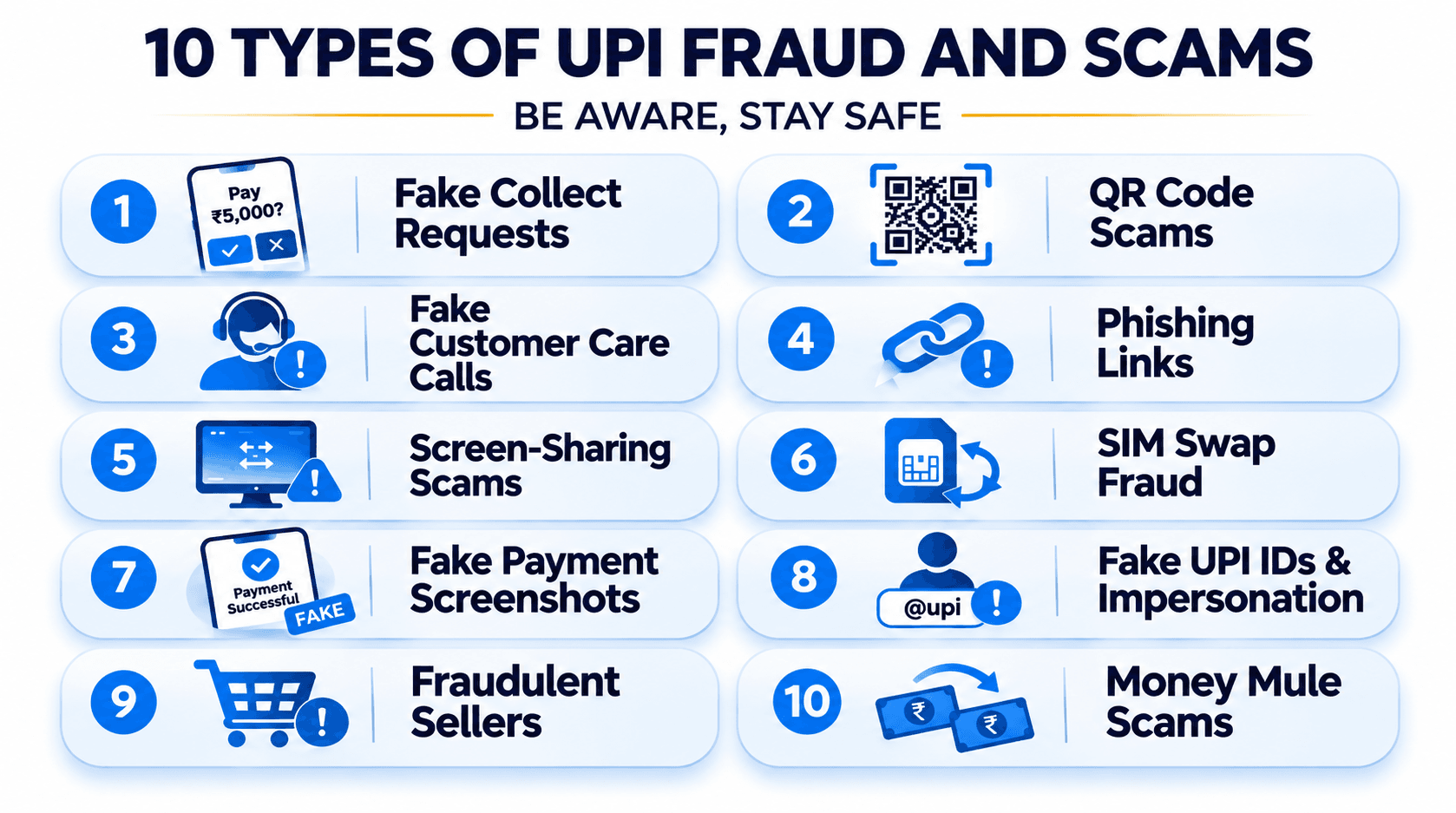
The ten most common types of UPI fraud in India are fake collect requests, QR code scams, fake customer care calls, phishing links, screen-sharing scams, SIM swap fraud, fake payment screenshots, fake UPI IDs, fraudulent sellers, and money mule scams.
1. Fake UPI collect request scams: The fraudsters send you a request for a refund or cashback. Once approved, your account is debited. “Always check whether it is a request to pay or to receive. For example, someone claiming to refund ₹5,000 may send you a UPI collect request. Approving the request and entering your UPI PIN will authorise a debit from your account, not a credit.
2. QR code scams: Victims are told to scan a QR code. When they scan it, the amount gets instantly debited from their account. NPCI’s fraud awareness guidance covers this trick and fake cashback offers.
Example: a sofa “buyer” asks you to scan a QR code to collect the advance.
3. Fake customer care scams: Fraudsters often pose as bank or payment app staff, often via a number from a fake search listing, and ask for OTPs, PINs, or remote access.
Example: a caller says that your KYC has expired and you need to update it.
4. UPI phishing and fake links: Fake websites and messages imitate banks or payment apps to capture credentials.
Example: an SMS threatens an emergency electricity disconnection with a “pay now” link.
5. Screen-sharing and remote access scams: Victims can install remote-access apps that expose their screen, OTPs, and banking activity.
Example: a “support executive” asks you to install one to fix a failed refund.
6. SIM swap fraud: Fraudsters choose a replacement SIM or otherwise take control of your mobile number. Then fraudsters send SMS messages and try to access linked financial accounts. A SIM swap alone does not give access to a UPI account.
Example: your phone loses the necessary network for hours.
7. Fake payment screenshot scams: Edited screenshots can convince sellers that the payment is complete.
For example: a buyer sends a “successful” screenshot, but no credit actually arrives.
8. Fake UPI IDs and impersonation: Scammers often create lookalike payment handles or pose as trusted contacts.
For example: someone pretending to be your landlord may send a payment request using a UPI ID that looks very similar to your landlord's actual ID but contains a different letter or number.
9. Fraudulent seller and marketplace scams: Fake sellers collect advance payments but never deliver the promised product.
Example: a social media page sells discounted phones for full prepayment.
10. Money mule scams: Fraudsters use other people's bank accounts to receive and transfer money obtained through illegal activities.
For example: someone may be asked to receive payments into their bank account and forward the money elsewhere for a commission. Even if you are unaware of the money's illegal source, handling such funds can expose you to police enquiries and legal consequences.
Read the guide to understand how Mule Account Fraud takes place.
How Does UPI Fraud Work?
UPI fraud generally follows four stages, from identifying a potential victim to transferring stolen money through fraudulent or mule accounts. Fraudsters often use multiple social engineering techniques in common UPI scams to manipulate victims into authorising payments or sharing sensitive information.
1. Target selection: Fraudsters first identify potential victims through phone calls, SMS messages, social media platforms, or fake websites.
2. Creating pressure or offering bait: Then, as the next step, they create a quick sense of urgency to convince victims with fake refunds, rewards, cashback offers, or account verification requests to gain their trust.
3. Payment approval or credential theft: Victims are even manipulated into approving fraudulent UPI requests, entering their UPI PIN, sharing sensitive credentials, or installing malicious applications that provide unauthorised access.
4. Fund transfer and movement: Once the transaction is properly authorised, the fraudster quickly transfers the money to a fraudster-controlled or mule account. It may then move through multiple accounts, making it much harder for banks and law enforcement agencies to trace and recover.
So, the critical point for preventing UPI fraud is before making the payment authorisation. Recognising suspicious requests, verifying recipient details, and never sharing a UPI PIN to receive money are essential steps to prevent fraudulent transactions.
What Are the Warning Signs of UPI Fraud?
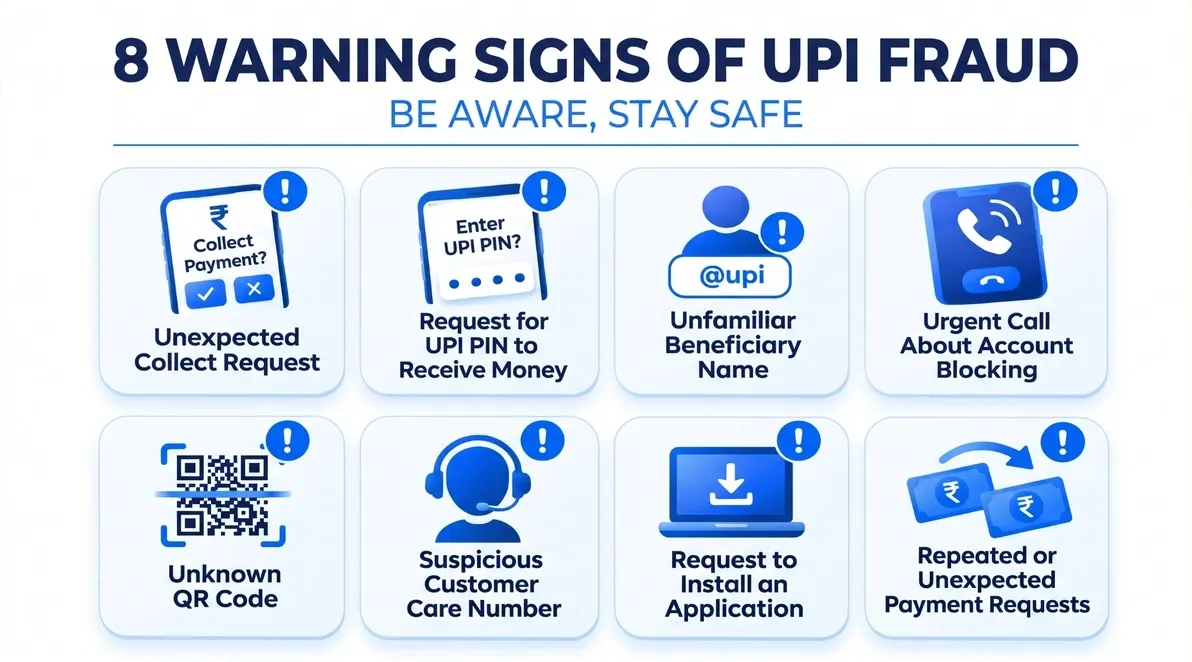
Recognising early warning signs can help users avoid UPI fraud. The most important red flag is a request to enter your UPI PIN to receive money. A UPI PIN is required to authorise payments, not to receive funds. Other warning signs include unexpected payment requests, unfamiliar beneficiary details, and urgent calls claiming that your bank account will be blocked unless you take immediate action.
| Warning Sign | What You Should Do |
|---|---|
| Unexpected collection request | Decline the request if you did not initiate or expect the transaction. |
| Request to enter your UPI PIN to receive money | Never enter your PIN to receive funds. Stop the transaction immediately. |
| Unfamiliar beneficiary name | Verify the recipient's identity and UPI ID before authorising payment. |
| Urgent call about account blocking | End the call and contact your bank using its official customer care number. |
| Unknown QR code | Avoid scanning unfamiliar QR codes, especially when asked to do so to receive money. |
| Suspicious customer care number | Verify contact details through your bank's official website or mobile application. |
| Request to install an application | Do not install unknown applications or grant remote access at a caller's request. |
| Repeated or unexpected payment requests | Decline suspicious requests, block the sender where possible, and report the incident to your bank. |
Swipe the table
Why Is UPI Fraud a Concern for Banks and Financial Institutions?
UPI frauds have become a serious and growing concern for banks and financial institutions. The reason behind this is that they affect financial security, customer trust, and regulatory compliance. However, some key concerns include:
1. Financial losses: UPI payment fraud can result in direct financial losses for customers while creating potential liabilities and recovery challenges for banks.
For example, in September 2026, a Panchkula resident lost ₹1.13 lakh through three unauthorised UPI transactions over three days. This particular incident highlights how fraudulent access to a UPI account can lead to substantial financial losses for customers.
2. Rapid movement of stolen funds: Fraudsters often route the stolen money through multiple mule accounts within minutes. Therefore, it becomes much more difficult to trace and recover funds.
3. Customer trust and reputation: Repeated UPI fraud incidents, delayed complaint resolution, and unsuccessful recovery attempts can weaken customers' confidence in digital banking services.
4. Investigation and operational burden: Every reported incident requires the banks to investigate different transactions, trace beneficiary accounts, coordinate with other institutions, and respond to customer complaints.
5. Regulatory compliance: The RBI (Commercial Banks – Fraud Risk Management) Directions, 2026, which were issued on 31 July 2026, establish a framework for fraud prevention. Furthermore, the RBI Directions strongly emphasise the importance of early detection and timely reporting, including the use of Early Warning Signals (EWS).
6. Risks from interconnected accounts: Wrong transactions are not just an example of isolated transfers, but networks of suspicious accounts. This allows banks to effectively track the unusual account relationships along with the transaction patterns that warn about potential fraud networks.
Ultimately, banks need to identify suspicious transactions as early as possible because this helps to prevent fraud. Early intervention can successfully improve the chances of restricting fund movement, limiting financial losses, and preventing further fraudulent activity.
How Can Banks Detect UPI Fraud?
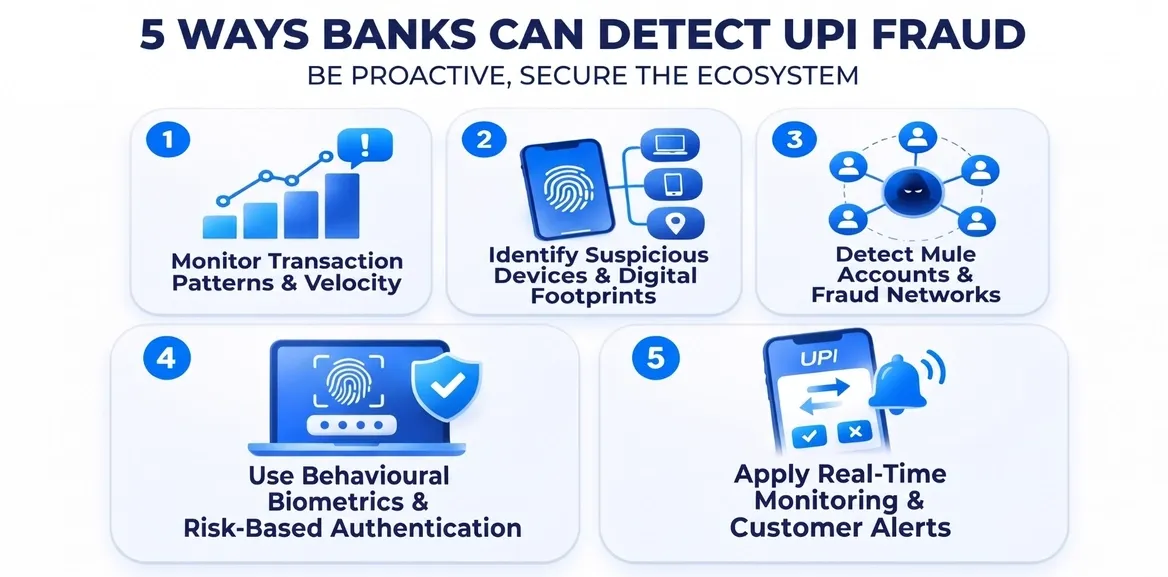
Banks look at transaction behaviour, account activity, device signals, and beneficiary risk to assess UPI payment fraud, not merely on the basis of amount limits. Many UPI scams are small, victim-approved payments that look normal on their own. Rule-based systems can miss them, so adding device, behavioral, and network intelligence improves UPI fraud detection and provides a broader view of risk.
1. Monitor Unusual Transaction Patterns and Velocity
Banks monitor UPI transaction patterns by comparing each payment with the customer’s own history and then flag sudden spikes in amount, unexpectedly large transfers, and money sent straight to newly added beneficiaries. For example, a customer who usually makes two or three small payments a day may suddenly send several transfers to new beneficiaries within minutes. Such unusual activity may go undetected by systems that rely only on fixed transaction limits.
2. Identify Suspicious Devices and Digital Footprints
Device intelligence helps banks to detect emulators, identify the chances of device changes, device reuse, and multiple accounts operating from one device. All these are common signs of organised fraud rings. Phone and email intelligence adds identity risk that transaction data alone would miss.
3. Detect Mule Accounts and Fraud Networks
Banks detect mule accounts by detecting some connected accounts, since mules usually receive funds from unrelated people and then pass them to multiple accounts quickly. Shared devices, repeated beneficiaries, and unusual fund movement are some of the warning signs of mule accounts, and those are linked into clusters.
Read this guide to learn What Is a Mule Account
4. Use Behavioural Biometrics and Risk-Based Authentication
Behavioural biometrics studies how a customer types and navigates a UPI app. For example, unusual variations in keystroke dynamics (typing speed), touch patterns, or app navigation can indicate potentially suspicious activity, including attempts to guide a customer through a payment. However, these signals indicate risk and do not prove fraud on their own. Risky sessions can trigger additional verification, such as re-authentication or another bank-approved security check, while routine transactions can proceed without unnecessary additional verification.
5. Apply Real-Time Transaction Monitoring and Customer Alerts
Real-time transaction monitoring uses some effective rules such as anomaly detection and risk scoring to flag suspicious UPI activity as it happens. Depending on the bank’s controls and payment-processing capabilities, the system may trigger extra authentication, decline a transaction, or start an investigation. Instant alerts let customers confirm or raise payment disputes.
How Can Banks Prevent UPI Fraud?
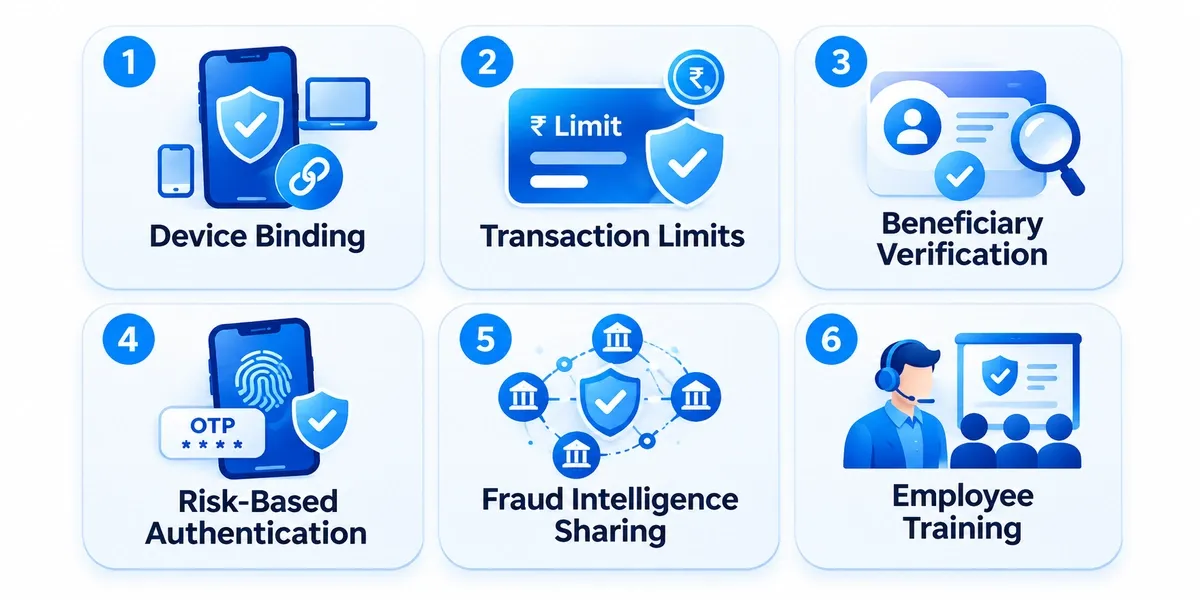
Banks can prevent UPI fraud by implementing advanced security controls and dealing with unauthorised transactions, account misuse, and fraudulent payments. Such prevention control methods include device binding, transaction limits, beneficiary verification, and risk-based authentication, to name a few. Employee training and customer awareness also help banks identify and address emerging fraud tactics.
| Prevention Control | How It Helps |
|---|---|
| Device binding | Links a UPI account to a registered device, helping identify transactions initiated from unrecognised devices. |
| Transaction limits | Restricts transaction amounts or frequency to limit potential financial losses. |
| Beneficiary verification | Helps customers verify recipient details before transferring money and reduces the risk of payments to unintended accounts. |
| Risk-based authentication | Applies additional verification when a transaction or account activity appears unusual or high-risk. |
| Fraud intelligence sharing | Helps banks identify suspicious accounts, devices and transaction patterns associated with reported fraud. |
| Employee training | Equips bank employees to recognise emerging scam techniques, suspicious transactions and social engineering attempts. |
Swipe the table
These UPI fraud prevention controls reduce risk but cannot stop every social engineering attack, so monitoring and customer education sit alongside them.
What Should You Do After a UPI Fraud?
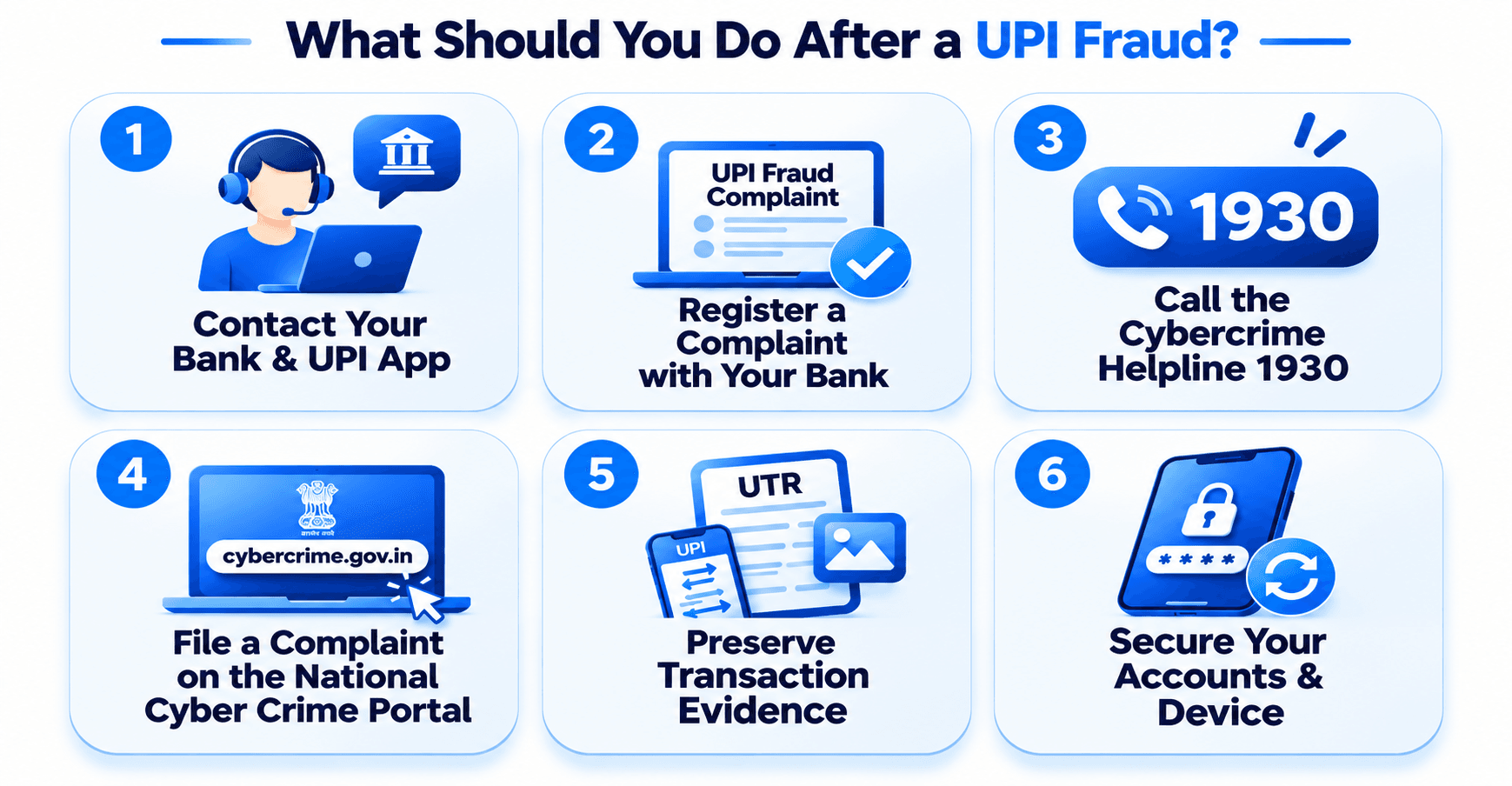
If you suspect UPI fraud or notice an unauthorised debit, contact your bank immediately through its official complaint channel and call India's cybercrime helpline 1930 without delay. Prompt reporting may help banks and authorities trace or freeze the transferred funds, although recovery is not guaranteed.
Follow these steps after a suspected UPI fraud:
-
Contact your bank and UPI app: Report the fraudulent transaction through their official customer support channels and request that further suspicious transactions be stopped.
-
Register a UPI fraud complaint with your bank: Raise a formal dispute, explain what happened, and save the complaint acknowledgement number.
-
Call the cybercrime helpline 1930: Report the financial fraud as soon as possible and provide the requested transaction details.
-
File an online UPI fraud complaint: Visit the National Cyber Crime Reporting Portal and complete the complaint process as instructed after calling 1930.
-
Preserve transaction evidence: Keep the UPI transaction ID or UTR number, transaction date, time, and amount, along with bank alerts, screenshots, messages, and relevant call details.
-
Secure your accounts and device: If you think your credentials have been compromised with time, immediately change the UPI PIN and related passwords through official channels immediately. Also, it is advisable to remove the suspicious apps or remote access tools, and never share your PIN or OTP with anyone claiming to help recover your money.
According to the Ministry of Home Affairs, India's Citizen Financial Cyber Fraud Reporting and Management System has helped save more than ₹11,158 crore across over 32.80 lakh complaints. This figure reflects financial cyber fraud broadly, not just UPI fraud alone.
Further, RBI’s customer protection framework has provisions for different levels of liability depending on the circumstances of an unauthorized electronic transaction. For example, if the customer is negligent, such as sharing payment details, the customer may be at risk of loss until the customer reports the transaction to the bank. But liability will depend upon the facts of the case and the rules that apply.
Detect UPI Fraud Earlier with Continuous Account Monitoring
Preventing UPI fraud requires more than monitoring individual transactions. Banks also need to identify suspicious account behaviour, account takeover attempts and mule networks before fraudulent activity escalates.
Sign3’s Cortex supports this by continuously monitoring active accounts and sessions. It combines device, behavioural and network intelligence to identify unusual activity, detect potential mule accounts and uncover connections between suspicious accounts. Its risk-scoring engine helps banks assess potential threats and apply appropriate controls, such as additional authentication or transaction restrictions, based on their risk policies.
By adding continuous fraud intelligence to existing banking systems, the technology Cortex helps financial institutions strengthen UPI fraud detection without relying solely on some transaction-based rules. Book a demo and explore how banks can prevent UPI fraud with Sign3’s Cortex and strengthen their fraud monitoring capabilities.
Frequently Asked Questions About UPI Fraud
What are the most common types of UPI fraud?
The most common types of UPI fraud are fake collect requests, QR code scams, phishing links, fake customer care calls, screen-sharing apps, SIM swap attacks, and fake payment screenshots.
Can someone steal money using only a UPI ID?
No, someone can not steal money using only a UPI ID. Sharing your UPI ID alone does not let anyone debit your bank account. But scammers can still use it to send fake requests or impersonate you, so never approve an unexpected request.
Can I get my money back after a UPI fraud?
If you want to get your money back, it is necessary to take some quick action. The recovery depends on how quickly you report, where the money has moved, and the applicable bank and regulatory procedures. Report to your bank and 1930 immediately; a refund is not guaranteed.
Does scanning a QR code receive money in UPI?
No. Scanning a payment QR code and entering your UPI PIN generally authorises a payment from your account. You never need to enter a PIN to receive money in UPI.
How can banks and NBFCs protect customers from UPI fraud?
Banks and NBFCs can strengthen UPI fraud prevention with Sign3's fraud intelligence solution. By combining Device Intelligence, Behavioural Biometrics, Digital Footprint, and Graph Intelligence, Sign3 helps financial institutions identify suspicious devices, detect unusual user behaviour, uncover mule account networks, and assess transaction risks. This enables faster risk-based decisions and helps protect customers from emerging digital payment fraud.
How can banks identify UPI fraud before a transaction is completed?
Banks can identify potential UPI fraud by assessing transaction behaviour, device signals, user activity, and beneficiary relationships in real time. Sign3 combines Device Intelligence, Behavioural Biometrics, Digital Footprint, and Graph Intelligence to detect suspicious patterns, flag high-risk activity, and help financial institutions intervene before fraudulent transactions cause losses.


