

Document forgery is the creation or alteration of a document that is used to deceive another person or to support a fraudulent claim. In India, forgery is covered under section 336 of the Bharatiya Nyaya Sanhita (BNS), and the penalties depend on the offence and the intention. Fake documents like Aadhaar and PAN cards, bank statements, salary slips and certificates pose a threat of identity theft, financial loss and compliance risk for lenders, financial institutions and businesses.
The guide discusses the various types of document forgery, the laws related to it in India, and what a business can do to identify and avoid the forgery of documents.
- What is document forgery: Document forgery is considered the act of making a false document or electronic record, with the intent to cause damage or injury, support a false claim or title, or commit fraud, as defined in Section 336 of the BNS.
- Legal penalties: General forgery under BNS Section 336 is punishable with up to 2 years of imprisonment, whereas forgery with intent to defraud can lead to up to 7 years of imprisonment.
- Common targets are Aadhaar and PAN cards, bank statements, salary slips, ITRs and educational certificates.
- Detection methods include visual inspection, digital file analysis, source verification and submitter risk checks.
- Prevention: Employ multi-layered verification rather than a single check to identify counterfeit documents.
7 Common Types of Document Forgery
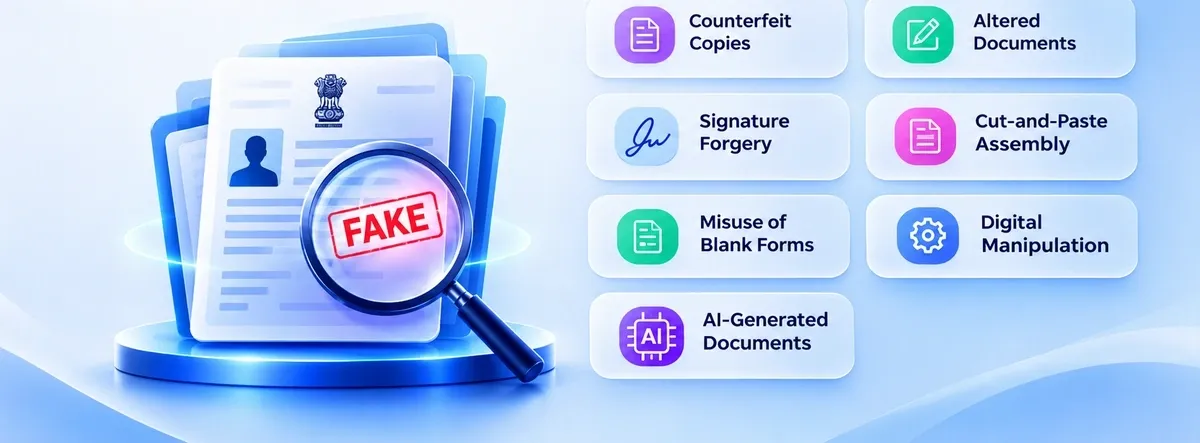
There are many ways of forging documents, from altering the real ones to creating completely fake ones. However, one attempt can have multiple methods. So it is very important to check both the document and the real source.
| Type of Document Forgery | What It Involves | Example |
|---|---|---|
| Counterfeit copies | Creating an imitation of a genuine document using copied designs, layouts or identifying details. | A fabricated PAN card designed to resemble an authentic one. |
| Alteration of a genuine document | Changing details such as names, dates, balances or amounts on an existing document without authorisation. | Increasing the income shown on a genuine salary slip. |
| Signature forgery | Copying or fabricating another person's signature without their authorisation. | Signing a loan application in someone else's name. |
| Cut-and-paste assembly | Combining genuine and fabricated elements to make a document appear authentic. | Using a genuine bank statement header with fabricated transaction details. |
| Misuse of blank forms | Filling in a blank document that is signed or stamped without the signer's consent or authority. | Adding an unauthorised amount to a pre-signed form. |
| Digital document manipulation | Editing a PDF, scan or document image to change information or conceal alterations. | Changing the date on a scanned utility bill submitted as address proof. |
| AI-generated synthetic documents | Creating fabricated documents using generative AI or similar tools to misrepresent identity, credentials or other information. | Generating a false identity document for a fraudulent KYC application. |
Swipe the table
These document forgery types can have some serious financial consequences. The recent Hyderabad case illustrates that. On October 24, 2026, the Enforcement Directorate (ED) conducted multiple searches at seven locations in connection with an alleged ₹326 crore bank fraud involving Kanakadhara Ventures Pvt Ltd and associated entities.
According to the investigation, the accused allegedly used fabricated steel purchase invoices and transport documents to route the transactions and divert funds that were obtained through credit facilities from five separate banks. The ED even seized documents, digital devices and financial records as part of its ongoing investigation. This case shows why businesses and financial institutions need strong document-verification processes to spot forged records before they cause financial losses.
Furthermore, Document forgery is one part of a wider financial fraud problem. Businesses and financial institutions need a broader approach to identify suspicious activities across customer onboarding and transactions.
Read this guide to fraud detection and prevention and understand the techniques and practices that help organisations identify and prevent evolving fraud threats.
Document Forgery Laws in India
The Indian Penal Code (IPC) was replaced by the Bharatiya Nyaya Sanhita (BNS), 2023, effective from 1 July 2024. Chapter XVIII provides for offences relating to documents and property marks, including Sections 335–344, which deal with false documents, forgery, use of forged records, and falsification of accounts. Businesses should be looking at the current BNS provisions and not just at older IPC references. For businesses dealing with document forgery in India, check out the laws mentioned below:
BNS Section 336 Explained
BNS Section 336 defines forgery and reveals punishments based on the nature and purpose of the offence. It also includes false documents and electronic records, making it much more relevant for forged certificates, altered bank statements and manipulated digital files.
| BNS Sub-section | What It Covers | Corresponding Old IPC Section | Legal Provision |
|---|---|---|---|
| 336(1) | Forgery involving a false document or electronic record made with the intent specified in the law | 463 | No separate punishment specified under this sub-section; the general punishment is covered under Section 336(2) |
| 336(2) | General forgery | 465 | Imprisonment up to 2 years, or fine, or both |
| 336(3) | Forgery intended to facilitate cheating | 468 | Imprisonment up to 7 years and a fine |
| 336(4) | Forgery intended to harm a person's reputation | 469 | Imprisonment up to 3 years and a fine |
Swipe the table
These penalties depend on the specific offence and the evidence establishing the relevant intent. Businesses dealing with suspected forged documents should distinguish between detecting suspicious records and establishing criminal liability.
Other BNS Sections on Forged Documents
Other provisions address forgery involving specific categories of documents, possession of certain forged records and their use as genuine.
| BNS Section | What It Covers | Corresponding Old IPC Section | Punishment |
|---|---|---|---|
| 335 | Making a false document or electronic record | 464 | No separate punishment is prescribed under this section. If making the false document amounts to forgery, punishment is covered under Section 336. |
| 337 | Forgery of court records, public registers, government identity documents and certain other official records | 466 | Imprisonment up to 7 years and a fine |
| 338 | Forgery of valuable securities, wills and specified related documents | 467 | Imprisonment for life or up to 10 years, and a fine |
| 339 | Possessing specified forged documents, knowing they are forged and intending to use them as genuine | 474 | *The punishment depends on the type of forged document: Documents covered under Section 337: Imprisonment up to 7 years and a fine. Documents covered under Section 338: Imprisonment for life, or up to 7 years, and a fine. |
| 340 | Definition of a forged document or electronic record and the fraudulent or dishonest use of one as genuine | 470, 471 | Punishable in the same manner as if the person had forged the document. The punishment depends on the applicable forgery provision. |
| 344 | Falsification of accounts by a clerk, officer or servant acting in the relevant capacity | 477 A | Imprisonment up to 7 years, or fine, or both |
Swipe the table
Note: Section 339 does not create a distinct category of forged documents. Instead, it refers to Sections 337 and 338 for the kinds of forged documents covered by its provisions. The punishment for knowingly possessing such documents with the intention to use them as genuine varies according to the type of document. That is why both sections are referenced in the punishment column.
Overall, Section 340 matters the most because businesses may encounter some cases where someone submits a forged document without creating it. Under Section 340(2), using a fake document as genuine, or knowing or having reason to believe it is forged, is punishable like forgery.
IT Act 2000 and PMLA Links
Document forgery involving digital systems may also raise issues under the Information Technology Act, 2000. But it mainly depends on the conduct involved.
-
Section 66C: This section covers the fraudulent or dishonest use of another person’s electronic signature, password or other unique identification feature. The maximum punishment is three years’ imprisonment and a fine of up to ₹1 lakh.
-
Section 66D: This section covers cheating by personation using a communication device or computer resource. The maximum punishment is three years’ imprisonment and a fine of up to ₹1 lakh.
The Prevention of Money Laundering Act (PMLA), 2002, may also become relevant where the facts satisfy its money-laundering provisions and applicable scheduled-offence requirements. Its application is not automatic merely because a forged document is involved. Each document fraud case needs to be judged on its own facts.
How to Detect Forged Documents
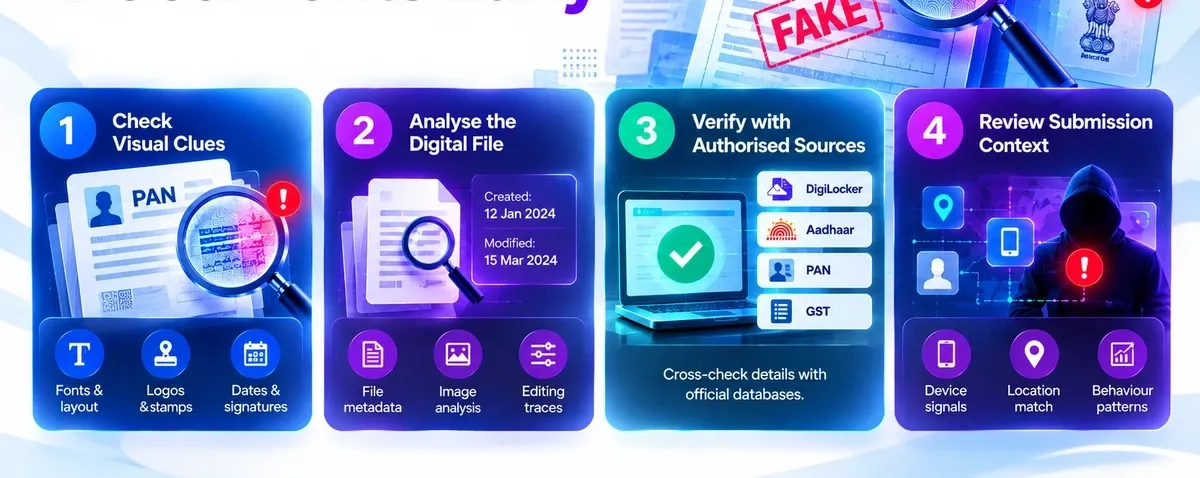
To detect a forged document, you need to use visual inspection, digital file analysis, verification through authorised sources and checks on the submission context. Each layer helps identify risks that other checks may miss. For teams tackling document forgery in India, fake document detection works best when these layers are combined.
1. Visual and Manual Checks
Visual and manual checks involve examining the document for visible inconsistencies. Reviewers should look for:
-
Fonts and spacing: These often change within a line or table. Genuine documents are often generated in one pass, so the mixed styles often point to later edits.
-
Logos: Blurry logos, stretched or the wrong colour. Genuine logos are usually crisp and correctly proportioned.
-
Seals and Stamps: Seals and stamps that look pasted on, or are missing where they should appear.
-
Signatures: Signatures that look identical across papers, or differ from a known sample. A signature that repeats perfectly may have been copied and pasted.
-
Date inconsistencies: Dates that don't fit the timeline, such as a salary slip from a month before the person joined. Check dates against the joining date, the issue date and the statement period.
-
Missing Security Features: Missing some security features, such as QR codes, microtext or watermarks the issuer normally includes. Compare it against a known genuine sample from the same issuer.
Visual checks can identify obvious alterations, but sophisticated forgeries may look convincing. Treat these checks as an initial screening step, not definitive proof of authenticity.
2. Digital Forensic Checks
Digital forensics checks are performed on the file’s properties and structure, looking for evidence of manipulation.
-
File metadata: Check when the document was created or last edited and which software was used to edit it. Unusual dates or signs that the file was edited using unexpected software may indicate changes that need further review.
-
Pixel and layer analysis: Check for unusual differences in image quality, clarity or layers that may indicate edited or manipulated content.
-
Font consistency: Inconsistent size, style, colour, alignment or spacing.
-
Scanned, photocopied, and re-photographed copies: Lower image quality or missing original metadata that may reduce chances of fraud verification.
Overall, these indicators do not detect anything on their own. Legitimate file conversions, scans and edits can also change metadata or image quality. Automated tools can help flag anomalies for further review. This is where automated fake document detection adds the most value.
3. Verify Against the Source
Where possible, verify the required information with an authorised source rather than relying solely on the submitted copy.
-
DigiLocker: Access & verify the required documents through issuer-linked services supported.
-
Aadhaar: Use appropriate UIDAI-approved verification methods, including secure QR code verification or permissible offline verification.
-
PAN: Verify the relevant details through the authorised Income Tax Department verification services.
-
GST registration: Check the registration details, legal name and status via the GST portal.
-
Account Aggregator: Where supported and authorised, access financial information shared by the relevant financial information provider with the customer’s consent, reducing the need to upload bank statement PDFs.
Validate appropriateness of each method for document, use case and applicable data-access requirements. Source checks make fake document detection stronger than visual review alone.
4. Check Who Is Submitting the Document
A document may look real, but may still be submitted by someone who is not allowed to use it. Consider some contextual signals in addition to document-level checks.
-
Device: Check for multiple applications submitted from the same device under different identities, or unusual device-integrity signals.
-
Location: Check whether the geographical location associated with a submission conflicts with the applicant's stated details or expected onboarding context. Such discrepancies may require further verification.
-
Behaviour: Look for repeated submission attempts or irregular patterns in how applicants complete forms.
-
Identity or Document Reuse: Check whether the same identity or document details appear across multiple applications with conflicting names or other information.
These signals together help prioritise applications for authentic review, but none of them individually proves fraud. They need to consider the totality of evidence while escalating suspicious cases to verify before making a decision.
Commonly Forged Documents in India
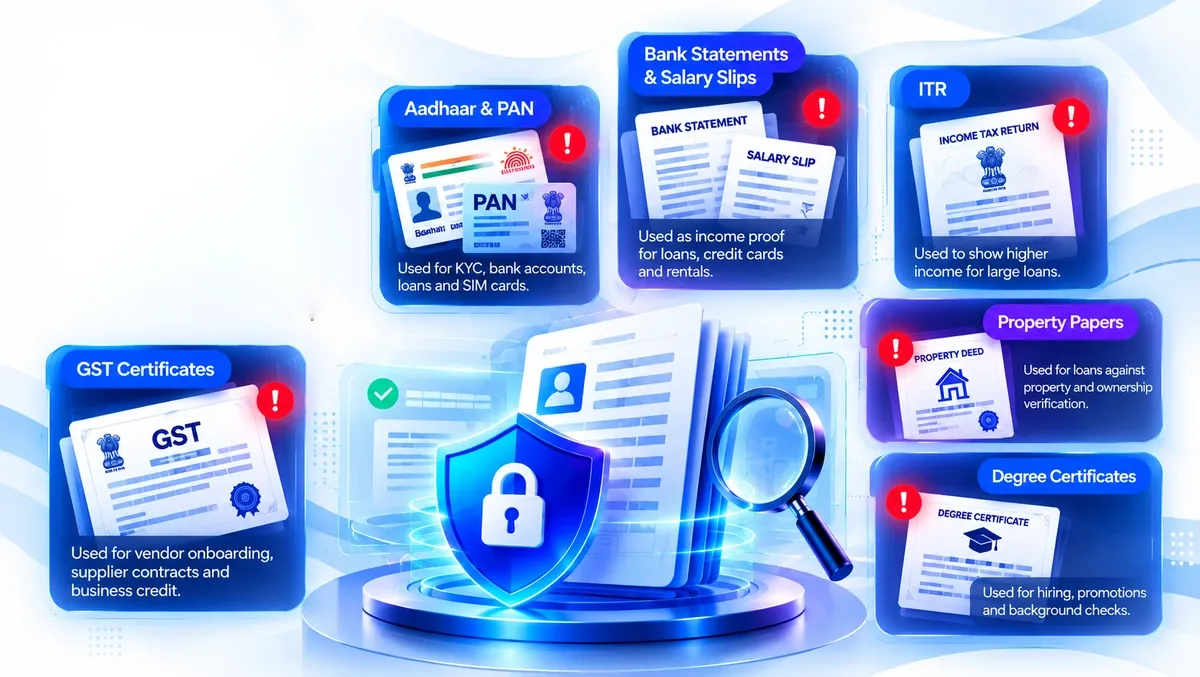
Aadhaar and PAN, Bank Statements and Salary Slips, ITR, GST Certificates, Property Papers, and Degree Certificates are some of the most forged documents in India. They are used to verify identity, income, qualifications or ownership. That’s why understanding how often these documents are targeted, and how they’re misused, helps companies spot potential risks as they beef up their verification processes.
-
Aadhaar and PAN: Forged documents such as Aadhaar and PAN help to pass KYC checks, open bank accounts, take loans and activate SIM cards in another person’s name. Both carry numbers that look genuine on a printed copy, so the copy alone proves little.
-
Fake bank statements and salary slips: Fake bank statements and salary slips are used to support personal loans, credit cards and rentals as proof of income. Even forgers pad balances or conceal bounced payments to appear as a safer borrower.
-
ITR: A fake ITR file is often used as income proof for higher-value loans. Here, the lenders will look at the tax records as proof against the salary declared
-
Fake GST Certificates: Fake GST certificates help with vendor assessment before onboarding, supplier contract checks, and business credit applications.
-
Property documents: The applicants can use altered property papers to avail loans. Forged or altered ownership records may conceal a mortgage or lien on the property.
-
Degree certificates: Fake degree certificates are submitted during hiring, promotions, and background checks to claim non-existent qualifications.
How Banks, NBFCs and Fintechs Can Prevent Document Fraud
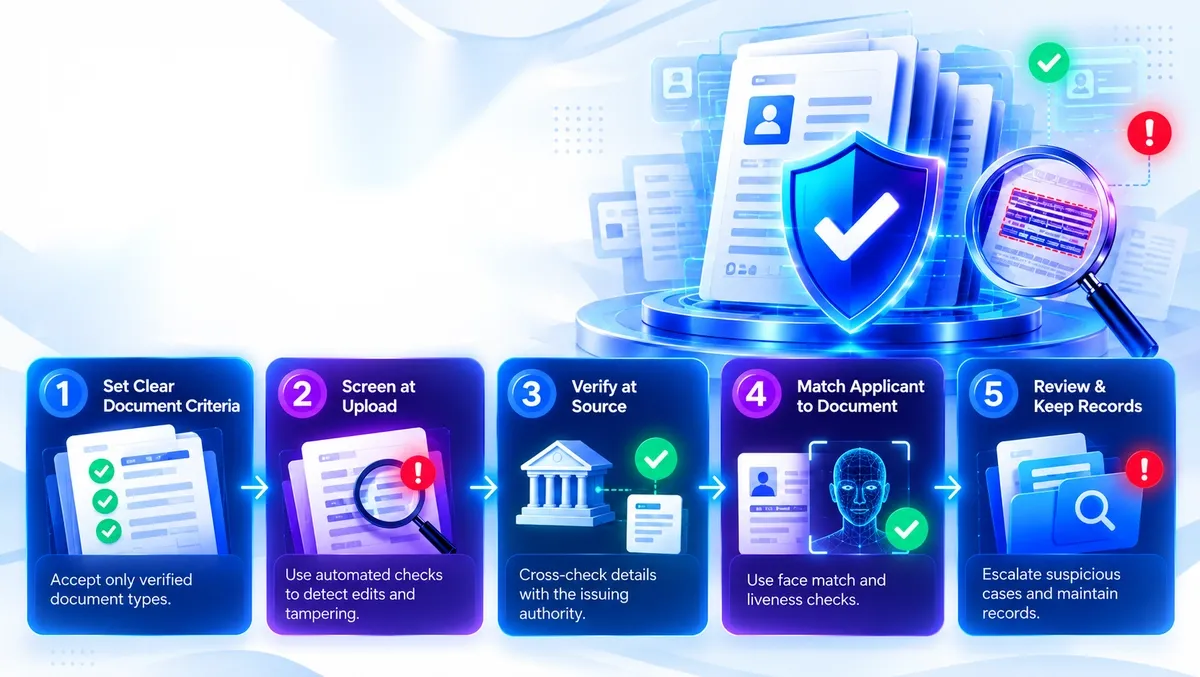
Banks, NBFCs, fintech companies, lenders and insurance providers handle identity documents throughout customer onboarding and verification. A single forged document can expose these businesses to identity theft, synthetic identities and financial fraud. Preventing these risks requires multiple verification layers rather than relying on a single check. Here are five steps financial institutions can follow to strengthen document fraud prevention:
| Prevention Step | What Businesses Should Do | How to Do |
|---|---|---|
| 1. Standardise accepted documents | Accept the right document types that can be verified through authorised sources while reducing verification gaps. | Create a list of different document types that are accepted for each type of verification. Note down the acceptable formats, required fields, and validity requirements to ensure submissions are consistent. |
| 2. Screen documents at upload | Use genuine and automated checks to flag suspicious edits, document inconsistencies and potential tampering before opting for any manual review. | Automated document verification tools help you to check the quality of your files, detect changed images, detect suspicious edits and flag inconsistencies during upload. |
| 3. Source-check | Businesses should verify the information contained in the document with the issuing authority or approved database | Cross-check the details on the document with the records of the issuing authority, authorised databases or official verification portals wherever applicable. |
| 4. Relate the applicant to the document | Businesses can use face matching and liveness check capabilities to confirm that the applicant is the real holder of the documents. | Identity details should be extracted using OCR; the applicant’s live image is compared to the photograph on the submitted identity document using face matching and liveness checks. |
| 5. Review and document suspicious cases | Escalate flagged submissions that need further investigation. Also, it helps to keep the relevant files and records for reporting when needed. | Flagged submissions should be put through a manual review process. Cross-check records, keep original documents and maintain an audit trail for possible investigation or audit. |
Swipe the table
For banks, NBFCs and fintech platforms, document verification should work alongside other fraud detection capabilities. We at Sign3.ai bring together capabilities such as OCR, device intelligence, behavioural biometrics and identity verification to help businesses assess suspicious onboarding activity beyond the submitted document alone.
Each of the prevention steps addresses risk factors that other checks may miss. When a document fails a check, the submission should be flagged for review. This layered approach strengthens fake document detection while helping minimise unnecessary friction for genuine customers.
Detect Forged Documents with Sign3
Preventing document fraud requires more than checking individual documents. Financial institutions need a reliable verification process that can identify suspicious alterations, detect image manipulation and flag potential fraud before it affects onboarding or lending decisions.
Sign3’s Image Intelligence layer helps businesses successfully identify potentially forged documents during upload. The technology even assesses the submitted files and detects any kind of sign of document tampering and image spoofing. It even flags suspicious submissions before they progress further through lending, KYC or onboarding workflows. Book a demo and explore how Sign3’s Image Intelligence layer works and how it can support your document verification workflow.
FAQs
Is using a forged document a separate offence?
Yes. Section 340(2) punishes anyone who fraudulently or dishonestly uses a document as genuine when they know, or have reason to believe, it is forged. The punishment is the same as if they had forged it.
Is forgery bailable in India?
Whether forgery is bailable in India depends on the particular type of forgery or the law under which the case is registered. However, a case of General forgery under 336(2) is bailable, while forgery for cheating under 336(3) is non-bailable. That’s why you should check the current BNSS updates or speak to a lawyer for a specific case.
How do you report a forged document?
To report a forged document, you need to start by filing a complaint or FIR at the nearest police station. If you find any online financial fraud, you can report that case at the National Cyber Crime Reporting Portal or https://cybercrime.gov.in/ or the 1930 helpline. However, to report a complaint, businesses have to preserve the original file, its metadata and the submission logs.
How can businesses detect forged documents during digital onboarding?
Sign3 helps banks and financial institutions detect forged documents during digital onboarding through automated document verification, image analysis and fraud intelligence. Its Image Intelligence technology identifies some signs of document tampering, image manipulation, and spoofing during digital onboarding. This lets banks and financial institutions flag suspicious submissions and assess them for further review.
How does Sign3 help NBFCs detect document and identity fraud?
Sign3 helps NBFCs by strengthening digital onboarding by analysing multiple identity and fraud signals beyond submitted documents. Its Image Intelligence module examines the KYC images and identifies face mismatches, spoofing, duplicate identities and suspicious capture patterns.
What security risks can forged documents create for NBFCs?
Forged or manipulated documents can expose NBFCs to identity theft, synthetic identity fraud, fraudulent loan applications and financial losses. They can even increase manual verification costs and create compliance challenges. This allows high-risk borrowers to pass basic KYC checks. Sign3 helps NBFCs address these risks by combining image, device, behavioural and digital footprint intelligence to identify suspicious applicant patterns and support more informed lending decisions.


