

The identity can be genuine. The intent can be fraudulent.
That is what makes mule account fraud so difficult to detect.
A customer may have a genuine identity, valid documents, a verified phone number and a legitimate reason for opening an account. Their KYC can pass without concern, and their initial transactions may look completely normal. The risk may emerge much later, when the way that account is being used begins to change.
A salary account may suddenly receive funds from dozens of unrelated individuals. A customer with historically low transaction activity may begin moving money rapidly to newly added beneficiaries. A device previously associated with one account may suddenly appear across several seemingly unrelated accounts. Individually, these signals may not prove fraud. Together, they can reveal a very different pattern.
This is the central challenge with mule account fraud - the risk is often not visible in who the customer is, but in what the account is becoming and how it connects to the wider financial ecosystem.
The scale of the challenge is difficult to ignore. According to the Ministry of Home Affairs, by 31 January 2026, more than 27.37 lakh Layer-1 mule accounts had been shared with participating entities through the Indian Cybercrime Coordination Centre’s Suspect Registry, helping prevent transactions worth ₹9,518.91 crore from being processed. Behind these numbers are not just suspicious accounts, but individuals, businesses and financial institutions that can become caught up in fraud networks, sometimes knowingly and sometimes without realizing what their accounts are being used for.
KYC remains essential, but for mule account fraud, identity verification is the starting point, not the finish line.
What Are Mule Accounts and Mule Account Fraud?
A mule account is a bank or financial account used to receive, hold, transfer, withdraw or otherwise move funds on behalf of another party, particularly when those funds are connected to fraud or other illicit activity.
A mule account does not necessarily mean a fake account.
- The person behind the account may be completely real.
- Their identity may be genuine.
- Their documents may be genuine.
- Their KYC may be valid.
- The account may have been opened legitimately.
- The risk emerges from how that legitimate account is subsequently used.
Consider a simple lifecycle:
Real Person → Real KYC → Real Account → Behaviour Changes → Suspicious Relationships → Mule Activity
In some cases, the account belongs to a person who knowingly participates in the movement of illicit funds. In others, the account holder may have been deceived into believing they are performing a legitimate activity. An account can also be compromised and controlled by someone else without the customer's knowledge.
This makes the mule account meaning broader than simply a “criminal account.” Traditional onboarding is designed to establish who the customer is, validate identity documents, meet customer due-diligence requirements and, depending on the institution and product, assess whether the customer’s stated profile makes sense.
These controls are necessary. But they primarily answer a question about identity and onboarding.
Mule account fraud introduces a different question : what is happening to the account after onboarding?
A customer can remain exactly the same person while their account takes on a completely different role.
That is why the distinction between identity risk and behavioural risk matters. KYC establishes the customer's identity, thus, mule detection needs to establish the account's behavioural context.
How Mule Account Fraud Works
Mule accounts become particularly difficult to detect when they are used as part of a broader chain rather than as isolated endpoints.
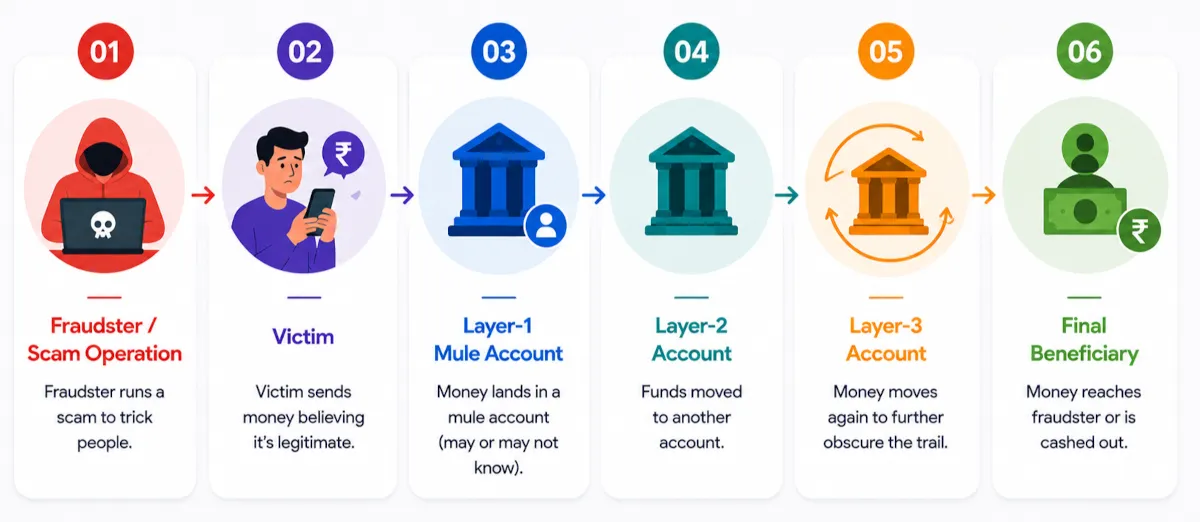
Suppose a victim is persuaded to transfer ₹50,000 as part of an investment scam. The money does not necessarily go directly into an account controlled by the fraudster. It may first reach another person's account. That account may transfer part of the money to another account, which sends it onward again. Eventually, the funds may reach an account controlled by the actual fraud operator or may be converted into cash or another asset.
The significance of this structure is that each individual account can be deliberately kept within what looks like a relatively normal range of activity. Individually, the accounts may not cross a high-value transaction threshold. Collectively, however, they may represent a coordinated money-moving network.
The crime exists in the relationship between the accounts, not necessarily in the behaviour of any one account. And that changes the nature of detection.
Three Faces of a Mule Account
Not every mule account holder has the same level of awareness, behaviour or intent. This matters because a fraud-detection system that treats every mule account as evidence of deliberate criminal participation can create serious customer-impact and investigation problems.
Complicit Mules
A complicit mule, also known as rented mules, knowingly allows their account to be used for fraudulent or illicit activity. They may receive money and transfer it onward, withdraw cash, provide account access or otherwise facilitate the movement of funds. In some cases, they may be recruited specifically because they are willing to provide access to a bank account in return for a fee or a share of the funds routed through it.
In India, such recruitment can take place through direct outreach on platforms such as WhatsApp, Telegram and Instagram, where individuals are offered quick income for allowing supposedly legitimate “business payments” to pass through their personal accounts.
The challenge for the financial institution is not necessarily proving that the account exists. It is recognizing that the customer's behaviour is consistent with a deliberate role in a larger network. This is where network intelligence becomes particularly valuable.
An account that repeatedly receives money from unrelated parties and rapidly transfers it to a small set of beneficiaries may become much more meaningful when those beneficiaries are themselves connected to other suspicious accounts.
Deceived Mules
A deceived mule is more complicated because the account holder may not know that they are facilitating fraud. This can happen through fake employment schemes, work-from-home offers, payment-processing jobs or other social-engineering tactics. A person may be told that their role is simply to receive payments on behalf of an employer or business and transfer them onward after retaining a small commission.
From the customer's perspective, the activity may appear legitimate. From the bank's perspective, the account is receiving and transferring funds in a manner consistent with mule activity. This is an important distinction because a suspicious transaction does not automatically establish criminal intent.
A 2025 LocalCircles survey reported that 42% of surveyed WhatsApp users in India had received fraudulent job offers, including offers involving work-from-home or part-time opportunities.
For investigators, the question therefore cannot stop at "Did this account participate?" It also needs to consider "Did the customer knowingly participate, or was the customer manipulated into participating?"
Compromised-KYC Mules
A compromised-KYC mule account involves a genuine account that is being controlled or accessed by someone other than the legitimate account holder.
The customer may have no intention of participating in fraud at all.
This is where behavioural change can be particularly useful. An account that historically received a salary, paid household bills and transferred money to a small number of known beneficiaries may suddenly begin showing unfamiliar access patterns, new beneficiaries and rapid outward transfers.
For example:
| Historical Behaviour | Sudden Behaviour |
|---|---|
| - Regular salary credits - Normal bill payments - Familiar beneficiaries - Predictable transaction timing | - New device - Unusual login pattern - Unfamiliar beneficiaries - Rapid outward transfers - High transaction velocity |
Swipe the table
The account did not become suspicious because the identity suddenly became fake. It became suspicious because the behaviour no longer matches the customer's established pattern. That distinction can help institutions identify potential account takeover and separate it from deliberate mule activity.
Why KYC Alone Cannot Stop Mule Account Fraud
KYC is not the problem.
The problem is expecting KYC to solve a problem it was never designed to solve on its own.
KYC establishes who the customer is. It helps a financial institution understand the person or entity it is onboarding and supports broader customer due diligence obligations.
But mule risk can emerge after that process is complete.
Imagine an account that is opened on Monday. The customer passes every onboarding check. For the next several weeks, the account behaves normally. Then, six weeks later, it starts receiving payments from multiple unrelated individuals. The funds are transferred out shortly afterwards to newly added beneficiaries. A new device begins accessing the account, and that device is also associated with other accounts showing similar transaction patterns.
Nothing about the customer's name, Aadhaar or identity documents necessarily tells you what happened.
The customer's identity remains genuine.
The account has changed.
This is why continuous monitoring matters. Risk is not always a fixed characteristic established at the moment of onboarding. It can change as the customer's circumstances, behaviour or relationships change.
The CBI’s 2025 investigation into mule accounts demonstrates that the challenge can also extend beyond customer behaviour to the broader account-opening ecosystem. The CBI reported approximately 8.5 lakh mule accounts across more than 700 bank branches, with concerns including KYC, customer due diligence and initial risk assessment processes.
The lesson is not simply that onboarding needs more checks. It is that mule risk can enter through the broader account-opening ecosystem and may only become visible when subsequent account behaviour is examined.
The practical implication is straightforward: KYC should be treated as the beginning of customer risk assessment, not the end of it.
Why Traditional AML Monitoring Struggles With Mule Networks
Traditional transaction monitoring is built around a useful but relatively narrow unit of analysis: the transaction and the individual account.
A rule may look for a large transaction, unusual transaction velocity, a geographic anomaly, a new beneficiary or a particular pattern of incoming and outgoing funds. These scenarios remain valuable because many forms of financial crime do produce identifiable account-level anomalies.
Mule networks create a different challenge.
The fraudster does not necessarily need any one account to look obviously suspicious. Instead, the activity can be distributed across many accounts, each handling relatively modest amounts or operating only for short periods.
Imagine 100 accounts, each receiving small amounts from different individuals and moving the funds onward. If every account is evaluated independently, the system may find 100 moderately unusual accounts. If the network is evaluated collectively, however, it may reveal a coordinated structure with common beneficiaries, shared devices and highly similar transaction behaviour.
This is why the problem can be compared to detecting a Distributed Denial-of-Service attack. Looking at one network packet may tell you very little. The packet itself may be perfectly ordinary. The attack becomes visible when you examine the scale and coordination of the traffic.
Mule networks work in a similar way. The suspicious signal may not be contained within a single transaction. It may exist in the relationships between transactions and accounts. This is a fundamental shift in the unit of analysis, from the individual account to the network around it.
The False-Positive Trap
There is an understandable response when traditional monitoring misses mule activity. It creates more rules, lowers thresholds and generates more alerts.
The problem is that legitimate financial activity can look remarkably similar to mule behaviour.
A business can suddenly receive a large payment and distribute it quickly among vendors. A company can process salary payments for hundreds of employees. A merchant can receive a large settlement from a marketplace. A customer can receive a GST refund and then make several large payments.
A system that sees only the transaction pattern may classify these behaviours as suspicious.
The result is a difficult trade-off. If the rules are too loose, sophisticated mule activity can pass through. If they are made increasingly aggressive, alert volumes rise and investigators spend more time clearing legitimate activity.
This is the false-positive trap.
The cost is not limited to operational efficiency. Excessive false positives can affect genuine customers, create unnecessary friction and make it harder for investigators to focus on cases that genuinely require attention. The objective of a mature detection system should therefore not be to identify every transaction that looks unusual. It should be to understand why an unusual transaction is unusual in context.
A sudden increase in transaction velocity is not necessarily fraud. A sudden increase in velocity combined with new counterparties, an unfamiliar device, shared infrastructure with known suspicious accounts and rapid movement of funds to common beneficiaries is much more informative.
Context is what turns an anomaly into intelligence.
From Alert Saturation to Fraud Intelligence
An alert tells an investigator that something happened. Fraud intelligence helps explain what that event may mean.
Instead of asking only: "Is this transaction suspicious?" ask:
- Who sent the money?
- Who received it?
- Where did the money go next?
- Is this behaviour normal for the customer?
- Has the customer's behaviour changed?
- What device is being used?
- What other accounts are associated with that device?
- Are the counterparties connected?
- Are the beneficiaries connected?
- Does this account resemble other known mule accounts?
- What role does the account play in the larger network?
This creates multiple layers of context.
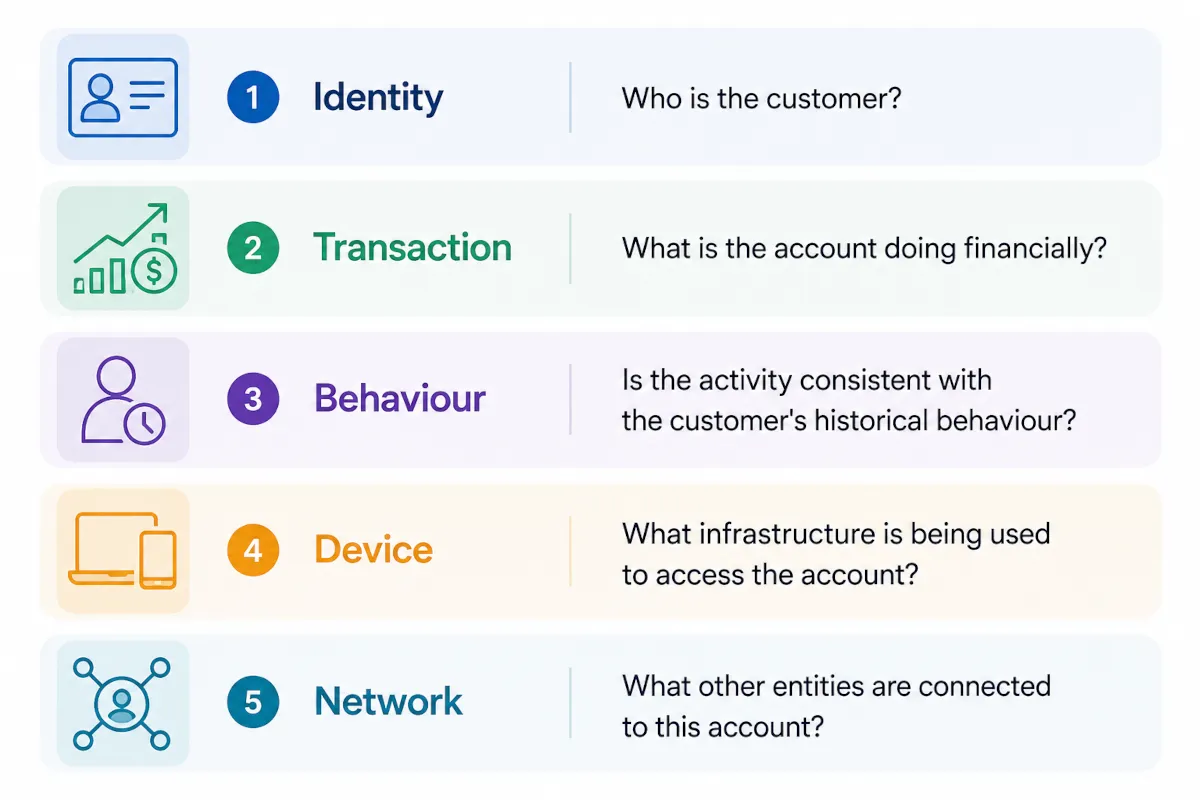
Together, this five-layer architecture creates something more valuable than an isolated alert - Contextual Risk Intelligence.
The value comes from combining these layers rather than treating each signal independently.
How to Detect Mule Account Fraud
There is no single rule that can reliably identify every mule account. The more effective approach is to look for combinations of signals and, importantly, to understand those signals against the customer's normal profile.
Start with Transaction Behaviour / Anomalies
Transaction monitoring remains the first layer of detection. Potential signals include:
- unusual inbound volumes,
- sudden changes in transaction value,
- rapid movement of funds,
- high transaction velocity,
- repeated pass-through behaviour,
- unusual cash withdrawals,
- unexpected beneficiary changes,
- sudden increases in account turnover.
But none of these signals should be interpreted in isolation.
A high-velocity account is not necessarily a mule account. A legitimate business may have exactly that profile. What matters is whether the activity makes sense for the customer and whether it connects to other indicators of risk.
Look for Behavioural Changes
One of the strongest questions a detection system can ask is “what has changed?”
If a customer's historical behaviour is stable and suddenly shifts, that change may be more informative than an absolute threshold. For example:
| Historical Behaviour | New Behaviour |
|---|---|
| Few monthly transactions | Dozens of daily transactions |
| Familiar beneficiaries | Multiple new beneficiaries |
| Salary-driven inflows | Multiple unrelated credits |
| One regular device | New device or infrastructure |
| Predictable timing | Unusual transaction timing |
| Low account turnover | Rapid pass-through activity |
Swipe the table
Behavioural Biometrics can add another layer by examining changes in how a customer interacts with the digital channel. Such signals can help identify potential account takeover, automation or other unusual interaction patterns, although they should be treated as risk indicators rather than definitive evidence of fraud.
Examine Counterparties
The counterparties surrounding an account often provide information that the account itself cannot.
Who is sending money into the account? Are those people or entities connected to one another? Are they new to the customer? Does the account receive money from many unrelated sources but send most of it to a small number of beneficiaries?
A pattern of many-to-one or one-to-many movement can be legitimate, but when it appears alongside other indicators, it can help identify the account's role within a broader network.
Add Device Intelligence
Customer identity tells you who owns an account. Device intelligence can tell you something about the infrastructure through which multiple accounts are being accessed.
Suppose several apparently unrelated accounts are repeatedly accessed from the same device or infrastructure. That relationship is not proof of fraud. Families can share devices, businesses can share infrastructure, and legitimate agents can operate multiple accounts.
But if the same relationship appears alongside suspicious transaction behaviour, rapid fund movement and common beneficiaries, it becomes significantly more valuable.
The important point is that device intelligence creates a relationship that may remain invisible when an investigation is limited to account and transaction data.
Move from Accounts to Networks
Ultimately, this is where mule detection becomes much more powerful. Instead of asking only whether Account A is suspicious, the system can examine Account A's relationships with other accounts, devices, beneficiaries and transactions.
The account can then be evaluated in the context of the network around it. That network may reveal that Account A is an isolated anomaly, or it may show that Account A is one node in a much larger structure.
The second situation is often where the real fraud intelligence lies.
Why Network Intelligence Changes Mule Account Fraud Detection
Network intelligence changes the question from "Is this account suspicious?" to "What role does this account play?"
That distinction may sound subtle, but it changes how an investigation works.
Accounts can act as first-layer receiving accounts, pass-through accounts, intermediaries, cash-out points or common beneficiaries. Some may be deliberately controlled by participants in the fraud. Others may belong to customers who have been deceived or compromised.
A graph-based view makes these relationships easier to understand. Accounts become nodes. Transactions create edges. Devices, beneficiaries, shared identifiers and behavioural similarities can create additional relationships. The resulting network can expose patterns that are difficult to see in a conventional account-level investigation.
However, the network does not automatically prove criminality. What it does is provide investigators with context that would otherwise be difficult to obtain.
The objective, therefore, should not simply be to identify more suspicious accounts. It should be to understand suspicious networks and identify the role individual accounts play within them.
When the Mule Is Also a Victim
One of the most important nuances in mule account fraud is also one of the easiest to overlook. The person whose account is being used is not always the person behind the fraud.
A customer may have responded to a fake job advertisement, accepted a fraudulent payment-processing role or been persuaded to receive and transfer funds on behalf of someone they believed was a legitimate employer. By the time the fraud is detected, the customer's account may look exactly like a mule account.
From the perspective of transaction monitoring, that classification may be reasonable as an initial risk signal. From an investigation perspective, however, it is only the beginning.
The investigator needs to understand whether the customer knowingly participated, was manipulated, or lost control of the account altogether. This distinction matters because the financial institution is not simply trying to determine whether money moved through the account. It is trying to understand why the money moved through the account and what role the account holder played in that movement.
That is another reason why a purely rules-based approach is insufficient. A rule can identify behaviour. It cannot, by itself, establish intent.
What Banks and Fintechs Need to Rethink
The response to mule account fraud should not be to abandon existing AML controls. KYC, transaction monitoring, sanctions screening, customer due diligence and suspicious transaction reporting remain fundamental components of a financial crime programme.
The opportunity is to connect those controls more effectively.
A customer should not be viewed as a static record created at onboarding. Their risk profile should evolve as their behaviour evolves. This means bringing together information that is often examined separately: identity, transaction history, behavioural patterns, devices, beneficiaries and network relationships. It also means changing what investigators receive.
A case containing only a list of suspicious transactions forces the investigator to reconstruct the story manually. A case that already shows the relevant relationships can help the investigator understand the likely role of the account much faster. This matters for suspicious transaction reporting as well.
The value of a report is not simply that it contains a suspicious transaction. Its value increases when the underlying activity can be explained clearly: where funds came from, how they moved, what relationships exist between the parties and why the overall pattern is inconsistent with the customer's expected activity.
Better intelligence should ultimately lead to better investigations and more useful reporting, rather than simply more alerts.
Go Beyond KYC. Detect More with Sign3.
Mule account fraud does not necessarily begin with a fake identity. Sometimes, it begins with a completely legitimate customer whose account gradually becomes part of a fraud network.
Sign3’s fraud intelligence capabilities can help banks and NBFCs look beyond onboarding data and understand what is happening after the account is opened. Device Intelligence can uncover connections between accounts through shared devices and digital infrastructure. Behavioural Biometrics can identify meaningful deviations from a customer’s established interaction patterns. Network Intelligence can connect accounts, transactions, devices and counterparties to reveal relationships and potential mule networks that may remain invisible when each account is assessed separately.
Effective mule account fraud detection cannot depend only on whether an individual account crosses a predefined threshold. It requires continuous risk assessment that brings together identity, transactions, behaviour, devices and networks.
With Sign3, the shift is from asking “Is this account suspicious?” to understanding “What is happening around this account?”
Because ultimately, mule account fraud is a network problem disguised as an individual-account problem.
Frequently Asked Questions
What is mule account fraud?
Mule account fraud occurs when a bank or financial account is used to receive, hold, transfer or withdraw funds connected to fraud or other illicit activity. The account may belong to a genuine person and may have passed KYC successfully.
What is a money mule?
A money mule is a person who knowingly or unknowingly receives illegally acquired money into their bank account and transfers or forwards it to someone else.
How can banks detect mule accounts?
Banks can combine transaction monitoring with behavioural analysis, device intelligence, counterparty analysis and network intelligence. The strongest approach is to examine multiple signals collectively indicating that an account is being used in a way that is inconsistent with its expected behaviour.
What are the different types of mule accounts?
Three useful operational categories are complicit, deceived and compromised-KYC accounts. Complicit mules knowingly participate, deceived mules may be manipulated into participating without understanding the underlying fraud, and compromised-KYC accounts are legitimate accounts that have been taken over or controlled by someone else.
Are all mule account holders criminals?
No. Some mule account holders knowingly take part in fraud. Other mule account holders however may simply be victims of deception. May have their accounts compromised. That is why we should identify activity and then do a contextual investigation, rather than automatically labeling every account holder as a deliberate participant.
Why can't KYC alone detect mule account fraud?
KYC is primarily designed to establish and verify customer identity. Mule risk can emerge after onboarding when transaction behaviour, counterparties, devices or account relationships change. Detecting that evolving risk requires continuous monitoring and contextual analysis in addition to KYC.
Why do mule account detection systems need behavioural and device intelligence?
Transaction patterns alone may not explain why an account suddenly behaves differently. Behavioral intelligence can spot changes from a customer's habits. Device intelligence can show links between accounts that seem separate. When these signals are used together they can give details that transaction checking on its own might overlook.


