

Money laundering follows three stages, including placement, layering and integration. Placement introduces illegally obtained money into the financial system, layering moves it through multiple transactions to conceal its origin, and integration brings it back into the economy as seemingly legitimate wealth. Together, these stages form the money laundering process, allowing criminals to disguise the proceeds of fraud, corruption and organised crime.
For banks, NBFCs and fintechs, understanding the placement, layering, and integration model is considered essential to identifying suspicious financial activity. Each stage leaves different indicators, from unusual deposits to complex transaction patterns and unexplained wealth. Recognising these signals early can help financial institutions investigate suspicious activity before illicit funds become harder to trace.
This guide explores how each stage works, the common warning signs to watch for and how financial institutions can strengthen their crime detection efforts.
Key Takeaways
- The 3 stages of money laundering are Placement, Layering, and Integration, each with its own distinct characteristics.
- The placement-layering-integration model describes how illicit money enters, travels through and leaves the financial system as seemingly clean funds.
- Placement is the most exposed stage; layering in money laundering is the hardest to trace, and integration is the hardest to challenge once it is done.
- The strongest red flags are often considered mismatches. This is an activity that does not fit a customer’s profile, income or history.
- KYC and transaction monitoring remain the backbone of detection. Device, behavioural and location signals add context around them.
What Is Money Laundering?
Money laundering is the act of making illegally obtained money appear legitimate. Criminals use it to conceal the origin of funds generated through illegal activities and make them usable without raising suspicion. The proceeds can come from various criminal activities, including phishing and online fraud, bribery, drug trafficking, illegal lending operations, tax evasion, human trafficking and cybercrime.
In India, money laundering is an offence under the Prevention of Money Laundering Act, 2002 (PMLA). Banks, NBFCs and other reporting entities must report suspicious transactions to the Financial Intelligence Unit–India (FIU-IND), as required under applicable regulations. For financial institutions, the risks extend beyond regulatory penalties. Furthermore, the exposure to illicit financial activities can damage institutional reputation, undermine customer trust and lead to serious compliance consequences. This makes effective money laundering detection an essential part of financial crime prevention.
Stage 1: Placement
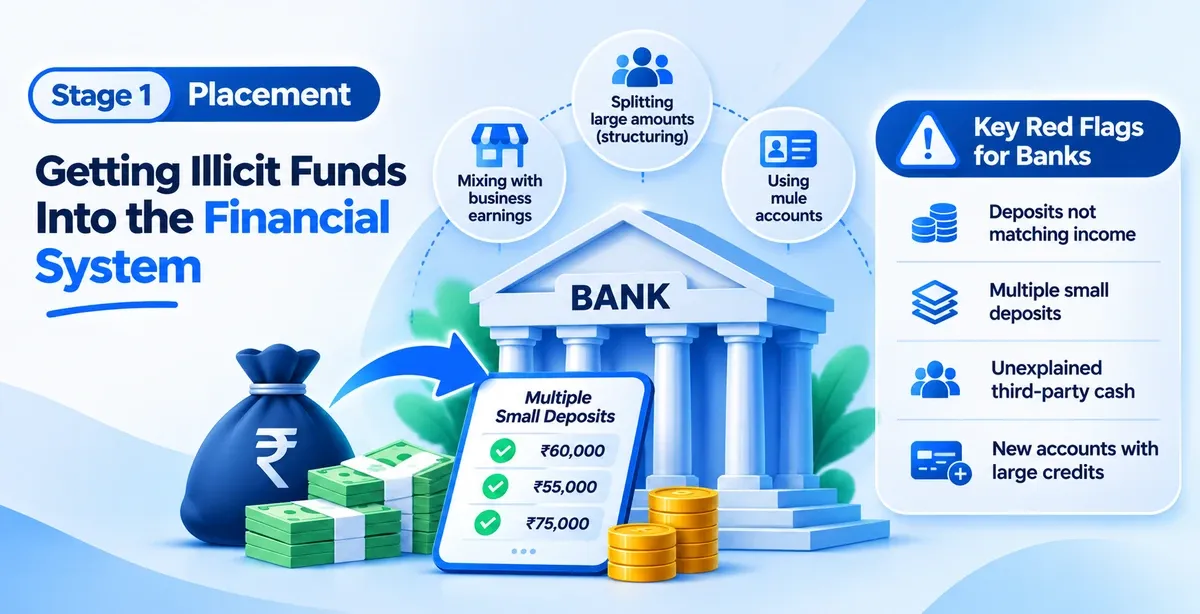
Placement is the first stage of the money laundering process, where the illegally obtained funds enter the financial system. It is often the most exposed stage because criminals in this stage find a way to introduce the illicit money without triggering any kind of scrutiny. Their prime objective is to deposit or transfer the funds while making the activity appear consistent with legitimate financial transactions.
One common method is to divide the large amount of cash into smaller deposits. This helps avoid detection, a practice known as structuring or smurfing. For example, the ₹9 lakh amount may be deposited across fifteen accounts held by different individuals, with each deposit amount kept relatively small to avoid triggering further scrutiny.
Criminals may also mix the illicit cash with the legitimate earnings of cash-intensive businesses, such as restaurants or salons, and report the combined amount as business revenue. In digital fraud cases, the stolen funds may enter the financial system directly through mule accounts opened using borrowed or stolen identities.
For banks and other financial institutions, placement offers an important opportunity for early detection. Warning signs include:
-
deposits that do not match a customer's occupation or income
-
multiple small deposits that collectively represent a large amount
-
unexplained cash deposits by third parties
-
newly opened accounts receiving unusually large credits within a short period.
Identifying these patterns early can help financial institutions flag suspicious activity before illicit funds move further through the financial system.
Stage 2: Layering
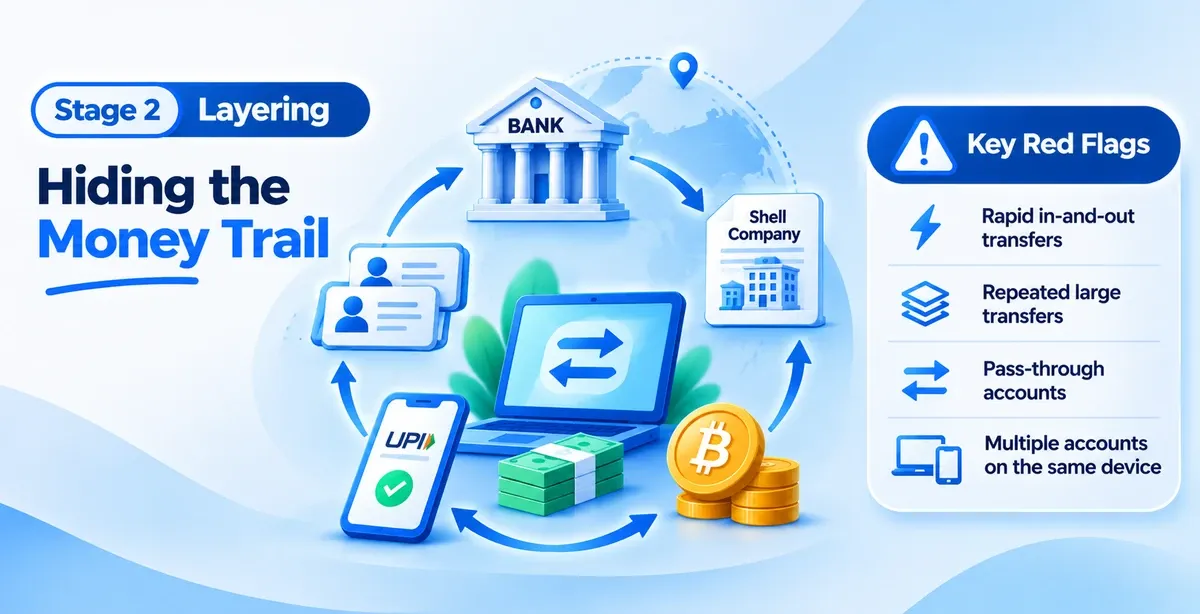
Since the placement stage defines when the money enters the financial system, the second stage - layering is about concealing the origin of illicit funds. It is also known as the complex stage of money laundering, as criminals use multiple transactions and financial channels to make the original source of money increasingly difficult to trace. Each additional transfer creates another layer between the funds and the underlying criminal activity.
At this stage, money is transferred between multiple bank accounts, payment applications, financial institutions and countries. The offenders may also:
-
convert the money into crypto assets
-
transfer it to shell companies for invoices for services that were never rendered
-
route it through multiple mule accounts using different channels, for instance, UPI.
Each transaction may seem legitimate in isolation, but the whole trail of transactions can reveal suspicious patterns.
Layering in money laundering is highly challenging for banks and financial institutions because no single bank may have the proper visibility into the entire movement of funds. A transaction that appears routine to one institution could be another step in a wider network of suspicious transfers. High transaction volumes and rapid fund movements make these activities even harder to identify.
Some warning signs include:
-
funds arriving and leaving an account within hours
-
repeated huge-amount transfers between accounts with no apparent business relationship
-
accounts suddenly behaving like pass-through channels
-
multiple accounts sharing the same device, phone number or address.
Such connections deserve closer investigation, particularly when several fraud indicators appear together.
Stage 3: Integration

The final and third stage of the money laundering process is integration. By the time the illegally obtained money reaches this stage, it has already been through a number of transactions and may have acquired what looks like a credible financial history. Then the criminals can use the money for their own spending, or for investments or for business activities without exposing their source right away.
Some common ways are:
-
buying property at different levels above or below market value
-
buying or investing in businesses, buying jewellery, art, vehicles or other high-value items.
Criminals may also use these illicit funds to repay loans, thereby making the repayment appear legitimate. Another method is over-invoicing. A company owned by the money-launderer charges another company for services that were never actually performed and presents the money as business revenue.
Integration is particularly difficult to investigate because funds may now appear as legitimate profits, investment returns or sale proceeds. Investigators therefore seek any kind of inconsistencies. These include:
-
declared income that cannot truly justify a property purchase
-
unusually large loan repayments from unexplained sources
-
business turnover that does not match the company's size and operations.
Detecting these inconsistencies can help financial institutions identify disguised illicit wealth and prevent it from re-entering the legitimate economy.
How Placement, Layering and Integration Work in Money Laundering
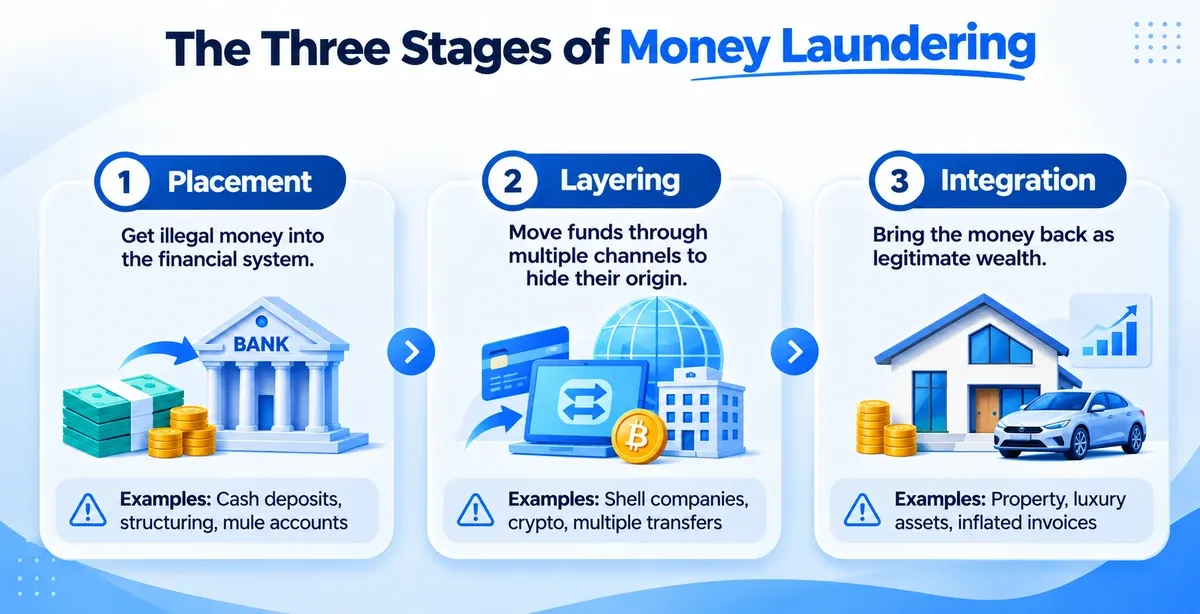
Although the placement, layering, and integration stages are interconnected, each one serves a different purpose. These stages differ in how illicit funds enter the financial system, how criminals conceal their origins and how the money eventually re-enters the economy. Comparing these stages helps financial institutions to understand the methods used at each point and recognise the warning signs associated with them.
| Comparison | Placement | Layering | Integration |
|---|---|---|---|
| Purpose | Introduce illicit money into the financial system | Conceal the original source and break the transaction trail | Make illicit funds appear legitimate and usable |
| How funds move | Cash deposits or fraud proceeds enter multiple accounts, often in smaller amounts | Rapid transfers across accounts, banks, entities and borders | Funds return as investments, purchases, business income or loan repayments |
| Common methods | Structuring, cash-intensive businesses, mule accounts | Shell companies*, crypto conversions, mule account chains | Property, luxury assets, inflated invoices, loan repayments |
| Warning signs | Deposits inconsistent with customer profiles; multiple small credits | Rapid in-and-out transfers, shared devices, circular transactions | Wealth inconsistent with declared income; unusually early loan closures |
| Examples | Illicit cash is deposited in several bank accounts through smaller transactions | Funds move through multiple mule accounts and shell companies to obscure their origin | Illicit funds are used to purchase property or invest in a seemingly legitimate business |
Swipe the table
Good to Know: Shell companies are businesses that exist legally but have little or no significant business operations, employees or physical presence. Criminals may use such companies' names to conceal the ownership and origin of illicit funds. They even route money through multiple transactions or make illegal proceeds appear like legitimate business income. They are often used during the layering stage of money laundering to create complex financial trails and make transactions harder to trace.
For banks, NBFCs and fintechs, recognising these key differences helps the compliance teams to look beyond the individual transactions. They can also successfully identify suspicious patterns and investigate potential financial crime before it becomes much harder to trace.
Common Red Flags Related to Three Stages of Money Laundering
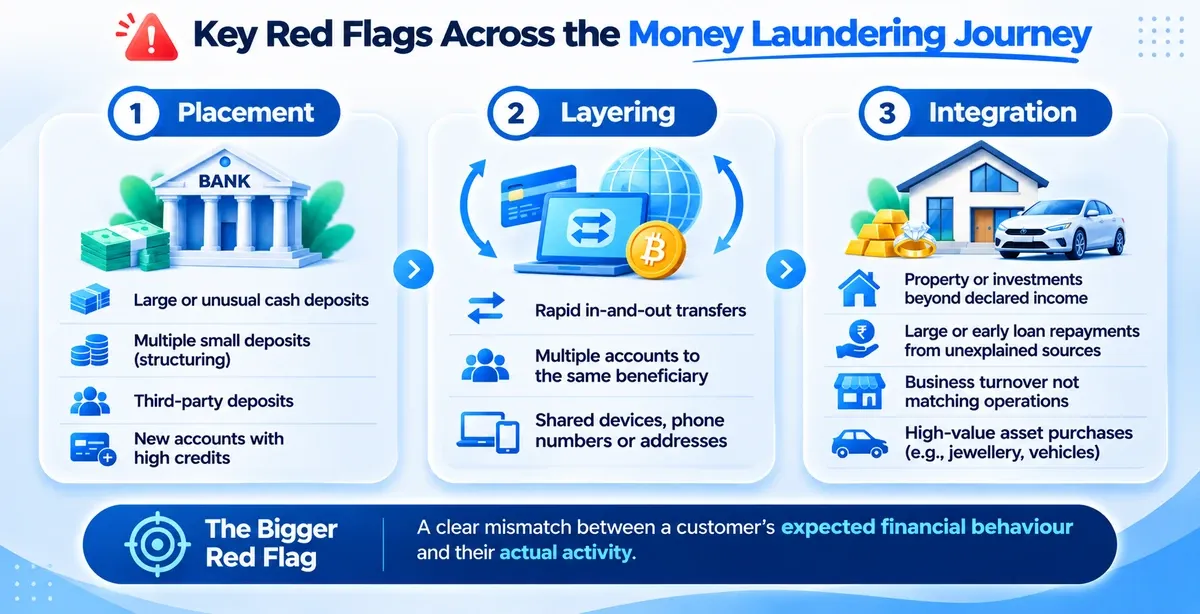
Red flags in the money laundering process emerge when a customer's financial activity does not match their declared income, occupation or usual transaction behaviour. While a single indicator does not necessarily prove money laundering, multiple warning signs appearing together may warrant further investigation.
That’s why banks and financial institutions should watch for the following indicators across the placement, layering, and integration stages:
1. Placement:
-
Unusually large cash deposits that do not match the customer's declared income source or occupation.
-
Multiple smaller deposit amounts collectively represent a significant amount, potentially indicating the pattern of structuring.
-
Third-party cash deposits into multiple accounts without an apparent business or personal connection.
-
Newly opened accounts that are receiving unusually large credits shortly after activation.
2. Layering:
-
Funds are moving into and out of accounts within a short period.
-
Multiple unrelated accounts are transferring money to the same beneficiary.
-
New beneficiaries are being added shortly before making large transactions.
-
Sudden changes in transaction frequency, volume or value compared with the customer's usual activity.
-
Multiple accounts sharing the same device, phone number or address, particularly when other suspicious patterns are present.
3. Integration:
-
Property purchases or investments that do not match the customer's declared income or financial profile might trigger fraud alerts.
-
Large loan repayments or early loan closures, but those are funded through unexplained sources.
-
Business turnover that appears inconsistent with the company's size, operations or industry.
-
High-value purchases of jewellery, vehicles or other luxury assets without a clear financial explanation.
Across all three stages: The most important warning sign is assessing the mismatch between a customer's expected financial behaviour and their actual activity. When compliance teams identify and understand these indicators together, they can investigate for any unusual patterns rather than relying solely on a particular aspect.
How Can Banks Detect and Prevent Money Laundering?
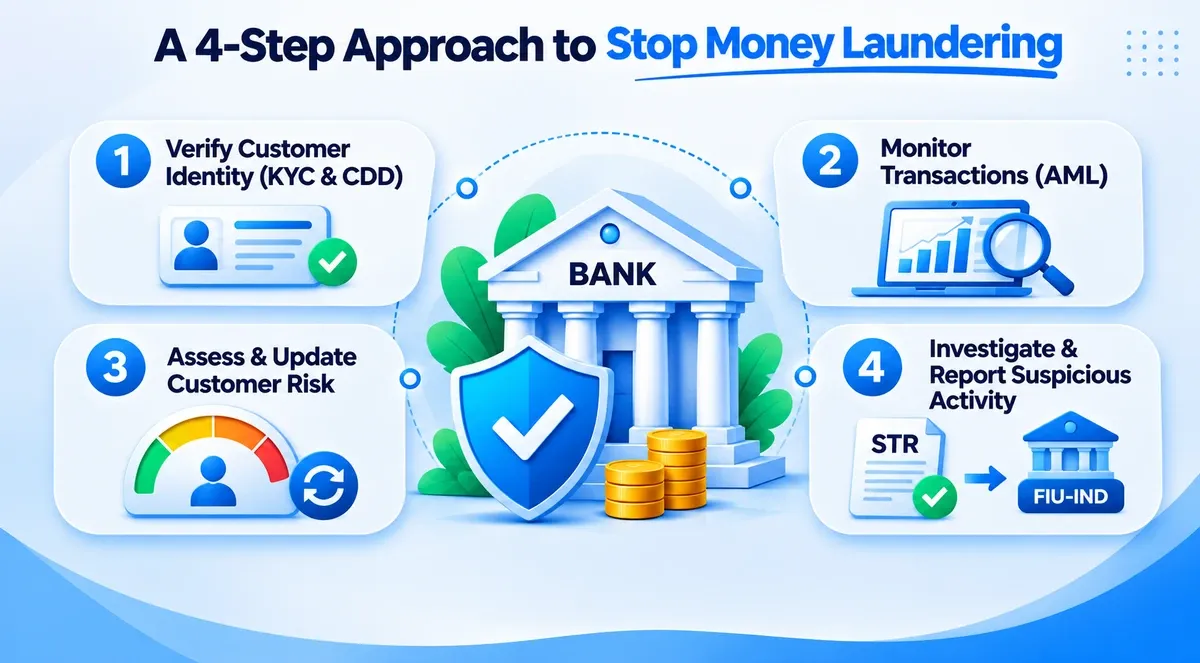
Banks need a combination of customer verification, transaction monitoring and ongoing risk assessment to detect and prevent money laundering. By understanding customer profiles, tracking unusual financial activity and investigating suspicious account relationships, financial institutions can identify potential risks across all three stages of the money laundering process. Key measures include:
- Conduct KYC and Customer Due Diligence (CDD): Verify customer identities, occupations, business activities and their sources of funds. Establish a significant threshold for usual transaction patterns to identify activities that do not match a customer's financial profile. Higher-risk customers, such as politically exposed persons (PEPs) and businesses with complex ownership structures, may require Enhanced Due Diligence (EDD).
Read the guide to understand KYC vs. Fraud Intelligence
-
Implement AML Transaction Monitoring: Use rules and analytical models to flag unusual transaction amounts, frequency, velocity, beneficiaries and geographical patterns. Monitor rapid transfers, unfamiliar counterparties and transactions involving multiple interconnected accounts.
-
Maintain Continuous Customer Risk Assessment: Review the customer accounts and assess their transaction behaviour regularly. Reassess the risk factors when the financial activities, such as a huge number of transactions or frequent credits, seem suspicious. Update customer profiles with relevant information and establish clear escalation procedures for suspicious alerts.
-
Investigate and Report Suspicious Transactions: Ensure compliance teams investigate unusual activities to determine whether they have legitimate explanations. Where required, submit Suspicious Transaction Reports (STRs) to the Financial Intelligence Unit–India (FIU-IND).
Following a proper and risk-based approach, as outlined in the RBI's KYC Directions and FATF Recommendations, helps banks and financial institutions to strengthen their AML controls and investigate potential financial crime more effectively.
Strengthen Money Laundering Detection with Device Intelligence
Understanding the placement-layering-integration stages of money laundering helps financial institutions detect suspicious activities before the funds become much harder to trace. Effective money laundering detection starts with strong KYC checks, continuous transaction monitoring and a clear understanding of customer behaviour. However, transaction data alone may not reveal connections between seemingly unrelated accounts.
That’s where Sign3's Device Intelligence adds value. Our fraud intelligence helps identify multiple accounts operating from the same device, which reveals potential links between mule accounts and organised fraud networks. Book a demo and explore Sign3’s Device Intelligence to strengthen your financial crime detection capabilities.
FAQs
What are the three stages of money laundering?
The three stages of money laundering are placement, layering and integration. Placement introduces illegally obtained money into the financial system, layering moves it through multiple transactions to conceal the funds' actual origin, and integration brings the illegally obtained money back into the economy as apparently legitimate wealth. Together, these stages explain how fraudsters attempt to disguise the proceeds of illegal activities.
What is placement in money laundering?
Placement is known as the first stage of money laundering, where criminals introduce the illegally obtained money into the financial system. They may also deposit cash in smaller amounts, use cash-intensive businesses or transfer stolen funds into accounts controlled by money mules. Moreover, the actual objective is to move illicit funds into the financial system without attracting unnecessary attention.
How does layering in money laundering work?
Layering in money laundering works by moving the illicit funds through multiple accounts, financial institutions, businesses or payment channels. Criminals may split the transactions, transfer money between mule accounts or use shell companies to create complex financial trails. Although individual transactions may appear legitimate, this makes the original source of funds much harder for banks and financial institutions to trace.
What happens during the integration stage?
During integration, the illegally laundered money re-enters the economy as seemingly legitimate wealth. Criminals may invest those illegally obtained funds in property, businesses, luxury assets or other financial instruments. They may also use the money to repay loans or generate apparently legitimate business income. At this integration stage, identifying the original criminal source is particularly vital yet challenging.
Why is layering difficult for banks to detect?
Layering is considered difficult for banks to detect because funds move rapidly across multiple accounts, financial institutions and payment channels. Banks and financial institutions may only see a small part of the transaction trail, making it difficult to understand the complete movement of money. High transaction volumes and seemingly legitimate transfers can further conceal suspicious relationships between accounts.
Can money laundering occur without all three stages?
Yes, money laundering can occur without all three stages because it does not always follow the correct sequence of placement, layering and integration. For example, proceeds from digital fraud may enter the financial system directly through some mule accounts. Hence, it bypasses the traditional cash-based placement. Some schemes may also repeat or combine different stages depending on how fraudsters attempt to conceal the source and movement of funds.
How can Device Intelligence help identify potential money laundering networks?
Device Intelligence uses persistent device fingerprinting to identify and connect accounts operating from the same device. This can help financial institutions uncover potential relationships between seemingly unrelated accounts, including those associated with mule account networks. With Sign3’s device intelligence module, such device-level connections provide additional context for investigating suspicious transaction patterns and identifying possible organised fraud activities.
How can Device Intelligence strengthen existing AML controls?
Device intelligence adds device-level insights to customer verification, transaction monitoring and risk assessments. As a result, banks, NBFCs, and fintechs can identify suspicious connections, such as multiple accounts accessed from the same device. Sign3's Device Intelligence supports further investigation and complements existing KYC and AML systems to enable more informed risk decisions.


