

Transaction monitoring is an advanced regulatory requirement for every RBI-regulated entity and a core component of AML compliance. As transaction volumes grow and fraud networks become more sophisticated, traditional rule-based monitoring is increasingly showing its limitations. It relies on certain predefined rules and thresholds, making it effective at detecting known patterns but less capable of identifying emerging threats and complex fraud networks. It can also generate large volumes of false positives, increasing investigation workloads for compliance teams. That’s exactly why you need Transaction monitoring.
In this article, we explain how the transaction monitoring process works in India, where rule-based systems fall short and how fraud intelligence fills the gap.
Understanding Transaction Monitoring in Modern Banking
Transaction monitoring is a component of the larger anti-money laundering (AML) and financial crime compliance programs for banks, NBFCs, fintechs, payment aggregators and virtual digital asset (VDA) platforms. It is the ongoing scrutiny of customer transactions, including deposits, withdrawals, transfers, transaction frequency, value and counterparties. Its goal is to spot activity that is outside of a customer’s expected behaviour and identify potential money laundering, terrorist financing, fraud, sanctions evasion and other financial crimes.
The regulatory framework for Transaction monitoring in India is primarily driven by:
- The RBI's Master Direction: Know Your Customer (KYC) Direction, 2016, which requires customer risk assessment, ongoing due diligence, and transaction monitoring throughout the customer lifecycle.
- The Prevention of Money Laundering Act (PMLA), 2002, and related rules: These require reporting entities to identify, record, and report suspicious transactions to the Financial Intelligence Unit–India (FIU-IND).
An accurate customer risk profile is the foundation of effective transaction monitoring. Without a clear understanding of the customer’s expected activity, source of funds, business profile and risk level, financial institutions have no reliable baseline against which to assess whether behaviour is unusual or potentially suspicious. This is why KYC and transaction monitoring are closely linked components of an effective AML program.
Transaction Monitoring vs Transaction Screening: Why Banks Need Both
Transaction monitoring and transaction screening are distinct financial crime controls. While both are designed to help financial institutions detect and prevent money laundering, terrorist financing, sanctions violations, and other illicit activity, they operate at different stages of the transaction lifecycle and address different types of risk. Let’s check out the differences:
| Transaction Screening | Transaction Monitoring |
|---|---|
| Checks a transaction or counterparty against sanctions lists and watchlists before or during processing | Analyses transaction behaviour and patterns over time, after or across multiple transactions |
| Prevents a prohibited transaction from completing | Detects suspicious behaviour that already occurred, for investigation and reporting |
| Generates alerts for potential sanctions, watchlist, or restricted-party matches | Generates alerts for unusual activity requiring investigation and potential suspicious transaction reporting |
Swipe the table
In practice, banks and financial institutions need both controls to build an effective defence against modern threats. While screening blocks known risks at the point of transaction, monitoring uncovers hidden patterns that only become visible over time. As fraud networks, mule accounts, and synthetic identities grow more sophisticated, combining real-time screening with intelligent, risk-based monitoring has become essential for effective fraud detection and prevention.
Read more: Fraud Detection & Prevention: Methods, Techniques & Best Practices
AML Transaction Monitoring vs. Transaction Monitoring: What Is the Difference
The terms “transaction monitoring” and “AML transaction monitoring” are often used interchangeably, but they aren't quite the same. Transaction monitoring is the broader discipline used to detect activities such as fraud, payment abuse, unauthorised transactions, account compromise, and operational irregularities, while AML transaction monitoring focuses specifically on identifying money laundering, terrorist financing, structuring, sanctions evasion, and other suspicious financial activities.
| Aspects | Transaction Monitoring | AML Transaction Monitoring |
|---|---|---|
| Scope | Broad risk-control function | AML-specific monitoring |
| Coverage | Fraud, payment abuse, and operational risk | Money laundering and terrorist financing |
| Objective | Risk management and fraud prevention | AML/CFT compliance |
| Owned By | Risk, fraud, and operations teams | AML and compliance teams |
| Outcome | Internal risk or fraud action | Investigation and potential STR filing |
| Example | Monitoring unusual transaction volumes, rapid fund transfers, account takeover indicators, or transactions outside a customer’s normal behaviour | Detecting structuring, unusual cash deposits, rapid movement of funds across accounts, or transactions involving high-risk jurisdictions |
Swipe the table
In practice, many banks and financial institutions use the same monitoring infrastructure for both purposes. However, the distinction matters because the objectives, ownership, investigation processes, and regulatory requirements often differ.
How the Transaction Monitoring Process Works in Indian Banks
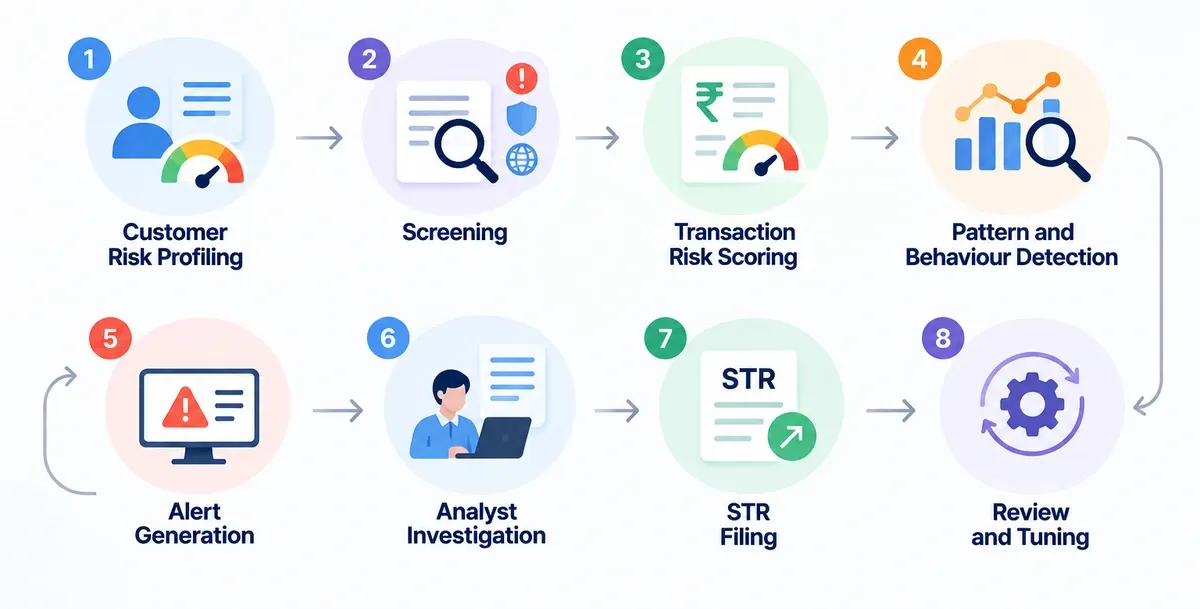
Transaction monitoring is not a single check but an ongoing cycle that runs every time money moves through a bank account. For RBI-regulated entities, this cycle is tied directly to compliance obligations and typically unfolds across eight stages.
Step 1: Customer Risk Profiling
Every customer gets a risk category, low, medium, or high, right at onboarding. This happens under the KYC Master Direction and determines whether the bank applies Simplified Due Diligence or Enhanced Due Diligence going forward. A politically exposed person, for instance, would automatically fall into the high-risk bucket and get watched more closely.
Step 2: Screening
Before a transaction is processed, the customer and relevant counterparties are screened against sanctions lists, watchlists, and other restricted-party databases. This step acts as a gatekeeper, helping financial institutions identify potential compliance risks and prevent prohibited transactions from proceeding.
Step 3: Transaction Risk Scoring
Every transaction is checked against what the bank knows about the customer, their declared profile, source of funds and stated purpose behind the relationship. If a transaction doesn't fit this picture, it's flagged for a closer inspection.
Step 4: Pattern and Behaviour Detection
Instead of fixed thresholds, banks compare a customer’s current activity to their historical baseline. This detects more subtle issues, like someone slowly changing their transaction habits in a way that doesn’t match how they’ve behaved before.
Step 5: Alert Generation
When a transaction crosses a rule, threshold, or a behavioural deviation, the system automatically raises an alert. These alerts are considered the trigger point that brings a transaction to human attention.
Step 6: Analyst Investigation
A compliance officer then reviews the alert. They look at supporting documents, transaction context, and any prior alerts tied to the same account or customer. This allows them to develop a complete picture before deciding whether the activity is genuinely suspicious.
Step 7: STR Filing
If the investigation confirms suspicion, the bank files a Suspicious Transaction Report with India's Financial Intelligence Unit, FIU-IND. This formal regulatory step then hands the matter over to higher authorities for further scrutiny.
Step 8: Review and Tuning
Monitoring doesn't stop once an alert is closed. Banks periodically reassess their rules and thresholds to keep pace with new fraud patterns, and they revisit a customer's risk rating whenever their profile or behaviour changes materially.
Suspicious Transaction Reporting (STR): What Gets Reported and Who Receives It
Transaction value alone does not make a transaction suspicious. Big transactions are often perfectly legitimate, and small transactions sometimes indicate financial crime. A suspicious transaction is defined as inconsistent with a bank’s or financial institution’s knowledge of the customer, including their risk profile, source of funds, occupation, business activities, and expected transaction behaviour.
Transaction monitoring systems are intended to identify such anomalies and trigger alerts for review. Institutions must review an alert to determine if the activity should be escalated and reported.
Common Red Flags That Trigger Investigation
Some of the most common indicators of suspicious activity include:
- Structuring or smurfing: Multiple transactions are deliberately kept below reporting or monitoring thresholds to avoid fraud detection. Read more about smurfing in banking in this blog.
- Deviation from expected behaviour: Sudden spikes in transaction volume, unusual transaction types, unfamiliar counterparties, or dormant accounts becoming unexpectedly active.
- High-risk geographies: Funds moving to or from jurisdictions with weak AML controls, sanctions risks or elevated financial crime exposure.
- Fast movement of funds: Funds deposited into and withdrawn from accounts in a short time without any apparent economic purpose, a pattern often associated with mule-account activity.
- Third-party account control: A major red flag in many mule-account and fraud investigations when the person who controls the account and the person using it appear to be different people.
STR vs. SAR vs. SMR: How These Three Differ
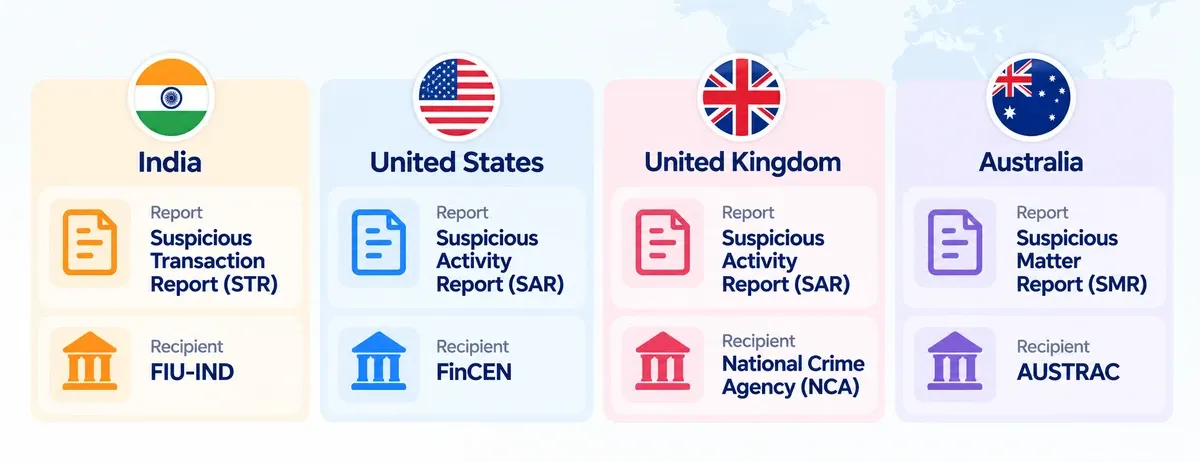
While financial institutions worldwide must report suspicious activity, the report name and the authority that receives it differ by jurisdiction.
| Country | Report | Recipient |
|---|---|---|
| India | Suspicious Transaction Report (STR) | FIU-IND |
| United States | Suspicious Activity Report (SAR) | FinCEN |
| United Kingdom | Suspicious Activity Report (SAR) | National Crime Agency (NCA) |
| Australia | Suspicious Matter Report (SMR) | AUSTRAC |
Swipe the table
In India, the reporting entities are required to submit Suspicious Transaction Reports (STRs) to the Financial Intelligence Unit–India (FIU-IND) if they find any activity which may be related to money laundering, terrorist financing, fraud or other criminal activities. India’s suspicious transaction reporting mechanism is centralised through FIU-IND, whereas in some jurisdictions, reporting obligations are distributed across several agencies. This makes accurate investigation, documentation and timely filing critical elements of an effective AML compliance programme.
Why Traditional Rule-Based Transaction Monitoring Is Reaching Its Limits
Rule-based transaction monitoring remains foundational; it underpins regulatory compliance and will continue to detect most obvious cases. But its limitations are becoming harder to ignore as transaction volumes and fraud sophistication both rise.
The False-Positive Crisis
SAS's research places true detection rates as low as 0.5–7% across transaction monitoring programmes. That means compliance teams at Indian banks routinely investigate thousands of alerts a month, only to find a small fraction are genuine, pulling analyst time away from the cases that matter.
Mule Account Networks Are Invisible to Single-Account Rules
Rule-based systems typically evaluate activity at the individual account level. Mule-account networks, however, operate across multiple accounts, devices, beneficiaries, and institutions. This means that low-risk-looking accounts may look perfectly reasonable in isolation, but when viewed in the aggregate, they are supporting significant fraud and money laundering. Detecting these networks requires relationship analysis and cross-entity intelligence rather than individual transaction rules.
Static Rules Miss Dynamic Behaviour
Customer risk segments are often reviewed only every 12–18 months, while spending and transfer behaviour shifts continuously. A rule calibrated for last year's typical customer may be poorly matched to this year's.
Rule Sprawl Compounds the Problem
As new typologies emerge, banks add new rules rather than retiring old ones. Overlapping rules generate duplicate alerts for the same underlying activity, creating additional investigative effort without delivering meaningful detection benefits.
Limitations of Traditional Rule-Based Monitoring
The biggest limitation with rule-based monitoring is that it can only find patterns that have been identified and already incorporated within the system. But things have changed as fraudsters are continuously adapting their fraud tactics to remain below established thresholds.
Emerging threats such as synthetic identities, first-party fraud and coordinated mule-account networks often exhibit behaviours that don’t align with the existing rules. As fraud schemes get more sophisticated, financial institutions are increasingly in need of monitoring approaches that go beyond predefined scenarios to detect previously unseen patterns.
Why Fraud Intelligence is Important in Today’s Transaction Monitoring
Banks and financial institutions need more context and deeper intelligence to uncover hidden risks associated with sophisticated mule-account networks, synthetic identities and coordinated fraud schemes.
- Behavioural analytics develops dynamic customer baselines, identifying deviations from expected behaviour instead of relying solely on certain fixed thresholds and static rules.
- AI and machine learning help uncover emerging fraud patterns and anomalies that may not yet be represented in existing monitoring scenarios. Read more to learn about how AI fraud detection works for banks and FinTechs in this blog.
- Network and link analysis reveals relationships between accounts, devices, identities, beneficiaries, and IP addresses, helping institutions identify mule-account networks, synthetic identities, and coordinated fraud rings that traditional monitoring may miss.
- Risk-based decisioning combines multiple signals into a unified risk score, enabling compliance teams to prioritise high-risk alerts and reduce investigative workload.
Rule-based monitoring evaluates individual transactions, while fraud intelligence can detect suspicious transactions linked to the identities, devices, and behaviours behind them. This broader view helps banks and financial institutions to identify complex fraud patterns and financial crime risks that traditional monitoring alone may miss.
How Sign3 Adds an Intelligence Layer Beyond Traditional Transaction Monitoring
Traditional transaction monitoring is good at spotting known risk scenarios, but often misses the hidden links behind modern financial crime. With fraud schemes becoming more networked and identity-driven, financial institutions need more context than just transaction data. This is the place where fraud intelligence enhances transaction monitoring, finding risks that rules and thresholds may miss.
- Device intelligence: identifying when the same device is completely linked to multiple accounts or identities.
- Behavioural biometrics: differentiating between genuine customer behaviour and scripted or automated activity.
- Digital footprint intelligence: assessing the broader credibility signals behind an identity, beyond the transaction itself.
- Network and relationship analysis: mapping connections between accounts to expose mule networks before funds move through them.
- Risk scoring: prioritising real-time alerts that are most likely to represent genuine suspicious transaction activity while reducing investigation load on financial data analysts.
At Sign3, we combine transaction monitoring with device, behavioural, and network intelligence to help financial institutions see hidden connections that traditional rules often miss. Instead of analysing transactions in isolation, teams gain a broader view of the identities and associations behind them, allowing them to identify mule accounts, synthetic identities, and other complex financial crime risks earlier.
Conclusion
Transaction monitoring remains a foundational AML control, but modern financial crime increasingly operates across multiple accounts, devices, and identities. As mule-account networks and sophisticated fraud schemes evolve, financial institutions need more than static rules and thresholds. By combining transaction monitoring with behavioural, network, and fraud intelligence, institutions can gain deeper visibility into hidden risks and improve detection accuracy. So, connect with us to learn how this fraud intelligence layer can work in real time in your system.
Frequently Asked Questions
What is transaction monitoring in banking?
Transaction monitoring in banking is the ongoing review of customer transactions to detect activity inconsistent with expected behaviour, helping banks identify money laundering, fraud, and sanctions evasion risks as required under RBI and PMLA regulations.
What is a suspicious transaction report (STR), and who receives it in India?
A suspicious transaction report, or STR, is a report filed when a bank's Principal Officer concludes a transaction is suspicious. In India, it must be filed with FIU-IND within seven days of that conclusion, under Section 12 of the PMLA.
What is the difference between transaction monitoring and transaction screening?
Screening checks a transaction or counterparty against sanctions and watchlists before processing. Transaction monitoring reviews transaction behaviour and patterns after the fact, over the customer's full lifecycle, to identify suspicious activity that a point-in-time screening check would not detect.
What is the difference between transaction monitoring and AML transaction monitoring?
Transaction monitoring is considered the broader function that covers fraud, payments, and operational risk. AML transaction monitoring is considered a subset, particularly built to meet PMLA and RBI's anti-money laundering obligations.
What are the steps in the transaction monitoring process?
The transaction monitoring process includes customer risk profiling, screening, risk scoring, pattern detection, alert generation, investigation, STR filing, and ongoing rule review. Each of them is tied to a specific RBI or PMLA obligation for regulated entities in India.
Are crypto and VDA platforms required to carry out transaction monitoring in India?
Yes, crypto and Virtual Digital Asset (VDA) platforms operating in India must carry out comprehensive transaction monitoring. Since a March 2023 amendment to the PMLA, virtual digital asset service providers are classified as reporting entities and must register with FIU-IND, apply KYC checks, and report suspicious transactions on the same statutory basis as banks.
Can AI replace rule-based transaction monitoring?
No, AI can not replace rule-based transaction monitoring. Rules remain necessary for regulatory compliance and for reliably detecting known typologies. AI and network intelligence extend what rules can see; they don't replace rule-based transaction monitoring, but add a layer that closes its detection gaps.


