

Credential stuffing is a type of automated cyberattack where a cybercriminal uses stolen usernames and passwords from one organisation. The data is usually obtained in a breach or purchased on the dark web to access user accounts at another organisation.
Credential stuffing attacks are one of the most common causes of data breaches. These attacks exploit password reuse, allowing cybercriminals to test stolen credentials across multiple accounts. Okta's 2025 Consumer Identity Trends Report found that one in five Indian consumers reused the same password across all their personal accounts. When those credentials are exposed in a data breach, attackers may use them to attempt unauthorised access to other services.
However, you can prevent credential stuffing attacks by implementing the right cybersecurity measures. In this blog, we will discuss how credential stuffing works, why these attacks succeed, how credential stuffing vs password spraying differ, and how to reduce the likelihood that your organisation will be a victim.
Key Takeaways On Credential Stuffing
- What is credential stuffing?
An automated cyberattack that uses stolen username and password combinations from previous data breaches to access accounts on other platforms.- Why does it work?
Password reuse often allows attackers to exploit previously compromised credentials across multiple websites and applications.- What are the risks?
Successful attacks can even lead to account takeover, financial fraud, unauthorised transactions, data theft, and misuse of customer accounts.- How can organisations prevent it?
Credential stuffing prevention works best when you combine MFA and passkeys with device intelligence, behavioural bot detection, breached-password checks, login rate limiting, and risk-based authentication.
What Is Credential Stuffing?
Credential stuffing is a type of cyberattack in which hackers use automated bots to try username and password combinations leaked in one data breach on many other sites and apps. Many people reuse passwords, so a small percentage of those attempts succeed. Each success gives the attacker a working account.
Attackers typically steal these credentials from previous data breaches, infostealer malware logs, or underground marketplaces. They then compile that data into lists of email addresses and passwords, which automated tools can test en masse against login pages.
For example, in 2024, Roku disclosed two credential stuffing incidents affecting approximately 15,000 accounts and a further 576,000 accounts. Nearly 400 accounts were linked to unauthorised purchases. The incidents demonstrate how attackers can exploit reused passwords to access accounts and make unauthorised transactions.
That’s why credential stuffing is so difficult to detect. Attackers usually abuse legitimate credentials, so login attempts may appear as normal user activity. Traditional firewalls alone may not be able to detect the threat, so authentication controls, device intelligence, and behaviour analysis are critical to identifying suspicious access.
How a Credential Stuffing Attack Works: 5 Stages
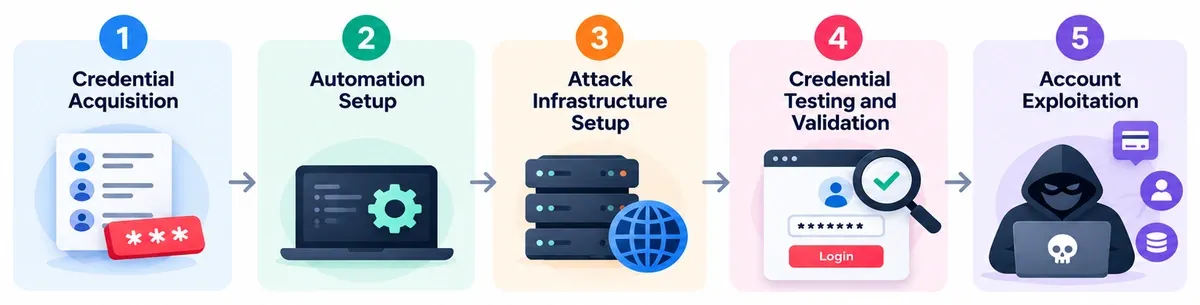
Credential stuffing attacks usually progress through five stages.
1. Credential Acquisition
Attackers will get username and password combinations from previous data breaches, malware logs, underground marketplaces, or from leaked datasets that are publicly available. This stage involves attackers taking these real credentials and making lists out of them to test against other websites and applications. However, unlike guessing attacks, credential stuffing usually relies on credentials that have already been leaked.
2. Automation Setup
Attackers use automated scripts or tools available on the market to attempt to use stolen credentials against multiple targeted login pages. Also, they can send a lot of fast authentication requests with these tools. Some campaigns even use CAPTCHA-solving services and rotating proxies to bypass basic security controls. Together, they distribute login attempts across different IP addresses, making fraudulent activity harder to detect and block.
3. Attack Infrastructure Setup
Attackers also built the infrastructure to distribute login attempts and manage responses. This step can be executed via a number of devices, servers, or proxy networks to make the traffic come from different sources. In addition, the spread of requests can also make detection more difficult, especially when security systems are based on IP addresses or simple login thresholds.
4. Credential Testing and Validation
In the credential testing and validation process, the automated campaigns try the stolen username/password combinations on the target accounts. Most attempts are unsuccessful because the credentials are incorrect, outdated, or no longer valid. But if a combination matches an active account, the attacker can get unauthorised access to that account and conduct fraudulent transactions.
5. Account Exploitation
Once an account is compromised, attackers may change its recovery details, steal personal information, make unauthorised purchases, or conduct fraudulent transactions, depending on the account's permissions and security controls. They may also exploit access to reach other systems.
How to Prevent Credential Stuffing
To prevent credential stuffing, it is necessary to apply a multi-layered security strategy because no single control can stop the attacks. Here’s how you can do that:
1. Enable MFA and Passkeys
Multi-factor authentication (MFA) adds an additional verification layer beyond passwords. Passkeys, on the other hand, use cryptographic credentials to resist phishing and password reuse. That’s where organisations prioritise passkeys or secure app-based authentication over SMS OTPs wherever possible. Additional verification should also protect sensitive actions, such as adding payees or changing account recovery details.
2. Use Device Intelligence
Device intelligence analyses multiple aspects such as hardware, software, and device-related signals to identify suspicious login attempts. It can even detect emulators, cloned apps, and devices attempting to access multiple accounts. Furthermore, by connecting different activities across sessions, organisations can successfully identify potential credential stuffing attacks even when attackers rotate IP addresses. This helps them block risky logins or request additional verification.
3. Detect Bots with Behavioural Signals
Behavioural analysis examines certain typing patterns, mouse movements, touch gestures, and navigation behaviour to distinguish genuine users from automated attacks. Repetitive or unnatural interactions may indicate bot activity. Combined with other security signals, behavioural detection can identify suspicious login attempts and account takeover activity, even when attackers use valid credentials to bypass basic authentication controls.
4. Block Breached Passwords and Rate-Limit Logins
Organisations should check new and reset passwords against known compromised-password lists and reject exposed credentials. Login rate limiting across accounts and devices can help detect automated attempts, including attacks using rotating proxies. Consistent error messages and password manager support further strengthen login security while helping users adopt unique passwords for different accounts.
5. Add Risk-Based Step-Up Authentication
Risk-based authentication changes the level of verification required depending on the risk of a login or transaction. Sessions that are normal and low risk can continue as normal. But when suspicious activity is detected, like logging in from an unknown device or a strange location, the user must verify their identity again. High-risk attempts can be blocked, helping to prevent account takeover without creating unnecessary friction for legitimate users.
Why Credential Stuffing Attacks Succeed
Credential stuffing attacks become successful because attackers can exploit exposed credentials through automation and exploit weaknesses in traditional login security. Below are four key factors that make credential stuffing prevention difficult.
-
Password reuse: When users reuse passwords across multiple places such as banking, shopping, and social media accounts, a data breach on one platform can expose their password to their other accounts. Even a strong password offers little protection if attackers already know it and can reuse it elsewhere.
-
A continuous supply of stolen credentials: Previous data breaches, infostealer malware, and underground marketplaces provide attackers with large collections of username and password combinations. When new credentials are exposed, attackers successfully get more chances to target accounts across multiple platforms.
-
Affordable automation tools: Pre-built automation tools allow attackers to automate thousands of login attempts without the need to use their own software. These tools allow testing the stolen credentials at scale, making credential stuffing much more accessible to a wider range of cybercriminals.
-
Evasive traffic techniques: Attackers use multiple rotating residential proxies and distributed connections to make login attempts appear to originate from different users and locations. This makes IP-based detection and blocking much less effective.
Credential Stuffing Detection: Warning Signs
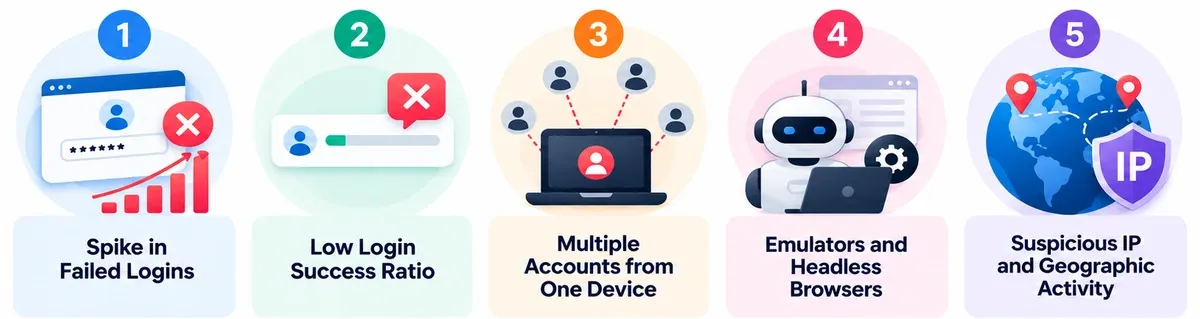
Credential stuffing detection usually starts with the login funnel. Automated bots generate login patterns that differ from those of genuine customers, particularly when attackers test stolen credentials at scale. To understand the differences between credential stuffing vs password spraying, looking at how failed login attempts are distributed across accounts and passwords can provide better insight.
While credential stuffing reveals multiple accounts per device, spraying, on the other hand, reveals repeated use of one password across multiple accounts. That’s why checking for these signals together is necessary. In isolation, the signals may fail to prove any strong case.
| Key Signals | What You Will See | Why It Matters |
|---|---|---|
| Spike in failed logins | A sudden increase in failed authentication attempts compared with normal traffic | A sudden rise can signal bots testing large volumes of stolen credentials. |
| Low login success ratio | A high volume of login attempts with very few successful authentications | This pattern often suggests that many stolen credential pairs are outdated or invalid. |
| Multiple accounts are targeted by one device | One device or fingerprint is attempting to access numerous accounts | A single device accessing numerous accounts could point to automated credential testing. |
| Emulators and headless browsers | Virtual device environments, automation frameworks, or unusual browser signals | Virtual environments and unusual browser signals can expose bots designed to bypass conventional login protections. |
| Unusual geographic or session patterns | Logins from distant locations within a short period or unexpected changes in the session context | Rapid logins from distant locations or unexpected session changes can signal account takeover attempts. |
| Suspicious IP and proxy activity | Login attempts from data-centre IPs, rotating proxies, or unusual network sources | Data-centre IPs and rotating proxies can help attackers distribute login attempts and evade IP-based detection. |
Swipe the table
These warning signs should also be analysed together. These help distinguish credential stuffing from legitimate spikes in login activity. Furthermore, monitoring changes against normal traffic patterns helps security teams identify suspicious attempts earlier. Combining these signals with device intelligence and behavioural analysis can improve credential stuffing detection and reduce the risk of account takeover.
Credential Stuffing vs Brute Force vs Password Spraying
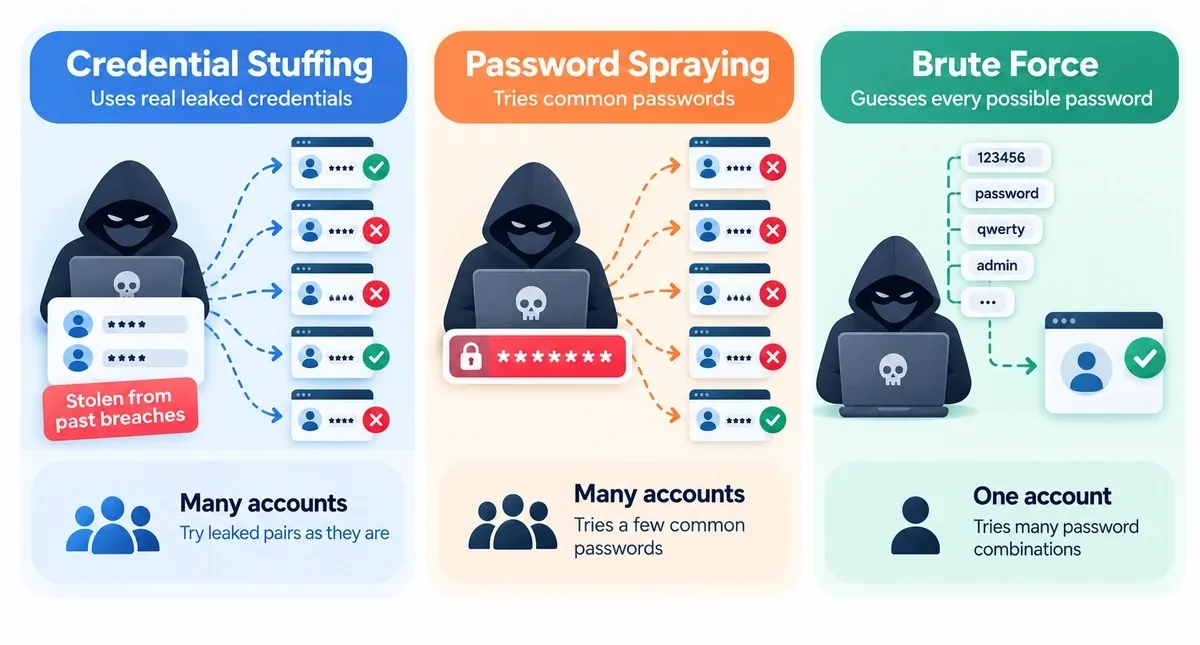
Credential stuffing vs password spraying is the pairing most often confused, because both target many accounts at once. There are three popular password-based cyberattacks that attempt to gain unauthorised access to user accounts: credential stuffing, brute force, and password spraying. Although they share a common goal, they approach it differently by how they leverage credentials, perform login attempts and exploit security vulnerabilities. Recognising these differences enables organisations to detect suspicious login patterns and put in place relevant security controls.
| Key Aspects | Credential Stuffing | Password Spraying | Brute Force |
|---|---|---|---|
| What the attacker knows | Real username and password pairs from past breaches | A list of usernames, but no passwords | Usually, one username and nothing else |
| How guesses are made | Each leaked pair is tried as it is | A few common passwords were tried across many accounts | Many guesses, or every combination, against one account |
| Login pattern | Many accounts, one or two attempts each, from many devices | Many accounts, few attempts each, slow and steady | Many rapid attempts on a single account |
| How to detect | Low login success ratio, many accounts per device | Same password attempted across many accounts | Repeated failures on one account |
| Best defence | MFA, breached-password checks, device and behaviour signals | Banned common passwords, MFA, and alerts on failed login attempts | Rate limits, lockouts, strong passwords |
Swipe the table
Although credential stuffing, password spraying, and brute-force attacks are interchangeable terms, in the end, all these target user authentication and each of them exploits passwords differently. Organisations should even tailor their defences to these attack patterns rather than relying on a single security measure. That’s why combining multi-factor authentication (MFA), login rate limiting, breached-password checks, device intelligence, and behavioural monitoring helps detect suspicious activity, prevent unauthorised access, and reduce the risk of account takeover.
Detect Credential Stuffing with Sign3!
Sign3’s Device Intelligence not only strengthens credential stuffing detection by analysing device-level signals, but it also successfully identifies suspicious login patterns. Sign3’s device intelligence can flag emulators, identify cloned apps and detect devices attempting to access multiple accounts. The intelligence works effectively even when attackers rotate IP addresses to evade fraud detection.
Furthermore, by connecting the links between login attempts, organisations can potentially identify fraudulent sessions before the fraudsters lead to account misuse. These insights enable security teams to trigger additional verification or block high-risk access while minimising friction for legitimate customers. Book a demo and find out how to strengthen your defences against credential stuffing.
Frequently Asked Questions
Is credential stuffing illegal in India?
Yes, credential stuffing is illegal in India. When it comes to accessing an account without permission can attract the Information Technology Act, 2000, including Sections 43 and 66. Fraudulent use of someone else's password falls under Section 66C, which carries up to three years in prison and a fine of up to ₹1 lakh.
Does a strong password stop credential stuffing?
No, a strong password cannot stop credential stuffing. If the password is reused and the attacker already has it, they can access the account. Using a unique password for every account protects you, and a password manager makes the task much easier.
Can MFA stop credential stuffing?
Yes, MFA can stop credential stuffing, but only to a certain extent. It happens because MFA stops multiple attempts. Similarly, passkeys and app-based approvals can help to that extent. Sign3’s fraud intelligence layer further strengthens fraud prevention through device intelligence and behavioural checks. Layering these security measures helps businesses identify suspicious login attempts and close gaps that manual or single-authentication approaches alone may miss.
How is credential stuffing different from phishing?
Credential stuffing is different from phishing because phishing attacks typically trick a person into handing over a password. Credential stuffing doesn't require a victim at the time. Automated bots also reuse data that was leaked earlier.
What should users do if their password leaked?
If passwords have leaked, users should change them immediately on that particular site and anywhere else they were used. Switching to a password manager, turning on MFA and reviewing recent activity are also necessary. If money is missing, inform the bank at once and report it to 1930 or cybercrime.gov.in.


