

No credit history does not necessarily mean that the applicant is a high-risk borrower, but it means the lenders have less evidence to approve the loan application. With fraudsters able to submit multiple applications remotely using stolen identities, manipulated documents, or fabricated financial information, lenders face a dual challenge. These include assessing repayment capacity without an established credit history and identifying fraudulent applications before disbursement.
NBFCs seeking to deepen access to formal credit can find a substantial growth opportunity in India's new-to-credit (NTC) borrowers. However, without an established credit history, it may be difficult to assess their ability to repay and creditworthiness. Lenders need to look at other signs of financial stability and tell the difference between real first-time borrowers and fraudulent applicants. NTC Underwriting helps NBFCs to make good lending decisions, manage credit risk and offer responsible finance to underserved customer segments.
In this guide, we will cover what is new in credit underwriting, how the process works, and how NBFCs make more informed lending decisions when de-risking loans to first-time borrowers while approving credit responsibly.
Key Takeaways
- Assessing new-to-credit (NTC) borrowers requires identity verification, verified income, affordability checks, and relevant alternative data.
- No credit history does not automatically indicate poor creditworthiness. That’s why credit scoring for first-time borrowers should evaluate applicants using reliable evidence rather than treating an unavailable bureau score as a rejection trigger.
- Phone, email, device, image, and address signals used as alternative data for credit risk assessment can help to identify inconsistencies and suspicious applications. But these signals cannot independently establish the applicant's repayment capacity.
- Students, salaried professionals, self-employed individuals, freelancers, and street vendors need to provide enough data to cooperate with multiple income verification methods and affordability assessments.
- Apply risk-based lending policies, validate assessment models, and monitor the complete repayment performance to refine the credit decisions and strengthen credit risk management for NBFCs over time.
How NBFCs Can De-Risk Lending to Thin-File Borrowers
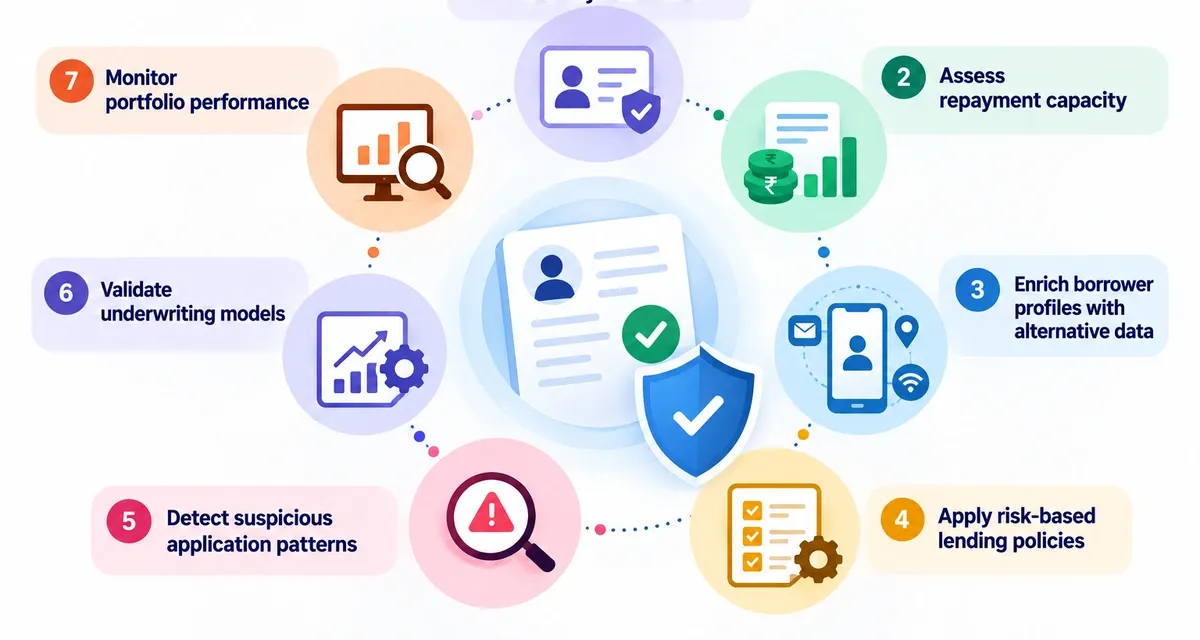
NBFCs can de-risk lending to thin-file borrowers by combining reliable identity verification, affordability checks, alternative data, and risk-based underwriting. Rather than treating the absence of a credit history as a sign of high risk, lenders should build a more complete view of each applicant before making a decision. The following measures can help NBFCs identify potential fraud, assess repayment capacity, and extend credit responsibly to first-time borrowers.
- Strengthen identity verification: Complete KYC checks and look for inconsistencies in identity details, submitted documents, and application information to identify potential impersonation or synthetic identity fraud.
Read the guide to learn more about synthetic identity fraud.
-
Assess repayment capacity: Evaluate verified income, bank inflows, business cash flow, existing obligations, and proposed EMI affordability, which is the core of credit risk assessment for first-time borrowers. Use the appropriate evidence to understand the borrower's employment or business model rather than relying solely on their salary slips.
-
Enrich borrower profiles with alternative data: Use consented phone, email, image, address, and device signals as alternative data for credit risk assessment to identify any kind of inconsistency and add the necessary context to applicants with limited bureau records.
-
Apply risk-based lending policies: Establish clear approval, rejection, and manual-review thresholds. Where justified by the lender's policy and affordability assessment, consider smaller initial loan amounts or even shorter tenures for applicants whose risk level can be managed, which helps in de-risking loans to first-time borrowers.
-
Detect suspicious application patterns: Examine some signals such as repeated device usage across unrelated applications, reused images, inconsistent contact details, and unusual address overlaps. All these together flag applications for further verification.
-
Validate underwriting models: Test credit risk models, including alternative credit scoring models, against real repayment outcomes. Assess how accurate, fair and suitable they are for first-time borrowers in different segments. As the NBFC's loan portfolio grows, borrower profiles evolve, and new repayment data become available, review model performance regularly.
-
Monitor portfolio performance: Track early delinquencies, missed EMIs, and emerging fraud patterns after disbursement. When these findings are used appropriately, they help to refine certain risk thresholds, lending policies, and monitoring practices that support credit risk management for NBFCs.
De-risking loans to first-time borrowers does not mean approving every applicant. It means making evidence-based decisions that distinguish genuine applicants with limited credit histories from applications with unverifiable repayment capacity or elevated fraud risk.
Understanding the NTC Borrower Opportunity in India
India’s new-to-credit (NTC) segment presents an opportunity for NBFCs to expand access to formal lending. These borrowers may include salaried employees, self-employed professionals, small-business owners, and gig workers who have never borrowed through formal credit channels. Without an established borrowing history, they may be harder to assess using conventional credit scoring methods.
According to CRIF High Mark’s April 2026 report, Bridging the Gap: Unlocking Growth from New-to-Credit Borrowers, 4.4 crore borrowers entered the formal credit system in the 12 months ending February 2026, compared with 3.6 crore four years earlier. NBFCs accounted for over 60% of new-to-credit accounts, highlighting their role in extending formal credit to this segment.
TransUnion CIBIL’s July 2026 study, Unlocking Access: Journey of Credit Expansion in India, estimates that India had 89 crore credit-eligible individuals in March 2026, of whom 74% had accessed retail credit at least once. NTC borrowers accounted for 13% of retail credit originations in the March 2026 quarter, down from 32% in March 2017. Although their share has declined, opportunities remain to extend formal credit to people who have not yet established a borrowing history.
For NBFCs, the challenge is to identify creditworthy applicants without relying solely on conventional bureau records. Combining credit bureau checks with verified income documents, affordability assessments, and relevant alternative data can help lenders evaluate repayment capacity and manage risk while expanding access to responsible credit.
What is NTC ( New to Credit ) Underwriting?
NTC underwriting is how lenders evaluate applicants who have never borrowed through formal credit channels, and therefore do not have an established credit history. There isn’t a credit score to rely on, so lenders have to look at other evidence such as verified identity, income or business records, bank transaction patterns and relevant application data.
NTC borrowers and thin-file borrowers are not the same. NTC applicants have no formal borrowing history; thin-file applicants have some credit history, but not enough bureau data for a reliable assessment. Both groups may require further validation, but their underwriting needs are different.
Also, not having credit history is not the same as having poor credit history. A borrower with a bad record has a record of past credit behaviour; an NTC applicant has no formal borrowing history to judge. Risk-based underwriting lets lenders distinguish between applicants with little evidence of repayment and those with a history of repayment problems.
In practice, the underwriter’s job is to build a reliable picture of the applicant’s capacity to repay, using verifiable evidence, rather than treating the absence of a credit score as an automatic reason for rejection.
Why Traditional Credit Underwriting Struggles with NTC Borrowers
For new-to-credit (NTC) borrowers, the absence of an established borrowing history limits the information available to conventional credit scoring models. This makes it harder for NBFCs to assess creditworthiness using traditional methods alone. The key challenges include:
-
No established credit history: Conventional credit scoring models rely on past borrowing and repayment behaviour. For NTC borrowers, the absence of an established credit history may mean that a bureau-based credit score is unavailable, leaving lenders with limited historical evidence to assess creditworthiness.
-
Limited income documentation: Young professionals, consultants, and freelancers may not have any conventional salary slips or consistent employment records to demonstrate their earnings.
-
Irregular income patterns: Shopkeepers, gig workers, and even self-employed individuals often experience fluctuating earnings, making standard affordability assessments less reliable without additional cash-flow evidence.
-
Incomplete financial records: Cash-heavy businesses and informal-sector workers may have limited formal banking activity or documentation, making it harder to establish their actual income and financial stability.
-
Difficulty distinguishing missing data from high risk: An absent credit history does not automatically indicate a high likelihood of default. Treating all unscored applicants as risky can lead lenders to reject creditworthy borrowers, including many credit-invisible consumers.
-
Risk of inadequate verification: Relaxing lending criteria simply because an applicant lacks credit history can expose NBFCs to unverified repayment capacity and potential fraud.
Effective credit risk management for NBFCs requires distinguishing between borrowers who lack a credit history and applicants whose repayment capacity or identity cannot be adequately verified. The goal is to assess each applicant using reliable, relevant evidence rather than treating missing information as proof of risk.
Types of NTC Borrowers Lenders Can Assess
New-to-credit (NTC) borrowers span several customer segments, each with different income patterns, documentation requirements, and new-to-credit underwriting challenges. NBFCs can tailor their credit risk assessment for first-time borrowers to the following groups:
-
College students: Students often have little or no independent income, making repayment capacity dependent on a co-applicant or guarantor. Lenders should assess the institution, course details, and the co-applicant’s income and credit profile.
-
First-time salaried employees: Individual’s entering their first formal job may have limited employment and credit histories. Offer letters, recent payslips, employment details, and bank salary credits often help establish income stability.
-
Self-employed doctors and chartered accountants: These professionals may have strong earning potential but variable income. Income Tax Returns (ITRs), professional registration, practice details, and bank statements can help lenders verify declared earnings and assess their financial position.
-
Proprietors and small merchants: Business and personal finances may overlap, making income assessment more complex. GST records, bank statements, business vintage, and available evidence of business activity can help establish creditworthiness.
-
Street vendors: Daily and cash-based earnings may leave limited financial records. Lenders in such cases can assess identity, business and location stability, and available income evidence. Based on this assessment, they may start with a small loan limit and increase it after the borrower demonstrates consistent, timely repayments.
-
Gig workers and freelancers: Earnings may come from multiple platforms or clients and fluctuate monthly. Platform payout records, bank credits, invoices, and transaction history can help establish income consistency.
-
Informal-sector workers: These borrowers may have limited documentation and work with informal employers. Lenders can use appropriate identity checks, available income evidence, employer or work verification, and relevant alternative signals to build a more complete applicant profile.
NBFCs should match verification methods to each borrower’s circumstances to assess repayment capacity without automatically excluding credit-invisible consumers.
What Is Alternative Data in Credit Underwriting?
Alternative data is the information used in a credit decision that does not come from a traditional credit bureau. In alternative credit scoring, lenders may use consented signals from phone numbers, email addresses, devices, images, or addresses alongside standard identity and income checks to gain additional context about an applicant.
These signals help a lender judge whether an applicant is who they claim to be, whether the application looks genuine, and whether their digital footprint fits a genuine person. The data can not independently prove that someone has the capability to repay a loan, but it can strengthen the factors whether an applicant is trustworthy through established income and cash flow.
Types of Alternative Data Used to Assess NTC Borrowers
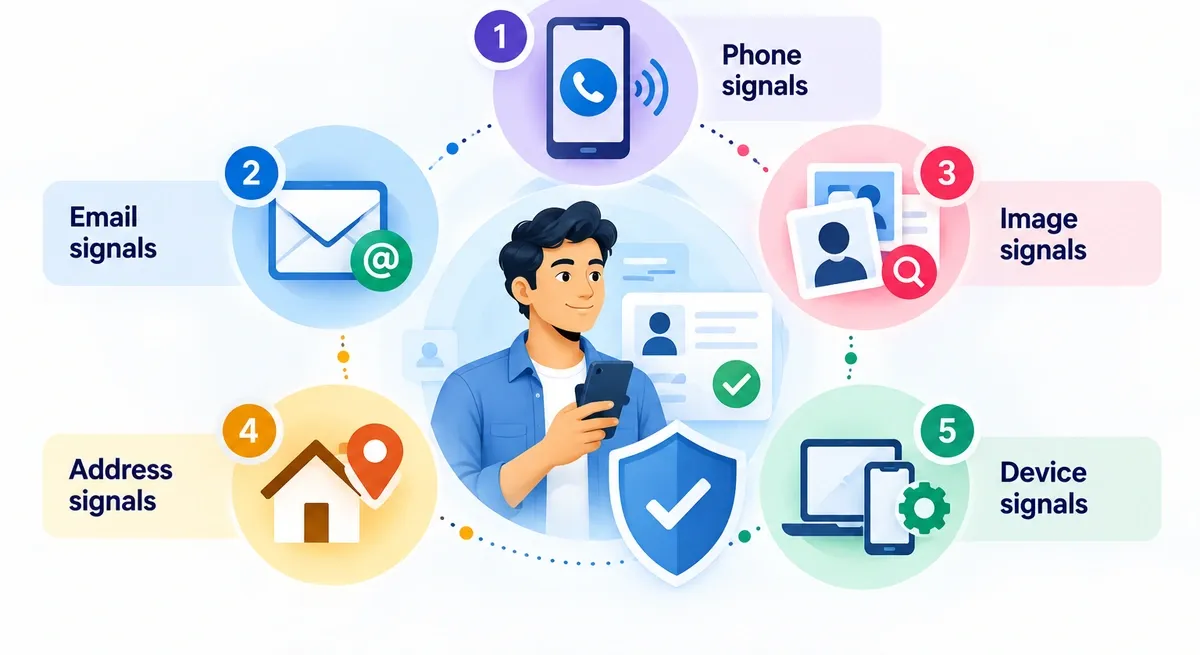
Alternative data for credit risk assessment helps NBFCs build a more complete view of new-to-credit borrowers when traditional credit records are very limited. Five categories of alternative signals can supplement identity verification, application integrity checks, and digital lending risk assessment.
-
Phone signals: Assess the age and consistency of a phone number and its associations with other accounts, where available. A long-standing number may provide some useful context, while a recently created number may trigger the requirement for additional checks.
-
Email signals: Examine the email age, usage patterns, and indicators of disposable or recently created addresses. These signals can help identify inconsistencies in an applicant's digital footprint.
Read the guide to learn more about the digital footprint.
-
Image signals: Analyse submitted photographs and documents for signs of reuse, manipulation, or inconsistencies with the claimed identity. Suspicious findings can trigger further verification.
-
Address signals: Compare declared addresses with available records and relevant location information. Repeated use of the same address by unrelated applicants may warrant investigation, although shared addresses can also have legitimate explanations.
-
Device signals: Examine device history, repeated use across applications, and indicators of emulators or device tampering. Such signals can help flag potentially coordinated or fraudulent applications for further review.
Together, these signals can support identity consistency checks, application integrity assessment, and digital footprint analysis. Sign3’s fraud intelligence platform uses these signals to help financial institutions identify potential fraud risks and strengthen underwriting decisions for thin-file and new-to-credit borrowers.
Alternative Data vs. Traditional Credit Bureau Data
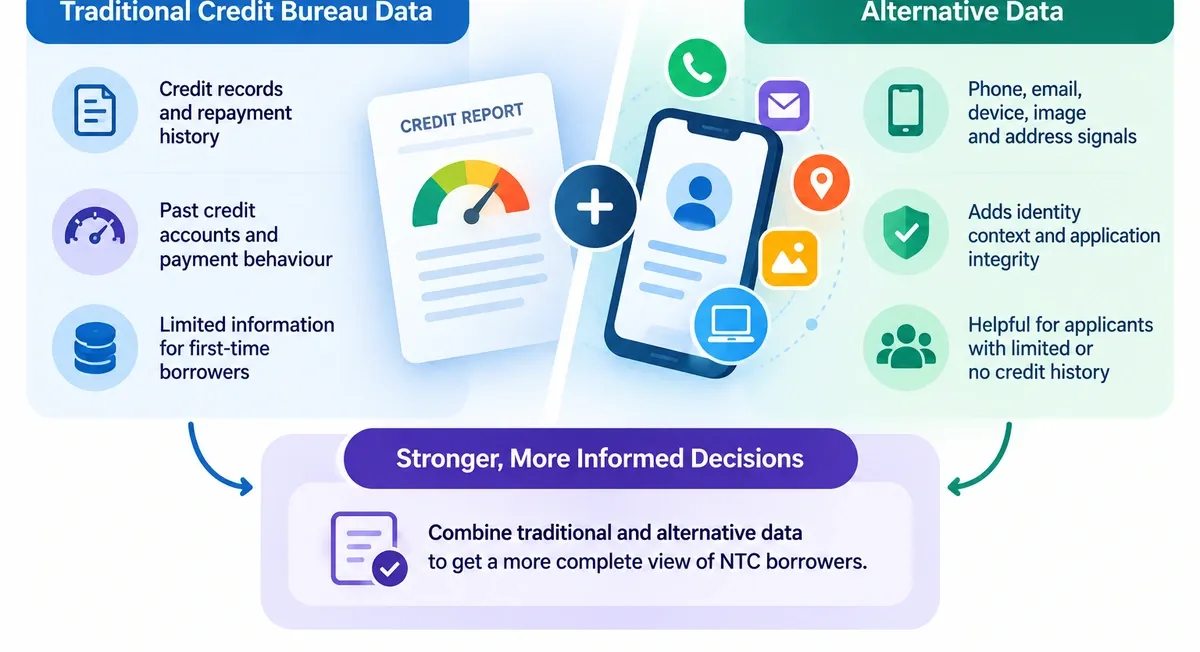
Traditional credit bureau data provides information on reported borrowing and repayment history, and alternative data can add context around an applicant’s identity, digital footprint, and the consistency of the application. Combining these sources with verified income and affordability assessments can help NBFCs make more informed underwriting decisions for new-to-credit borrowers.
| Factors | Traditional Bureau Data | Alternative Data |
|---|---|---|
| Data availability | Primarily provides credit records for applicants with an established borrowing history | Can provide additional signals for applicants with a digital presence |
| Repayment history | Provides information on past credit accounts and repayment behaviour, where available | Does not directly establish repayment behaviour or capacity |
| Digital signals | Does not typically focus on phone, email, and device intelligence | Can include phone, email, device, image, and address signals |
| Identity context | Provides limited digital identity context | Can add context about identity consistency and application integrity |
| Suitability for NTC applicants | Limited when no credit history exists | Can supplement traditional checks when bureau information is unavailable |
| Limitations | May not provide a score or repayment history, which limits credit scoring for first- time borrowers | Requires appropriate consent, data-quality checks, validation, and careful interpretation |
| How they work together | Provides repayment history and credit exposure information where available | Helps fill information gaps and flag inconsistencies for further assessment |
Swipe the table
For effective new-to-credit underwriting, NBFCs should use alternative data and alternative credit scoring that complement bureau checks, identity verification, and affordability assessment, not as a standalone measure of creditworthiness.
Why NTC Borrowers Are Difficult to Evaluate
NTC borrowers are much more difficult to evaluate because conventional underwriting relies on credit histories, formal income documents, and established financial records. When these data are missing or incomplete, NBFCs are left with much less information to evaluate an applicant's creditworthiness.
| Challenge | What It Means for the Lender |
|---|---|
| No bureau score | The lender has limited information about the applicant's past credit behaviour and repayment history. |
| Limited formal income proof | Salary slips, income tax returns (ITRs), or other income documents may be unavailable or may not fully reveal the actual earnings. |
| Irregular earnings | Fluctuating monthly cash flow makes it much harder to assess affordability while using standard income measures alone. |
| No repayment records | There might be little or no evidence of how the applicant manages formal debt obligations. |
| Identity verification challenges | Limited records can make it harder to identify impersonation, synthetic identities, or inconsistencies in application details. |
| Limited visibility into the customer profile | The lender has little information beyond what the applicant declares |
Swipe the table
Distinguishing Credit Risk from Fraud Risk
Two different risks can look similar when an applicant has a thin credit file:
-
Credit risk: The possibility that a genuine borrower will be unable to repay the loan as agreed.
-
Fraud risk: The possibility that an applicant is misrepresenting their identity, submitting manipulated documents, or using a fraudulent application.
India’s digital lending market continues to create opportunities for NBFCs to expand access to formal credit. Digital lenders disbursed ₹97,381 crore in the first half of FY2025–26, highlighting the scale of lending activity. That’s why detecting suspicious identities and inconsistencies early strengthens credit risk management for NBFCs by avoiding lending decisions based on unreliable applicant information. Once identity is sufficiently verified, lenders can complete credit risk assessment for first-time borrowers using suitable income evidence, affordability checks, and relevant alternative data.
How to Underwrite Borrowers Without Credit History: A Checklist
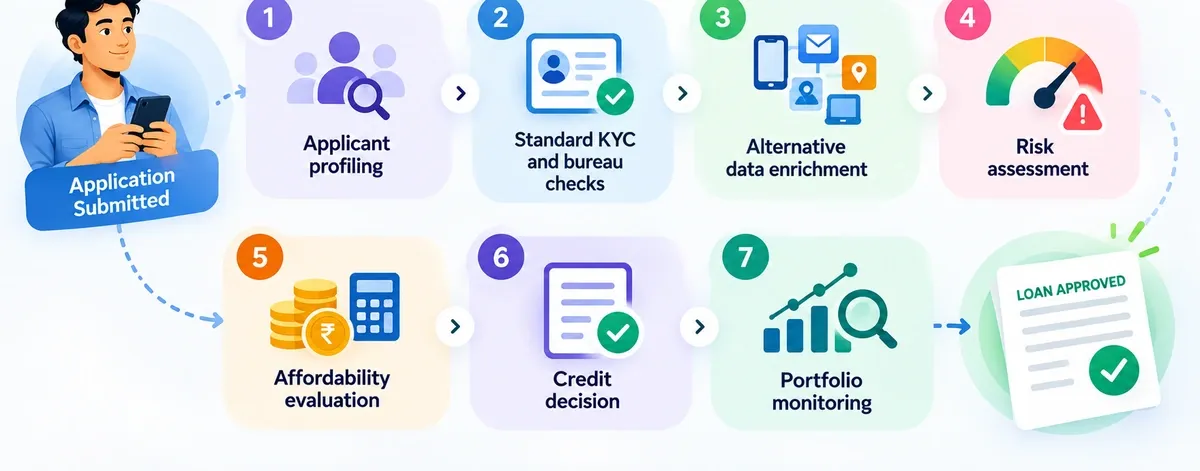
Loan underwriting for thin-file borrowers, including new-to-credit (NTC) applicants, requires a well-structured process. NBFCs can follow these seven steps to make informed lending decisions while managing both credit and fraud risks effectively.
-
Applicant profiling: Classify the applicant as a student, first-time salaried employee, self-employed professional, small merchant, or gig worker. This classification helps to identify the most relevant income and identity evidence.
-
Standard KYC and bureau checks: Verify the applicant's identity and also review the available bureau records. This allows lenders to establish whether the borrower is genuinely new to credit.
-
Alternative data enrichment: Incorporate the relevant phone, email, image, address, and device signals to add the proper context to the applicant's profile. Collect and use these signals in accordance with applicable consent and data-protection requirements.
-
Risk assessment: Evaluate the available evidence for credit risk assessment for first-time borrowers through a validated risk model or scorecard. It helps to flag inconsistencies and trigger the requirement for further investigation or manual review for high-risk cases.
-
Affordability evaluation: Assess the income or business cash flow against existing financial obligations and the proposed EMI. Select the right evidence, which is appropriate to the borrower's employment or business model.
-
Credit decision: Apply predefined lending policies to approve, decline, or offer suitable loan limits. Set limit, tenure, and pricing to match verified repayment capacity and assessed risk.
-
Portfolio monitoring: Track early repayment behaviour, missed EMIs, and emerging fraud indicators after disbursement. Feed repayment outcomes and portfolio performance data back into underwriting policies and risk models to refine lending decisions over time.
Lenders can integrate these steps into their digital application workflows to improve processing efficiency while maintaining appropriate verification, risk assessment, and lending decision controls.
See Beyond the Credit Score with Sign3 Digital Footprint
New-to-credit (NTC) borrowers aren't necessarily high-risk applicants; lenders may simply lack enough information to assess them confidently. NBFCs can make more informed lending decisions by combining traditional credit checks and affordability assessments with relevant alternative data.
Sign3 Digital Footprint uses phone and email signals to add context to digital lending risk assessment. For lenders evaluating new-to-credit borrowers, this can complement existing checks in loan underwriting for thin-file borrowers and help build a more informed view of applicant profiles.
Ready to enrich your NTC underwriting process? Book a demo and explore how our Digital Footprint, along with additional phone and email intelligence, can support more informed applicant assessment.
Frequently Asked Questions
What is NTC underwriting?
New-to-credit (NTC) underwriting is the process lenders use to assess loan applications from individuals who have never borrowed through formal credit channels and therefore lack an established credit history.
How can lenders assess borrowers with no credit history?
Lenders can assess borrowers with no credit history by verifying identity and testing affordability against income or cash flow. They also check for signals such as phone, email, device, and address data to build a more data-enriched profile.
What is alternative data in lending?
Alternative data in lending refers to information used outside the traditional credit bureau records. However, lenders collect it with the user's consent, and it provides context about an applicant's identity, behaviour, and application integrity.
How can NBFCs lend to first-time borrowers?
NBFCs segment first-time borrowers based on income type, employment status, and repayment capacity, and start with smaller limits. Income is verified by salary slips and bank statements for salaried applicants and bank statements and business records for self-employed applicants.
Can alternative data replace a credit score?
No. Alternative data cannot completely replace a credit score, but alternative credit scoring can supplement traditional credit assessment and provide additional insights into an applicant's risk profile. For applicants with no established credit history, it can help fill information gaps by adding context on identity and application integrity.
How can lenders assess self-employed borrowers without salary slips?
Lenders can assess self-employed borrowers by reviewing their ITR, GST returns, bank statements, and business registration to estimate income. Then, they add alternative data for credit risk assessment, such as phone and email age, device history, image reuse, and address consistency, to confirm their identity and application integrity.
Can students get loans without credit history?
Yes, students can get education loans without a credit history. Lenders may consider the co-applicant's or guarantor's income and credit bureau records, along with the student’s admission status, course, institution, and repayment prospects. Eligible students may also avail of government-backed schemes: education loans of up to ₹7.5 lakh are eligible for a 75% government guarantee against the outstanding default under the PM-USP Credit Guarantee Fund Scheme for Education Loans (CGFSEL), subject to scheme conditions. This allows banks to make collateral-free loans without a third-party guarantor.


