

Biometric verification is the process of confirming a person's identity by matching their unique physical or behavioural characteristics (such as fingerprints, face or voice) to a stored reference. Instead of using traditional passwords or documents that can be stolen, shared or compromised to carry out fraudulent activities, biometric verification checks that the person presenting the identity is the legitimate owner by matching unique physical or behavioural traits to a stored biometric reference.
This guide explains how biometric verification works, the different types of biometrics, common use cases, security considerations, fraud prevention applications and how organisations can combine biometric signals with other risk intelligence to build stronger digital identity verification systems.
Key Takeaways
-
Biometric verification confirms a user’s identity using unique traits like fingerprints, face, or voice.
-
Biometric identification searches a database to find who someone is, not confirm a claim.
-
Common use cases include KYC, banking logins, payments, healthcare, and remote onboarding.
-
Pairing biometrics with device and behavioural signals strengthens fraud protection.
-
No single method is foolproof, so layered, multi-signal defences matter most.
What Is Biometrics?
Biometrics is the physical or behavioural data a system uses to confirm a person’s identity. Common biometric traits include fingerprints, facial features, iris patterns, voice characteristics, and behavioural signals such as typing rhythm.
The system does not store a photo or a fingerprint image in the traditional sense; rather, it converts the physical trait into a mathematical representation. Then, the system checks whether a new sample matches that representation closely enough to consider the same person genuine.
Traditional identity checks are based on data or something a person knows, such as a password, or something they carry, such as an ID card or an OTP. They can be forgotten, stolen or given to another person to commit fraud.
But biometric traits are much harder to convincingly fake, which is why banks, fintech apps, telecom providers and government platforms have adopted biometric verification for onboarding, login and high-risk transactions. It does not replace every other check, but it closes a gap that traditional passwords and documents were never built to cover.
Biometric Verification Meaning: How Does It Work?
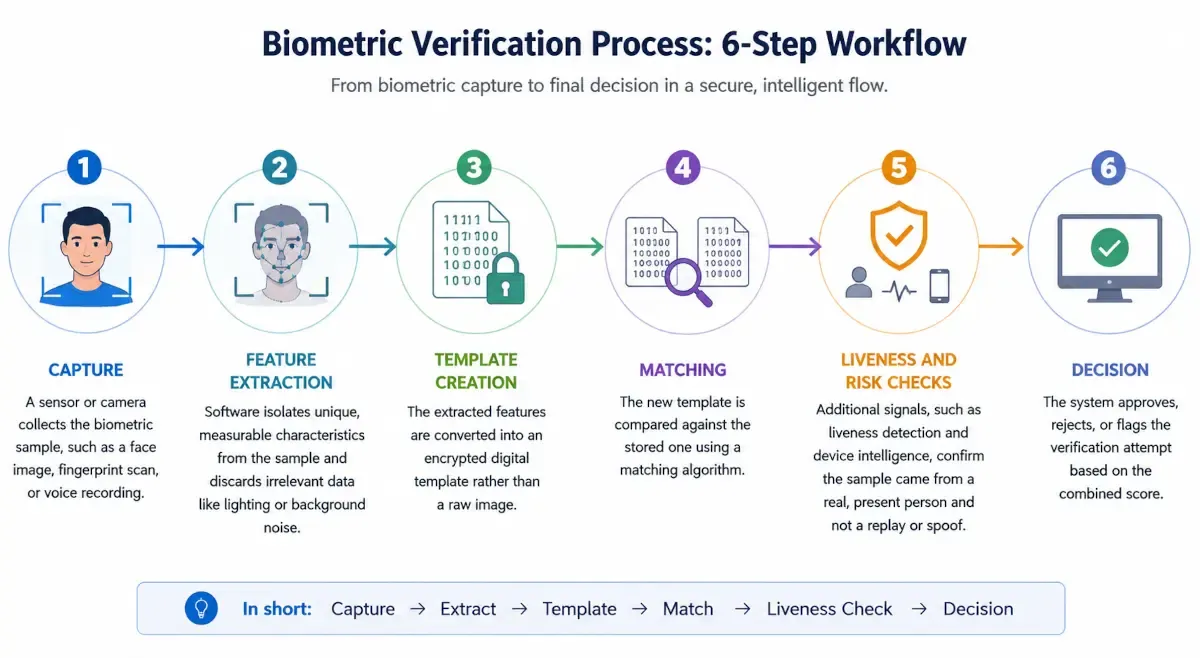
Biometric verification is the process of confirming that a person is who they claim to be by comparing a live biometric sample against a previously stored biometric template within the system. The system never compares raw images directly. It extracts distinguishing features, such as the ridges on a fingerprint or the distances between facial landmarks, converts these features into a numerical template, and securely stores that template.
The process is repeated on the new sample when someone tries to re-verify their identity, and the matching algorithm is employed to ascertain the closeness of the match between the two templates. If the similarity score is higher than a threshold, the verification is successful.
The process typically follows these steps:
- Capture: A biometric sample (e.g., facial image, fingerprint scan, voice recording) is taken by a sensor or camera.
- Feature extraction: The software identifies the unique and quantifiable characteristics of the sample, discarding irrelevant information, like lighting or background noise.
- Template generation: Instead of a raw image, the extracted features are transformed into an encrypted digital template.
- Matching: The new template is matched against the stored template.
- Liveness and risk checks: Other signals such as liveness detection and device intelligence check that the sample is provided by a real, live person, not a replay or a spoof.
- Decision: The combined score results in an acceptance, rejection or flagging of the verification attempt.
Types of Biometrics: How Different Types of Biometrics Help
Biometric traits generally fall into two categories: physiological and behavioural. Each type of biometrics plays a different role in identity verification. While some biometric systems use certain unique human characteristics, different biometric traits offer different levels of accuracy, convenience, security, and resistance to fraud. Some rely on physical attributes, and others analyse patterns.
The table below can provide a quick glance at the types.
| Factor | Physiological Biometrics | Behavioural Biometrics |
|---|---|---|
| What It Measures | Physical traits such as fingerprints, face, iris, palm geometry, or voice | Behavioural patterns such as typing speed, mouse movements, swipe behaviour, device handling, and gait |
| Verification Type | Point-in-time identity verification | Continuous and ongoing identity verification |
| User Interaction Required | Usually requires an active action such as a face scan or fingerprint scan | Typically passive and invisible to the user |
| Best Use Cases | KYC, onboarding, account creation, border control, and device unlocking | Account takeover detection, bot detection, fraud monitoring, and session risk assessment |
| User Experience | May introduce additional verification steps | Minimal friction because verification runs in the background |
| Role in Fraud Prevention | Confirms that a claimed identity belongs to a real person | Detects suspicious behaviour that may indicate fraud, bots, or account compromise |
Swipe the table
In identity verification, physiological biometrics are usually used for the initial, high-confidence check, such as confirming a new user during onboarding. Behavioural biometrics then work quietly in the background to detect account takeover or bot activity after that first verification. Together, these approaches create a more resilient identity verification system by combining strong identity proofing with continuous fraud monitoring.
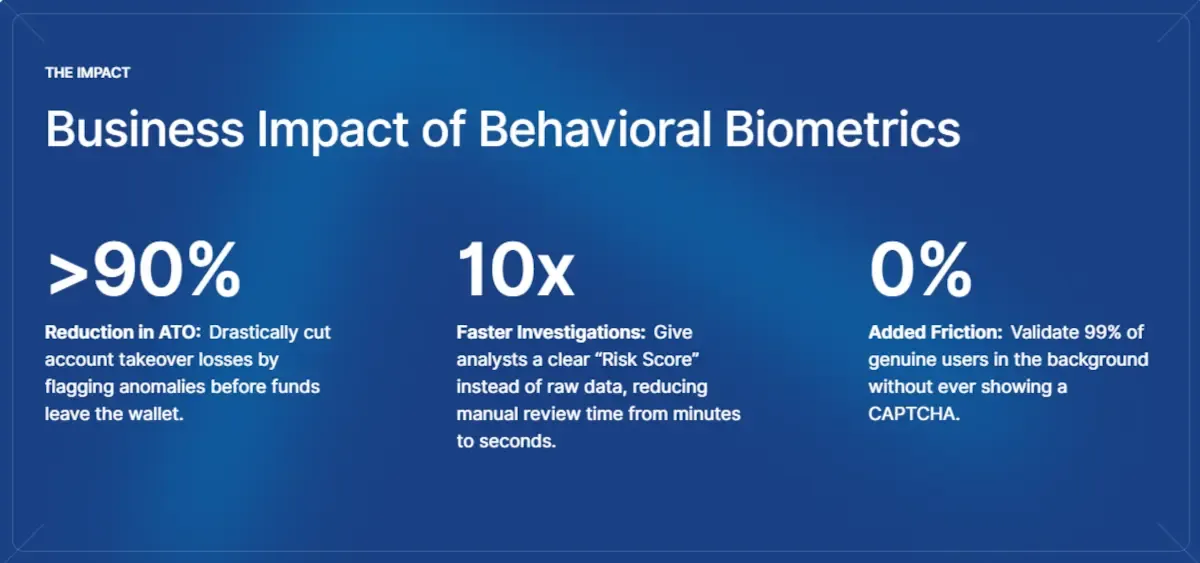
This is where solutions such as Sign3 turn out valuable for banks and financial institutions. Sign3's behavioural biometrics distinguish genuine users from bots, fraudsters, and compromised accounts in real time. The result is stronger fraud prevention without adding unnecessary friction to the user experience.
Read More: What Is Behavioral Biometrics? A Complete Guide
Common Biometrics Examples
Common biometrics examples include facial recognition, fingerprint scanning, iris or retina recognition, voice recognition, palm or hand geometry, and behavioural biometrics. Some biometric methods are so common that most people interact with them daily without thinking twice. Here is a quick table that provides detailed insights on how these work and where each one shows up in real products.
| Biometric Type | How They Work | Usage |
|---|---|---|
| Facial Recognition | Maps geometric points on the face, such as eye distance, jawline, and nose shape, and compares them with a stored template | Smartphone unlock, video KYC, airport e-gates |
| Fingerprint Scanning | Reads the unique ridge and valley pattern on a fingertip | Mobile banking apps, office access, national ID |
| Iris/Retina Recognition | Scans the unique pattern in the iris or blood vessels in the retina | Border control, high-security facilities |
| Voice Recognition | Analyses pitch, tone, cadence, and speech patterns | Call centre authentication, voice assistants |
| Palm/Hand Geometry | Measures hand shape, finger length, and palm size | Physical access control, banking kiosks |
| Behavioural Biometrics | Tracks typing rhythm, touchscreen pressure, and navigation patterns | Continuous fraud monitoring, bot detection |
| Signature Verification | Compares handwriting pressure, speed, and stroke patterns | Legal documents, cheque processing, insurance forms |
Swipe the table
No single biometric in this list works equally well for every scenario. Facial recognition and fingerprint scanning are the most common options for consumer applications because most smartphones already include the necessary hardware. Similarly, Iris recognition and palm geometry are more common in high-security environments where organisations can justify the cost of specialised hardware.
Behavioural biometrics work differently. Instead of verifying identity at a single checkpoint, they continuously analyse actual user behaviour in the background to detect suspicious activity and allow teams to prevent fraud.
Biometric Verification vs. Biometric Identification: How These Two Differ
Biometric verification and biometric identification are often used interchangeably, but they answer different questions. Verification asks: Is this person who they claim to be? It performs a one-to-one match between a live sample and a single stored template tied to a claimed identity, such as confirming a face on camera matches the ID photo on file for one account.
Identification asks a broader question: who is this person? It runs a one-to-many search, comparing a sample against an entire database without the person first claiming an identity. Fingerprints found at a crime scene, searched against a criminal database, are identification; a banking app matching a login attempt to that specific user's stored face template is verification.
Verification is faster and lighter since it only checks one record. Identification needs more processing power and raises more privacy concerns because it searches across many data points, which is why regulators pay closer attention to identification deployments.
| Aspect | Biometric Verification | Biometric Identification |
|---|---|---|
| Question Answered | “Are you who you claim to be?” | “Who are you?” |
| Match Type | One-to-one (1:1) | One-to-many (1:N) |
| Speed | Faster, lighter processing | Slower and more resource-intensive |
| Common Use | Login, KYC, and payments | Law enforcement, watchlists, and surveillance |
| Privacy Footprint | Lower, as it checks against one specific record | Higher, as it searches across an entire database |
Swipe the table
Practically, most consumer-facing products only ever need verification, since they are confirming one specific person rather than searching for one among many. Identification is reserved for scenarios like law enforcement or large-scale watchlist screening, where the question is not who someone claims to be, but who they actually are among a large pool of possibilities.
Biometric Verification vs. Biometric Authentication: What Are the Core Differences
Biometric verification and biometric authentication are so similar that many platforms use the two terms interchangeably. But there is a fine difference. Verification is typically a one-time process that verifies a person’s identity, typically during an onboarding or KYC check, by matching a live biometric sample with an ID document or reference photo.
Authentication, on the other hand, proves a person’s identity repeatedly and multiple times, such as unlocking a phone every morning or approving a payment. Authentication assumes the identity was already established; verification is the step that establishes it in the first place.
| Aspect | Biometric Verification | Biometric Authentication |
|---|---|---|
| When It Happens | Typically once, during onboarding or KYC | Repeatedly, for ongoing access |
| Purpose | Establishes identity for the first time | Confirms an already-known identity |
| Example | Matching a selfie to an ID during account opening | Unlocking a phone with a fingerprint each day |
| Typical Trigger | New account or a high-risk transaction | Login, payment approval, or app unlock |
Swipe the table
Most digital products use both of them in sequence. That is why treating biometric verification and authentication together as a continuous check is crucial. This allows banks and financial institutions to detect and prevent fraud effectively without letting fraudsters bypass the traditional verification methods.
What Is Liveness Detection in Biometric Verification
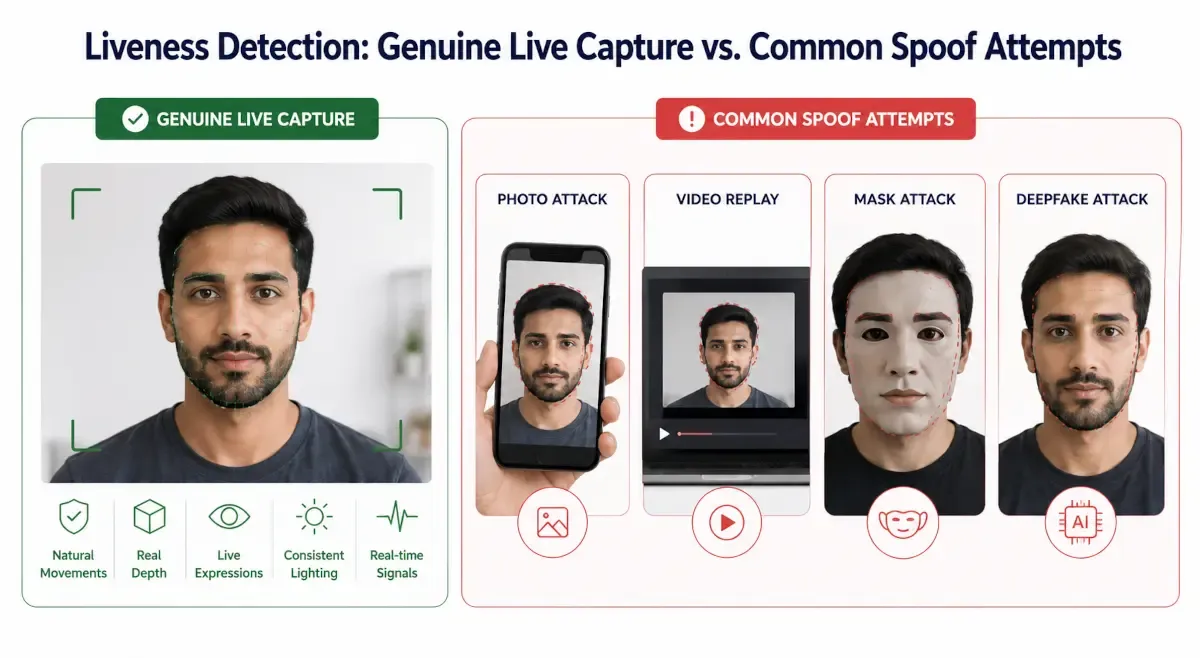
Liveness detection is the mechanism that determines whether a biometric sample is coming from a real, physically present person or from a spoofed source such as a photo, video, or mask. Without it, biometric verification would be easy to trick: a printed photo held up to a camera, a recorded video played on another screen, or a 3D mask could all fool a system that only checks whether facial features match.
Liveness detection works by looking for signals a static or replayed image cannot produce. These include:
-
Subtle movements (blinking or head turns)
-
Natural skin texture and light reflection
-
Depth information distinguishes a real face from a fake photo
-
Micro-expressions happen naturally
Some systems actively monitor liveness by asking the user to blink, smile or turn his/her head. Others use passive liveness checks that run silently in the background without asking the user to do anything.
The stakes in biometric verification and liveness detection are high because digital attacks are evolving and the patterns are getting more sophisticated. Deepfake videos and AI-generated faces have made simple photo or video spoofing checks insufficient on their own. Modern liveness detection increasingly needs to detect synthetic media, not just physical spoofing attempts like printed photos or masks, which means it has to evolve at the same pace as the tools being used to fool it.
Biometric Verification for Fraud Prevention
Biometric verification confirms that a face or fingerprint matches a stored template. It does not automatically tell a business whether that attempt is part of a coordinated fraud ring, whether the device has been used to create dozens of other accounts, or whether the surrounding transaction pattern looks synthetic. This is where biometric signals become far more powerful when combined with other risk signals rather than used in isolation.
Impersonation, account takeover, and synthetic identity fraud rarely show up as a single red flag. A fraudster might pass a liveness check using a convincing deepfake, but the same device could already be flagged for opening multiple accounts under different names, or the app could be running on an emulator instead of a real phone.
This is why pairing biometric verification with device intelligence, behavioural biometrics, and a user's digital footprint closes gaps that biometrics alone cannot see. A face match confirms identity at one moment; device fingerprinting and behavioural patterns confirm whether the surrounding context actually makes sense and proves the user’s or person’s authenticity.
At Sign3, biometric verification is treated as one signal within a broader fraud intelligence framework rather than a standalone identity check. By combining biometric signals with device intelligence, behavioural biometrics, digital footprint data, and risk analytics, organisations can make more accurate trust decisions throughout the customer journey.
This multi-signal approach helps detect certain threats that a face match alone may miss. The result is stronger fraud prevention with less friction for genuine users.
Biometric Verification Use Cases
Biometric verification now anchors identity checks across industries that once relied entirely on paperwork or in-person visits. Each sector has adapted it to its own risk profile.
-
KYC and eKYC: Banks and fintechs use facial biometric checks to match a live selfie against a government ID during digital onboarding, replacing in-person document verification and cutting account-opening time from days to minutes.
-
Banking and fintech: Biometric login and payment approval reduce reliance on OTPs, which remain vulnerable to SIM swap fraud and phishing, giving institutions a stronger first checkpoint before a transaction ever reaches review.
-
Payments: Biometric authorisation at point-of-sale terminals and in-app checkout adds a fraud check that does not depend on a card number or a password, closing a gap that stolen card details are built to exploit.
-
Account opening: New-to-bank customers verify their identity remotely, without visiting a branch, using face matching against an ID document, which lowers drop-off compared to mailing in paperwork.
-
Login access: Fingerprint and facial unlock have replaced PINs on most modern smartphones and are spreading to enterprise systems, reducing credential-based attacks like password reuse and phishing.
-
Healthcare: Hospitals use biometric verification to prevent identity mix-ups and reduce medical record fraud. This is especially useful at the time of registration and while picking up a prescription, where a wrong match can have serious consequences.
-
Government services: Biometrics is used for verifying citizen identity at scale in national ID programs and passport control, sometimes processing millions of verifications a day across borders and welfare programs.
-
Travel: Airports are implementing facial recognition at e-gates and boarding checkpoints to accelerate the flow of passengers and verify identity against travel documents, minimising queue times without introducing a manual check.
-
Remote onboarding: Insurance, lending, and telecom providers verify new customers entirely online, using biometrics as the anchor for digital onboarding in place of physical paperwork, the same moment when identity fraud risk tends to be highest.
Read More: AI Fraud Detection: The Complete Guide for Banks & Fintechs in 2026
Benefits of Biometric Verification
Biometric verification solves problems that passwords, PINs, and physical documents were never designed to handle. It shifts the burden of proving identity away from something a person has to remember or carry, onto something they simply are, which changes both security and everyday user experience.
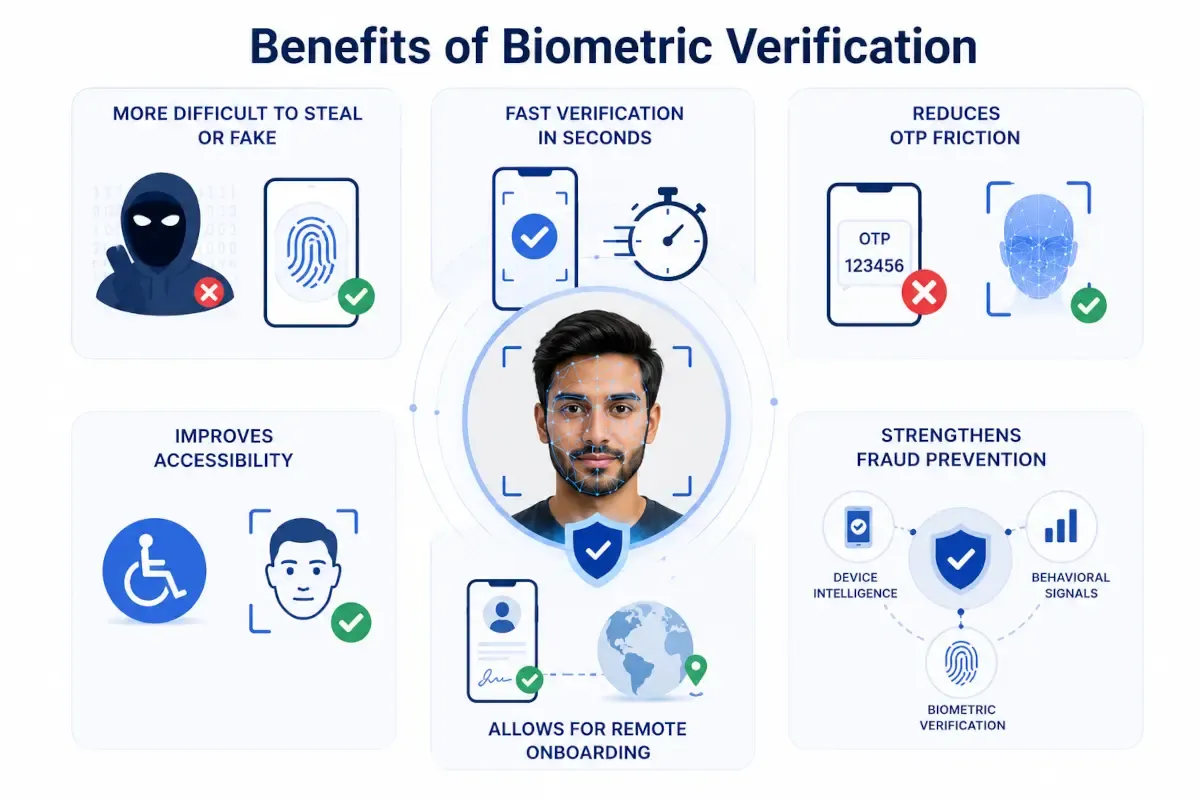
- More difficult to steal or fake than a password or physical ID: You can't guess a fingerprint or face in a brute-force attack, write it on a sticky note, or hand it over to someone else like a PIN or ID card.
- Easier Verification: Verification can often be done in seconds, enabling faster onboarding and login, as opposed to the minutes it takes to fill out a form, dig up a document, or wait for an OTP to arrive.
- Reduces OTP friction: One-time passwords are still susceptible to SIM swap fraud, phishing and delivery delays that frustrate legitimate users almost as often as they prevent fraudsters.
- Improves accessibility: A user who has trouble remembering multiple passwords or PINs on their accounts always has their fingerprint or face with them, no resets or forgotten passwords.
- Allows for remote onboarding: New customers can complete KYC fully from a phone, in one sitting, without a branch visit or a pile of physical paperwork.
- Strengthens fraud prevention: A matched face alone does not confirm the surrounding session is genuine, so pairing biometrics with device intelligence and behavioural signals closes gaps that biometrics can't see on their own.
Challenges & Limitations of Biometric Verification
Biometric verification does not come without challenges. Organisations that deploy biometric systems have to balance security, privacy, accuracy, accessibility and user experience. By understanding these limitations, banks and financial institutions can deploy biometric verification more effectively and adopt the right approaches.
-
Privacy Concern: Biometric data can’t be changed like a password. But if compromised by fraudsters, this could create risk for a lifetime. Companies that collect biometric data must keep it secure, encrypt templates instead of raw images, and be transparent about how long they keep the data and why.
-
Accuracy Limitation: False rejection can lock out legitimate users; False acceptance can allow a fraudster to bypass the system easily and gain access to mishandle data and money. Moreover, some environmental factors such as poor lighting, low-quality cameras, injuries, or ageing can affect matching accuracy.
-
Security and Usability: Stronger verification often comes with more friction for users. For example, NIST’s 2026 Face Recognition Technology evaluation reported false non-match rates between 0.12% and 0.13% for a few of the top face verification algorithms, along with very low false match rates, showing how far biometric accuracy has come. Modern biometric systems are highly accurate, but their performance in the real world can be affected by image quality, environmental factors, demographic variation and how the system is deployed in operation.
-
Accessibility Challenges: Some users may not be able to provide reliable biometric samples because of disabilities, injuries, worn fingerprints, or devices that lack the required sensors.
-
Spoofing and Deepfake Threats: Deepfakes and synthetic media become more sophisticated. That is why biometric systems must continually improve their liveness detection and anti-spoofing capabilities.
-
Implementation Costs: Deploying biometric verification can require investments in sensors, liveness detection technology, infrastructure, integration, and regulatory compliance.
How Secure Is Biometric Verification?
Biometric verification is generally more secure than passwords or static documents because a biometric trait is difficult to guess, steal remotely, or share by accident. However, security is not automatic. A system that only checks whether a face matches a template, without confirming liveness, can be fooled by a photo or a well-made deepfake.
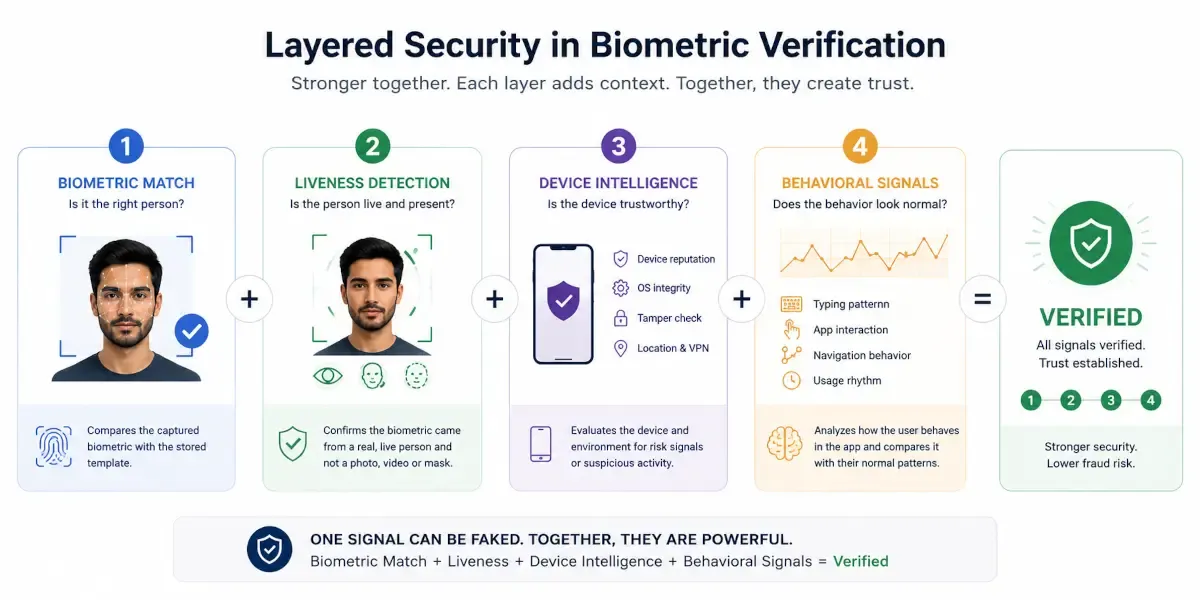
Modern biometric security therefore relies on multiple layers of verification rather than a single biometric check:
- Liveness detection verifies that the sample is from a person who is actually present.
- Device intelligence considers whether the device itself appears legitimate or has a history of fraudulent activity.
- Behavioural signals detect anomalies that are not consistent with a real user’s normal app usage.
None of these signals is foolproof alone, but together they make the system considerably harder for a fraudster to pass every check.
This is why modern fraud prevention treats biometric verification as one strong signal among several, not a single point of failure. A system relying purely on face matching, with no liveness check and no device context, is far more exploitable than one that combines all three.
Biometric Verification for KYC & Digital Identity
Biometric KYC has become the backbone of remote onboarding for banks, fintechs, insurers, and telecom providers. Instead of asking a customer to visit a branch with physical documents, biometric identity verification lets them complete onboarding from a phone, matching a live selfie against the photo on a government-issued ID.
The shift towards digital identity verification is driven by both regulation and convenience. Financial institutions are required to comply with KYC and anti-money laundering requirements, and biometrics provide a way to do that remotely without compromising the identity check. A live facial scan with liveness detection is more assuring than a scanned document alone, which can be compromised, reused or submitted by someone other than the owner.
For digital-first businesses, biometric verification is often the only practical way to confirm a real, present customer during remote onboarding, since there is no in-person interaction to fall back on. This is also where digital identity verification and biometric KYC intersect most directly with fraud prevention, since a weak check at onboarding undermines every transaction built on top of it.
Sign3's digital onboarding solution is built around this exact moment, screening a new user's device and digital footprint alongside the biometric match so a passed face check isn't the only thing standing between a business and a fraudulent account.
Biometric Verification vs. Traditional Identity Verification
Traditional identity verification asks a person to prove who they are indirectly, through a document that can be forged or a code that can be intercepted. This works reasonably well in person, where someone can compare a live face to a photo ID, but it breaks down for remote or high-risk digital interactions where no one is physically checking anything.
Biometric verification relies on something inherent to the person instead of a document or a shared secret, and the practical differences between the two approaches show up clearly across security, user experience, fraud resistance, and typical use cases.
| Factor | Traditional Verification | Biometric Verification |
|---|---|---|
| Security Basis | Documents, passwords, and shared secrets | Physical or behavioural traits unique to the person |
| User Experience | Slower, often requiring manual entry or document uploads | Faster, often completed in seconds |
| Fraud Resistance | Vulnerable to theft, forgery, phishing, and SIM swaps | Harder to steal or replicate, especially when combined with liveness checks |
| Best Suited For | Low-risk checks and legacy systems | Remote onboarding, high-risk transactions, and repeated access |
Swipe the table
Neither approach fully replaces the other in every scenario, but biometric verification closes gaps that traditional checks were never built to handle, particularly for remote, high-risk digital onboarding. For businesses handling high-risk transactions or fully remote onboarding, that gap is the deciding factor in adopting biometric verification over a document-only process.
How Sign3 Uses Biometric Verification for Fraud Prevention
Sign3 does not treat biometric verification as a stand-alone verification, but rather as part of a larger fraud detection system. Biometric signals provide identity verification during onboarding and high-risk transactions, with additional layers of intelligence to provide context around the user and device.
Sign3 combines biometric authentication with:
-
Facial matching to verify that the user is real and physically present.
-
Device intelligence to flag devices associated with multiple accounts, emulators or prior fraud activity.
-
Digital footprint analysis for the evaluation of the trustworthiness of identifiers (email addresses, phone numbers, etc.)
-
Behavioural intelligence to identify unusual patterns that may indicate bots, account takeover attempts or other fraudulent activity.
The multi-signal approach is helping to uncover risks that a biometric check alone could miss. Sign3 brings together identity, device and behavioural signals in real time to help organisations better identify account takeover attempts, synthetic identities and fraud rings. This can enhance onboarding security, decrease manual reviews and provide a safer customer experience without introducing needless friction.
FAQ
What is biometric verification?
Biometric verification is the advanced process of confirming a person's identity by matching a live biometric sample, such as a face or fingerprint, against a stored reference template.
What is the difference between biometric verification and biometric identification?
Verification is a one-to-one match confirming a claimed identity. Biometric identification, on the other hand, is a one-to-many search to determine who someone actually is.
Is biometric verification safe?
Biometric verification is generally safer than passwords. However, the security depends on liveness detection and additional risk signals, not the biometric match alone.
What are examples of biometrics used in verification?
Some common examples of biometrics used in verification include facial recognition, fingerprint scanning, iris and retina scans, voice recognition, and behavioural dynamics like typing patterns.
What is liveness detection in biometric verification?
Liveness detection in biometric verification is a security control measure. It ensures that a biometric sample, such as a face, voice, or fingerprint, originates from a living, physically present human rather than a counterfeit representation like a printed photo, replayed video, or AI-generated deepfake.
How does biometric verification work in KYC?
During KYC, a live selfie is captured, and then it is matched against the photo on a government ID, mostly combined with liveness checks. This allows confirmation that the user is physically present.
Can biometric verification be spoofed?
Yes. Without strong liveness detection, photos, videos, masks, and deepfakes can potentially fool a biometric system, resulting in fraudulent activities. This is why layered checks matter.
What is the difference between biometric verification and authentication?
Generally, the difference between biometric verification and authentication is that verification proves identity (typically, once, at onboarding), whereas authentication repeatedly verifies a known identity (e.g., unlocking a device).
Why do banks use biometric verification?
Banks use biometric verification to meet KYC requirements remotely. It not only reduces the chances of fraud from stolen credentials but also speeds up onboarding without in-person visits.
What happens if biometric data is compromised?
Unlike a password, biometric data cannot be changed or reset. If your data is compromised, you face lifelong security risks, including permanent identity theft, deepfake impersonation, and unauthorised access to your personal or financial accounts.
Does biometric verification work without an internet connection?
Yes, biometric verification can work completely without an internet connection. Some device-based checks like fingerprint or face unlock work offline. Biometric verification that is tied to KYC or payments usually requires a connection to match against a server-side reference.
What industries use biometric verification the most?
Banking, fintech, healthcare, travel, telecom, and government services are among the leading industries that use biometric verification today.


