

A Suspicious Transaction Report (STR) is the crucial document that a reporting entity sends to the Financial Intelligence Unit–India (FIU-IND). The report reveals when a transaction, including an attempted one, gives reasonable grounds for suspicion under the Prevention of Money Laundering Act, 2002 (PMLA). Banks, financial institutions, non-banking financial companies (NBFCs), and other reporting entities must file it within seven working days of being satisfied that the suspicion is justified.
FIU-IND is the central agency that receives, analyses and shares information on suspect financial transactions to combat money laundering and terrorist financing. This guide clearly explains when to file the suspicious transaction report, who is accountable, what the report contains and how to file an STR in India, so that your compliance team can act properly and within the deadline.
Key Takeaways
- Reporting Scope: An STR reports a transaction, including an attempted one. It offers a strong and reasonable ground to report any suspicious case regarding money laundering or terrorist financing.
- Minimum threshold: Suspicion about fraudulent activity is enough. No minimum amount applies, and the transaction need not be completed or made in cash.
- Deadline: It is necessary to file the report within seven working days of being satisfied that the transaction is suspicious.
- Responsibility: The Principal Officer files the report, and the Designated Director oversees the compliance programme.
- Confidentiality: Never tell the customer that an STR is being considered or has been filed.
What Is a Suspicious Transaction Report (STR)?
A Suspicious Transaction Report (STR) is a confidential report that a bank or other reporting entity sends to the Financial Intelligence Unit-India (FIU-IND) when it suspects a transaction involves money laundering, terrorist financing or another offence listed under the PMLA. The Prevention of Money Laundering (Maintenance of Records) Rules, 2005 (PML Rules) define a suspicious transaction based on certain conditions. These include transactions that:
- Give a person acting in good faith reasonable grounds to suspect that they involve proceeds of crime.
- Appear unusually or unnecessarily complex.
- Have no clear economic purpose.
- May involve the financing of terrorism.
Financial institutions report such transactions to FIU-IND so it can examine suspicious financial activities and identify possible links to financial crimes. The report is called a Suspicious Activity Report (SAR) in several other countries, and in India, officially the report is known as STR.
When Should Financial Institutions File an STR?
You should file an STR whenever you have some genuine and reasonable grounds to suspect that a transaction is connected to money laundering or terrorist financing. Five points define the obligation in suspicious transaction reporting.
- Cash and non-cash transactions both qualify: The PML Rules cover any type of transaction, whether any cash is involved or not. A suspicious NEFT, UPI or card payment therefore comes under the same reporting criteria such as a suspicious cash deposit.
- Attempted transactions must be reported: RBI has clarified that banks must report the attempted transactions even when the customer does not complete them, irrespective of the amount.
- No minimum value applies: Unlike a Cash Transaction Report, an STR has no separate monetary threshold. Even a small transaction can warrant a report if the context is found suspicious. For example, a first deposit from an unrelated third party into a newly opened account.
- Connected transactions count: A series of linked transactions can significantly raise suspicion even when no single case looks unusual. That’s why the internal teams must review the transactions together by customer, counterparty and account instead of one at a time.
- Grounds must be reasonable and recorded: The suspicion must be based on multiple aspects that a person acting in good faith would find concerning. The Principal Officer must write down why the activity was found suspicious. This allows the institution to protect itself if the decision is reviewed later.
What Is the STR Filing Deadline in India?
The STR filing deadline in India is seven working days from the date the reporting entity is satisfied that the transaction is actually suspicious. The PML Rules require the Principal Officer to submit the information promptly and within that limit. This is one of the most crucial points of the STR reporting requirements.
Usually, the time starts when the institution decides the suspicion is justified, not when the first alert pops up. RBI guidance states that the conclusion should not be unduly delayed; hence, the alerts should move through the investigation and escalation without stalling.
Confidentiality must be maintained while making the report. Staff must not inform the customer or anyone outside the authorised process that an STR is under consideration or has been filed. Such disclosure is known as "tipping off" and is prohibited under the applicable PML rules. Furthermore, Section 12(2) of the PMLA requires confidentiality, while Section 14 provides protection to reporting entities and their employees for furnishing specified information.
Who Is Responsible for STR Filing?
The reporting entity is responsible for STR filing and must report the suspicious transactions to FIU-IND, while the Designated Director and Principal Officer oversee the reporting and compliance process.
- Designated Director: A senior-level officer nominated by the reporting entity must ensure overall compliance with the Prevention of Money Laundering Act (PMLA) and its associated rules.
- Principal Officer: A management-level officer responsible for furnishing information to FIU-IND, including STRs, and acting as the primary point of contact for regulatory reporting. The Principal Officer oversees the assessment and submission of suspicious transaction reports.
Both officers must be registered with FIU-IND through the prescribed process. Other employees also play an important role in identifying and escalating suspicious activity:
- Compliance and AML Teams: Investigate transaction alerts, review customer information, gather supporting evidence, and recommend whether an STR is warranted.
- Branch and Operations Staff: Identify unusual customer behaviour or transactions and promptly escalate concerns through internal reporting channels.
- Other Employees: Follow internal escalation procedures and maintain confidentiality throughout the investigation.
The Principal Officer is responsible for submitting the suspicious activity report to FIU-IND. Therefore, every reporting entity should maintain a clearly documented escalation process to ensure suspicious activity is investigated promptly and reported within the prescribed timeline. Employees must also avoid tipping off customers about an STR being considered or filed.
What Makes a Financial Transaction Suspicious?
A transaction becomes suspicious when it does not fit the customer's known profile, lacks a clear purpose or appears structured to avoid scrutiny. A single indicator rarely proves anything. The combination, assessed against the customer's profile, is what matters.
- Complexity without reason: Layers of transfers or intermediaries with no commercial explanation.
- No economic rationale: Payments that do not match the customer's business, occupation or income.
- Inconsistent behaviour: Activity that deviates sharply from the account's previous transaction history, such as a dormant account that suddenly receives heavy credits.
- Reluctance to provide information: Hesitation or refusal when asked for identification, source of funds or the purpose of a transaction. Genuine customers can usually explain their transactions.
- Unexplained transfers: Frequent movement of funds to or from unrelated parties or high-risk jurisdictions, where the customer cannot describe the relationship or the purpose.
- Structuring: Splitting large amounts into smaller ones to stay below internal or regulatory limits, such as repeated deposits placed just under a reporting threshold.
Common Examples of Transactions That May Require STR Filing
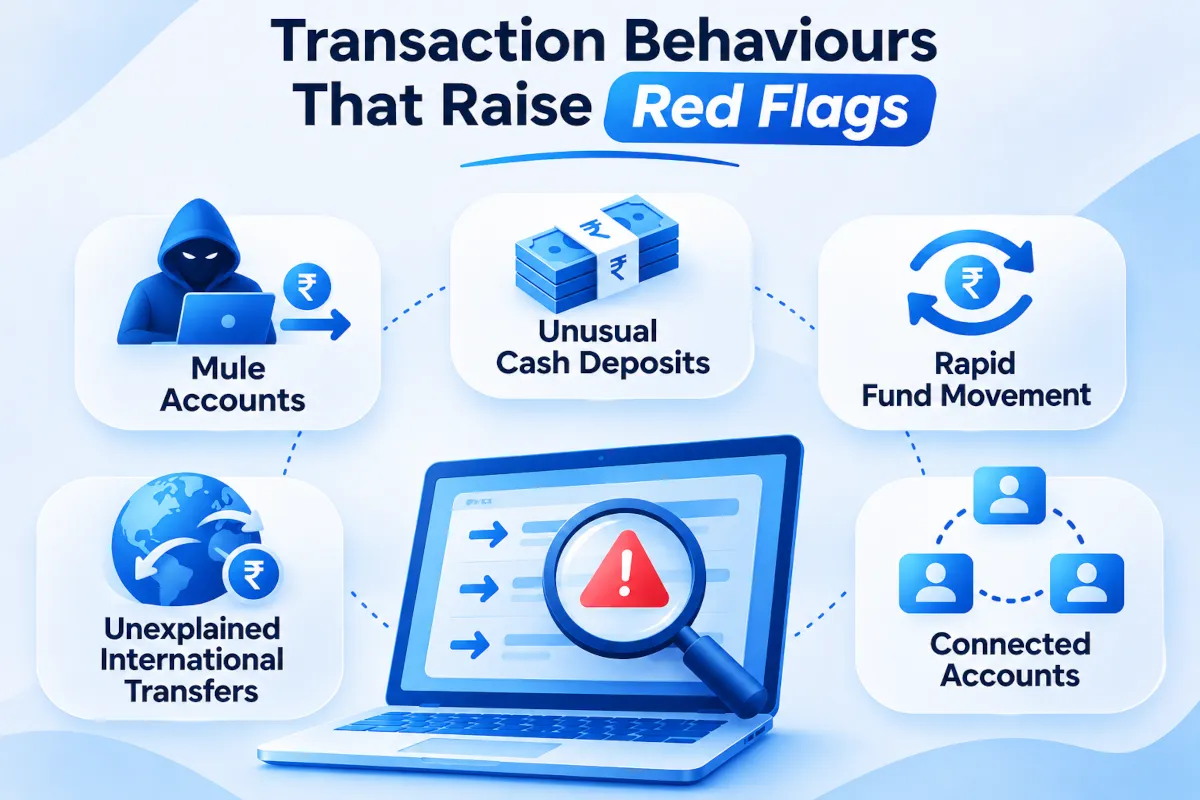
Financial institutions must look beyond individual transactions to identify the correct fraud patterns that may indicate money laundering, fraud or other suspicious financial activity. Certain transaction behaviours can raise red flags and warrant further investigation. Some common examples include:
- Mule accounts: A money mule account is used to receive funds from other individuals and transfer them to other accounts, often on behalf of criminals. These transactions can help conceal the origin and movement of illicit funds.
Read the guide to understand What Is a Mule Account? - Unusual cash deposits: Repeated cash deposits structured to keep the total below the ₹10 lakh Cash Transaction Report (CTR) threshold may indicate deliberate attempts to avoid reporting.
- Rapid fund movement: Credits followed by near-immediate debits, leaving a negligible account balance without any apparent legitimate purpose, may indicate suspicious fund movements.
- Unexplained international transfers: A salaried customer who receives large inward remittances from several countries without a documented relationship with the senders.
- Connected accounts: Several accounts that share a phone number, address or device may transfer the money among themselves. Common identifiers suggest one controlling party, and the circular flow can hide the true origin of funds.
What Information Is Required in an STR?
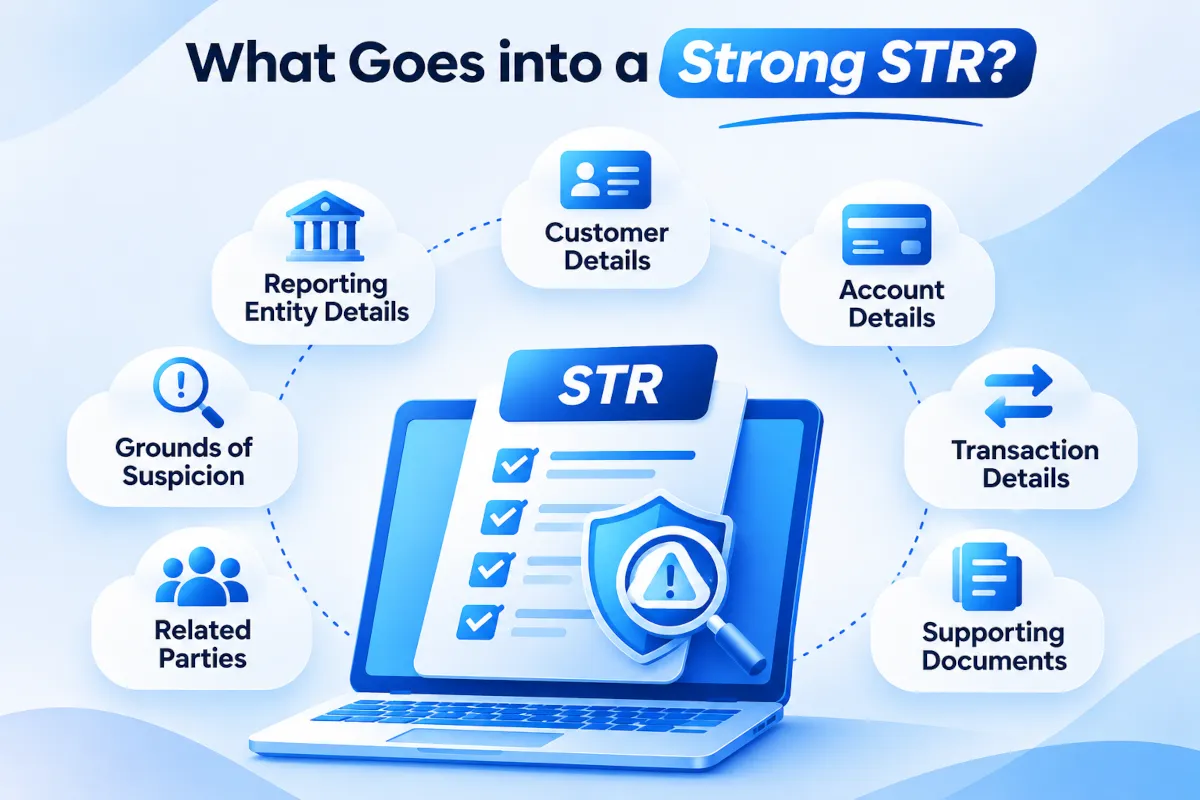
An STR should be detailed enough for the FIU-IND to understand who was involved, what happened and why you suspect the case. The report is submitted in the prescribed electronic form and addresses the following areas.
- Reporting entity details: The institution, the branch and the Principal Officer, so that FIU-IND knows who is filing and whom to contact for clarification.
- Customer identification: Name, identifiers such as PAN, address and KYC details of the person or entity involved.
- Account details: Account numbers, type, opening date and current status.
- Transaction details: Dates, amounts, modes and counterparties.
- Related parties: Beneficiaries, co-account holders, introducers and linked persons, who extend the picture beyond a single customer.
- Grounds of suspicion: A clear narrative of what was observed and why it is unusual. This is where the analyst reads your reasoning.
- Supporting documents: Records such as account statements and KYC files that substantiate the narrative.
How to File an STR with FIU-IND: Step-by-Step Process
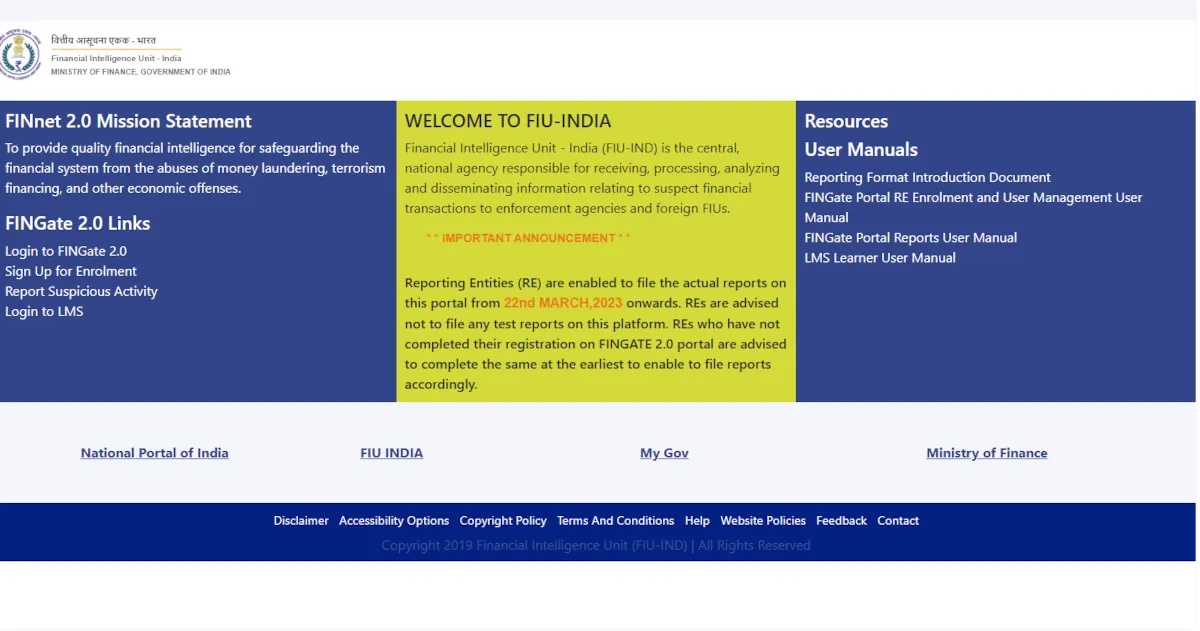
The FIU-IND reporting is submitted electronically through the FINGate 2.0 portal, after registering the entity and its Principal Officer. To file an STR with FIU-IND, there are seven steps to file an STR.
- Identify suspicious activity: Review monitoring alerts, staff escalations and customer behaviour that deviates from the expected profile. Detection can be triggered by a system alert or a branch employee. This clearly explains that both system-generated alerts and concerns raised by branch employees must go through the same review process.
- Investigate the activity: Review the transaction history, customer profile and connected accounts to determine whether the transaction has a legitimate purpose and aligns with the customer's usual financial behaviour. If the activity has a reasonable explanation, document the findings before proceeding with further reporting.
- Collect supporting information: Gather the relevant KYC records, account statements and proper transaction details that handle the case.
- Document the grounds for suspicion: Record all the factual terms why the activity warrants further reporting.
- Escalate to the Principal Officer: Submit the case to your internal AML reporting line for decision. The Principal Officer considers the evidence and observes the reasons for the transaction being suspicious.
- Prepare and submit the Suspicious Activity Report (STR): Submit it in the prescribed FIU-IND format and then file it through FINGate 2.0 within seven working days of satisfaction. Also, file it electronically, and keep the acknowledgement of filing in your records.
- Maintain records: Retain the report, supporting documents and filing acknowledgement for the period the PMLA requires.
STR vs CTR: What Is the Difference?
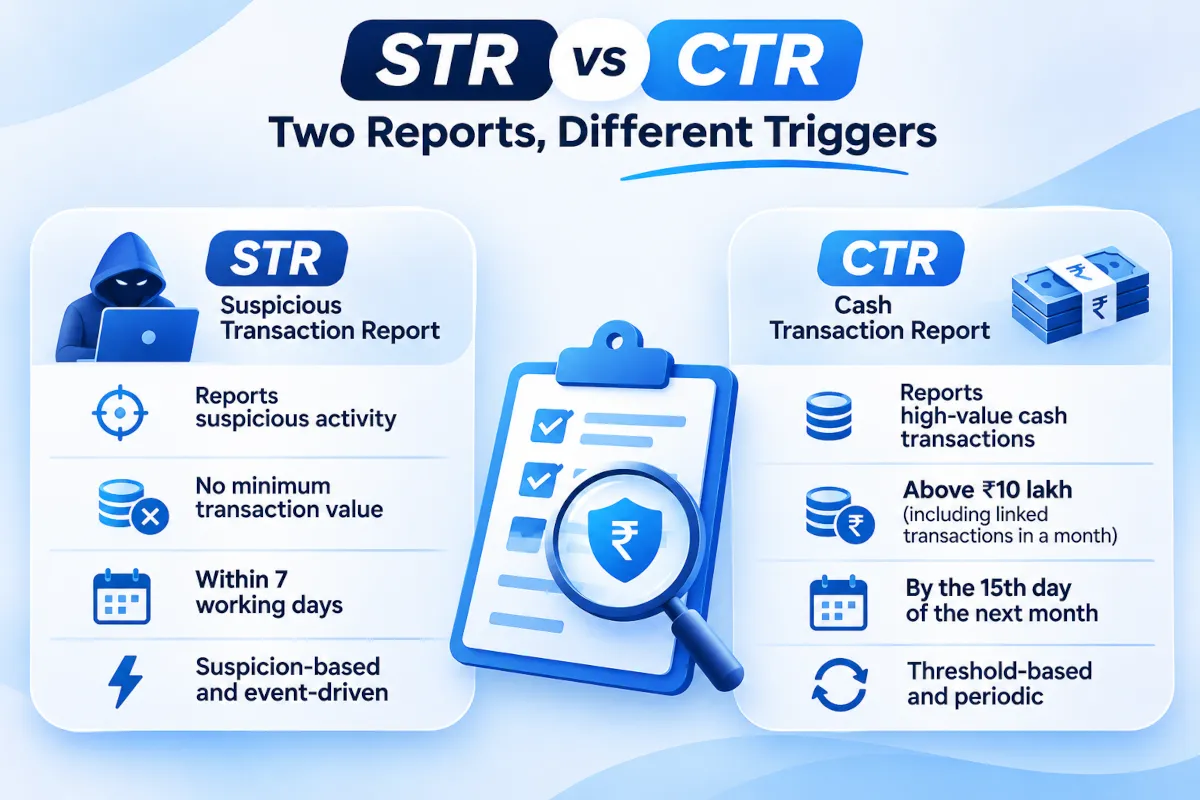
A Suspicious Transaction Report (STR) and a Cash Transaction Report (CTR) may sound similar, but both of these reports serve different purposes under India's anti-money laundering framework. A single transaction may trigger both reporting requirements if it meets the relevant criteria. The table below reveals the key differences between these two reports:
| Key Parameters | STR | CTR |
|---|---|---|
| Purpose | Reports suspected money laundering, terrorist financing or other suspicious financial activity | Reports qualifying high-value cash transactions |
| Trigger | Reasonable grounds for suspicion | Cash transactions exceed ₹10 lakh, including the qualifying linked transactions within a month |
| Monetary threshold | No minimum transaction value is required | ₹10 lakh |
| Filing timeline | Within seven working days of the reporting entity being satisfied that the transaction is suspicious | By the 15th day of the succeeding month |
| Nature | Suspicion-based and event-driven | Threshold-based and periodic |
Swipe the table
STR and CTR are the reporting categories recognised under India's PML Rules. SAR (Suspicious Activity Report) is a term commonly used in other jurisdictions, but it is not a separate prescribed reporting category under India's PML Rules.
Challenges in Identifying and Reporting Suspicious Transactions
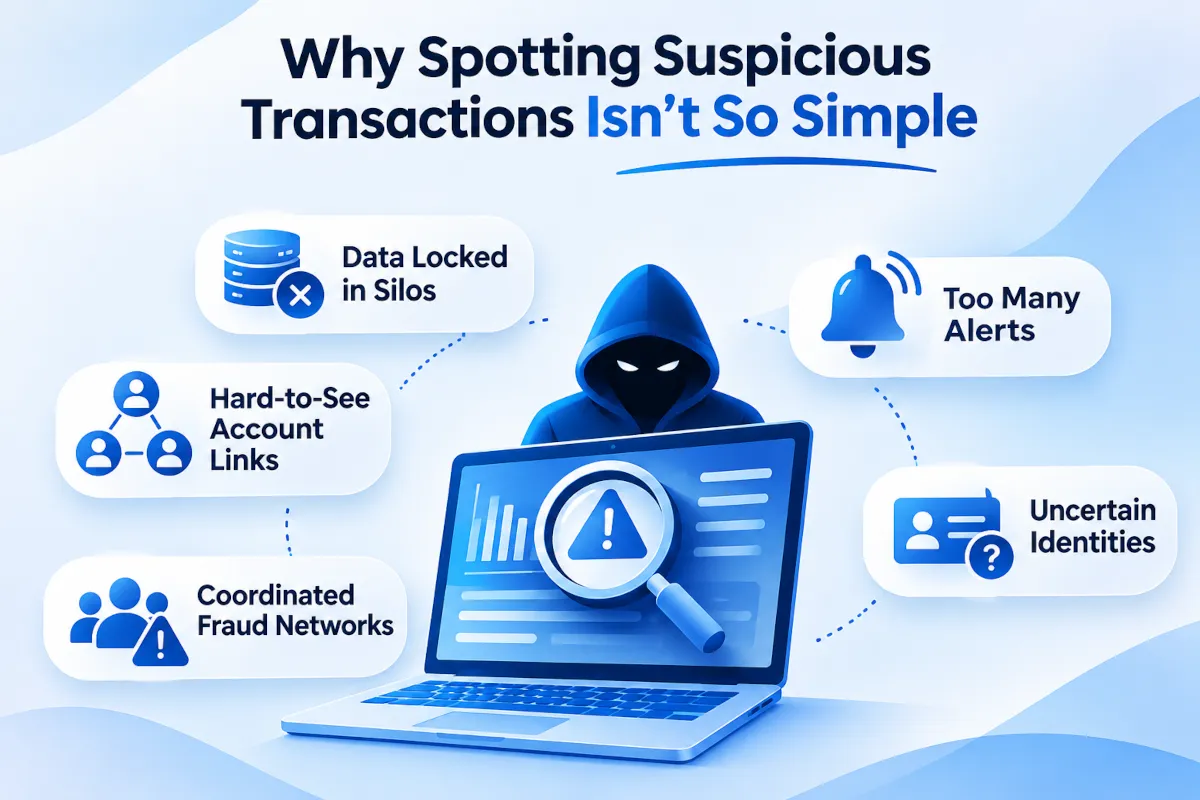
Identifying suspicious transactions is considered much more challenging than completing the STR filing process. Financial institutions must analyse the large volumes of transaction data while identifying unusual patterns and establishing reasonable grounds for suspicion within tight reporting timelines. However, fragmented information, sophisticated fraud techniques and limited investigation resources can make this difficult. Most institutions face five recurring challenges:
- Fragmented Data: Customer profiles, account information and transaction records often sit across disconnected systems. This makes it much more difficult for the data analysts to build a complete picture of customer activity while identifying suspicious patterns.
- Hidden Connections Between Accounts: Multiple accounts may share devices, phone numbers or different behavioural patterns without having obvious transaction links. Without these additional signals, data analysts may investigate the connected accounts as separate cases.
- Limited Visibility into Coordinated Fraud Networks: Organised fraud groups often distribute transactions across different accounts to avoid detection. Individual transactions may appear much more legitimate, making it much harder to identify the larger network behind them.
- High Alert Volumes: AML monitoring systems can generate numerous false positives alongside genuine suspicious activity. Furthermore, reviewing every alert manually consumes analyst time and can delay the investigation and escalation process.
- Identity Uncertainty: Different verification methods relying heavily on submitted documents can make it difficult to differentiate between genuine customers and fraudulent or synthetic identities. Even the most basic checks may be passed by forged, manipulated, or artificially assembled identity details. This adds some extra risks in terms of customer onboarding and ongoing monitoring.
Strengthen AML Investigations with Sign3 Device Intelligence
Timely and accurate STR filing depends on identifying suspicious activity early, documenting the grounds for suspicion and reporting within the prescribed seven working days. However, transaction monitoring alone may not reveal connections between seemingly unrelated accounts. This is where our Device Intelligence adds value.
Sign3 helps financial institutions identify multiple accounts operating from a common device, uncover hidden relationships between suspicious users and detect potential organised fraud networks.
By adding device-level insights to existing AML monitoring and investigation workflows, analysts can access stronger supporting evidence, investigate alerts more effectively and make better-informed decisions. While the Principal Officer remains responsible for determining whether an STR is warranted, better intelligence can strengthen the investigation process. Book a demo and explore our Device Intelligence solution to uncover hidden account connections and strengthen your institution's suspicious activity detection capabilities.
Frequently Asked Questions
1. What is a Suspicious Transaction Report (STR)?
A Suspicious Transaction Report (STR) is a confidential report of financial transactions suspected of being linked to money laundering, terrorist financing or proceeds of crime. A financial institution submits it to the Financial Intelligence Unit-India (FIU-IND) when it has strong and reasonable grounds to suspect that a transaction may involve money laundering, terrorist financing, or proceeds of crime. It covers both completed and attempted transactions, regardless of their value.
2. When should a bank file an STR with FIU-IND?
A bank must file an STR with FIU-IND as soon as it confirms that the transaction is suspicious. This applies to both cash and non-cash transactions, including attempted transactions. The reporting process should not be delayed while the bank waits for conclusive proof of financial crime.
3. What is the deadline for filing an STR in India?
In India, a Suspicious Transaction Report (STR) must be filed within 7 working days of the Principal Officer forming a suspicion about a transaction. This applies to transactions that may involve proceeds of crime, lack economic rationale or show unusual complexity, as mandated under Rule 8 of the PML Rules.
4. Who is responsible for filing an STR?
The Principal Officer is responsible for filing an STR. The reporting entity is responsible for examining suspicious activity and submitting STRs to FIU-IND. The Designated Director oversees the organisation's overall compliance with PMLA requirements and ensures that appropriate reporting procedures are in place.
5. Can attempted or incomplete transactions be reported through an STR?
Yes, attempted or incomplete transactions can be reported through an STR. This is an effective way to convey strong and reasonable grounds for suspicion, even when the customer abandons the transaction or the transaction is unsuccessful. This helps authorities to identify suspicious financial activity before funds are transferred or illicit transactions are completed.
6. Is there a minimum transaction amount for filing an STR?
No. There is no minimum transaction value for filing an STR. Even a low-value transaction must be reported if it raises reasonable grounds for suspicion. The decision, furthermore, depends on the nature, circumstances and certain patterns associated with the transaction rather than its monetary value.
7. What is the difference between an STR and a CTR?
A Suspicious Transaction Report (STR) is filed when a transaction raises strong and reasonable grounds for suspicion, irrespective of its value. A Cash Transaction Report (CTR), on the other hand, covers cash transactions that often exceed ₹10 lakh. This includes some connected cash transactions that meet the prescribed criteria. STRs are filed promptly, within the prescribed seven-working-day period, while CTRs are submitted monthly.
8. How can banks strengthen STR investigations?
Banks can strengthen STR investigations by combining transaction monitoring, customer due diligence and fraud detection. They can analyse unusual patterns, trace suspicious fund flows, identify linked accounts, and gather the necessary evidence. Sign3’s device intelligence helps uncover multiple accounts and shared devices that may reveal organised fraud rings. This enables investigation teams to identify suspicious activity more accurately, build stronger cases, reduce false positives and submit more comprehensive Suspicious Transaction Reports (STRs) to the relevant authorities.


