

Have you ever received a call saying your bank account will be blocked unless you verify your details? Or someone claiming to be from your bank, telecom provider, courier company, or government department, asking you to share an OTP immediately?
You may think you can spot a scam call easily. But social engineering attacks are designed to make you react before you have time to question what is happening. It’s a psychological manipulation technique where attackers may create a sense of urgency, pretend to be someone you trust, or use information about you to make the conversation sound genuine.
So what is social engineering? How these manipulation tactics work is now essential for banks, fintechs, lenders, and consumers alike. Let’s discuss.
What Is Social Engineering? Understanding the Meaning
Social engineering is one of the most common cybercrime techniques, manipulating people into giving up sensitive information, approving transactions, or bypassing security controls. Attackers exploit human psychology to gain access to accounts, systems, personal data, or digital assets. Common outcomes include disclosing credentials, sharing one-time passwords (OTPs), authorising fraudulent payments, installing malicious software, or gaining unauthorised access to accounts and digital assets.
Most social engineering attacks rely on four powerful triggers. Attackers use these triggers to manipulate emotions and decision-making, making victims more likely to act without verification.
-
Trust: Attackers build credibility by impersonating trusted organisations, colleagues, service providers, or even family members, making victims more likely to comply with requests without suspicion.
-
Urgency: Scammers create time-sensitive situations that pressure people to act immediately, leaving little room to verify information or carefully assess the request.
-
Authority: By posing as bank officials, government representatives, law enforcement officers, or senior executives, attackers exploit people's tendency to follow instructions from perceived authority figures.
-
Fear: Threats such as account suspension, financial penalties, legal action, data loss, or service disruptions trigger emotional responses that override rational decision-making.
However, these triggers do not operate in isolation. Attackers often combine trust, urgency, authority, and fear to create convincing scenarios that pressure individuals to share information, approve transactions, or bypass security controls.
How Hackers Manipulate People During Social Engineering Attacks
Most social engineering attacks are scripted psychological approaches. Understanding these manipulation techniques is necessary as they appear legitimate in almost every modern fraud scheme, from fake bank calls to attempts to take over an account.
1. Creating a Sense of Urgency
Scammers create situations that pressure people to decide quickly before they have time to verify information or question the request. The caller might say an account will be suspended within an hour, a KYC update is required today, or a compliance notice needs an immediate reply. Scammers often make up a false deadline to pressure victims into making a quick decision.
2. Impersonating Trusted Authorities
People are more inclined to trust recognised institutions and authority figures. Fraudsters take advantage of this tendency by posing as bank executives, RBI representatives, police personnel, government officials, or customer care agents. They often use official designations, reference numbers, and scripted language to appear legitimate and persuade victims from questioning their instructions.
3. Exploiting Fear and Panic
Victims may be warned about suspicious transactions, legal action, loan defaults, tax violations, or blocked accounts. When people believe they are facing an immediate threat, they are more likely to focus on resolving the problem quickly rather than carefully evaluating whether the warning is genuine.
4. Using Rewards and Financial Incentives
Social engineering attacks often exploit excitement, curiosity, or the commitment of offering money. Scammers offer guaranteed cashback rewards, lottery winnings, tax refunds, investment opportunities, or exclusive benefits. Once they successfully convince victims, they ask for an OTP, card details, an advance payment, or even get access to an account in the name of releasing the reward.
Read more about carding fraud to gather detailed insights on card attacks.
5. Using Personal Information
Stolen or leaked personal data lends credibility to fraudulent messages. When a caller correctly identifies a person’s name, address, bank, employer, or recent transaction details, the victim is more likely to believe the interaction is legitimate. Criminals often rely on data from breaches, public records, and social media profiles to create this false sense of trust.
6. Building Trust Over Time
Scammers even offer small profits initially. Fraudsters can spend weeks building an emotional connection, while fake recruiters can hold several interviews before requesting a fee. Social phishing is the starting point for many of these long-running scams where a generic social media or messaging platform eventually escalates to a request for money, credentials, or sensitive information.
The Most Common Types of Social Engineering Attacks in BFSI
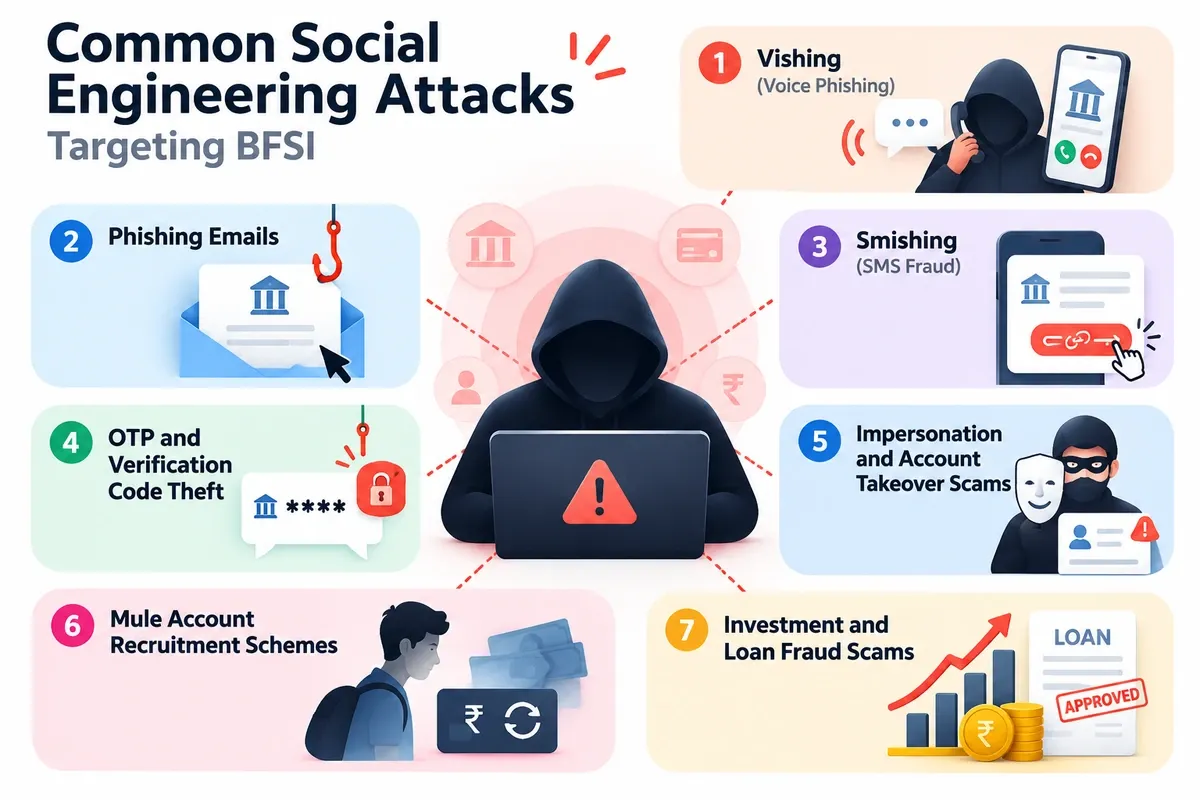
Some of the most common types of social engineering attacks in the BFSI sector are vishing, phishing, smishing, Business Email Compromise (BEC), account takeover fraud, impersonation scams, social phishing, and mule account recruitment schemes. Understanding the most common attack types is key to identifying fraud patterns and strengthening prevention strategies throughout the customer lifecycle.
1. Vishing (Voice Phishing)
In a standard vishing attack, a scammer calls and claims to be a bank’s fraud prevention team, customer service desk, or compliance department. Callers may claim they detected a suspicious transaction and ask the customer to share card details, provide an OTP, or install a remote access app. Such a live conversation builds trust and reduces the victim's ability to verify the request on their own.
Read more about vishing fraud to gather detailed insights on vishing attacks.
2. Phishing Emails
Phishing emails imitate legitimate messages from banks, lenders, insurers, or regulatory bodies. These messages often use cloned branding, spoofed sender identities, and fake links that lead victims to credential-harvesting websites. Attackers also use similar tactics on social media and messaging platforms, a technique commonly known as social phishing.
3. Smishing (SMS Fraud)
Smishing attacks use text messages to create urgency around account activity, KYC compliance, payment dues, or expiring rewards. The message typically includes a link that looks legitimate but redirects victims to a fake website or malicious app. This makes victims more likely to click the link without scrutiny.
4. OTP and Verification Code Theft
This attack relies on manipulating customers into sharing genuine authentication codes generated by a bank or financial institution. Fraudsters may claim the code is required to cancel a transaction, verify an account, or resolve a security issue. While the OTP itself is legitimate, the social engineering behind the request enables unauthorised account access or transaction approval.
5. Impersonation and Account Takeover Scams
Phishing, vishing, data breaches, or social media profiling are often the starting point for account takeover fraud, as they're used to collect personal information. Once fraudsters gather enough information, they can reset credentials, attack authentication mechanisms, or add new devices, allowing them to take over the customer’s account and perform unauthorised actions.
6. Mule Account Recruitment Schemes
Fraud networks frequently target students, gig workers and job seekers with promises of easy money in return for access to their bank accounts. Fraud networks then use these accounts to receive, transfer, or withdraw proceeds. Many victims have no idea they’re part of a larger money-laundering operation until regulators or law enforcement step in.
7. Investment and Loan Fraud Scams
Investment fraud schemes advertise unrealistic returns using fake trading platforms, unregulated investment opportunities, or fabricated wealth-building programs. Similarly, scam lenders often ask for processing fees up front before issuing any loan. Both schemes rely on social engineering tactics to quickly access funds.
Why Social Engineering Risks Are Increasing in India
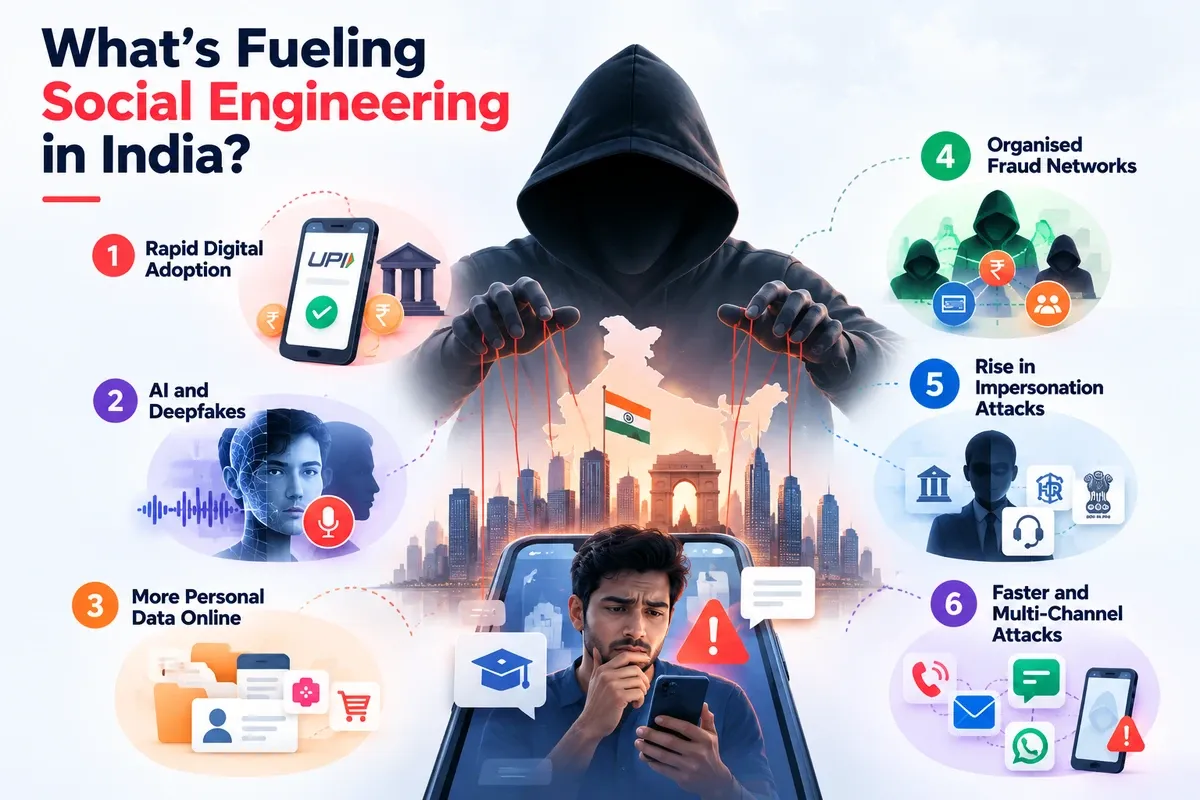
Social engineering attacks are becoming more sophisticated as India's digital economy expands. With more people using online banking, digital payments and other financial services, fraudsters have more opportunities to impersonate trusted institutions and manipulate users into sharing sensitive information or approving fraudulent transactions. The growing availability of personal data can make these attacks more convincing and harder to recognise.
1. Rapid Growth of Digital Payments and Banking
India has seen increased access to banking and financial services through digital payments. Digital lending, mobile banking, and UPI have made day-to-day transactions easier and faster. But this convenience also creates opportunities for fraudsters. They may pose as bank officials or trusted institutions to trick people into divulging sensitive information or approving fraudulent transactions.
2. AI-Powered Fraud and Deepfake Technology
Social engineering attacks are sounding more believable because of artificial intelligence (AI). Scammers use AI to clone voices, create deepfake audio, and generate synthetic content to impersonate a bank representative, a company executive, a government official, or even a family member. These technologies make fraudulent communications seem more genuine and harder to detect.
3. Increased Availability of Personal Data
Vast amounts of personal, educational, health, and consumer data are stored and shared electronically. Attackers can use data breaches, exposed databases, and information gathered from social media to craft scams that are more likely to succeed. If the fraudster knows the victim's name, institution, employer, or recent activity, their impersonation attempts look far more convincing.
4. Growing Complexity of Fraud Operations
Most modern fraud networks are not single actors but organised ecosystems. Different groups specialise in data collection, impersonation, mule account recruitment, phishing campaigns, and money laundering. This specialisation enables attackers to run highly targeted, scalable social engineering campaigns across the BFSI sector.
5. Rise in Targeted Impersonation Attacks
Attackers are increasingly posing as internal HR teams, IT helpdesks, customer support agents, tax authorities, utility providers, and financial institutions. They use familiar brands and trusted names to lower suspicion and increase the likelihood that victims will follow instructions without checking.
6. Faster and More Sophisticated Attack Techniques
Today’s social engineering attacks happen through multiple channels, including phone calls, SMS messages, email, social media, and messaging apps. A victim may receive a phishing email, a verification call, and a false text link. This results in a coordinated attack that appears legitimate and increases the likelihood of success.
Why Traditional Fraud Controls Struggle Against Social Engineering
Most traditional fraud controls were built to stop unauthorised access, and they usually rely on static rules such as stolen passwords, suspicious login attempts, malware, or known fraud patterns. In social engineering attacks, when the victims share the information themselves, the transaction may appear legitimate to existing controls, exposing critical gaps in identity verification, behavioural analysis, real-time risk detection, and customer authentication.
1. Rule-Based Systems Miss Context
Rules usually flag all the known patterns, such as high-value transfers or unusual locations. A victim who sends ₹40,000 from their own phone, on their usual network, looks normal to the bank and the system. The rule engine cannot see the phone call running in the background.
2. OTP Verification Does Not Verify Intent
An OTP confirms who holds the device and the code, but it cannot detect why the transaction is happening or the intent behind it. When a victim shares the code under pressure, authentication passes even if it's used to commit fraud.
3. Device Checks Alone Are Insufficient
A trusted device confirms the handset. In many cases, the genuine customer on a genuine device is being manipulated. With remote access, attackers can easily operate through that trusted device.
4. Manual Reviews Fail to Cope Up
The fraud detection team cannot evaluate every flagged transaction in the few minutes available. As queues grow, genuine customers face delays. That’s where fraudsters exploit gaps to bypass controls and commit fraud.
These limits show why banks and financial institutions need an advanced fraud intelligence layer that reads behaviour, devices, and relationships, not just the credentials and rules.
How Banks and Financial Institutions Can Reduce Social Engineering Fraud
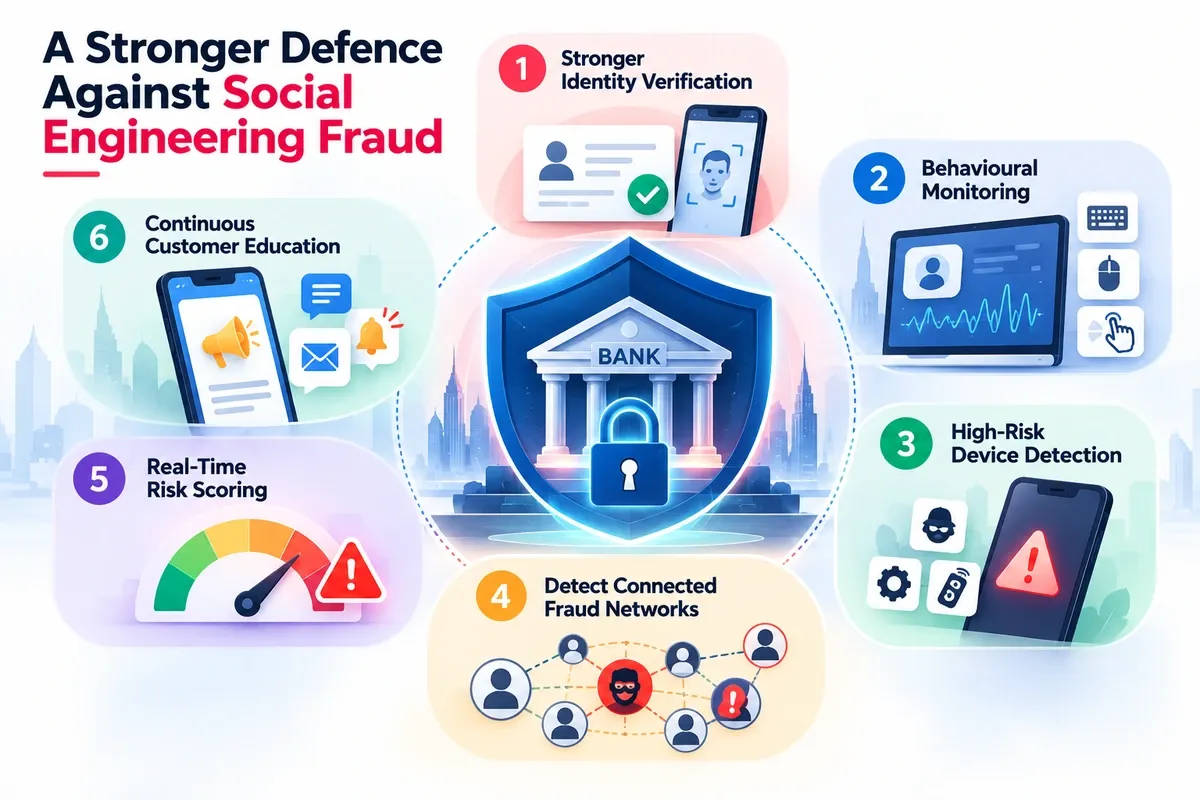
Reducing social engineering fraud requires a layered defence strategy rather than reliance on any single control. Because these attacks exploit human behaviour rather than technical vulnerabilities, no individual verification step can provide complete protection.
1. Strengthen Identity Verification
Instead of relying on a single OTP to verify identity, use multiple independent signals like document verification, liveness detection, and phone, email, and address data consistency.
2. Monitor Behavioural Signals
Monitor how people actually type, swipe, and move around during an online session. Long pauses, copied values, or step-by-step guided navigation can indicate that someone is being coached during a session.
3. Detect High-Risk Devices
Before approving a transaction, assess the device for risk indicators such as emulators, rooted devices, remote access tools, and links to previously detected fraud.
4. Identify Connected Fraud Networks
Instead of evaluating each application individually, link accounts, devices, phone numbers, and beneficiaries to uncover rings and mule clusters.
5. Implement Real-Time Risk Scoring
Combine every signal into an assessment score and consider onboarding, login, or payment. This allows banks and financial institutions to act instantly.
6. Educate Customers Continuously
Use in-app notifications, SMS reminders, and short real-world examples. Education turns out effective when it reaches customers at the moment of risk. A warning shown just before a first-time payment to a new beneficiary is far more effective than a generic awareness email.
Best Practices to Prevent Social Engineering Fraud
Effective prevention depends on recognising warning signs, following secure verification practices, and maintaining strong fraud controls across every stage of the customer journey. The following best practices for both consumers and banks can help reduce exposure to social engineering risks and minimise the impact of attempted fraud.
For Consumers
-
Never share OTPs: No bank, government office, or delivery agent will ever need your OTP, PIN, or CVV.
-
Verify caller identity: Hang up and call back on the official number printed on your card, passbook, or the bank's website.
-
Avoid unknown links: Do not click links in SMS, email, or social messages. Type the official address yourself instead. This also protects you from social phishing messages sent by unknown profiles.
-
Use official channels: Complete KYC updates, refunds, and complaints only through the verified app, website, or branch.
-
Report quickly: If you are targeted, call the 1930 helpline or file a complaint at cybercrime.gov.in immediately or within the next few hours. Speed improves the chance of recovering the money.
For Banks and Fintechs
-
Employee awareness training: Staff are targeted too, through helpdesk impersonation and insider-imitated calls. So regular role-based training is necessary.
-
Real-time fraud monitoring: Watch onboarding, login, and payment events as they happen.
-
Behavioural analytics: Look at how a session unfolds, since manipulated customers often behave differently from usual and genuine consumers.
-
Device intelligence: Identify emulators, device farms, and repeat fraud devices before they cause losses.
-
Mule account detection: Track unusual inflows, shared devices, and linked beneficiaries to prevent the laundering chains early.
How Sign3 Helps Identify High-Risk Activity Before Losses Occur
Sign3 brings several signals together into one fraud intelligence layer, so risk teams see the full picture instead of isolated alerts. Each component answers a different question about the person, the device, and the network behind an action.
1. Device Intelligence
Device intelligence examines the handset behind every session. It detects device farms where many fake profiles run from the same hardware, repeat fraud devices that return under new identities, and emulator usage that hides the real device. This detects a fraud infrastructure that a customer name or phone number alone would never reveal.
2. Behavioural Biometrics
Behavioural biometrics studies how a user interacts with the app. It reveals unusual typing patterns, navigation anomalies, and automated behaviour that does not match a real person. A customer being coached on a call often moves differently from one acting alone, and these signals expose that difference.
3. Digital Footprint Analysis
Digital footprint analysis checks whether an identity holds together. It evaluates identity consistency across data points, contact intelligence on phone numbers and email addresses, and reputation indicators that show whether an identity has a history of misuse. Thin or inconsistent footprints often point to synthetic or borrowed identities.
4. Graph Intelligence
Graph intelligence uses Graph Neural Networks (GNNs) to analyse relationships between entities, such as users, devices, accounts and transactions. By learning patterns across these connections, GNNs can help identify suspicious links, coordinated fraud rings and mule account networks that may go unnoticed when each transaction is assessed individually. This allows fraud teams to investigate connected risks rather than isolated alerts.
Conclusion
As fraud schemes become more sophisticated across digital onboarding, payments, lending, and account servicing journeys, organisations need visibility beyond traditional identity verification and rule-based controls. Sign3 helps banks and lenders uncover connections between seemingly unrelated users, devices, and accounts to detect mule accounts and coordinated fraud networks earlier. This enables teams to investigate high-risk activity more effectively and prevent fraud before losses occur.
Looking to strengthen your fraud prevention strategy? Book a demo and see how Sign3 helps identify high-risk users, detect social engineering attacks, uncover connected fraud networks, and stop fraud before losses occur.
Frequently Asked Questions
What is social engineering?
Social engineering is a cybercrime method in which attackers deceive people instead of gaining access to their systems. They use trust, fear, urgency, or authority to make victims share OTPs, passwords, or card details. Social engineering focuses on manipulating human behaviour rather than compromising systems.
What are the common types of social engineering?
Common types of social engineering include vishing, phishing emails, smishing, OTP theft, impersonation, account takeover, mule account recruitment, and investment or loan scams. Each uses a believable story to push the victim into acting quickly, without stopping to verify who is asking.
How do hackers manipulate victims?
Hackers manipulate victims by creating urgency, posing as authority figures, triggering fear, and offering rewards. They even use leaked personal data or build trust slowly over weeks. However, the goal is always the same: making the victim act emotionally before they can think through the request.
What is the difference between phishing and social engineering?
Phishing is one technique, delivered through email, SMS, or social phishing messages. Social engineering is the wider category of manipulation tactics that includes phishing, vishing, impersonation, and in-person tricks. Every phishing attempt is a manipulation tactic, but not every manipulation tactic is phishing.
How can banks prevent social engineering fraud?
Banks should combine layered identity checks, behavioural signals, device intelligence, and graph analysis to find mule networks. Real-time risk scoring then triggers step-up verification or blocks, while continuous customer education reduces the chance of a victim complying.
What is the difference between technical hacking and social engineering?
Technical hacking targets vulnerabilities in software, devices, or networks; social engineering attacks target human decision-making. Social engineering attacks exploit trust and emotion, letting attackers bypass security controls.
What role does fraud intelligence play in detecting social engineering?
Fraud intelligence connects device, behavioural, digital footprint, and network signals into one risk score. This lets teams spot manipulated or high-risk activity in real time and intervene before money leaves the account.


