

If you are a victim of a vishing scam in India, immediately report it by calling the cybercrime helpline 1930, and also get in touch with your bank to block your account, card or UPI ID that has been compromised. You can also lodge a complaint on the National Cyber Crime Portal (cybercrime.gov.in). Banks and authorities often describe the first hour after a fraudulent transaction as the golden hour when they have the best chance of freezing suspicious transactions before funds are moved through multiple accounts.
Vishing scams happen over voice calls and commonly employ real-time manipulation techniques that may coerce victims into actions they would normally not do. This guide explains exactly what you need to do, which helplines to call, what evidence you’ll need, and your recovery options in India.
What Is a Vishing Scam?
A vishing scam is a type of cybercrime in which criminals use voice calls to impersonate trusted organisations and trick people into revealing login credentials, financial information, OTPs, or other personal details, or authorising payments. The term vishing combines voice and phishing, meaning it is phishing carried out through phone conversations rather than emails or text messages. Often, attackers who use vishing rely on scripts carefully constructed around fear, urgency, trust, or rewards. They may purchase leaked personal data so they can mention your name, bank, recent transactions, or other details to make the call seem legitimate. This familiarity makes it easier to build trust and pressure victims into taking immediate action.
How to Report a Vishing Scam in India
You can report a vishing scam in India through four routes: the 1930 cybercrime helpline, the National Cyber Crime Portal, your bank and, where needed, the local police. Use the first three together and as fast as possible.
Method 1: Call the Cybercrime Helpline 1930
1930 is the national helpline for cyber financial fraud, run under the Indian Cyber Crime Coordination Centre (I4C).
-
Your call is logged on a central reporting system, and the details are shared with the banks and payment platforms involved so they can act on the suspected funds.
-
When the complaint reaches the bank that received your money, it can place a hold on the amount before it is withdrawn or moved on. This works only while the funds are still present in the account. Fraudsters move funds quickly, often through several transfers, and every move makes tracing harder.
After you call, the operator records your details and gives you an acknowledgement number. Note it down because the number helps to track the complaint and lets you file the full report on the portal.
Method 2: Report on the National Cyber Crime Portal
The portal at cybercrime.gov.in lets you file a written complaint with evidence. Follow these steps:
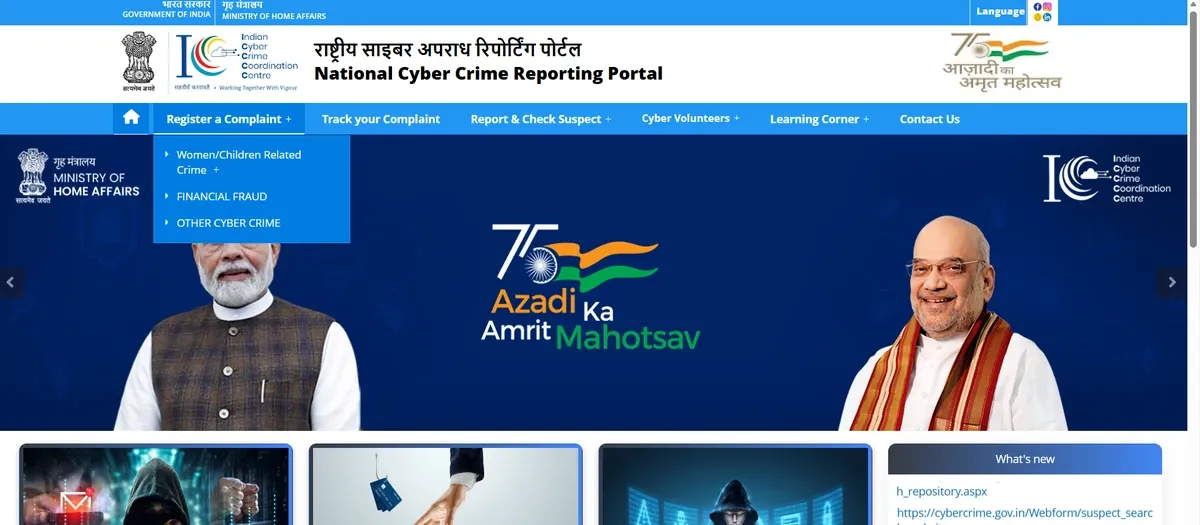
- Visit the National Cyber Crime Portal at cybercrime.gov.in. On the homepage, choose the Financial Fraud category.
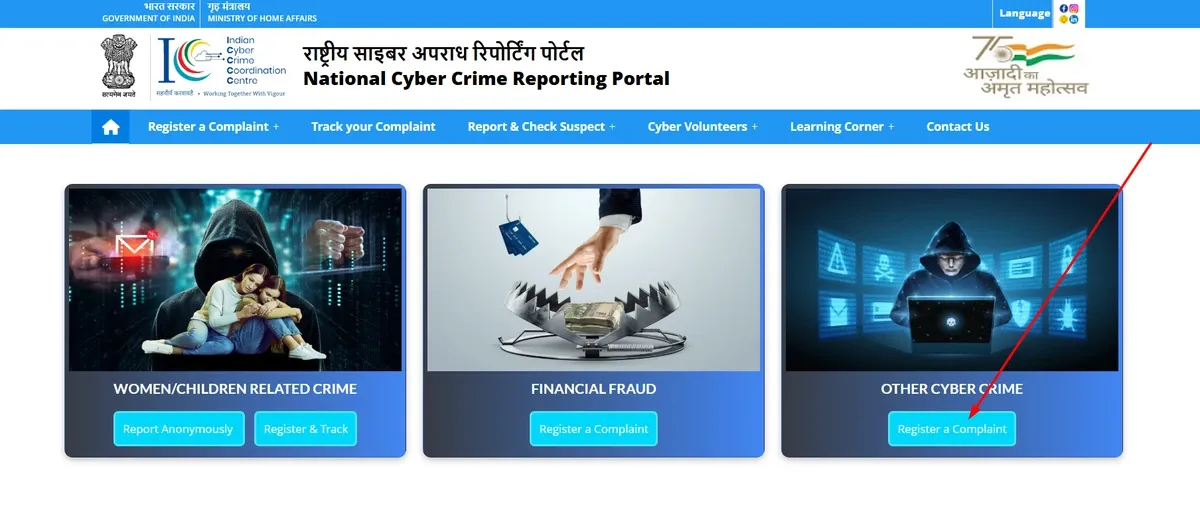
- You will be redirected to the Filing complaint page. Choose the option “Other Cyber Crime” and then file a complaint.
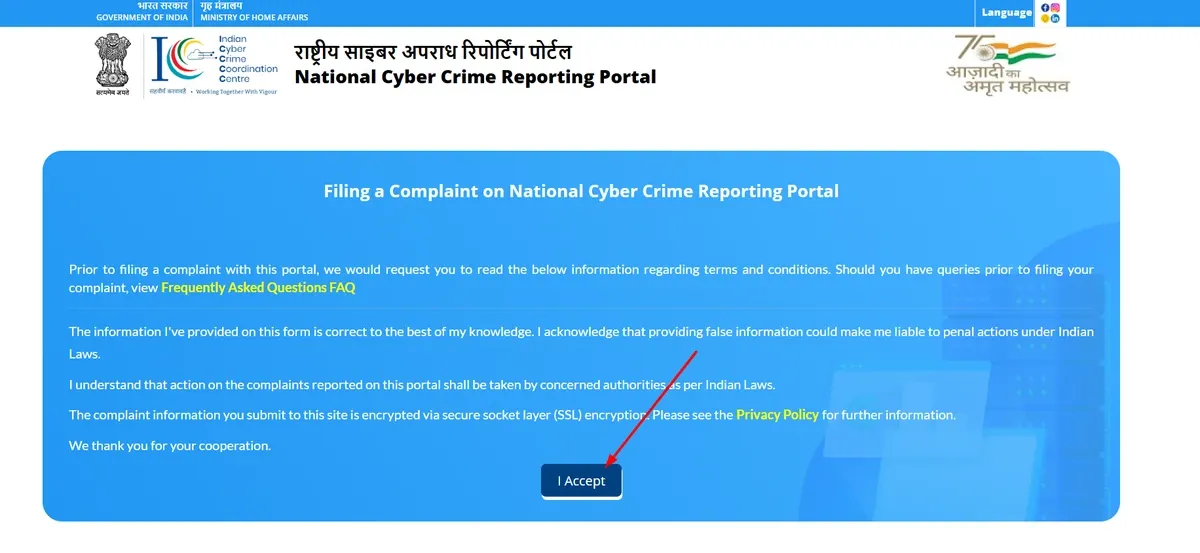
- Read the terms and conditions and click on “Accept”.
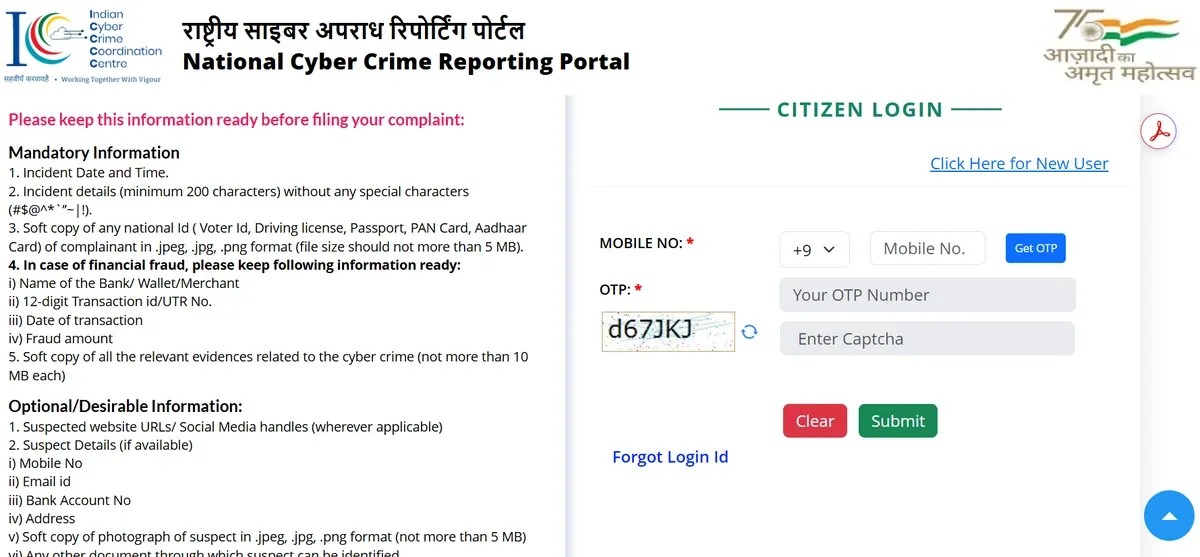
- You’ll be redirected to the citizen login page. Register with your mobile number. You will receive an on-time OTP. Enter it and log in.
- Enter the incident details: date, time, amount, payment mode and the scammer's number or account.
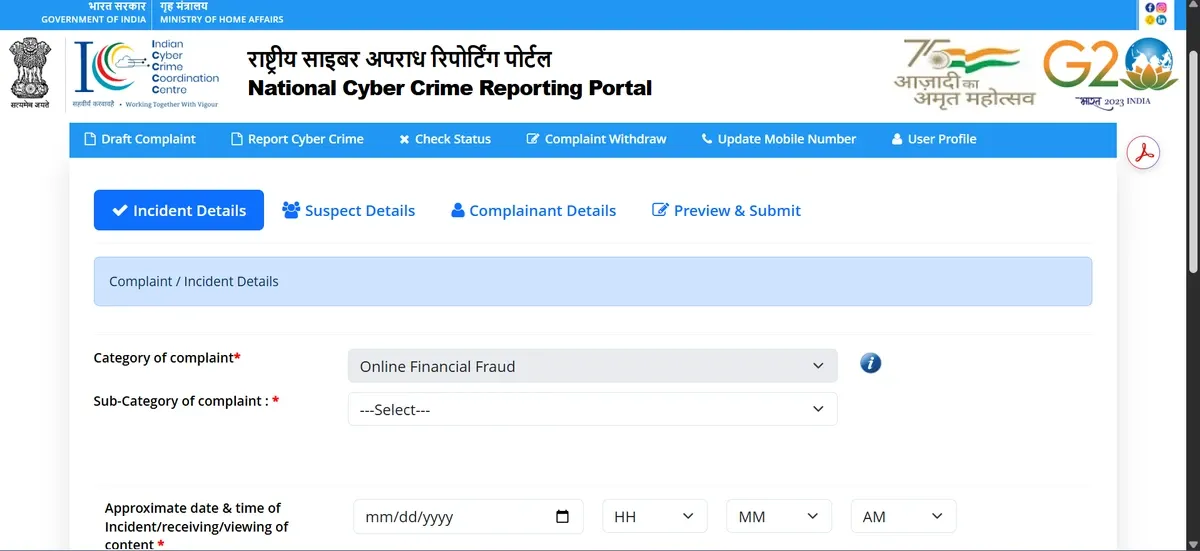
- Upload your evidence, such as screenshots, call logs and transaction proof.
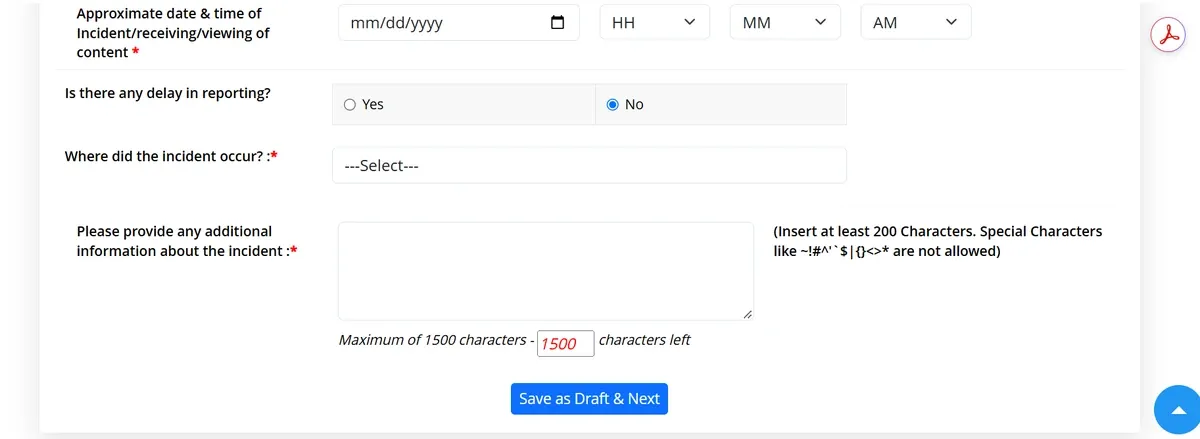
- Submit the complaint and save the acknowledgement number.
Complaints on the portal are reviewed by the cyber cell of the relevant state or union territory. Keep the acknowledgement number safe because your bank and police may ask for it. You can also report the scam number through the Chakshu facility on the Sanchar Saathi portal run by the Department of Telecommunications. This helps flag the number but does not replace a financial fraud complaint. Read this blog to gather detailed insights on how to report cyber fraud in India.
Method 3: Report to Your Bank
Report to your bank by phone first, then send a written complaint and ask for a reference number. Since your bank controls your account, you should lodge a complaint there directly by talking to their customer support team. While complaining, provide these details:
-
Share your account number
-
Transaction ID
-
Date and time of the transaction
-
Amount lost
-
Caller details, including the number used and the organisation the caller claimed to represent
Ask the bank to confirm in writing that it has blocked your access and started an investigation. This record supports any later dispute.
Method 4: File a Local Police Complaint (If Needed)
File a local police complaint when the case is serious enough to need an FIR. A police complaint is not always the first step, but it becomes important when:
-
The fraud amount is large
-
Your identity documents were misused or stolen
-
Multiple accounts or cards were affected
Carry your portal acknowledgement, your bank complaint copy and all evidence. Some bank and insurance processes may ask for a police report or FIR.
What Factors Affect Recovery Success After a Vishing Scam?
Recovering money lost to a vishing fraud is possible in some cases, but success largely depends on how quickly you report the fraud and whether the funds can be traced before they move through multiple accounts. The sooner victims act, the greater the chances that banks, payment providers, and law enforcement agencies can intervene.
The following factors commonly influence recovery outcomes:
| Key Factors | Likely Impact on Recovery |
|---|---|
| Fraud reported within 1 hour | Higher chance of freezing funds before they are withdrawn or transferred |
| Fraud reported within 24 hours | Moderate chance of tracing and blocking transactions |
| Fraud reported after several days | Lower chance of recovery as funds may have already been withdrawn or dispersed |
| Multiple account transfers (mule accounts) | Significantly reduces recovery prospects due to the complexity of tracing funds |
| Complete transaction evidence available | Improves investigation and dispute resolution |
| Delayed complaint or missing documentation | Can slow investigations and weaken recovery efforts |
Swipe the table
Cybercriminals often move stolen funds through several accounts within minutes, making tracing more difficult. Reporting the incident immediately to your bank, the 1930 cybercrime helpline, and the National Cyber Crime Portal gives authorities the best opportunity to freeze suspicious accounts before the money disappears from the financial system.
Common Channels Used in Vishing Scams
Fraudsters use several methods to reach potential victims. These vishing scams include:
-
Phone calls: Traditional calls, often from spoofed numbers that appear to be official bank helplines or government agencies.
-
WhatsApp calls: Calls from unknown numbers, sometimes using a bank logo or official-looking profile picture to appear credible.
-
VoIP numbers: Internet-based phone numbers that are inexpensive to obtain and difficult to trace.
-
Interactive voice response (IVR) scams: Automated systems designed to mimic a bank’s customer service menu and collect card details, PINs, or account information.
-
AI voice cloning: Synthetic voices that imitate a family member, colleague, or official using a short audio sample obtained online.
What Are the Common Vishing Tactics Used Against Indian Consumers?
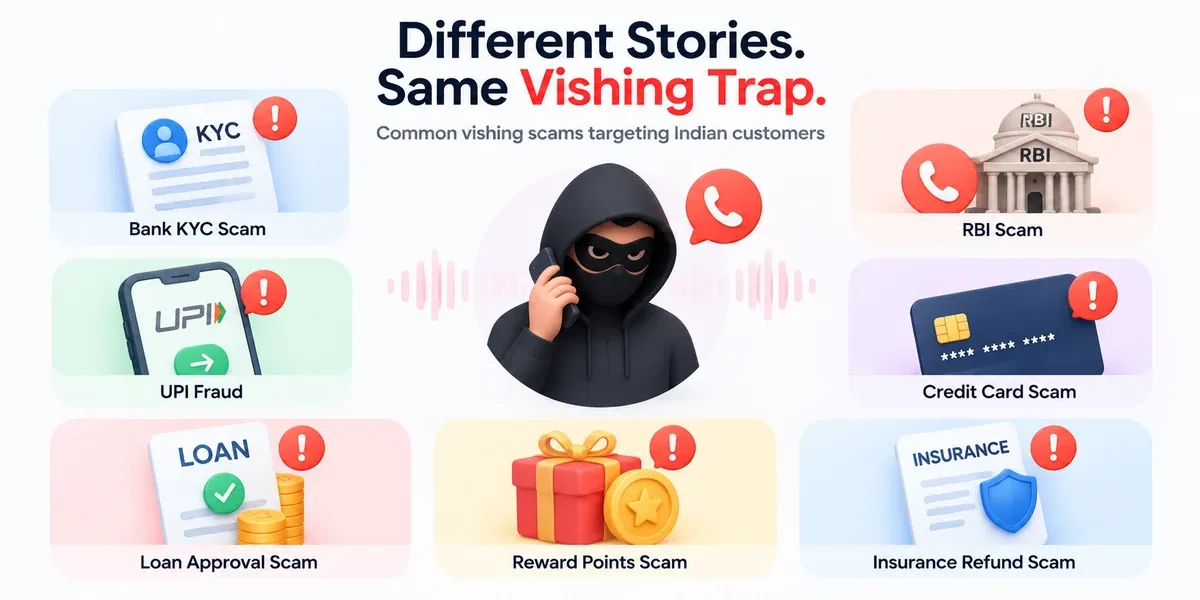
Vishing scams in India are designed to exploit trust, urgency, and fear. The following are some of the most common vishing tactics reported by Indian consumers:
| Scam Type | How the Scam Works |
|---|---|
| Bank KYC Scam | The caller claims your KYC has expired and warns that your account will be suspended if you do not update your details immediately. Victims are then asked to provide personal information, OTPs or install a remote-access app. |
| RBI Scam | Fraudsters impersonating RBI officials or other government agencies tell you your account is under investigation or will be frozen unless you confirm your identity or make a payment. |
| UPI Fraud | The scammer claims to send money or process a refund but instead sends a UPI collect request, fooling victims into authorising a payment from their own account. |
| Credit Card Scam | Victims receive calls saying their credit card is blocked, has been used in suspicious transactions, or is due for renewal. The caller then requests card details, CVV numbers or OTPs. |
| Loan Approval Scam | Fraudsters offer pre-approved loans with minimal documentation and ask for processing fees, verification charges, or account credentials before disbursal. |
| Reward Points Scam | The caller claims that reward points, cashback benefits, or loyalty rewards are about to expire and asks the victim to share banking details or approve a transaction to redeem them. |
| Insurance Refund Scam | Scammers pose as insurance representatives and promise a premium refund, policy bonus, or maturity benefit. Victims are then persuaded to share account details or make a payment to "release" the funds. |
Swipe the table
The Common Pattern Behind Every Vishing Scam
Although the pretext may differ, most vishing attacks follow the same sequence:
1. Create urgency by threatening account suspension, card blocking, or loss of benefits.
2. Build credibility by impersonating a trusted organisation and using personal information obtained from data leaks.
3. Request sensitive information such as OTPs, PINs, CVVs, passwords, or banking credentials.
4. Trigger a payment action by asking the victim to approve a UPI request, transfer funds, or install a remote-access application.
Recognising this sequence is crucial to understanding vishing in cyber security, because the same four moves repeat across every pretext.
Note: Legitimate banks and financial institutions will never ask for OTPs, PINs, CVVs, or passwords over a phone call.
What Should You Do Immediately After a Vishing Scam?
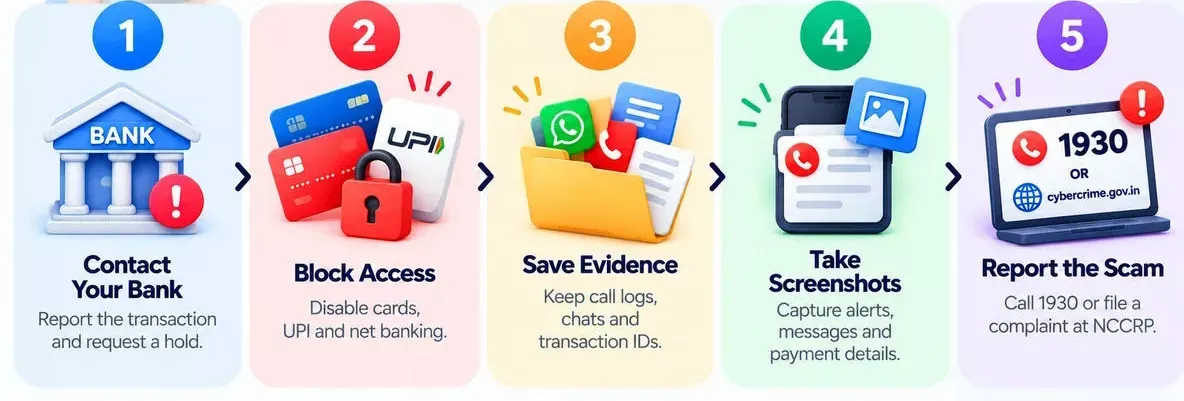
After a vishing scam occurs, you need to do a few things. Contact your bank, block your cards, UPI IDs and net banking. Preserve evidence and file a cyber complaint within the first 30 minutes. Speed matters in recovering the amount because stolen funds are often moved onward within minutes.
Step 1: Contact your bank immediately: Call the number printed on your card or on the bank's official website. Report the transaction and ask the bank to place a hold on the amount.
Step 2: Block access: Ask the bank to block your debit and credit cards, your UPI IDs and your net banking login. This stops further debits while the investigation begins.
Step 3: Preserve evidence: Fraud complaints move faster when you have proof ready. Keep:
-
Call recordings, if your phone saved them
-
The numbers the scammer used
-
SMS messages received during the call
-
WhatsApp chats and call logs
-
Transaction IDs and UPI reference numbers
Step 4: Take screenshots: Capture the call log, payment confirmations, bank alerts and any chat messages before they disappear or get overwritten.
Step 5: File a cyber complaint: Call 1930 and register the complaint on the National Cyber Crime Portal. Both are covered in detail below, along with your bank and the police.
What Is the Timeline for Reporting a Vishing Scam?
The first hour after discovering a vishing scam is often called the "golden hour" of fraud reporting. During this critical window, banks, payment service providers, and cybercrime authorities have the best chance of freezing suspicious transactions before the money is transferred through multiple accounts.
| Time Window | Action |
|---|---|
| 0 to 30 Minutes ( Golden Hour ) | Call your bank immediately, block affected cards or accounts, and report the fraud through the 1930 cybercrime helpline. |
| 30 to 60 Minutes | Save evidence, take screenshots and file the complaint on the cybercrime portal. |
| Within 24 Hours | Send a written complaint to your bank, change all credentials, and visit the police if needed. |
| After 24 Hours | Follow up using your complaint numbers, monitor your accounts and escalate if the bank does not respond. |
Swipe the table
How Can Financial Institutions Reduce Vishing Fraud?
Financial institutions can reduce vishing-related fraud by combining multiple layers of real-time fraud detection that identify suspicious activity before a transaction is completed.
-
Strengthen Device Intelligence: Device intelligence helps identify risky devices, detect multiple accounts linked to the same device, flag unusual device changes, and uncover connections to previously reported fraud cases.
-
Use Behavioural Biometrics: Behavioural biometrics can detect subtle signs of fraud by analysing how users interact with an app. These include unusual typing patterns, abnormal navigation behaviour, hesitation during transactions, or indications that a customer is being guided by a third party during a call.
-
Monitor High-Risk Payment Activity: Real-time transaction monitoring helps identify suspicious payment patterns such as first-time beneficiary additions followed by immediate transfers, sudden increases in transaction value, rapid fund movements, or payments that do not align with a customer's typical behaviour.
-
Detect Mule Accounts Early: Early mule account detection lets institutions identify accounts used to receive and move stolen funds by analysing account relationships, transaction networks, shared devices, and unusual fund-flow patterns. All these together may indicate organised fraud activity.
-
Implement Risk-Based Authentication: Risk-based authentication dynamically increases verification requirements when it detects elevated risk, ensuring high-value transfers, unusual login attempts, or transactions involving new beneficiaries. These receive additional scrutiny without impacting low-risk customers.
-
Leverage Digital Footprint Intelligence: Digital footprint analysis helps uncover hidden risk signals by evaluating phone numbers, email addresses, identity attributes, and historical activity patterns. These may indicate fraudulent identities, mule accounts, or coordinated fraud attempts.
Tackling vishing in cyber security takes more than awareness campaigns. Effective prevention requires identifying risky devices, detecting behavioural anomalies, finding mule account networks, and assessing transaction risk in real time.
Conclusion
Vishing scams exploit trust, urgency, and fear to trick victims into sharing sensitive information or authorising fraudulent transactions. While awareness remains important, financial institutions need stronger, real-time defences to stay ahead of evolving fraud tactics. By combining device intelligence, behavioural analytics, digital footprint intelligence, and mule account detection, organisations can identify high-risk activity before losses occur.
Want to strengthen your fraud defence with real-time intelligence? Sign3 helps banks, lenders, and fintechs detect suspicious behaviour early, reduce fraud losses, and make faster risk decisions. Book a demo today to see how the platform can protect your business and customers.
Frequently Asked Questions
Is vishing fraud a cybercrime in India?
Yes. Vishing is a cyber financial fraud involving impersonation, cheating and unauthorised access to money, and it can be reported on the National Cyber Crime Portal or through 1930. Offences of this kind are prosecutable under Indian law.
Can I recover money after a vishing scam?
Yes, you can recover the money after a vishing scam, sometimes partly and sometimes fully. However, recovery depends on how fast you report, whether the funds are still in the receiving account and how quickly the bank acts. So it is advisable to report within the first hour if you can.
What is the cybercrime helpline number?
The national cybercrime helpline for financial fraud is 1930. Call it as soon as you notice an unauthorised transaction, then file a complaint on cybercrime.gov.in.
How quickly should I report fraud?
Report immediately, ideally within the first 30 minutes. If that's not possible, try to lodge the complaint within the first few hours. Early reports let banks hold funds before they are withdrawn or moved onward.
What evidence should I collect?
Collect call logs, recordings, the scammer's numbers, SMS and WhatsApp messages, screenshots, transaction IDs and bank alerts. Keep them in one folder, because the portal, bank and police may all ask for them.
Can scammers spoof bank phone numbers?
Yes. Caller ID spoofing can typically make a call appear to come from a real bank helpline. That’s why you should never trust the number on the screen. Hang up and call the number on your card or the bank's website.
Can AI-generated voices be used in vishing scams?
Yes, AI-generated voices can be used in vishing scams. AI voice cloning can copy a voice from a short audio sample, so a scammer can imitate a relative or an official. If a call asks for urgent money or codes, verify through a separate channel before acting.
How do banks investigate vishing fraud?
Banks start investigating by reviewing the transaction trail, device and session data, and also the receiving account. They coordinate with other banks and law enforcement, and they may place holds on suspect funds. A clear complaint with evidence speeds this up.


