

SIM swap fraud is a type of identity theft in which a fraudster takes control of your mobile number, either by getting a replacement SIM issued in your name or by moving your number to a SIM they already hold. Once that happens, calls and texts meant for you arrive on their phone instead.
This activity allows fraudsters to receive the one-time passwords (OTPs) and account recovery codes. Using these, fraudsters can get access to email and even create bank accounts or apps to steal the money. This guide explains how the SIM swap fraud attack works, the warning signs to watch for, how banks can detect and prevent it, and what to do if it happens to you.
Key Takeaways
- In SIM swap fraud, criminals take over your mobile number without consent and receive your calls, SMS messages and OTPs.
- The first sign is often a sudden loss of network, followed by unexpected OTPs, password reset alerts or unfamiliar transactions.
- A SIM swap alone does not make your account exposed to fraudsters. Fraudsters usually need other credentials or weak security controls too.
- Banks can spot suspicious activity by combining device, behaviour, location and transaction signals instead of relying on SMS OTPs alone.
What Is SIM Swap Fraud?
SIM swap fraud, also called SIM card swap fraud, happens when someone takes over your phone number without your knowledge. The number stays the same, but the SIM that carries it belongs to the fraudster. Your own SIM stops working, and theirs receives everything sent to you.
A SIM swap is not always considered a crime. Operators issue replacement SIMs every day because phones get lost or damaged. In a genuine replacement, the account holder even asks for the new SIM and passes the operator's identity checks. In a fraudulent swap, someone else makes the request while pretending to be the account holder.
All this matters because the mobile number has quietly become a form of identity. Banks also send alerts and OTPs to it, apps use it for login, and many services reset passwords through it. Whoever controls the number receives all of those messages.
How Does a SIM Swap Attack Work?
A SIM swap attack typically follows a few steps. Understanding how it happens can help customers recognise warning signs before fraudsters gain access to their accounts.
-
The fraudster collects personal information: Fraudsters start by gathering the victim's name, mobile number, date of birth, address and banking details through phishing messages, data leaks, social media or fraudulent calls.
-
They impersonate the victim: The fraudster contacts the telecom operator or visits a retail outlet, claiming to be the account holder. They even request a SIM replacement for a supposedly lost or damaged one.
-
They obtain a replacement SIM or initiate an unauthorised transfer: If the request is approved, the victim's number gets activated on the fraudster's SIM or even gets transferred to another operator without the account holder's consent.
-
The victim's SIM loses network connectivity: The original SIM stops receiving calls and messages. The victim may initially mistake this for a routine network issue.
-
The fraudster intercepts calls and messages: Calls and SMS messages, including banking OTPs, are redirected to the fraudster's device. They can then attempt to access accounts, reset passwords or initiate unauthorised transactions.
A SIM swap scam can unfold within hours, leaving victims with little time to respond. Recognising an unexplained loss of network connectivity and reporting it immediately can help limit the damage. To strengthen safeguards against fraudulent SIM replacement, the Department of Telecommunications (DoT) has reiterated the requirement for telecom operators to follow e-KYC or Digital KYC procedures for SIM swap and replacement requests. The instructions also require operators to preserve relevant customer verification records.
How Can Banks Detect SIM Swap Fraud?
Because the OTP can no longer prove who is on the other end, banks need to read the context around each login or transaction. Several risk indicators are worth watching:
-
A recent device change, especially close to a change in mobile access
-
Unexpected logins from unusual locations
-
New beneficiaries added soon after a login
-
Sudden spikes in transaction value or frequency
-
Unusual login behaviour, such as unfamiliar navigation patterns
-
Repeated authentication failures
-
Suspicious activity following a change in mobile access
One signal alone can have an innocent explanation, since customers do buy new phones. But when a new device, a new location and a new beneficiary appear in the same session, the risk rises sharply.
Four kinds of intelligence add useful context to these checks:
-
Device intelligence shows whether the device has been used on the account before, and whether it shows signs of tampering.
-
Digital footprints help judge whether the phone number, email and other identifiers look established or newly created.
-
Behavioural biometrics compare how someone types and swipes with how the genuine customer usually behaves.
-
Location signals reveal whether a login makes sense given where the customer normally is.
Together, these signals help a bank identify any fraudulent activities that an OTP alone cannot detect.
Common Methods Used in SIM Swap Scams
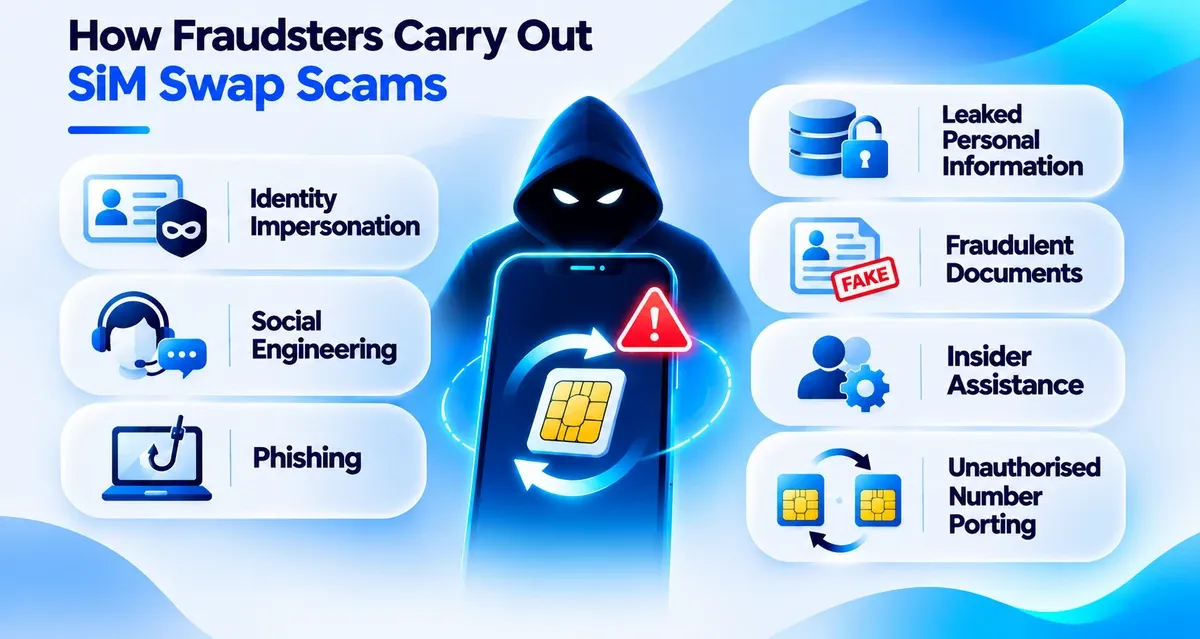
Fraudsters rarely rely on a single tactic to carry out SIM swap scams. They often combine identity theft, social engineering, and telecom-related manipulation to gain control of a victim's mobile number.
-
Identity impersonation: Fraudsters often pose as the genuine customer, using personal details to make their identity claims appear legitimate.
-
Social engineering: They manipulate telecom employees or victims through urgent or misleading requests, often claiming there is a problem with the existing SIM.
Read the guide to gather insights on Social Engineering Attacks.
-
Phishing: Fake messages and websites often trick victims into sharing their personal information or verification details that can later be used to commit fraud.
-
Leaked personal information: Data exposed through security breaches also gives attackers access to genuine information they can use to impersonate account holders.
-
Fraudulent documents: Forged identity proofs or fake authorisation letters may be used to support an unauthorised SIM replacement request.
-
Insider assistance: In some cases, individuals with access to telecom systems help process unauthorised SIM replacement requests.
-
Unauthorised number porting: Fraudsters attempt to transfer a victim's mobile number to another operator without their consent.
The Department of Telecommunications has also highlighted cases involving SIM cards obtained through fake documents, fraud, cheating and impersonation.
Real-world use case: In March 2023, Ahmedabad-based Collective Trade Links Pvt. Ltd. lost ₹1.19 crore in a SIM swap fraud. Fraudsters obtained a duplicate SIM for a company director's mobile number through a fraudulent replacement request. They intercepted banking OTPs, added 10 new beneficiaries and executed 22 unauthorised transactions. In July 2025, Gujarat's adjudicating officer held the telecom operator and bank liable for negligence and ordered compensation and penalties. The case highlights how weak SIM replacement verification and inadequate transaction monitoring can expose businesses to substantial financial losses.
Major Warning Signs of SIM Swap Scams
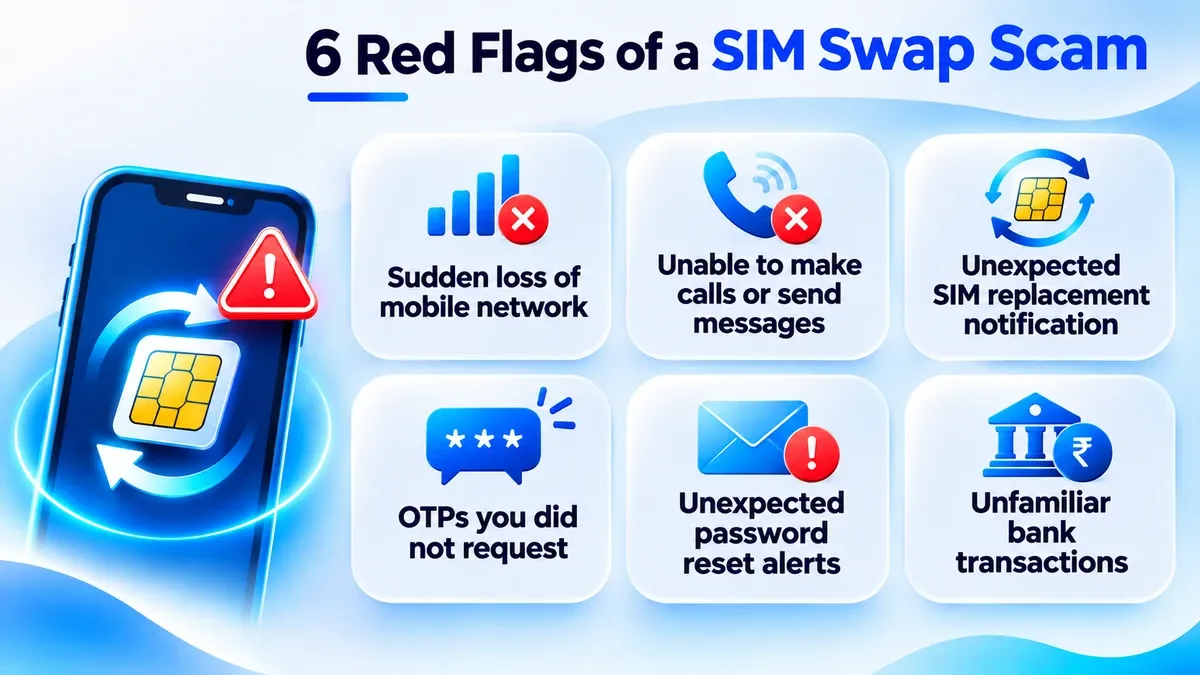
SIM swap scams often leave some warning signs before unauthorised financial activity occurs. In fact, a sudden loss of mobile connectivity may be the first indication, followed by suspicious account activity.
| Warning Signs | What These Signs May Mean |
|---|---|
| Sudden loss of mobile network | Your SIM may have been deactivated because a new one is active elsewhere |
| Unable to make calls or send messages | Your mobile number may no longer be connected to your original SIM. |
| Unexpected SIM replacement notification | Someone may have requested a SIM replacement or number transfer without your consent. |
| OTPs you did not request | Someone may be trying to log in or approve a transaction |
| Unexpected password reset alerts | Someone may be trying to take control of an account linked to your mobile number. |
| Unfamiliar bank transactions | Unauthorised access may have resulted in financial activity without your approval. |
Swipe the table
A sudden loss of network connectivity does not necessarily indicate a SIM swap fraud, because some routine network disruptions can cause similar issues. So, assess the right signs and identify unexpected OTPs, password reset alerts or unfamiliar transactions. Also, contact your telecom operator and bank immediately.
What Happens After a Successful SIM Swap Attack?
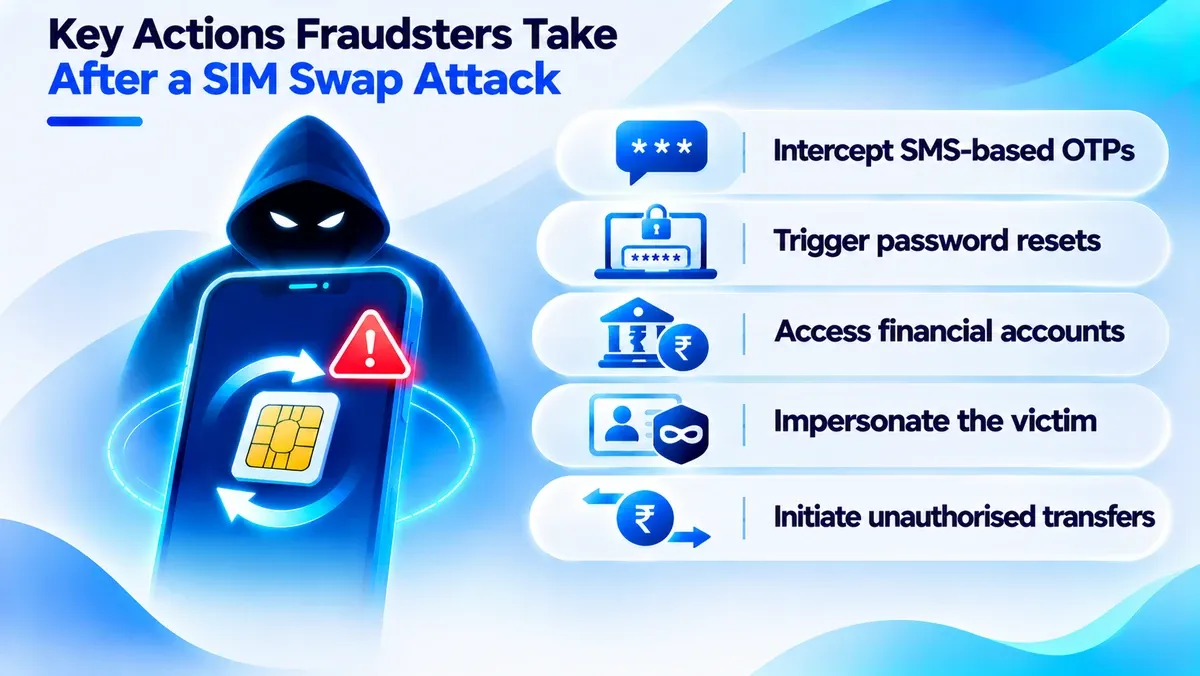
Once fraudsters gain control of a victim's mobile number, they can intercept SMS-based OTPs, initiate password reset attempts and try accessing banking or other financial accounts. The potential consequences include:
| What Fraudsters Can Do | Potential Impact On Victims |
|---|---|
| Intercept SMS-based OTPs | Receive verification codes intended for the account holder. |
| Trigger password resets | Attempt to take control of banking, email and other accounts linked to the mobile number. |
| Access financial accounts | Attempt unauthorised logins using intercepted OTPs and stolen credentials. |
| Impersonate the victim | Use the compromised number to pose as the account holder during calls or verification processes. |
| Initiate unauthorised transfers | Attempt to move money from compromised accounts. |
Swipe the table
However, controlling a SIM does not automatically grant access to every account. Most banking and payment apps also require a password, PIN, device authorisation or another authentication factor. Fraudsters often combine SIM swap attacks with stolen credentials or target accounts that rely heavily on SMS-based authentication.
This is why layered security remains essential even when a mobile number is compromised.
Why Is SIM Swap Fraud a Concern for Banks and Fintech Companies?
For financial institutions, a SIM swap is not just a telecom problem. It directly affects how they authenticate customers.
- Account takeover: Fraudsters who intercept OTPs may bypass SMS-based verification and gain an opportunity to access customer accounts.
Read more to understand Account Takeover (ATO) Fraud
-
Unauthorised transactions: Attackers may initiate fraudulent transfers before the genuine account holder becomes aware of the compromise.
-
Weakened OTP-based authentication: SMS-based authentication relies on the assumption that the registered mobile number is controlled by the genuine customer. A SIM swap undermines this assumption.
-
Identity theft: A compromised mobile number may be used to access or attempt to recover other accounts registered in the victim's name.
-
Financial and reputational losses: Customers may suffer financial losses, while financial institutions face disputes, investigation costs and potential damage to customer trust.
The biggest challenge for financial institutions is distinguishing genuine customers from fraudsters. An attacker may possess the correct mobile number, receive the valid OTP and have access to the victim's personal information. As a result, a fraudulent login can appear legitimate to conventional authentication systems.
How Can Banks Prevent SIM Swap Attacks?
Banks can prevent SIM swap attacks by applying layered and advanced detection methods. By applying the following preventive approaches, banks can succeed.
-
Layered authentication: Combine more than one authentication layer. When multiple signals are assessed together, such as device, biometric, and location, the stolen number alone is not enough to commit fraudulent activities.
-
Risk-based verification: Apply stricter checks, such as biometric authentication or alternative-channel verification, for unfamiliar devices, unusual locations or high-risk transactions while minimising friction for customers.
-
Transaction monitoring: Watch for any kind of account takeover patterns, particularly soon after getting a notification regarding the change in mobile access.
-
Extra checks for high-risk changes: A sudden update to a mobile number, adding a beneficiary or raising certain limits in account handling should trigger further verification.
-
Beneficiary adding periods: A short delay before making large transfers to a new beneficiary gives customers time to detect fraud.
-
Customer alerts: Notify customers about any type of sensitive changes through more than one channel.
-
Device binding: Link the accounts to some trusted devices so a new device faces more scrutiny, reducing the chances of SIM swap fraud.
-
Telecom coordination: Where appropriate, share some crucial information about suspicious SIM changes with other operators.
Banks should also avoid relying only on SMS OTPs for sensitive transactions. SMS depends on the security of the phone number, which is exactly what a SIM swap targets.
What Should You Do If You Suspect SIM Swap Fraud?
If you suspect that someone has taken control of your mobile number through a SIM swap fraud, it is necessary to follow some vital steps.
-
Contact your telecom operator immediately: Use another phone and contact your telecom operator immediately to report the unauthorised SIM replacement or number transfer.
-
Request suspension of the unauthorised SIM: Ask the operator to deactivate the fraudulent SIM and help you restore your number to your original SIM after verifying your genuine identity.
-
Contact your bank: Report the suspected SIM swap and ask the bank to secure your accounts. Also, request temporary blocking of net banking, cards or UPI services if necessary.
-
Change your passwords from a trusted device: Prioritise your email, banking and other accounts that use your mobile number for authentication or password recovery.
-
Review your transactions: Check your bank statements and linked payment apps to identify unfamiliar transactions or unauthorised changes.
-
Call 1930 if you have suffered financial loss: India's national cybercrime helpline allows victims to report financial cyber fraud and seek timely assistance.
-
File a complaint online: Visit cybercrime.gov.in and submit a complaint through the National Cyber Crime Reporting Portal.
Strengthen SIM Swap Fraud Detection with Sign3's Fraud Intelligence Solutions
SIM swap fraud exposes a legitimate customer to fraud through mobile numbers as proof of identity. Once fraudsters take control of a number and use the OTPs in the wrong manner, they can gain access to genuine information and make unauthorised transactions. For individuals, recognising warning signs and reporting suspicious SIM activity immediately are considered essential. For banks, stronger protection requires looking beyond OTP verification.
By combining layered authentication, transaction monitoring and intelligence-led fraud detection, financial institutions can identify suspicious access before it leads to financial losses. With our Fraud Intelligence Platform, banks can successfully add the contextual intelligence needed to strengthen their defences against SIM swap fraud. Book a demo to learn how Sign3 can help you handle evolving account takeover threats.
FAQs
1. What is SIM swap fraud?
SIM swap fraud is considered a form of identity theft in which a fraudster takes control of someone's mobile number by obtaining a replacement SIM or transferring the number to another SIM without the account holder's consent. This allows the attacker to receive calls, SMS messages and OTPs intended for the victim.
2. How does a SIM swap attack work?
A SIM swap attack usually begins when a fraudster collects personal information about a victim through phishing, data leaks or social engineering. This type of attack uses some genuine details of victims to impersonate the account holder and request a replacement SIM from the telecom operator. Once activated, the new SIM receives the victim's calls and messages, including banking OTPs.
3. How do fraudsters get access to someone's SIM card?
Fraudsters use methods such as identity impersonation, phishing, social engineering, leaked personal information and forged documents to manipulate SIM replacement or number transfer processes. In some cases, insider assistance within telecom operations may also facilitate an unauthorised SIM swap.
4. Can someone access my bank account through a SIM swap?
A SIM swap allows fraudsters to intercept SMS-based OTPs and attempt password resets for accounts linked to the compromised number. However, access to a bank account may also require additional credentials, such as a password, PIN or device authorisation. The risk increases when attackers possess stolen credentials or when accounts rely heavily on SMS-based authentication.
5. How can I identify if my SIM card has been swapped?
A sudden loss of mobile network connectivity, unexpected SIM replacement notifications, OTPs you did not request, and unfamiliar password reset alerts may indicate SIM swap fraud. Unauthorised bank transactions are another serious warning sign. Contact your telecom operator and bank immediately if you suspect your number has been compromised.
6. How can banks detect SIM swap fraud?
Sign3 helps banks strengthen SIM swap fraud detection through multiple intelligence capabilities. Its Device Intelligence identifies unusual device changes, Behavioural Biometrics detects deviations from established customer interaction patterns, Digital Footprint assesses linked digital identifiers, and Location Intelligence highlights unusual login locations. By correlating these signals, banks can identify suspicious account access even when an attacker has intercepted the correct OTP.


