

Penny drop verification allows banks, lenders, and fintechs to validate bank account details before processing payouts or completing onboarding. A small transfer, often ₹1, is made to verify the details given against the bank records, and the account holder's name is returned. A successful penny drop does not reveal that the applicant is genuine, controls the account, or will use it legitimately.
Fraudsters can use real, active accounts to move illicit funds. Money mule accounts, borrowed accounts, and synthetic identities can all pass basic account checks and still expose a financial institution to fraud. Detecting them takes more than confirming account ownership.
Penny drop still reduces payment errors and validates beneficiary details. It works best when combined with identity verification, device intelligence, behavioural signals, digital footprint analysis, and continuous account monitoring.
Key Takeaways
- Penny drop is a banking verification process where a small amount, usually ₹1, is transferred to validate bank account details and to confirm that the account is active, valid, and legally owned by the right person.
- The process has five steps: collect account details, send the transfer, receive the bank response, match the returned name, and record the outcome.
- Reverse penny drop needs the customer to start a transaction, and pennyless methods validate bank details without a ₹1 deposit.
- Common failure points are money mule accounts, name mismatches, borrowed accounts, bank-side errors, and changes in account behaviour after onboarding.
- Layered fraud intelligence can flag suspicious applicants and account links that basic bank account verification cannot see.
What Is Penny Drop Verification?
Penny drop is a method of bank account verification in which a business/fintech platform/financial institution transfers a nominal amount, commonly ₹1, to a beneficiary’s account and retrieves details such as the account holder’s name. The business then compares this name with the details provided by the customer to check whether they match.
In India, it is usually done on bank transfer rails such as IMPS or other supported payment channels. Businesses use it to validate beneficiary accounts before loan disbursals, vendor payments, investment transactions, insurance payouts, and other transfers.
How Penny Drop Verification Works: Step by Step
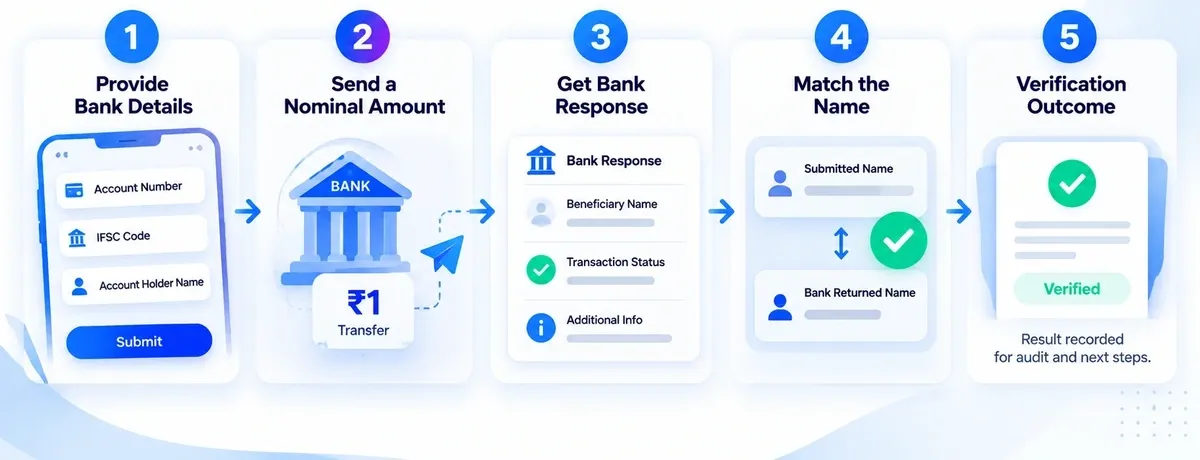
A standard penny drop workflow usually follows five steps.
-
Collect bank details: The customer first provides a live bank account number, the IFSC code, and the name registered on that account.
-
Initiate a small transfer: The system first instructs the bank to deposit a small amount, generally ₹1, using a compatible bank channel.
-
Receive the bank response: The reply may include the beneficiary name, transaction status, and any failure details, depending on the bank and verification provider.
-
Match the returned name: The system compares the returned name with the name the customer entered and other information.
-
Record the outcome: The application records everything, including the transaction reference, and then either accepts the details, asks for correction, or sends the case for manual review.
Process flow :
Customer details → ₹1 transfer → Bank response → Name matching → Verification decision and audit record.
An exact name match may support acceptance, while a partial match may require additional checks. Investigate a failed response rather than automatically treating it as evidence of fraud.
Where Penny Drop Verification Is Used
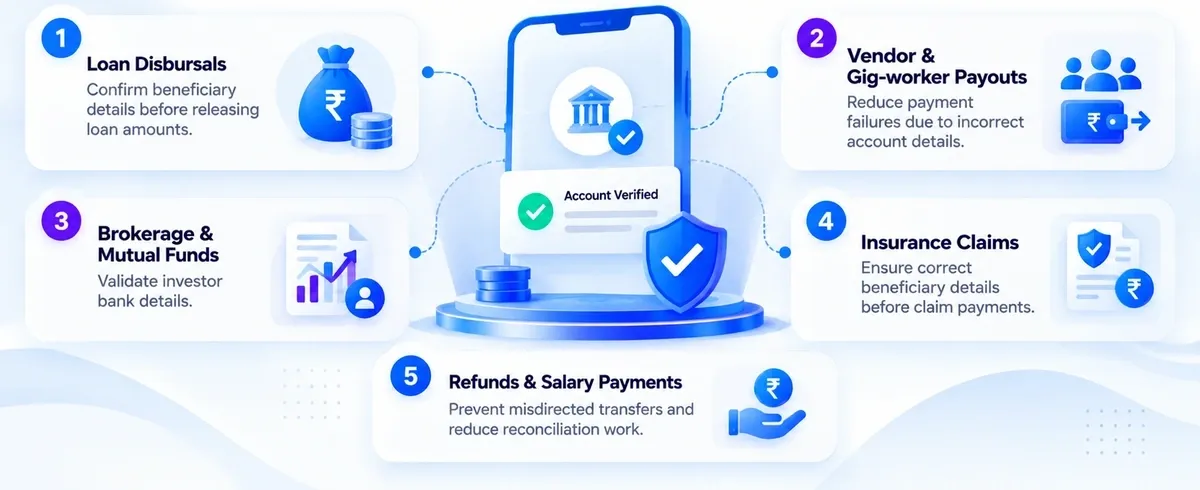
Penny Drop verification is mainly used by banks and financial institutions to verify bank details and bank account holders across multiple workflows:
-
Loan disbursals: Lenders commonly use this method to verify beneficiary details before disbursing approved loan amounts.
-
Vendor and gig-worker payouts: Penny Drop helps to assess payment failures in vendor and gig-worker payouts caused by incorrect account numbers or IFSC codes.
-
Brokerage and mutual fund onboarding: This assessment method helps to verify investor bank details where applicable rules and supported verification processes require it.
-
Insurance claims: The method is used to verify the beneficiary account details before eligible claim payments are processed.
-
Refunds and salary payments: Penny Drop helps you to identify misdirected transfers and avoid payment reconciliation work for refunds and salary payments.
In general, the detection method helps verify account details before making payments and can reduce operational mistakes. But the level of verification must match the transaction's risk. A routine, low-risk beneficiary update might require tighter fraud checks than a high-value loan disbursal.
Where Penny Drop Verification Fails
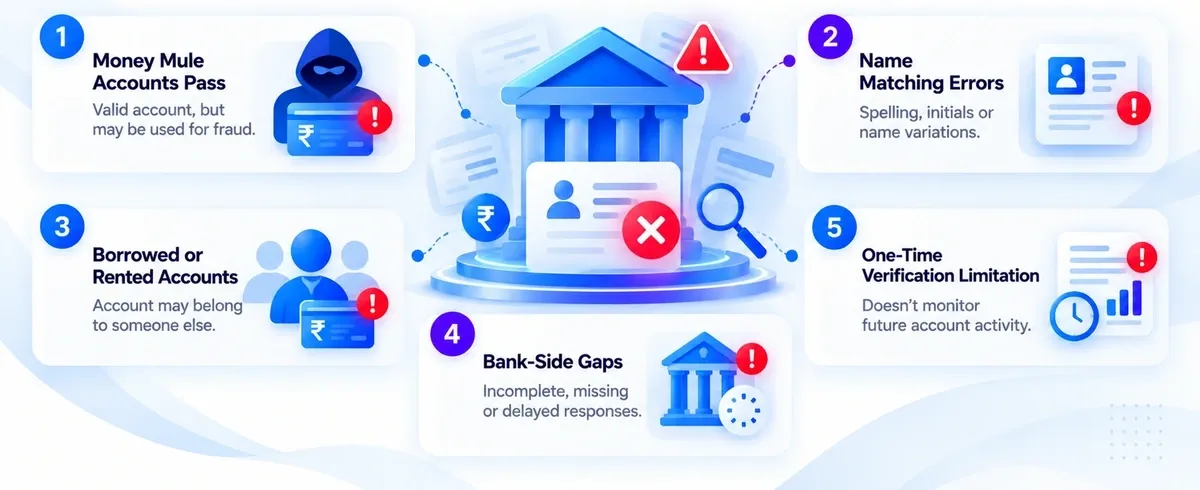
Penny Drop bank account verification helps validate bank account details, but it never reveals who controls the account or how it's used. However, it mostly falls short in five areas. Let’s discuss:
1. Money Mule Accounts Pass the Check
Money mule accounts are legitimate bank accounts used to receive, transfer, or withdraw funds linked to fraud. Some holders take part knowingly. Others are recruited through misleading job offers, commissions, and social engineering. The Reserve Bank of India explains that fraudsters recruit third parties to move funds through their accounts, creating chains that carry illicit proceeds.
A penny drop can succeed because the account exists and the bank returns a valid holder name. Neither result shows whether the account receives suspicious funds or whether the applicant belongs to a wider fraud network.
What helps : Combine account validation with device intelligence, digital footprint analysis, behavioural signals and checks for suspicious links between applicants, devices and contact details.
2. Name Matching Errors
Names rarely appear identically across customer submissions and bank records. Differences come from initials, spelling variations, name order, transliteration between Indian languages and English, maiden names and joint accounts. A strict exact-match rule rejects legitimate customers. A loose rule accepts unrelated names.
Business accounts add complexity because the applicant may supply a trading name, a legal entity or an authorised signatory rather than the exact name the bank holds.
What helps : Apply carefully configured normalisation rules, use confidence thresholds and route ambiguous cases for additional verification. A name match score should support a decision, not replace the institution’s risk assessment.
3. Borrowed or Rented Accounts
Some applicants use an account of a family member, associate, or third party. Others get access to accounts by force, deception, or paying for the use of an account. The account is active and the even name matches, but the applicant may not be the legitimate holder or authorised beneficiary.
A successful penny drop cannot show who controls the account or whether the proposed use is legitimate.
What helps : Verify the applicant’s identity separately, assess whether the account ownership is appropriate for the product, and investigate inconsistencies between the applicant, device, and submitted information.
4. Bank-Side Verification Limitations
Bank account verification depends on the response the bank returns. Some checks return incomplete information, while others fail to retrieve a name or show timeout errors due to temporary technical issues.
However, considering every failed response as fraud leads to unnecessary rejections. Accepting every partial answer introduces unnecessary risk.
What helps : Set some retry limits, differentiate technical failures from verified mismatches, track bank-specific failure trends, and offer compliant fallback options. Keep an auditable trail of the outcome and reason for any exception.
5. The Limitations of One-Time Account Verification
Penny Drop provides a point-in-time validation. Even when an account is valid during onboarding, subsequent activity may reveal suspicious behaviour, account takeover, or the emergence of mule activity.
A previously legitimate customer may also become involved in a fraud network after the original check. Static verification cannot independently detect these changes because it does not continuously evaluate account behaviour.
What helps : Monitor relevant risk signals after onboarding, reassess material changes and investigate unusual patterns as they emerge. The monitoring process should be proportionate to the product, applicable requirements and the institution’s risk level.
Penny Drop Failure Reasons and What They Mean
Penny Drop bank account verification can fail for many reasons, including incorrect bank details, unsupported account types, name mismatch, or temporary technical issues. If businesses understand these failure responses, they can distinguish data-entry errors from operational problems and know what to do next without unnecessarily rejecting legitimate customers.
| Failure response | What it may mean | Recommended next step |
|---|---|---|
| Invalid account | The account number may be incorrect or unrecognised | Ask the customer to recheck the account number |
| Closed or inactive account | The account may no longer support the intended transaction | Request valid account details and retry |
| Name not returned | The bank or verification route may not provide the expected name | Use an approved alternative verification method |
| Bank timeout | The bank or network did not respond within the expected time | Retry under controlled rules or use a fallback |
| Account type unsupported | The account or bank may not support the verification route | Offer an approved alternative method |
| Name mismatch | The returned name differs from the submitted name | Check spelling, initials, account ownership, and supporting evidence |
Swipe the table
A timeout or no response is not the same as a confirmed fraud signal. A name mismatch may not indicate suspicious intent; rather, it may be a legitimate variation. Verification systems need to separate out technical failures, data-quality issues, and true risk indicators.
How to Make Bank Account Verification More Fraud-Resistant
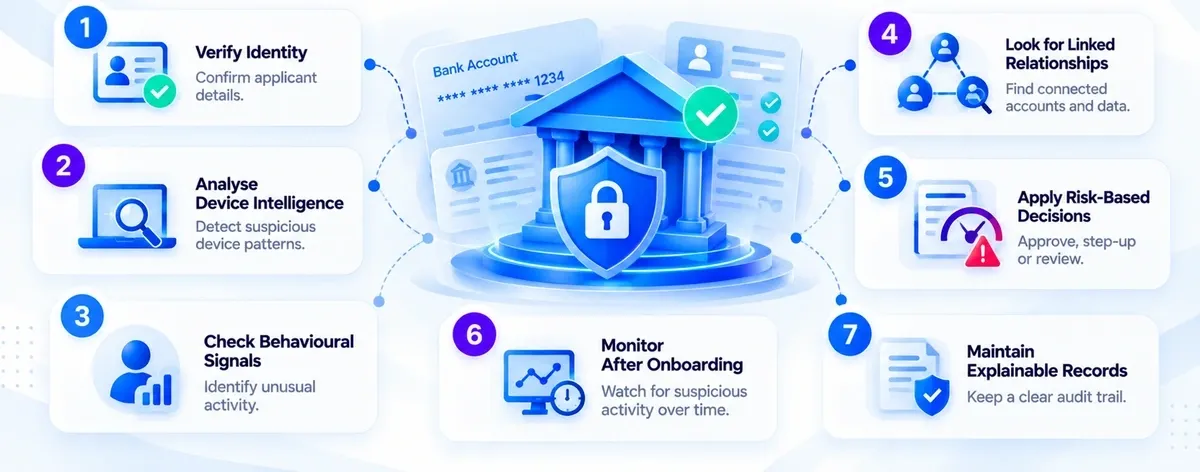
Penny drop verification works well as a first check on bank account details, yet it can’t detect every kind of financial fraud on its own. NBFC should pair it with identity checks, device intelligence, behavioural analysis, and digital footprint assessment to tighten bank account verification. Used together, these steps can surface suspicious activity that one account check alone might overlook.
1. Combine account verification with identity checks
Confirm the applicant's identity with proper evidence; verify the account matches the intended transaction. A valid account shouldn’t cancel out inconsistencies found elsewhere in the onboarding process.
2. Analyse device intelligence
Check for suspicious patterns such as shared devices, repeated registrations, device tampering, or multiple applicants using the same digital environment. Shared-device signals need context because families and legitimate businesses may share devices.
3. Evaluate behavioural signals
Assess relevant patterns in how applicants interact with digital onboarding journeys. Unusual behaviour may warrant additional verification, particularly when combined with other independent risk indicators.
4. Examine digital footprints and linked relationships
Compare relevant contact, device, and identity signals to identify clusters of connected applications. A group of apparently unrelated applicants linked through repeated infrastructure can warrant investigation.
5. Apply risk-based decisions
Combine signals into a risk assessment rather than relying on one binary pass-or-fail result. Depending on the evidence, the outcome may be approval, step-up verification, manual review, or rejection.
6. Monitor after onboarding
Continue assessing relevant account activity and risk indicators after the initial verification. Establish escalation procedures for suspicious patterns, material changes, and potential mule activity.
7. Maintain explainable records
Store every record, including signals, verification outcomes, and the decision reasons your institution’s governance framework requires. It also lets teams review false positives, look into incidents, and improve fraud-detection rules.
Layered verification creates a more complete assessment: Penny Drop validates bank details, while additional controls assess whether the applicant and subsequent activity present unacceptable risk.
Penny Drop and Compliance in India
Penny drop is used in several Indian financial workflows, but its regulatory status depends on the institution, product and applicable requirements. The following table summarises the key considerations.
| Regulatory area | Key requirement or consideration | Relevance to penny drop verification |
|---|---|---|
| RBI KYC requirements | Regulated entities must follow applicable customer due diligence and ongoing monitoring requirements. | Penny drop can support bank account validation but does not replace complete KYC or ongoing monitoring. |
| RBI guidance on money mules | Financial institutions should address the risks of accounts being misused to move proceeds of fraud. | A valid account can still be used for suspicious transactions, requiring additional risk checks. |
| SEBI requirements | Applicable securities-market processes may require bank-detail verification and provide alternatives in certain circumstances. | Intermediaries should follow the current requirements relevant to their specific workflow. |
| Consent and data handling | Collect and process personal information in accordance with applicable legal requirements. | Limit access to account details and protect verification responses. |
| Recordkeeping and audit trails | Maintain records in line with applicable regulatory obligations and internal policies. | Retain relevant verification outcomes and transaction references to support audits and investigations. |
Swipe the table
Before implementing a penny drop workflow, financial institutions must verify the latest applicable RBI, SEBI, and other relevant regulatory requirements. Penny drop should be part of the account verification process, not a substitute for KYC or a complete fraud detection system.
Addressing the Fraud Gap Beyond Account Validation
Penny Drop verification usually confirms the bank account details but cannot independently identify fraudulent applicants. That’s where Sign3 ScreenX complements this process by helping financial institutions detect suspicious applicants and potential money mules during onboarding. By combining our pre-onboarding services with ScreenX, financial institutions can validate account details while assessing broader fraud risks, enabling more informed onboarding decisions. Book a demo and explore how Sign3 can strengthen fraud detection across onboarding and ongoing monitoring.
Frequently Asked Questions
What is penny drop verification in banking?
Penny drop verification in banking is considered an account validation method in which a small amount is transferred to a bank account to confirm that it is active and retrieve the account holder’s registered name for verification.
How does penny drop verification confirm bank account details?
During penny drop verification, the bank processes a small credit and returns the account holder’s name and transaction status, where supported. The business even compares the necessary details with the customer’s submitted information and identifies mismatches before proceeding.
How long does a penny drop check take?
Many automated services return results in seconds; however, the actual time depends on the bank’s response, network availability, and the verification provider. A proper controlled retry or other verification method may be required for delays and timeouts.
Can penny drop verification detect fraudulent bank accounts?
Penny drop verification can flag invalid accounts, failed transactions, or name mismatches, but it cannot establish whether an account is being used for fraud. Banks and businesses should combine it with KYC, transaction monitoring, and other risk checks.
How can device intelligence strengthen bank account verification?
Device intelligence strengthens bank account verification by assessing device identifiers, usage patterns, location signals, and risk indicators. Sign3 helps businesses identify suspicious device activity and connections across applications, adding the context needed beyond bank account details alone.
How can businesses reduce fraud risks during customer onboarding?
Businesses can reduce onboarding fraud by combining document verification, KYC checks, bank account validation, face matching, liveness detection, and device intelligence. Sign3’s fraud intelligence platform brings together multiple fraud signals and helps flag suspicious applications for further review before approval or disbursal.


