

Ecommerce fraud prevention has become a vital priority for Indian retail brands. The key reason behind this is that online shopping has expanded over time, and fraudsters these days try to exploit every stage of the customer journey. The risk of online retail fraud isn't limited to stolen cards and payment fraud; it also extends to fake accounts, account takeovers, coupon abuse, cash-on-delivery (COD) refusals, and fraudulent refund claims.
During festive sales and flash discounts, these tactics can often drain marketing budgets, increase return-to-origin costs, and even damage customer trust. That’s where retailers often need a multi-layered retail fraud prevention approach that identifies suspicious behaviour from signup to delivery and returns without slowing down genuine shoppers. In this guide, we will discuss why retail brands are increasingly becoming a target, and you can get a clear idea of how ecommerce fraud prevention typically works for retail brands.
Key Takeaways
- Ecommerce fraud happens when someone intentionally causes an online store to lose money, inventory, discounts, or customer trust.
- Common types of ecommerce fraud; fake accounts and account takeover; coupon and referral abuse; stolen card payments; refusal to pay COD; return and refund abuse; fake reviews; reseller bots.
- Warning signs of ecommerce fraud include multiple accounts on one device, use of emulators, recently created email addresses, mismatched locations and delivery details, repeated refund claims, and unusual order spikes during sales.
- Retail fraud prevention best practices; Check every account at sign-up. It also helps secure customer logins, prevent promotion abuse, review orders before shipping, and strengthen checks on returns and refunds. Also, use additional verification only for high-risk transactions.
What Is Ecommerce Fraud?
Ecommerce fraud is a deceptive activity used to acquire multiple products, refunds, discounts, or account access without paying the legitimate cost. Criminals can exploit online retailers by using stolen payment card details, fake accounts, leaked passwords, or fraudulent claims. Some ecommerce fraud, compared to traditional payment fraud, happens after a transaction has been successfully completed or sometimes even without any payments involved.
This type of online retail fraud involves three groups of people.
-
First, fraudsters can make unauthorised purchases or access customer accounts using stolen card details, compromised account credentials, or fake identities.
-
Second, coordinated fraud rings across multiple accounts, devices and addresses by organised fraud rings. “They may be able to target retailers at scale, with automations and shared resources.
-
Third, policy abusers take advantage of customer-friendly policies by falsely reporting deliveries as missing, requesting refunds for products they received, returning used or substituted items, or setting up multiple accounts to repeatedly claim welcome discounts.
Each group requires a different prevention strategy. Payment screening alone cannot detect every threat. Retailers need to connect account, device, address, and transaction data to identify suspicious patterns, reduce financial losses, and protect genuine customers.
Ecommerce Fraud Prevention: Best Practices for Retail Brands
To effectively prevent ecommerce fraud, it’s important to run some risk-based checks at every step of the customer journey, from signup to returns. The table below explains six practical retail fraud prevention measures that retail brands need to follow to minimise fraud risks while protecting the shopping experience.
| Prevention Practice | What Retailers Should Do | How It Helps Prevent Fraud |
|---|---|---|
| 1. Block Fake and Duplicate Accounts at Signup | Use device intelligence to detect multiple accounts used on a single device. Investigate digital footprints through email and phone histories to identify suspicious signups. | Prevents duplicate accounts, duplicate welcome-offer claims and promotional abuse before the first order. |
| 2. Protect Customer Logins from Account Takeover | Apply risk-based login checks. Allow familiar devices to pass smoothly, but trigger additional verification for unusual devices or behaviour. That’s why monitor typing patterns and navigation behaviour, and notify customers about unfamiliar logins or address changes. | Helps detect stolen credentials, automated login attempts and unauthorized access to customer accounts, wallets and loyalty points. |
| 3. Abuse Control: Promo, Coupon, and Referrals | Set offer limits by device and customer identity, not just email or phone number. Track shared devices, addresses, and payment instruments across referrals. Postpone the payment of rewards until the order referred is delivered and not returned. | Reduces repeated coupon claims, false referrals and abuse of cashback or promotional rewards. |
| 4. Confirm Orders Before Shipping | Evaluate each order against a range of signals including device signals, delivery addresses, account age, and order history. High-risk COD orders should be verified with a call or message, and held orders should have a clear time limit for review. | Flag suspicious orders before dispatch, preventing fraudulent dispatches, delivery refusals and RTO costs. |
| 5. Enhance Return and Refund Checks | Link return histories to accounts, devices, and addresses. Request photographic or video proof for high-value claims, and investigate repetitive or conflicting refund requests. Keep it simple for real customers with routine refunds. | Assists in detecting consistent refund claims, false non-delivery reports, product swaps and multiple attempts to circumvent restrictions via multiple accounts. |
| 6. Add Friction Only Where Risk Is High | Clients with a low-risk rating may continue their activity without further checks. Medium-risk activities require one-time passwords or delivery confirmation. Transactions with a high risk rating get blocked. Monthly review of risk thresholds. | Balances convenience with fraud prevention. This reduces unnecessary verification steps and false declines. |
Swipe the table
How to Build an Ecommerce Fraud Management Programme
Effective ecommerce fraud management programs typically have clear accountability, risk-based controls, and regular performance reviews. Here are three key elements that help retail brands identify fraud early, minimise losses and protect genuine customers.
-
Assign Clear Ownership: Assign a single ecommerce fraud management lead from the risk or operations team and have him/her supported by marketing, logistics and customer service. This prevents coupon abuse and return-to-origin (RTO) loss.
-
Combine Rules with Machine Learning: Use some predefined rules to flag different known patterns, such as multiple accounts linked to one device. This works in parallel with machine learning and is able to identify complex or emerging fraud patterns.
-
Create Risk Review Queue: Send the medium-risk orders to a dedicated review team. This method helps with understanding the clear criteria for the correct approval, verification, or rejection. Record decisions and use findings to refine ecommerce fraud detection rules.
Besides these, it is also important to track four crucial metrics:
-
Fraud rate: The proportion of orders or transaction value lost to confirmed fraud.
-
False decline rate: The proportion of legitimate transactions incorrectly rejected.
-
Return-to-origin rate: The percentage of orders returned undelivered, tracked separately for COD and prepaid orders.
-
Chargeback ratio: The proportion of card transactions that result in chargebacks.
It is also necessary to make a comparison of the performance with the previous month, to investigate the fraud cases that bypassed the existing controls and to adjust the risk thresholds accordingly. Regular audits of ecommerce fraud management help businesses and brands keep ahead of new fraud tactics and help provide a seamless shopping experience for legitimate customers.
Types of Ecommerce Fraud Retail Brands Face
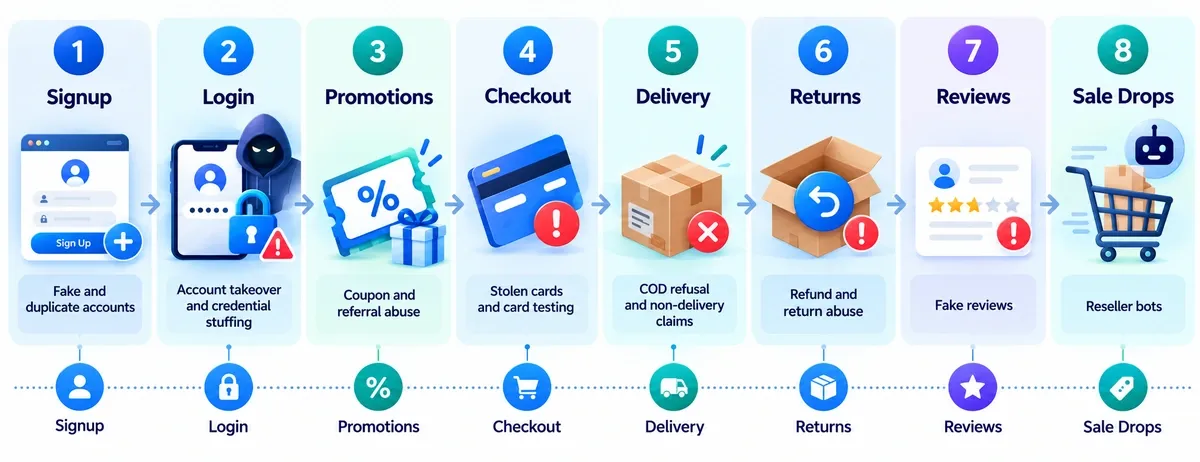
Ecommerce fraud can occur at every stage of the customer journey, from account creation to post-purchase reviews. The following table highlights the common fraud types, where they occur, and how they affect retail brands.
| Journey Stage | Fraud Type | How It Works |
|---|---|---|
| Signup | Fake and duplicate accounts | Fraudsters register multiple accounts using different email addresses, phone numbers, or fabricated identities to claim new-user offers repeatedly. |
| Login | Account takeover, credential stuffing | Attackers use credentials exposed in data breaches to attempt logins across multiple accounts. Once access is gained, they may make unauthorised purchases or redeem stored loyalty points. |
| Promotions | Coupon and referral abuse | Fraudsters create multiple accounts and use their own referral links or repeatedly apply promotional codes to obtain discounts they are not eligible for. |
| Checkout | Stolen cards, card testing | Attackers submit small transactions using stolen card details to identify valid cards, then use the working details to attempt larger purchases. |
| Delivery | COD refusal, "item not received" | Fraudsters place cash-on-delivery orders with no intention of accepting the parcels, or receive an order and falsely report it as undelivered to request a refund. |
| Returns | Refund and return abuse | Fraudsters request refunds for delivered items, then return used or different products, or send empty packages while claiming to have returned the original goods. |
| Reviews | Fake reviews | Fraudsters post fabricated reviews, coordinate paid ratings, or create multiple accounts to publish misleading positive reviews or negative reviews targeting competitors. |
| Sale drops | Reseller bots | Resellers deploy automated bots to submit purchase requests rapidly when limited-stock products become available, securing multiple units before genuine shoppers can buy them. |
Swipe the table
These online retail fraud types often tend to overlap, so retailers need to look beyond a single transaction. They need to focus on some specific patterns across accounts, devices, orders, and returns. A fraud intelligence layer, when applied within the system, can help ecommerce brands to successfully identify coordinated abuse earlier. This mitigates financial losses and protects real customers throughout their shopping journey.
The Real Cost of Ecommerce Fraud for Retailers
The real cost of ecommerce fraud for retailers extends far beyond the loss amount of a single order.
-
Direct Financial Losses: Products are shipped to fraudsters, and then refunds are issued against the false claims; this can result in unrecoverable revenue and inventory losses.
-
Return-to-Origin (RTO) Costs: In many cases, retailers need to pay for both outbound and return shipping when the COD orders are refused, or multiple delivery attempts fail. Razorpay has reported COD RTO rates of up to 40%, while Shadowfax estimates that RTO accounts for roughly 25–30% of operating costs for Indian ecommerce businesses. These figures reveal all failed deliveries, not just the fraudulent ones.
-
Promotional Budget Drain: Fraudsters using multiple new accounts exploit welcome offers, referral rewards, and discount codes. These activities divert acquisition budgets away from genuine new customers.
-
Lost Sales from False Declines: Overly restrictive fraud checks, on the other hand, can reject legitimate shoppers. This reduces potential opportunities for conversions while damaging customer loyalty.
-
Operational Overheads: Support and operations teams spend valuable time investigating certain disputes. Experts review suspicious orders, process claims, and resolve recurring issues.
These losses tend to compound throughout the customer journey. The retailer could lose significant money from promotional abuse and added shipping costs on a refused COD order. Additionally, the retailer may incur further costs investigating repeated refund claims, checking order histories, and processing disputes. Moreover, it’s not only about payment fraud and chargebacks in terms of tracking the overall cost of ecommerce fraud, but it’s also about recognising its impact on the business and building a better retail fraud prevention strategy.
Ecommerce Fraud Detection: Signals to Watch
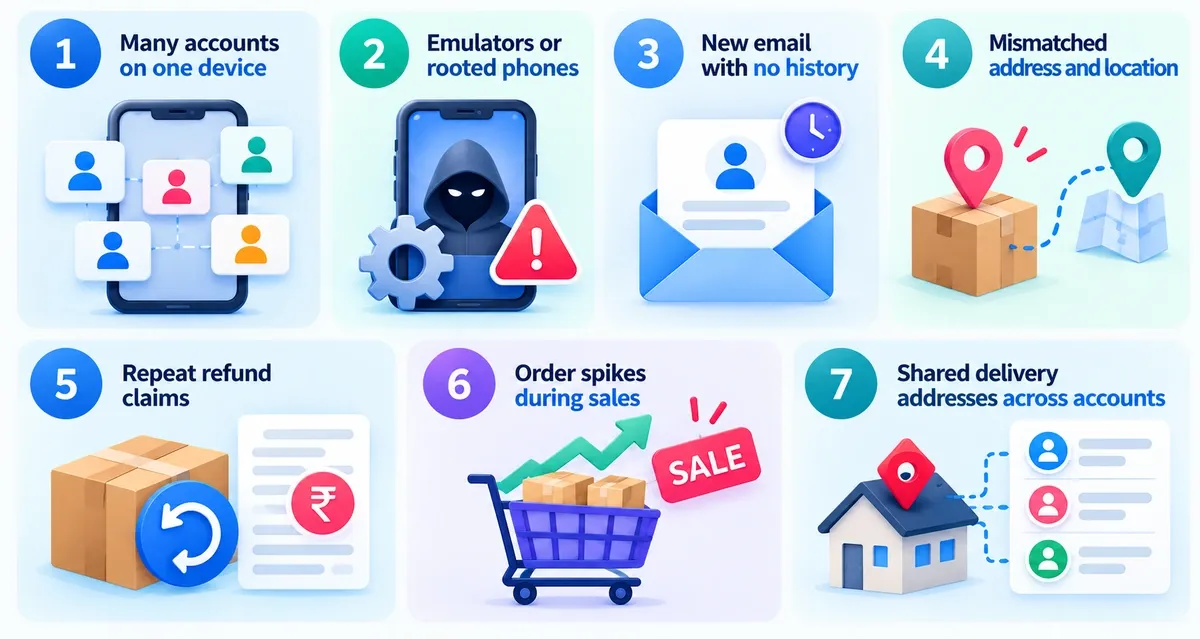
Effective ecommerce fraud detection starts with identifying multiple suspicious behaviours before it actually leads to financial losses. While no single signal alone can confirm fraud, multiple indicators appearing together can help retailers identify potentially fraudulent activity.
| Key Signals | What Those Actually Point To |
|---|---|
| Many accounts on one device | Multi-accounting and promo abuse |
| Emulators or rooted phones | Scripted signups and device spoofing |
| New email with no history | A throwaway identity made for one use |
| Mismatched address and location | Stolen payment details or a proxy |
| Repeat refund claims | Return abuse or serial "not received" claims |
| Order spikes during sales | Ring activity hidden in normal demand |
| Shared delivery addresses across accounts | Linked accounts working as one group |
Swipe the table
All these signals must be assessed together rather than used as standalone reasons to reject an order. When transaction velocity, repeated device and address patterns, and changes in customer behaviour are analysed, retailers can successfully strengthen ecommerce fraud detection and identify potential fraud cases earlier.
Stop Ecommerce Fraud Before It Costs You with Sign3
Fraudsters can create multiple accounts, exploit welcome offers, and coordinate suspicious orders while making each profile appear legitimate. Sign3’s Device Intelligence helps retail brands to identify these connections by generating persistent device fingerprints and assessing device integrity, network activity, and session-level risk in real time. It can also help by linking multiple accounts to the same device and detecting emulators and app cloning. The signal can even help to flag suspicious device environments.
For Indian ecommerce brands, this intelligence can even strengthen signup checks and even help to identify coordinated coupon and referral abuse before the rewards are issued. Furthermore, when Integrated with existing ecommerce fraud management systems, it even provides risk signals that teams can use to allow, review, or block suspicious activity without adding unnecessary friction for genuine shoppers.
Ready to strengthen your ecommerce fraud prevention strategy? Explore Sign3 Device Intelligence and book a demo to discover how it can protect your retail platform in real-time.
Frequently Asked Questions
What is the most common ecommerce fraud in India?
COD-related fraud and abuse is among the most visible forms of online retail fraud, since COD still covers a large share of online orders and a refused parcel costs the brand shipping both ways. Promo and referral abuse, along with return abuse, follow closely for multiple brands that run heavy discounts.
How do you stop COD fraud?
To stop COD fraud, it is necessary to score each of the COD orders before dispatch using device, address, and account history. In fact, high-risk orders must be verified with a call or message, and COD options should be restricted for certain PIN codes or accounts with repeated refusals.
What is promo abuse?
Promo abuse is considered the exploitation of marketing promotions, discounts, credits, or reward programs beyond their intended terms and rules. This promo abuse is usually done to extract the financial value repeatedly.
Can fraud tools block real customers?
Yes, there are multiple fraud tools that can block real customers if the rules are too strict. Considering a particular approach keeps false declines low: low-risk sessions pass, medium-risk sessions get one extra check, and only high-risk sessions are blocked. It is also considered necessary to track the false decline rate every month.
How do small NBFCs start handling fraud prevention?
Small NBFCs usually start by assessing losses from loan application fraud, identity misuse and synthetic identities. That’s where device intelligence, digital footprint checks, and simple risk-scoring rules before loan approval help flag suspicious applicants. Sign3's fraud intelligence platform supports this approach and helps NBFCs to strengthen digital lending security without requiring an enterprise-scale security budget.


