

How to Prevent Payment Fraud and Chargebacks in Ecommerce
To prevent payment fraud and chargebacks in ecommerce, businesses should screen orders prior to payment, use extra verification when faced with high risk, and maintain clear records of billing, refunds, and delivery. Strong payment fraud prevention starts before a transaction is approved. Processing a fraudulent order costs money: processing the payment, reversing the payment, paying dispute fees, and dealing with the time spent on chargebacks.
In this guide, you’ll learn what fraud signals to watch for, how to respond to different risk signals, and how to create actionable ecommerce fraud prevention strategies that minimise losses while keeping checkout easy for legitimate customers.
Key Takeaways
- Flag fraud early using device intelligence and digital footprints.
- Add the necessary verification where risk is high, without adding any friction.
- Catch suspicious payment patterns with velocity checks and risk signals.
- Reduce avoidable disputes with clear billing, refund policies, and prompt communication.
- Keep all the solid evidence to fight chargebacks: payment logs, messages and delivery proof.
- Stop unauthorised payments, resolve genuine complaints and challenge chargeback abuse.
What Are Payment Fraud and Chargebacks?
Payment fraud is an attempt to pay for goods or services with stolen, fake, or misused payment details. online payment fraud includes stolen cards, hijacked accounts, false refund claims, and promotion abuse.
However, a chargeback is a different event from payment fraud. It is a reversal step that follows a customer's dispute with their bank. The bank pulls the money back from the merchant while it reviews the claim.
The two are linked in a simple sequence:
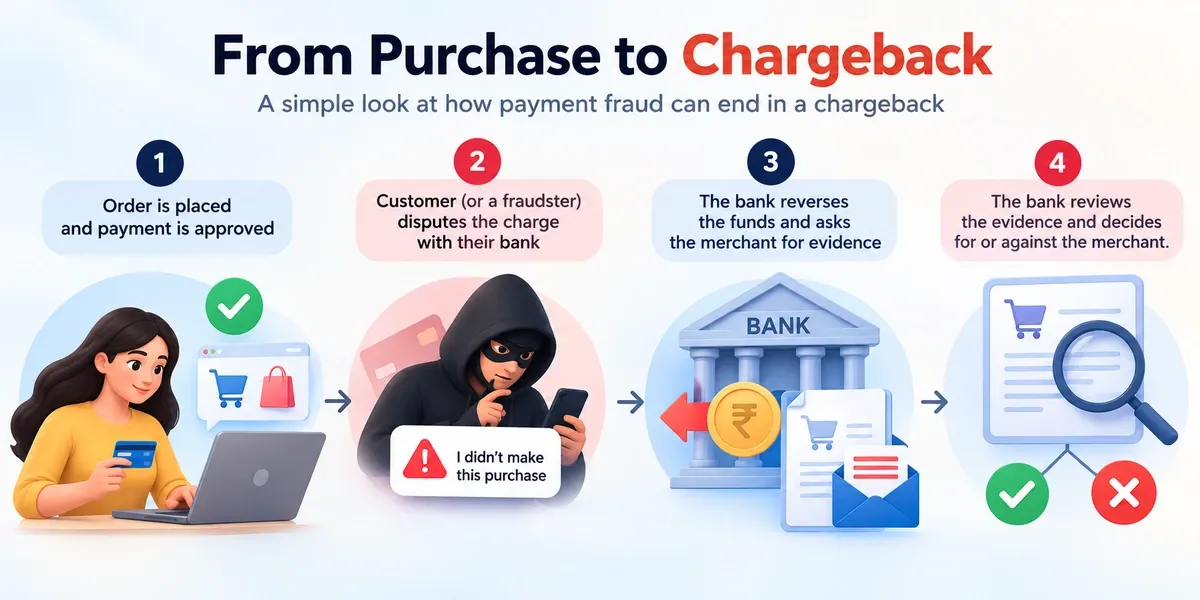
Online payment fraud is becoming more difficult to detect as attackers are reusing real customer data and mimicking normal buying behaviour. That is why ecommerce businesses need to implement layered security checks and not depend on a single detection method.
How to Prevent Payment Fraud Before Checkout
To prevent payment fraud before checkout, ecommerce businesses have to assess the device signals, verify customer identities when risk is high, and apply velocity rules to detect suspicious payment patterns. These checks also help flag potentially fraudulent orders before payment approval while reducing unnecessary friction for genuine customers.
1. Check the Device and Digital Footprint
Every online order comes from a device, for example, a mobile phone, tablet, or computer. Checking the device details and activity patterns can help e-commerce businesses easily identify suspicious orders, including attempts made using stolen customer credentials.
The table below explains what different signals may indicate and what action to take.
| Signals | What It Can Reveal | Suggested Action |
|---|---|---|
| New device on an existing account | Possible account takeover | Step-up authentication |
| Many accounts or cards on one device | Card testing or a coordinated ring | Hold or reject |
| Emulator, rooted device or remote access tool | Spoofed or automated session | Review or block |
| Very new email address with no history | Disposable or freshly created identity | Add email or phone verification |
| Recently changed SIM linked to a new order | Possible SIM swap | OTP check or manual review |
| Name, email, and phone that do not fit together | Details collected from different people | Hold for review |
Swipe the table
Device signals reveal information about the device and browsing session. Additionally, digital footprint signals describe the identity behind the order, such as how long an email address or phone number has existed and whether the details connect across online services. A real customer usually has a footprint that looks consistent over time. But a fraudster using a stolen card often does not have the same details.
Card-only checks might miss certain suspicious activities, since fraudsters could use valid card details with newly created accounts, unfamiliar devices, or inconsistent identity information. Signals like VPN usage, a new email address, or a high-value first order do not automatically mean fraud. Businesses should assess these signals together and consider the overall context before deciding whether to approve, verify, or review an order.
2. Use Strong Authentication on Risky Payments
Strong authentication provides an additional level of security by requiring customers to prove their identity before a payment can be authorised. In India, both domestic card-not-present transactions are generally subject to Additional Factor Authentication (AFA) as mandated by the Reserve Bank of India (RBI), often via an OTP, subject to applicable exemptions and regulatory requirements. E-commerce businesses can follow these baseline controls with additional risk-based checks.
Good to know: Risk-based step-up authentication refers to requesting additional verification only if a transaction carries higher risk. For example, a high-value order from a new device may trigger an additional check, while a returning customer on a recognised device may experience fewer interruptions.
Furthermore, combining device checks, risk-based authentication, transaction monitoring, and customer verification helps prevent fraud while keeping checkout simple for legitimate customers. Businesses should also adhere to the most recent directions issued by the Reserve Bank of India and the payment provider requirements, including any applicable rules relating to recurring transactions.
3. Set Velocity and Risk Rules
Velocity rules track how many times an action occurs within a specific period. They help ecommerce businesses identify unusual activity that may indicate payment fraud.
-
Several cards used on one device within an hour
-
Repeated failed payment attempts
-
Bulk orders to one address under different names
-
Repeated order attempts immediately after a payment is declined
Risk rules work best when they combine signals and lead to a clear outcome: approve, step up or review, or reject.
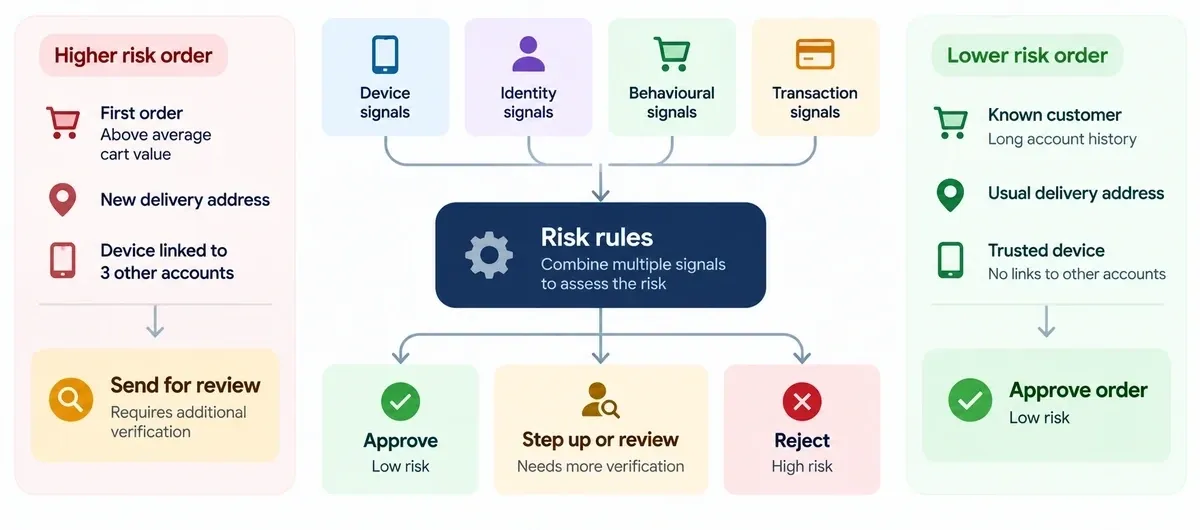
For example, a first order above your average cart value, shipped to a new address from a device linked to three other accounts, should go to review. The same order from a known device with a long account history can pass the checks.
Therefore, it is necessary to review the risk rules every month against confirmed fraud and false declines. Rules that are too strict may affect genuine customers. Rules that are too loose may bypass fraudulent activities. That’s why steady tuning keeps the rules in step while keeping things aligned with how fraudsters change their methods.
What Are the Warning Signs of a Fraudulent Order?
Some order patterns can signal possible payment fraud, but no single warning sign proves an order is fraudulent. E-commerce businesses should consider multiple signals together and decide on a suitable response (e.g., additional verification, manual review, or blocking the transaction). The following table outlines common red flags and how to respond to them.
| Warning Signs | Why The Signs Matter | Suggested Response |
|---|---|---|
| Billing and shipping addresses do not match | Common in stolen card orders, but also in gift purchases | Check other signals before acting |
| Several cards tried on one order | Typical of card testing | Block after a set number of failures |
| High-value first order with rush shipping | Fraudsters want goods before the cardholder notices | Step up verification |
| Freight forwarder or unusual delivery address | Goods may be rerouted | Manual review |
| Many orders from one device under different names | Possible fraud ring | Hold all linked orders |
| Request to change the delivery address after approval | Possible account takeover | Verify through the original contact details |
Swipe the table
Fraud teams should also record the outcome of every flagged order, whether it turns out genuine or fraudulent. That history shows which warning signs predict loss in your own business and which ones only create noise, so your payment fraud prevention improves with each review.
Any one of these can have an innocent explanation. Two or three together, especially alongside risky device or footprint signals, justify a hold or extra verification.
How to Prevent Chargebacks After the Order
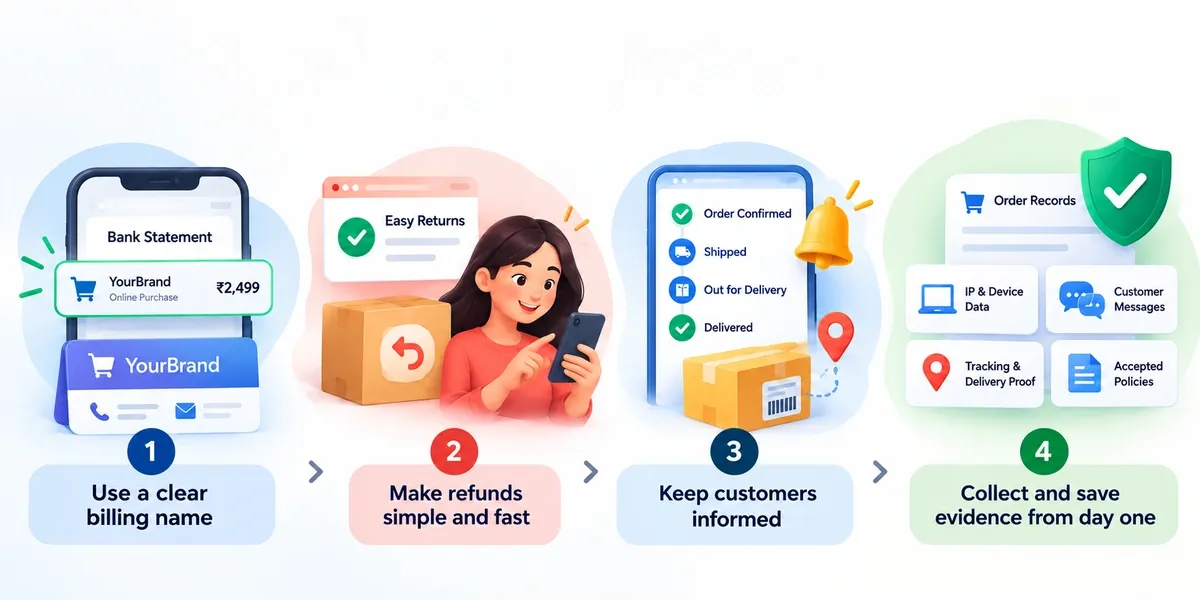
Chargebacks can occur when payment details are stolen, customers genuinely fail to recognise a transaction, or buyers misuse the dispute process. Although these situations can all lead to a chargeback, each has a different cause and requires a different prevention approach.
1. Make billing recognisable. Customers often dispute a charge simply because they do not recognise the name on their statement. Use a billing descriptor that matches your brand and put your support contact in every order confirmation.
2. Make refunds easy to get. A customer who can get a quick refund from you has little reason to ask their bank. Show your refund and return policy clearly at checkout and answer requests fast.
3. Keep customers informed. Send order confirmations, dispatch updates, and delivery notices. Contact buyers proactively when a delay happens. For subscriptions, send a reminder before each renewal.
4. Collect evidence as you go. Collecting evidence at the time of purchase makes dispute responses faster and more effective. For every order, maintain:
-
Order and payment records
-
IP address and device data from checkout
-
Customer messages and support history
-
Shipping label, tracking record, and proof of delivery, such as a signature or photo
-
The refund and return policy the customer accepted
-
A record of any authentication step completed
How to Respond to Disputes and Track Your Chargeback Ratio
When a dispute appears, speed and relevance both matter. Deadlines often vary by card network and based on the reason code, so it is necessary to record them in your dispute workflow and not rely on memory. The table below reveals the steps, what to do, and why they matter.
| Step | What to Do | Why it matters |
|---|---|---|
| Respond on time | Record deadlines in your dispute workflow. They vary by card network and reason code. | Never rely on memory. Speed and relevance both count. |
| Start with the reason code | Match your proof to the claim. “Did not make the purchase” needs different evidence from “never arrived” or “not as described.” | The wrong evidence for the claim weakens your case. |
| Build the evidence | Write a short summary that tells a clear story instead of sending every document you hold. | The strongest evidence shows the right person placed the order and received the goods: device and IP data, authentication records, and signed or photographed delivery. |
| Track the ratio | Compare disputes with transactions over the same period. Break it down by reason code, product, payment method, and sales channel. | The breakdown shows where the problem actually lies. |
| Investigate spikes | Look into any sudden jump straight away. | It usually points to a fraud attack or a process failure, such as a courier problem or an unclear descriptor. |
| Set internal alert levels | Pick a few levels well below any network limit. | Your team has time to act before a problem becomes a penalty. |
| Feed disputes back into your rules | Look for patterns in lost disputes, then add or tighten the signal they point to. | Chargeback prevention works best as a loop, where every dispute teaches the system something before the next order arrives. |
Swipe the table
A strong dispute management process allows ecommerce businesses to do more than simply address individual claims. Tracking chargeback ratios and identifying recurring dispute reasons can strengthen chargeback prevention by helping ecommerce businesses address the causes of repeat losses.
Types of Chargebacks: Unauthorised Payments, Genuine Disputes and Deliberate Abuse
Chargebacks are of different types, as shown below:
| Type | What It Means | Typical Example | Recommended Response |
|---|---|---|---|
| Unauthorised payment | A transaction the legitimate cardholder did not approve or make | A fraudster uses stolen card details to place an order | Screen orders before payment and apply risk-based authentication |
| Genuine customer dispute | A customer disputes a transaction because of confusion, a billing issue or a legitimate service problem | A customer does not recognise the billing descriptor or receives a damaged product | Improve billing transparency, resolve complaints promptly and make refunds accessible |
| Deliberate chargeback abuse | A customer knowingly disputes a legitimate transaction to obtain a refund while retaining the goods or service | A buyer falsely claims that an order was never delivered despite proof of delivery | Maintain transaction evidence and track recurring dispute patterns |
Swipe the table
Understanding why disputes occur helps businesses build a more targeted chargeback prevention strategy instead of treating every claim as fraud. Treat every dispute objectively and assess the available evidence before deciding how to respond. A disputed transaction is not automatically fraudulent; genuine service issues and billing confusion can also lead to chargebacks.
Common Types of Online Payment Fraud
Online payment fraud can come at any point of the customer journey, from login to checkout, refunds, and promotions. By learning about the common types, ecommerce businesses can spot suspicious activity, put the right controls in place, and cut unnecessary financial losses. Here are five common types of online payment fraud.
-
Stolen card fraud: A fraudster uses the card details that are stolen from a genuine customer to make purchases. Card testing is a common first step: fraudsters make small transactions to check whether stolen card details are still valid before attempting larger purchases.
-
Account takeover: An attacker gains access to a real customer account, often through leaked credentials or a SIM swap, and places orders using saved payment methods.
Read this guide to learn more about account takeover.
-
Refund abuse: A buyer claims a refund while keeping the goods, or returns an empty box or a different item.
-
Promo abuse: One person even creates multiple accounts to claim discounts, wallet credits, or first-order offers repeatedly.
-
Triangulation fraud: A fraudster lists goods on a marketplace at low prices, takes orders from real buyers, then fulfils them by buying from your store with stolen cards. The real buyer receives the goods, and the cardholder files the dispute with you.
Strengthen Your Ecommerce Fraud Prevention with Sign3
Preventing payment fraud starts with identifying suspicious activity before it leads to financial losses. At Sign3, we help ecommerce businesses detect potentially fraudulent activity before orders are fulfilled. Our Device Intelligence solution identifies suspicious devices, emulators, and devices linked to multiple accounts, helping fraud teams flag potential fraud and account misuse earlier.
Businesses can even make more informed risk decisions and protect legitimate customers by identifying device-level risks. If you want to strengthen your ecommerce fraud prevention strategy, schedule a demo and discover how we can help you detect suspicious activity earlier and protect your revenue.
Frequently Asked Questions
What is chargeback fraud?
Chargeback fraud is when a legitimate cardholder deliberately disputes a transaction with their bank to get their money back, for example, by claiming the item never arrived. That’s not the same as true fraud, where a third party uses the stolen details, or friendly fraud, where the dispute is often an honest mistake.
How can ecommerce businesses prevent payment fraud?
Ecommerce businesses can prevent payment fraud before checkout using device and digital footprint signals, apply step-up authentication to risky payments, and set velocity rules that combine several signals. Review these rules regularly against confirmed fraud and false declines. This layered approach underpins ecommerce fraud prevention.
What are the warning signs of a fraudulent order?
Some common warning signs of a fraudulent order include several cards tried on a single order, a high-value first order with quick shipping, many orders from one device but under different names. Also, a request to change the delivery address after an order approval. However, no single sign proves fraud, so evaluate them together.
How can a merchant reduce chargebacks?
A merchant can reduce chargebacks and take action against chargeback prevention with a recognisable billing descriptor, a clear refund policy, proactive delivery updates, and responsive customer support. When these measures are combined with pre-checkout fraud screening, they help prevent fraudulent orders from being fulfilled and reduce avoidable disputes.
What evidence helps a merchant contest a chargeback?
Order and payment records, device and IP data from checkout, authentication records, customer communication, tracking details, and signed or photographed proof of delivery; all of these help a merchant contest a chargeback.


