

A bank statement can look completely genuine yet hide an attempt at serious financial fraud. A few altered figures can inflate an account balance, give the impression of regular salary credits, or even hide missed EMI payments. Such activities trick lenders into approving loans they should not. For banks, NBFCs, and fintech companies in India, detecting these frauds calls for more than a cursory glance.
That’s why the correct way to verify bank statements is a mix of document analysis, transaction checks, identity matching, and source-level validation. This guide covers nine methods to detect fake bank statements, recognise signs of bank statement fraud, and flag questionable applications before loan disbursal.
Key Takeaways
- What is a fake bank statement: A fake statement is a forged statement where an altered, fabricated, or stolen account statement is presented to show proof of income or balance.
- Top red flags: Fonts are inconsistent, the logo is wrong, and balances don’t add up. Other red flags include abnormally rounded salary credits, missed EMI payments, and PDF metadata revealing the document was created or modified with editing software.
- Top 9 Fake Bank Statement Detection Methods: Fonts and Layout, balance recalculation, odd pattern identification, assessing metadata layers and pixel edits, account matching, cross-document checks, source fetching, and AI fraud detection with device signals are among the top fake bank statement detection methods.
- Most reliable cross-check: Fetch the correct bank statement from the source using the Account Aggregator framework or net banking, not from the uploaded PDF.
- How to scale bank statement checking: To verify bank statements at scale, match the right source data with automated tamper detection.
What Is a Fake Bank Statement?
A fake bank statement is a document that falsely represents the actual balance, transactions, or ownership of an account. It can be a real statement that has been edited, a completely fabricated statement or someone else’s real statement as the applicant’s own.
Here are the three types of fake bank statements that behave differently, so each of them needs a different check:
-
A real statement, edited: The fraudster downloads a genuine PDF and changes figures in an editor. The layout and account number look right, so only arithmetic and file-level checks expose it.
-
A fully made-up statement: It is built from a template or an online generator, and usually has the wrong fonts, spacing, or bank formatting. Visual checks and basic maths often detect it.
-
Someone else’s real statement: Nothing is altered, but the name, account number, or ownership doesn't match the applicant. Account matching and source checks can both detect the real statement.
Knowing which type you are facing can help you choose the best of the nine methods.
For example, the CBI reported allegations that a borrower obtained bank credit using manipulated financial statements with inflated sales, income, and profits, causing an alleged loss of approximately ₹80.73 crore to SBI.
The 9 Detection Methods of Fake Bank Statements
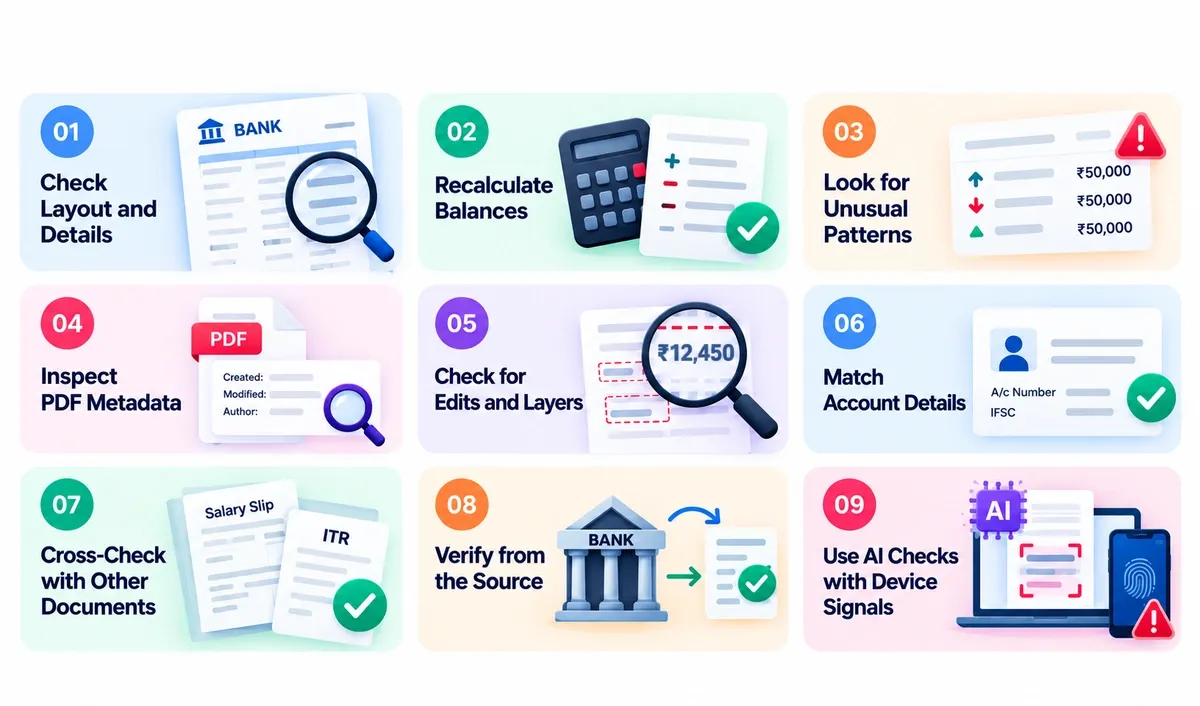
If you are wondering how to verify bank statements without slowing approvals, it is crucial to follow the correct approach. Below are 9 detection methods that allows one to identify the fake bank statements accurately.
1. Check Fonts, Logos and Layout
Every bank generates statements based on a fixed template that they follow. This means a document generated from the bank’s end must be the same every time. That’s where you look for mixed fonts or weights inside one line, a blurred or recoloured logo, uneven spacing between columns, misaligned decimals, and rows that do not line up correctly.
Compare the header and footer too, including bank address, branch details and page numbering. Most of the altered figures may use a slightly different pattern or may appear marginally misaligned with the surrounding text. That's where thorough visual checks can expose crude forgeries.
2. Recalculate Balances and Totals
A genuine statement remains mathematically consistent from the first transaction to the last. Recalculating the balances and totals is also necessary. Checking the opening balance along with the credits and minus debits must equal the closing balance. Also, the final up-to-date balance must align equally with the previous numbers once adjusted by that row’s credit or debit. Printed totals can be manipulated too, so recompute them independently.
3. Look for Round Numbers and Odd Patterns
Bank statement fraud can take a number of forms which are not visible from the document itself but can be spotted in transaction patterns. Look at salary credits, recurring expenses and account activity for a few months to identify any unusual patterns or inconsistencies. That's why it's important to look at salary credits, recurring expenses and account activity over a few months for anything unusual.
If you see salary credits, a lack of EMI or utility payments, recurring round-number balances, or a lack of bank charges and interest entries, this may warrant further investigation.
4. Inspect PDF Metadata and Edit History
The PDF metadata contains clues that suggest a bank statement may have been altered.
-
Check the document properties for author, application used for generation, date created and date last modified.
-
Research further where the software information is inconsistent with what you would expect to see in the bank’s statement-generation process. The statement may have been generated or edited using a consumer PDF editor, image-editing software or an online editing service.
-
Compare creation or modification timestamps to the statement period. If the PDF was edited after the reporting period, see if the original statement was changed in any way.
Use these findings as red flags and cross-reference with transaction-level and other document verification checks before making a decision on whether a statement is fraudulent.
5. Detect Layers and Pixel-Level Edits
You can edit a PDF even if the changed statement seems to be genuine at first glance. Scammers can add new text to existing figures or edit some parts. Look closely at the amounts and balances. Look for white spots behind text, blurred or resized areas, and image quality differences. Highlighting text may also reveal hidden characters or layers of overlapping text.
Other digital forensic techniques, such as error level analysis, may reveal some areas of a document being compressed differently from the rest. However, these signs are not conclusive evidence of fraud, as legitimate PDF processing can also result in inconsistencies. As application volumes grow, manual document reviews become more time-consuming and resource-intensive. So lenders can use automated document tampering detection to flag suspicious uploads for further review.
6. Match Account Details
Check that the account holder's name, account number, and IFSC match the applicant’s application, KYC, and bank branch details. Then confirm whether the account is real and belongs to them. A penny drop test involves transferring a small amount to the bank account to verify its status and confirm the beneficiary name the bank returns. This is the best defence against borrowed statements, where every number is genuine, but the account belongs to someone else.
Good to Know: What is the Penny Drop Test A penny drop test (or penny drop verification) is a method where the organisation or bank checks whether a bank account is active, valid, and belongs to the correct person. The verification occurs by depositing a tiny, nominal amount of money, such as ₹1 in India or a single penny elsewhere, into the account.
7. Cross-Check with Other Documents and Data
A bank statement matched to source financial documents can uncover discrepancies that are often not found through visual and manual review. Verify salary credits with the amount shown on salary slips and the exact dates mentioned on the salary slips. You have to check whether the applicant’s annual income matches the Income Tax Return (ITR) and Form 16 submitted. The employer name on the payslip should also be consistent with the name or transaction narration associated with salary credits in the statement.
You can also use SMS data to verify the credit and debit details. Correlate the alerts through messages from the bank for salary credits, EMI debits, and payment bounces with the transactions reflected in the bank statement. Any unexplained difference between these sources can be a red flag for further investigation.
8. Fetch the Statement from the Source
The best way to check a bank statement is to get the financials directly and not just have a PDF uploaded. The Reserve Bank of India (RBI) issued its Account Aggregator Directions on September 2, 2016, establishing a strong framework to secure financial data sharing with the customer’s explicit consent.
This framework allows a borrower to grant a lender permission to directly access eligible financial information from a participating financial institution, thereby decreasing the likelihood of document tampering.
9. Use AI Document Fraud Detection with Device Signals
Automated tamper detection scans each of the uploads and verifies it for pixel edits. These include font inconsistencies, layer changes, and metadata anomalies in seconds. Additionally, applying device and behaviour checks allows banks and financial institutions to identify who has uploaded the document and from where.
One device can flag statements for several applicants, an emulator or rooted phone, copy-pasted form entries, or a location far from the stated address. A clean document from a risky device is still a risk, and an odd document from a consistent, trusted device; both require a closer look. Together, document and device signals detect what a generic or manual detection often misses.
What to Do If You Find a Fake Bank Statement
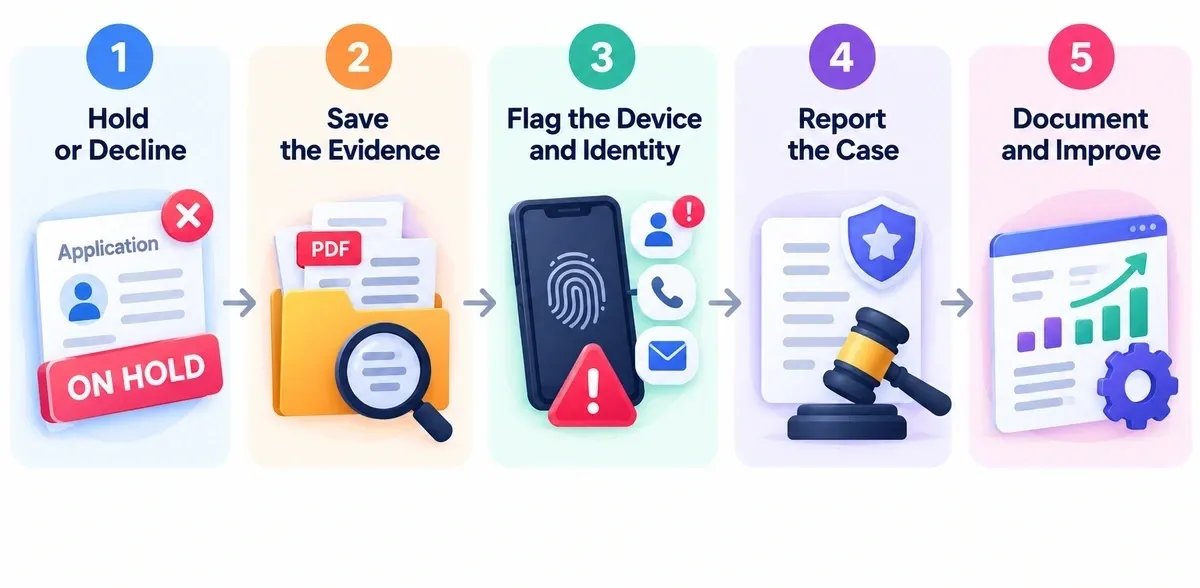
If you find a fake bank statement, the next step should be deciding on the account, not just rejecting it. Following a few steps can help to make the correct approach while ensuring the evidence holds up.
-
Hold or decline: Place the application on hold or decline it in accordance with the credit policy. Avoid disclosing the specific checks that identified potential fraud.
-
Save the evidence: Start by saving the original file, metadata screenshots, upload time, device and IP details, and reviewer notes.
-
Flag the device and identity: This is one of the most crucial steps; include the phone number and email so you can detect repeat fraud attempts across multiple applications.
-
Report the case: Follow the required procedure to document the internal fraud process, and involve legal and compliance teams to decide whether to file a complaint or share details with industry bodies.
-
Document the investigation findings and final decision: Use verified cases and confirmed patterns to refine fraud detection rules and improve the identification of suspicious applications over time.
Understanding the legal implications of forged documents helps lenders handle suspected fraud appropriately and determine when further legal action may be necessary.
Good to Know: Indian Code — Bharatiya Nyaya Sanhita, 2023 Sections 335 and 340 address making false documents and fraudulently using forged documents as genuine. Use the legislation for the legal context, not as evidence of fraud prevalence.
Common Types of Bank Statement Fraud
Most common types of bank statement fraud include edited balances, added salary credits, removed EMI bounces or cheque returns, etc. The table maps most of the common types and reveals the motive behind each fraud type, along with the clue that usually exposes it.
| Common Types | Fraud Category | What Is Changed | Why Fraudsters Do It | Key Indicators of Fraud |
|---|---|---|---|---|
| Edited balance | Financial manipulation | Closing or running balance is raised | To show repayment capacity or a minimum balance | Discrepancies in balance calculations; closing balances inconsistent with opening balances, credits and debits. |
| Added salary credits | Financial manipulation | Credits inserted or amounts inflated | To meet income criteria | Round figures; amounts and employer names disagree with payslips, ITR or SMS data |
| Removed EMI bounces or cheque returns | Hiding repayment problems | Failed debits and returns deleted | To hide repayment stress | Gaps in dates or sequence; no bank charges after a bounce |
| Changed name or address | Identity theft | Identity fields replaced | To make someone else’s account look like the applicant’s | Name, account number or IFSC mismatch; different font in the header |
| Fully fabricated statement | Financial manipulation | Whole document built from a template | The applicant has no account or history | Wrong layout, logo or fonts; impossible balances; no bank charges |
| Borrowed statement | Identity theft | A genuine statement of another person is used | To borrow a stronger financial profile | Account holder does not match the applicant; penny drop fails |
Swipe the table
Deleted transactions can leave gaps in the account history, while altered balances and credited salaries can create discrepancies in the transaction history. But borrowed statements can look completely authentic, so it is important to confirm ownership of the account and cross-check it with the applicant’s KYC details. With this knowledge, lenders can use the right verification methods to find suspicious statements before they make a lending decision.
Why Fake Bank Statements Are a Growing Problem
Due to the availability of advanced technology and changes in application workflow, fake bank statements are a rapidly growing problem in digital lending, rental markets, and financial services. The reasons are as follows:
-
Generative AI and Low-Cost Tools: You no longer need to have graphic design skills to create a forged document. Free consumer PDF editors, dark web fabrication services, and generative AI tools can churn out complete, pixel-perfect statements with custom transaction histories and running balances in minutes.
-
Digital Onboarding Shift: Most lenders, NBFCs (Non-Banking Financial Companies), and property managers now accept digital uploads (PDFs or scanned images) in lieu of physical paper. This change speeds up customer onboarding, but it makes digital manipulation easier.
-
Scale and Speed of Processing Volume: Today’s financial institutions process enormous volumes of applications every day. Checking every document by hand is economically unfeasible, leaving a blind spot for subtle forgeries to be missed by human reviewers.
-
High Financial Impact and Default Rates: Fraudulent financial documents can distort credit evaluations, obscure repayment risks, and result in substantial financial losses for lenders. Lending decisions that increase credit risk can be the result of inflating income, manipulating balances and hiding payment defaults.
-
Widespread Prevalence: The presence of altered, forged or misrepresented documents during the digital onboarding process is a major concern for financial institutions. With the increase in application volume, sophisticated changes may not be detected by manual reviews; hence, strong document verification is a must.
Manual Checks vs Automated Bank Statement Verification
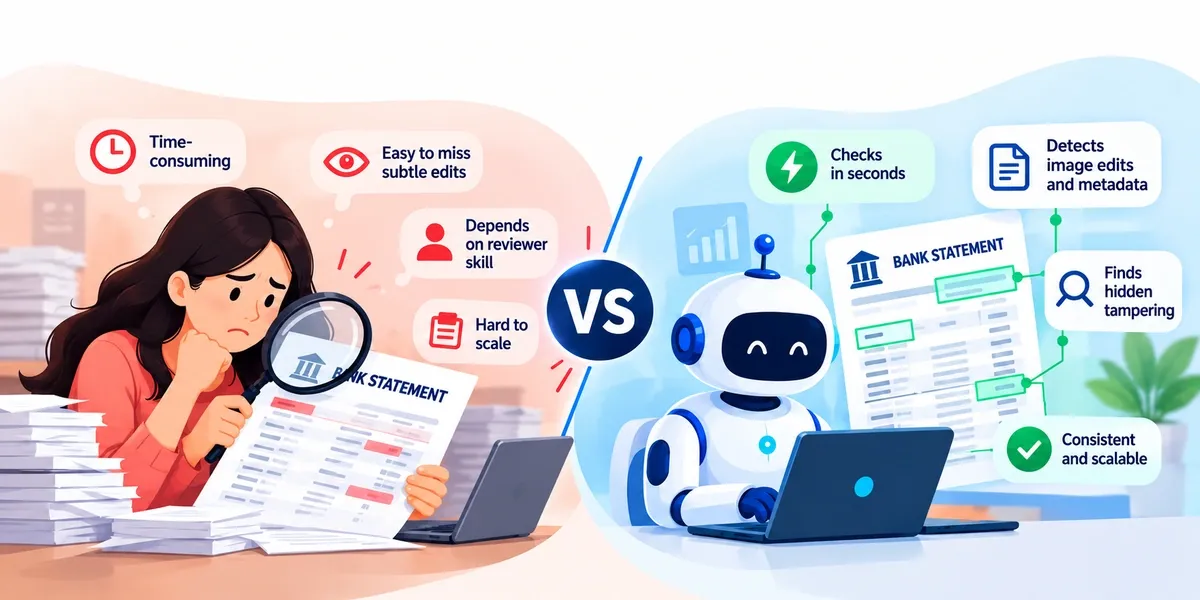
Manual verification of bank statements may help to detect obvious signs of fraud, especially when application numbers are low. But as volume increases, checking each statement becomes time-consuming, and subtle changes can be hard to detect, such as pixel-level editing or manipulated PDF metadata.
| Key Aspects | Manual Checks | Automated Verification |
|---|---|---|
| Speed | Minutes per statement, varying by reviewer | Seconds per upload |
| Accuracy | Depends on skill and attention; reliable mainly for obvious flaws | Same rules applied to every file, including metadata and image signals |
| Scale | Needs more reviewers as the volume grows | Scale automatically without extra headcount |
| Pixel-level edits | Rarely visible with manual reviews | Found through image and layer analysis |
| Cost | Low to start and often rises with volume and missed fraud cases | Higher upfront setup costs, but lower cost per document as volume increases. |
Swipe the table
Overall, lenders can use automated verification to process all bank statements uniformly and identify possible tampering across the board. A manual review offers an additional check for complicated or unclear cases. Lenders can use both approaches to minimise duplicate checks, flag suspicious applications for analysts, and make better lending decisions without relying solely on visual inspection.
Detect Fake Bank Statements with Sign3
Sign3’s ScreenX helps lenders detect potentially fraudulent bank statements during digital onboarding. The Image Intelligence capability analyses uploaded documents for signs of tampering, which helps flag altered figures, suspicious edits, and other inconsistencies before they reach an analyst. This enables lenders to identify potentially manipulated financial records earlier in the application process, reduce reliance on manual document reviews, and strengthen bank statement verification before loan disbursal. So, book a demo and explore how ScreenX can strengthen document fraud detection in your lending workflow.
Frequently Asked Questions
Is submitting a forged bank statement a crime in India?
Yes, submitting a forged bank statement is considered a crime in India. When used to obtain credit, this fraudulent approach can attract charges such as cheating and forgery under the Bharatiya Nyaya Sanhita, which replaced the IPC. However, the final consequences depend on multiple facts, so it is necessary to involve legal counsel before filing a complaint.
Can banks verify a statement directly?
Yes, banks can verify the correct statement directly. A lender can even ask the issuing bank to confirm a statement, or fetch the data with the customer’s consent through the Account Aggregator framework or net banking, which removes reliance on an uploaded PDF.
How do you check if a PDF statement is edited?
To check or verify whether a PDF statement is edited, start by checking the creator software metadata and dates. Also, it is advisable to look for pasted text layers and blurred areas, recalculate every balance, and run the automated tamper detection.
Are e-statements safer than scanned copies?
Generally, e-statements are considered much safer than scanned copies. This is because e-statements produce bank-generated structure and metadata you can inspect. However, those can still be edited, so “safer” does not mean verified. Scanned copies are harder to test for tampering.
What is the fastest way to verify fake bank statements?
To verify fake bank statements in the fastest way, it is necessary to fetch the available data from the source with the customer’s consent and run automated checks through a specialised bank statement fraud detection method.


