

We have built one of the world's most sophisticated digital financial ecosystems. Aadhaar has digitised identity. UPI has digitised payments. Account Aggregator is making financial information portable. Credit bureaus have turned repayment history into a core underwriting signal. NBFCs and digital lenders can now verify income, bank accounts, GST records and other financial information without depending entirely on paper documents.
And yet, one of the oldest pieces of information in a loan application is still treated almost exactly as it was twenty years ago - the address.
For an NBFC, an address is one of the most frequently collected pieces of borrower data—and one of the least intelligently used.
A borrower provides an address, uploads a document, and once it is verified, the data often becomes little more than a stored KYC field.
That is the problem.
Indian addresses aren't useless. They are underutilised.
A location can reveal far more than where a borrower lives. It can provide signals about identity consistency, stability, fraud patterns and economic activity, if lenders know how to read it.
India's Next Credit Customers Won't Always Have Conventional Credit Histories
The argument for better address intelligence begins with a larger change happening in Indian credit.
The country's formal credit ecosystem has expanded dramatically. TransUnion CIBIL's 2026 analysis found that India's credit-eligible population increased from 79 crore in 2017 to 89 crore in 2026. More strikingly, the proportion of eligible Indians who had accessed retail credit at least once more than doubled, from 35% in March 2017 to 74% in March 2026.
This is not simply a story about more people taking loans. It is a story about who is entering the formal credit system.
Credit growth is increasingly reaching younger consumers, women and borrowers outside India's traditional metropolitan centres. The analysis shows that states such as Uttar Pradesh, Madhya Pradesh and Bihar have been outpacing some traditional credit strongholds in credit growth.
At the same time, the market is still dealing with a substantial population of new-to-credit borrowers or have relatively thin credit histories (also known as thin-file borrowers). That creates a difficult underwriting problem.
What's the Problem of Underwriting?
If a borrower has five years of bureau history, multiple loans, a clean repayment record and stable income documentation, a lender has plenty of information with which to make a decision.
But what happens when the borrower is 24 years old, self-employed, applying for their first formal loan and has limited bureau history?
The answer increasingly lies in alternative data.
The Economic Survey 2025–26 makes this shift explicit in the context of digital payments. It notes that digital payment infrastructure such as UPI creates verifiable transaction histories that can help banks and fintechs expand lending across the risk spectrum, particularly to new-to-credit borrowers. Importantly, the Survey cites evidence that richer transaction data can improve identification of underserved but creditworthy borrowers without increasing default rates.
The industry is already moving in this direction. A 2025 report citing data from the Fintech Association for Consumer Empowerment found that 84% of lenders use a combination of traditional and alternative data in underwriting. For NBFCs, particularly those serving new-to-credit and underserved borrowers, this makes alternative signals increasingly important.
Location data was reportedly used by 57% of lenders, putting it ahead of several other alternative data sources such as SMS data and payment transaction behaviour. For NBFCs, this creates an opportunity to extract more value from location data they may already collect during KYC and onboarding.
So the real question is whether NBFCs are extracting enough intelligence from the data they already collect.
And address data is one of the clearest examples.
An Indian Address Is Not Really A String
The fundamental problem begins with how addresses are represented.
In a perfectly standardised world, an address might look like this:
House 12, MG Road, Bengaluru, Karnataka, 560001.
A database can split that neatly into house number, street, city, state and PIN code. India rarely works that cleanly.
An address might instead say:
“Near Shiv Mandir, behind the government school, Ward 8, village Bakoli.”
Or:
“Flat 203, French Apartments, opposite Reliance Mall, Sector 4, Gurgaon.”
Or simply:
“Main Road, near bus stand, Village XYZ, District ABC.”
Google's own documentation on Indian addresses acknowledges the complexity, Indian addresses can have non-standard formats, landmarks, inconsistent component ordering, spelling variations and ambiguous sub-premise information.
To a person familiar with the locality, these descriptions can be perfectly meaningful. Yet, to a conventional database, they are messy text.
And this is where the gap between address verification and address intelligence begins.
Address verification asks whether an address is plausible or whether the document associated with it can be validated.
Address intelligence asks a much more valuable question:
“What can this location tell us about the application?”
That distinction changes everything.
A Location Can Tell A Lender More Than A Document Can
Imagine two loan applications.
Both borrowers have valid identity documents. Both provide bank statements. Both have mobile numbers that pass verification. Both have addresses that appear legitimate.
On paper, the applications look similar.
But now imagine that the lender can analyse the addresses as structured geographic information. The first borrower has lived at the same location across multiple interactions. The address is consistently associated with the same customer identity and contact information. The stated workplace is geographically plausible. The location behaves like a residential property.
The second borrower provides an address that has appeared repeatedly across unrelated applications, is associated with a large number of identities, and changes frequently across different credit applications.
Neither of these patterns necessarily proves fraud.
But they are signals.
And credit underwriting is ultimately about signals.
The same principle is particularly relevant for NBFCs financing MSMEs. If a small business claims to operate from a particular location, the NBFC can ask whether the declared business address is consistent with the nature of the business. Is it a residential property? A commercial location? A location shared by dozens of unrelated businesses? Has the business moved repeatedly?
Again, location does not provide the answer by itself.
It provides context.
That context becomes particularly valuable when conventional credit history is limited.
The Address Is Also an Operational Problem
For an NBFC, a poor-quality address is not just a data-quality issue. It can become an operational problem.
An address that cannot be accurately resolved can mean a failed field visit, repeated verification attempts, delayed disbursal or higher verification costs. This is particularly relevant for NBFCs that still rely on physical verification across large or geographically dispersed borrower networks. Address intelligence can make that process more useful.
Before sending a field agent, an NBFC can determine whether the address is actually resolvable, whether the location appears residential or commercial, whether the address is precise enough to locate the borrower, and whether the location is consistent with the customer's declared profile.
It can also surface patterns that a single field visit may miss. Is the same address appearing across multiple unrelated applications? Has the borrower repeatedly changed locations? Does the declared business actually operate from the stated location?
The goal is not to replace field verification.
It is to make field verification more targeted, faster and more informed.
The Biggest Problem With Address Data Is That It Dies After KYC
There is another reason address data is underutilised: it is generally treated as an onboarding attribute rather than a continuing behavioural signal.
A borrower gives an address when applying for a loan. The lender verifies it. The address goes into the system.
Then time passes. The borrower moves. Their business relocates. Their contact details change. Their relationship with a particular location changes. But the old address may continue sitting inside the lender's database as though nothing happened.
This is important because an address can be genuine and still be stale.
RBI's KYC framework recognises that customer information, including address information, needs periodic updating. Its 2025 KYC amendment also specifically addressed mechanisms for obtaining self-declarations when address details change.
The regulatory emphasis is primarily around KYC compliance, of course. But it also illustrates a broader data problem for lenders: a verified address at time T is not necessarily a reliable representation of a customer at time T+3 years.
Credit models are increasingly dynamic. Income can change. Transactions change. Bureau behaviour changes. Device behaviour changes. Why should location remain frozen?
The Fraud Opportunity Is Even Bigger
The most interesting use case for address intelligence may actually be fraud detection.
Fraud rarely behaves like an isolated bad application. It behaves like a network.
One identity may be linked to several phone numbers. Multiple identities may share a device. Several applications may originate from related locations. A supposedly independent group of borrowers may repeatedly use the same address or geographic cluster.
This is why alternative data is becoming increasingly important for NBFCs and digital lenders in India.
Business Standard reported in 2025 that lenders were using alternative signals including location information, payment behaviour, SMS data, third-party app usage and metadata to identify fraud and improve underwriting for new-to-credit customers. For NBFCs, these signals can be particularly useful when conventional bureau data is insufficient to distinguish between apparently similar applications.
Now consider what happens when address data becomes part of that network.
An address is no longer simply:
Borrower → Address
It becomes:
Borrower ↔ Address ↔ Phone ↔ Business ↔ Other borrowers ↔ Other applications
That relationship can reveal patterns that are impossible to see when an address is stored as plain text.
The value isn't in knowing that someone lives at “House No. 42.”
The value is in knowing what else is connected to House No. 42.
For an NBFC, that network can become an additional layer of evidence during underwriting and fraud screening.
Doesn’t Imply Judging Borrowers By Where They Live
There is an important distinction here.
Turning location into a credit signal should not mean creating simplistic rules such as “people from this neighbourhood are risky” or “this PIN code gets rejected.”
That would be both poor underwriting and potentially discriminatory.
The value of address intelligence lies elsewhere. It is about consistency, authenticity, relationships and change.
- Does the declared address resolve to a real location?
- Does the customer's information remain consistent over time?
- Is the same address appearing across suspiciously unrelated identities?
- Does the location make sense relative to the customer's declared business or employment?
- Has the customer's geographic footprint changed significantly?
- Are there unusual clusters that deserve further investigation?
These are fundamentally different questions from judging someone by their postcode.
A sophisticated model should use location to understand the integrity of the application, not to make crude assumptions about the person.
The Technology Stack Is Finally Catching Up
This is particularly relevant now because India's lending infrastructure is becoming increasingly digital.
The government and RBI have been actively strengthening the ecosystem of digital lending in India, including the RBI's public directory of Digital Lending Apps and the 2025 Digital Lending Directions.
Meanwhile, public-sector lending is also moving toward digitally fetched and verifiable information. The government's digital credit assessment initiatives for MSMEs have brought together data sources such as GST information, bank statements, income-tax data, bureau information and fraud checks to reduce dependence on traditional manual appraisal.
The larger trend is unmistakable.
Credit underwriting is becoming a data engineering problem.
The best lenders will not simply have more data. They will be better at converting fragmented data into reliable signals. That is exactly where addresses need to evolve.
From Dead Data To Living Intelligence
The future of Indian address verification should therefore not be another OCR engine that converts an Aadhaar card into a text string slightly faster.
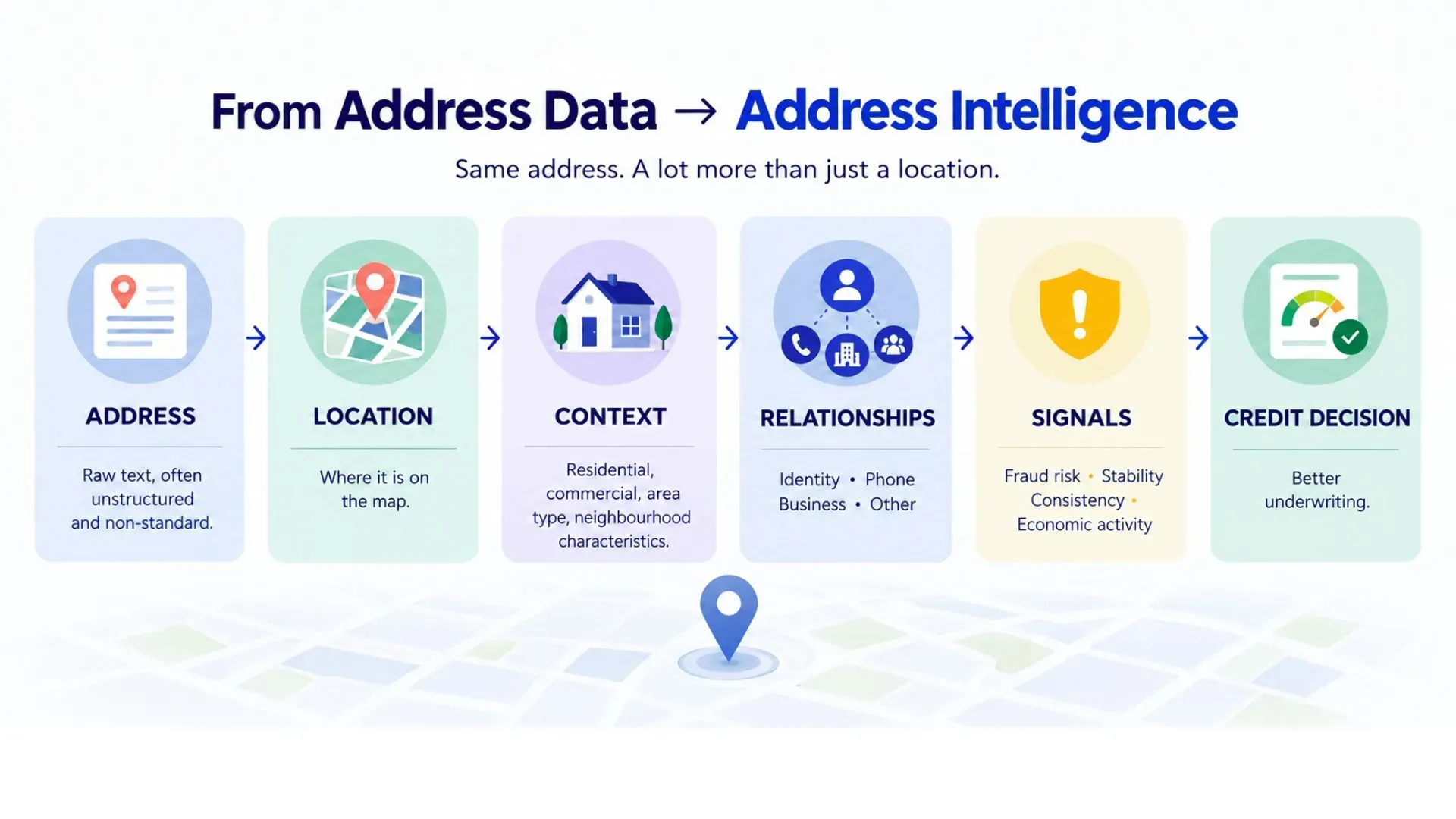
It should be an address intelligence layer that turns messy location information into structured, explainable and continuously useful signals.
An address should be standardised and geocoded. It should be connected to geographic context. Its history should be understood where legitimately available. Its relationships with applications and identities should be analysed. Changes should be detectable.
Most importantly, the output should be usable by underwriting and fraud systems.
The transformation is simple to describe:
Address → Location → Context → Relationships → Signals → Credit decision.
India has already built digital infrastructure capable of transforming payments into credit signals. The Economic Survey's findings on UPI demonstrate how behavioural financial data can expand access to formal credit while improving the lender's understanding of risk.
Location deserves the same transformation. Because an Indian address is not just a place where a borrower lives.
With geospatial data in lending, a lender determines whether an identity is consistent, whether a business footprint is plausible, whether an application resembles known patterns and whether a supposedly new borrower has more observable stability than their bureau file suggests.
The address field has been sitting inside credit applications for decades. The data was never actually dead. _ We just weren't reading it._
From Dead Address Data to Intelligence
The problem with Indian addresses isn't a lack of data. It is the lack of intelligence extracted from that data. At Sign3, we transform messy addresses into structured, geocoded and enriched location signals—helping lenders verify existence, understand neighbourhood context, detect spatial inconsistencies and identify suspicious geographic patterns.
From onboarding and KYC to fraud, AML and credit underwriting in India, the address can become an active decisioning signal rather than a static field.
With Sign3, dead address data becomes intelligence that lenders can act on.


