

What is a deepfake?
A deepfake is an image, audio clip, or video created or manipulated by artificial intelligence to make it appear as though a real person is saying or doing something they never said or did. The term is a combination of “deep learning” and “fake” and is mostly used to describe the AI techniques used to generate convincing simulacra of a person’s face, voice, or mannerisms.
Deepfakes are a type of synthetic media that can replicate real people’s faces, voices, or mannerisms to a high degree of believability.
Good to know: Synthetic media generally refers to audio, images, videos, or other content that is created or heavily manipulated with advancements in artificial intelligence (AI) technology. Examples include AI-generated photographs, cloned voices, virtual avatars, computer-generated videos, and digitally altered footage used for fraud.
Have you ever received a video call from your teammate or CFO asking you to approve and release an urgent payment? At first, nothing seems wrong. The face looks familiar, the voice sounds right, and the request seems appropriate. But what if none of those is real? That's the risk of deepfakes, a sophisticated and evolving financial fraud technique where a fraudster can imitate a fake and convincing scenario to commit fraud.
So, how does deepfake detection work? Why do traditional detection methods fail, and how can businesses identify suspicious activity before it leads to financial loss? Let’s explore.
How Do Deepfakes Work?
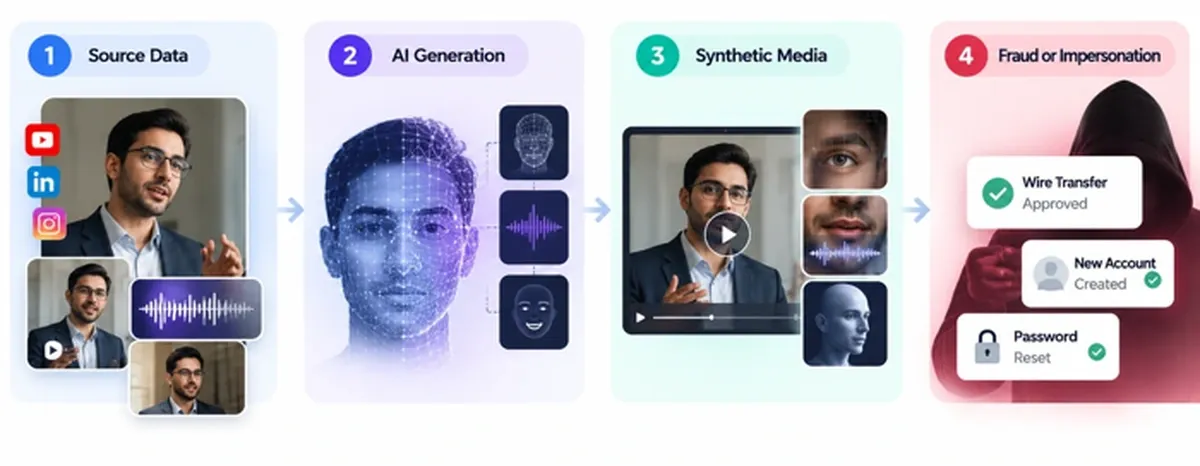
Most deepfakes follow a four-stage chain, which includes the Source Data, AI Generation, Synthetic Media, and Fraud or Impersonation. The table below reveals how these 4 cycles work, what happens in each cycle, and how they look in practice.
| Stage | What happens | What it looks like in practice |
|---|---|---|
| Source Data | An attacker collects photos, video clips, and voice samples of the target | A conference talk, a LinkedIn video, or a public webinar |
| AI Generation | Generative models learn the person's face, voice, and mannerisms to create convincing imitations of a person. | A model trained on a few minutes of footage |
| Synthetic Media | The model produces face swaps, cloned voices, lip-synced video, or fully generated faces | A video message in the target's voice, saying new words |
| Fraud or Impersonation | The output is used to pass an identity check or persuade someone to act | A payment approved, an account opened or a password reset |
Swipe the table
Generative AI and machine learning sit at the centre of the process.
-
A face-swapping model studies a person's face from many angles, then maps it onto someone else's video.
-
Voice-cloning models pick up pitch, accent and rhythm, then speak new sentences in that voice.
-
Lip-sync tools adjust mouth movement to match the audio.
-
Image generators can produce faces of people who do not exist, which is handy for anyone building a fake identity.
None of this needs a studio anymore. Consumer apps now do much of the work in minutes.
How Does Deepfake Detection Technology Work?
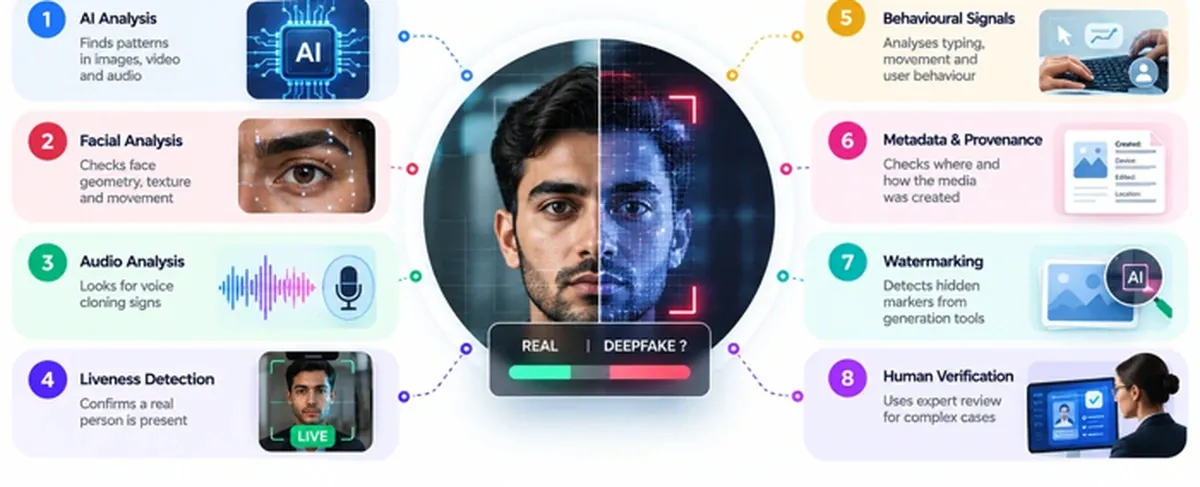
Deepfake detection technology uses several methods. Each one answers a different question, helping banks and financial institutions to take the right action.
-
AI and machine learning detection: The technology learns patterns from real and AI-generated media. They examine unusual textures, inconsistencies between video frames, and also identify suspicious sound patterns that allow them to estimate whether content has been manipulated.
-
Facial analysis: Facial analysis looks at facial features, skin texture, expressions, and movements to find inconsistencies. The method can even detect unnatural facial movements in a selfie uploaded during digital onboarding. However, this technology cannot independently verify a person’s identity.
-
Audio analysis: The technology analyse pitch, rhythm, speech patterns, and acoustic irregularities that indicate voice cloning. However, poor recording quality and background noise may affect the accuracy of the result.
-
Liveness detection: Liveness checks determine whether a real person is present during identity verification rather than using a photograph or prerecorded video. But some systems can be manipulated using sophisticated replay and camera-injection attacks.
-
Biometric signals: This particular technology checks typing speed, how quickly you interact, how you navigate, and even other behavioural patterns. Unusual activity might lead to extra checks, but these signals alone may fail to determine the authenticity of a deepfake.
-
Metadata and provenance: These tools analyse file properties and existing origin records to detect signs of editing or inconsistencies in a file’s history. But because metadata can be changed or deleted, it alone cannot speak to authenticity.
-
Watermarking: These are AI tools embedded within the identifiable markers in generated media. Compatible detection systems can look for these markers, but may not bring accurate results with all types of detection systems.
-
Human verification: When automated checks can not bring accurate results, trained reviewers start reviewing for evidence and independently verify suspicious requests.
Moreover, not a single technology can reliably detect all deepfakes. That’s where combining multiple signals such as media analysis, liveness checks, device intelligence, behavioural signals together can help with the verification process.
Common Types of Deepfake Fraud
Depending on how audio, video, or images are manipulated by attackers to trick their targets, deepfakes can support different types of fraud.
-
Executive impersonation: To imitate fake scenarios, fraudsters use cloned voices or manipulated videos of senior executives to pressure finance teams. They create convincing scenarios that lead to unauthorised payments or the disclosure of confidential information.
-
Voice cloning: Attackers replicate someone's voice using AI tools and audio samples. They use this compromised voice to impersonate relatives, employees, or bank representatives and request money or ask for sensitive information without raising anything suspicious.
-
Video impersonation: Attackers use manipulated or AI-generated videos during video calls. These assist with impersonating trusted individuals and allow fraudsters to gain access to different accounts. In fact, it also allows them to obtain fraudulent approvals while bypassing traditional checks.
-
Face-swap fraud: Fraudsters replace their own face with another person's face in a video or live verification session. This can help them impersonate someone else and bypass identity checks.
-
Fake identity and KYC fraud: AI-generated faces may be combined with forged or stolen identity documents to create fraudulent applications and deceive digital onboarding systems.
-
Romance and social engineering scams: Fraudsters use fabricated identities and convincing video interactions to build trust before requesting money or personal information.
-
Financial scams: Fake videos featuring celebrities, business leaders, or other public figures promote fraudulent investment schemes and mislead potential investors.
Each of these tactics is getting harder to detect because deepfake tools are now faster and easier to use, which puts convincing fakes within reach of far more fraudsters than before.
Why Are Deepfakes a Growing Fraud Risk?
Deepfakes are making it much harder to detect fraud than it was before. This also happens because they take advantage of the trust that people have in familiar faces and voices. But some of the key risks are:
- Account takeover and identity theft: Attackers impersonate legitimate users to gain access to existing accounts or misuse stolen identities. Then they take over a genuine user’s account and use it to commit fraud.
Read this guide to learn more about account takeover.
-
Digital onboarding fraud: Synthetic faces, face swaps, and doctored videos can fool remote identity verification systems during account opening or loan applications.
-
Phishing and social engineering: Realistic audio and video impersonations make the fraudulent messages or requests more credible. This causes victims to share sensitive information or send money.
-
Payment fraud: Fraudsters will use the guise of trusted people to influence financial decisions. This could bypass approval processes or shift payments.
-
Scalable attacks: Consumer AI tools and publicly available photos, videos, and voice samples make it easier to create convincing impersonations and target multiple people or businesses.
How Businesses Can Prevent Deepfake Fraud
Banks, fintechs, ecommerce platforms, and other digital businesses need multiple security controls that reduce the chances of deepfake fraud. Relying on a single verification method can leave gaps that attackers exploit. The following measures can strengthen fraud prevention:
-
Implement step-up authentication: Start by requesting additional verification when a transaction involves a new device, a changed contact detail, or even an unusually large transfer.
-
Use liveness detection: Check whether a real person is present during selfie verification, account opening, and account recovery. Combine liveness checks with other controls to address replay and injection attacks.
-
Apply behavioural analytics: Analyse typing patterns, navigation and session activity to identify behaviour that differs from an established user profile.
-
Monitor transactions: Flag unusual payment amounts, unfamiliar beneficiaries and sudden changes in transaction patterns for further assessment.
-
Deploy device intelligence: Identify devices associated with multiple accounts, suspicious device configurations, or potentially manipulated environments to uncover connections that identity checks alone may miss.
-
Verify high-risk requests independently: Confirm sensitive payment instructions or account changes through a trusted, previously registered phone number or another established communication channel.
-
Include human review: Escalate suspicious or inconclusive cases to trained reviewers who can assess additional evidence before approving high-risk actions.
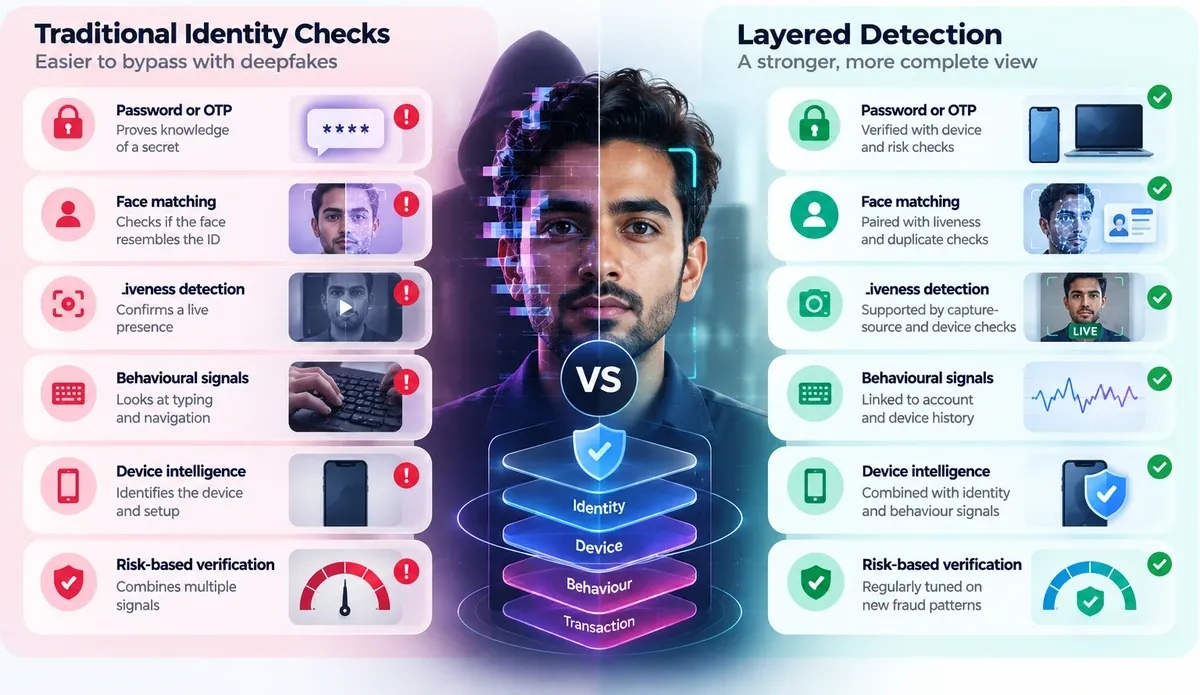
Combining these controls helps businesses assess identity, device, behaviour, and transaction risk together. This makes deepfake-enabled fraud harder to execute without adding unnecessary friction to every customer interaction.
Traditional Identity Checks vs. Layered Detection
Traditional identity checks are no longer enough to detect sophisticated deepfakes and AI-driven identity fraud. Layered detection adds multiple verification steps to spot manipulated images, fake identities, and suspicious behaviour that basic checks may miss.
A Practical Deepfake Prevention Checklist
Before approving a suspicious request, reviewing a video call or processing a digital onboarding application, use this checklist to identify potential warning signs:
| Check | What to Look for |
|---|---|
| Media quality | Look for unusual blurring, unnatural smoothness, or glitches around facial features. These signs warrant further checks but do not prove manipulation. |
| Facial and audio cues | Check whether lip movements, facial expressions, and speech appear consistent. |
| Liveness | Confirm that the selfie or video passes the available liveness checks and assess whether replay or injection attacks may be involved. |
| Identity validation | Match the face against the identity document and check for duplicate faces across applications. |
| Device risk | Examine whether the device shows suspicious configurations or links multiple unrelated accounts. |
| Behavioural patterns | Identify unusual typing, navigation, or session activity. |
| Transaction context | Investigate payments that differ significantly from the customer's established patterns. |
| Independent verification | Confirm high-risk payment instructions or account changes through a trusted, previously registered communication channel. |
Swipe the table
No single check can reliably detect every deepfake. Combining these signals helps businesses decide whether to proceed, request additional verification, or escalate a case for manual review.
How Real-Time Fraud Detection Helps with Deepfake Detection
Real-time fraud detection helps identify potential deepfake-related fraud in the following ways:
-
Detecting suspicious onboarding attempts: Real-time systems assess selfies, liveness results, device signals, and duplicate identities to flag potentially manipulated images or suspicious applications during account creation and KYC.
-
Identifying account takeover risks: When someone attempts to recover an account or log in from an unfamiliar device, the system evaluates identity signals, device history, and behavioural patterns to identify activity that may indicate impersonation.
-
Flagging suspicious payment requests: If a deepfake is used to impersonate an executive or customer, transaction monitoring can flag unusual payment amounts, unfamiliar beneficiaries, or unexpected changes in transaction behaviour.
-
Enabling faster risk-based decisions: The system combines these signals to determine whether an activity can proceed, requires additional authentication, or needs manual review.
Strengthen Your Deepfake Detection Before They Strike
Deepfake detection usually starts with identifying suspicious images before they compromise digital onboarding. At Sign3, we help NBFCs, banks, lenders, and fintechs assess KYC selfies using our Image Intelligence solution. It analyses multiple facial features, liveness, duplicate faces, background context, and image metadata to help flag potential spoofing attempts, manipulated images, and identity reuse.
Businesses can also make more informed onboarding decisions by assessing image-related risks without major changes to existing workflows. If you want to strengthen your deepfake detection strategy, schedule a demo and discover how Sign3’s Image Intelligence can help identify suspicious onboarding attempts earlier.
Frequently Asked Questions
What is deepfake detection?
Deepfake detection is the identification process of identifying whether audio, video, or images have been created or altered by AI. Detection methods include sophisticated software analysis, biometric checks, metadata review, and human judgment. These approaches are useful for differentiating authentic media from synthetic or manipulated content.
How can you detect a deepfake?
To detect a deepfake, it is necessary to look for unnatural facial movements, lip-sync errors, odd lighting, audio glitches, and inconsistent expressions. Since visual clues alone cannot reliably confirm a deepfake, using AI-powered image analysis, facial verification, and liveness checks is necessary. These assist with identifying manipulated content and suspicious identity verification attempts.
Can AI detect deepfakes?
Yes, AI models can detect deepfakes by identifying multiple patterns humans or traditional checks often miss. However, the accuracy often varies widely depending on the format (image, audio, or video) and how sophisticated the forgery is. That’s where the detection system works best when combined with multiple detection signals.
How is deepfake detection done?
Deepfake detection is done by training models based on real and synthetic media. The models then start assessing a score based on new content after checking for signs of manipulation. They look at texture, motion, sound patterns and file data. On the other hand, liveness checks and device signals provide additional evidence.
Can deepfake detection be 100% accurate?
No deepfake detection can be 100% accurate. There are multiple generation techniques, and when organisations use those detectors, there could be both missed and false alarms. Layering several methods, including device, behavioural and transaction signals, gives a more dependable result than any single tool.
How can businesses prevent deepfake fraud?
Businesses can prevent deepfake fraud using multiple signals such as device intelligence, behavioural analytics, transaction monitoring and risk scores for suspicious activities. Although single control is enough to detect fraud accurately, together they can work effectively.


