

Preventing identity theft comes down to a few steady habits. Sharing personal information wisely, using strong passwords and different password combinations for every account, turning on multi-factor authentication, and double-checking any KYC or banking request before you act on it; all these approaches matter. In fact, reviewing your financial accounts regularly matters just as much, because unusual activity is often the first sign that something has gone wrong.
None of these steps is complicated, but together they make it much harder for fraudsters to misuse your identity for unauthorised transactions, account takeovers, or fraudulent applications. With banking, KYC verification, and digital services moving online, stolen identity data can be exploited across multiple platforms within minutes. Let’s cover the most effective identity theft prevention practices, along with identity theft safety tips to better secure your personal data in an increasingly digital world.
Identity Theft: Dos & Don'ts - A Checklist
To protect your personal information from Identity theft, it is necessary to follow a simple yet effective checklist. The do’s and don’ts mentioned in the checklist can be considered a preventive approach, and you can actually protect both financial and digital identity.
| Do’s | Don’ts |
|---|---|
| Use strong passwords and ensure they are unique for each account. | Never use the same password for every account because these might be easier for fraudsters to trace |
| Enable MFA (Multi-Factor Authentication) as an additional layer of security | Never share your PIN or passwords with anyone. Banks and officials never ask for such information. |
| Regularly check bank statements and credit reports | Never ignore any unusual transactions or alerts and take immediate action if anything suspicious occurs |
| Protect all personal information and electronic records | Do not publicly post any kind of sensitive personal information |
| Keep both your system software and security settings up to date | Don’t do your banking or make payments on unsecured public Wi-Fi |
Swipe the table
The best way to reduce the impact of identity-related fraud is to stay alert, protect sensitive data, and act fast if something suspicious appears.
What Is Identity Theft?
Identity theft is a financial crime when a fraudster obtains and uses an individual's personal or financial information without consent and impersonates those details for multiple fraudulent purposes. The information may include a person's full name, date of birth, PAN, Aadhaar number, bank account details, card information, passwords, or mobile number.
Fraudsters need those basic documents to open bank accounts, apply for loans or credit cards, make unauthorised transactions, buy SIM cards, or take over online accounts. Victims often realise that they have been scammed only when they receive unexpected transaction alerts, debt collection notices, or verification requests for certain services they never applied for.
How to Avoid Identity Theft: The 6 Steps
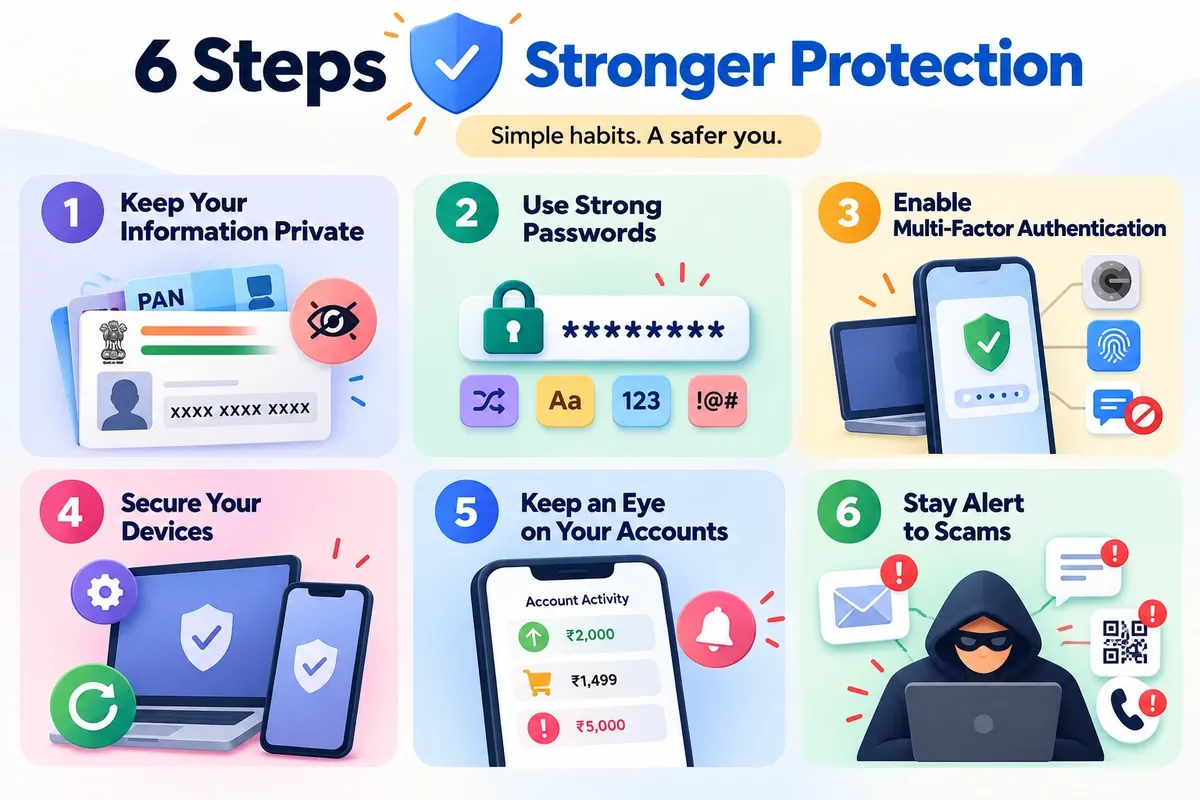
If you want to avoid identity theft, one preventive approach is not enough; rather, you need to apply multiple security layers. Following these six steps that work effectively to form an identity theft prevention strategy and reduce your risk of becoming a victim.
Step 1 Protect your personal information: Identity theft often starts with a detail you handed over without a second thought. Before you share anything, ask yourself who is on the other end and think logically. If you have to share your Aadhaar, send a masked copy. Keep your PAN, date of birth, and phone number out of public posts altogether.
Step 2 Use strong passwords: For every account, use a different password that is at least 12 characters long. Ensure you create it by mixing letters, numbers and symbols, like Cloud9Moon#28. Skip easy names, birthdays, and weak patterns such as Password123. Scammers try those first.
Step 3 Enable MFA: Add a second layer of protection. MFA, or Multi-Factor Authentication, protects your email, banking, payment, and social media accounts. So a stolen password alone won't get a scammer very far.
Step 4 Secure your devices: Install security updates on your phone, tablet, and computer as soon as they arrive. Use a strong screen lock and download mobile applications only from official stores and authorised links.
Step 5 Monitor your financial accounts: Set up instant transaction alerts on your bank, credit card, and payment apps, and look through your activity often. If a charge looks unfamiliar, flag it right away. Check your credit report too, in case someone has taken a loan in your name.
Step 6 Stay alert to scams: Be careful with unexpected emails, messages, links, QR codes, and phone calls that ask for personal or financial details. A genuine organisation will never ask for your password, PIN, or OTP over a call, email, or message.
If you can implement only one measure today, enable MFA on your main email account. It's a key gateway to recovering most of your other accounts, so protecting it protects the rest.
Common Warning Signs of Identity Theft
Some common warning signs of Identity theft are unauthorised transactions, OTPs you never asked for, changed login details, and unfamiliar credit inquiries. In most cases of identity theft, the activity often goes unnoticed until the money is gone.
| Warning Sign | What It May Mean |
|---|---|
| Unauthorised transactions on your bank account or credit card | It may mean a criminal may have gained access to your account or payment credentials and is using them for fraudulent purchases or transfers. |
| OTPs, login alerts, or password reset notifications you did not even request | A fraudster may be attempting to access your account or initiate an account takeover. |
| Unexpected loan approvals, credit inquiries, or credit card applications | Your personal information may be used to apply for financial products without your knowledge. |
| New bank accounts, wallets, or services opened in your name | Criminals may have used stolen identity information to create accounts for fraud or money laundering. |
| Calls or emails about transactions you never made | Fraudsters may already be using your credentials, cards, or accounts for unauthorised activity. |
| Missing account access or changed login credentials | Your account may have been taken over, and the attacker may have changed passwords, email addresses, or phone numbers. |
| Personal information appearing in data breach notifications | Exposed personal data can be used in phishing, account takeover, synthetic identity fraud, or impersonation scams. |
Swipe the table
Understanding the early warning signs of identity theft is critical because quick action can reduce the financial loss, prevent further misuse of personal information, and improve the odds of recovering compromised accounts.
What to Do If You Become a Victim of Identity Theft?
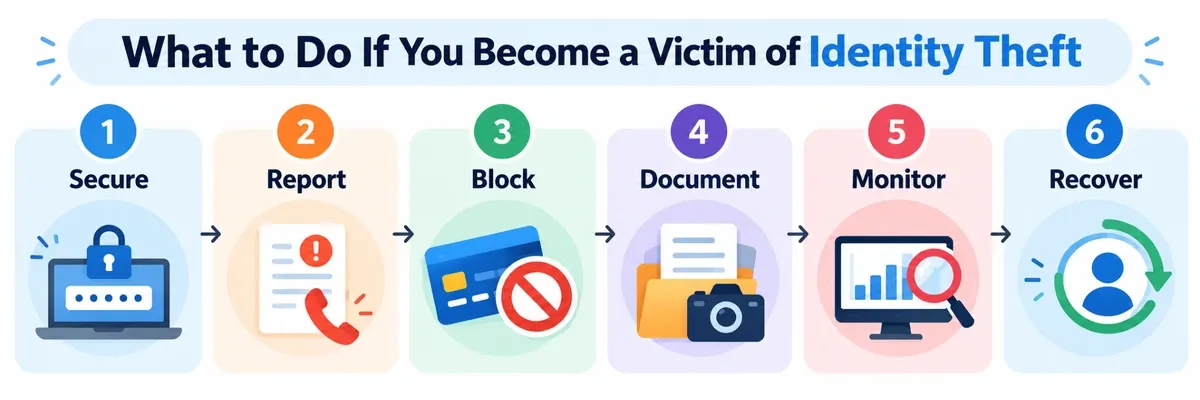
The steps are mentioned below.
-
Secure Your Accounts: Take immediate action by freezing your account. Change passwords on your email, banking, and any account that shares the compromised password. Log out of all devices and enable multi-factor authentication (MFA).
-
Report to the National Cybercrime Helpline: Dial 1930 immediately or file a complaint on the National Cyber Crime Reporting Portal (cybercrime.gov.in). Prompt reporting always helps authorities to freeze stolen funds before they move through multiple accounts.
Read this guide to understand the process in detail.
-
Block Financial Access: Contact your bank or card issuer to block all the debit cards, credit cards, UPI IDs, net banking access, and digital wallet access. If a SIM was issued in your name without your consent, report it through the Department of Telecommunications’ Sanchar Saathi portal.
-
File a Police Complaint / FIR: Visit your nearest police station or cybercrime cell to lodge a First Information Report (FIR). Mention all the relevant information while complaining and keep a copy of the FIR or acknowledgment receipt for bank and legal follow-ups.
-
Secure Identity Documents: If your Aadhaar or PAN was compromised, lock your Aadhaar biometrics via the mAadhaar app or the UIDAI website, and monitor your PAN usage through the Income Tax portal.
-
Monitor and Follow Up: For the next few months, keep a close watch on your bank accounts and credit report. Criminals may try to access your accounts again, so keep following up with the bank, bureau, and police until your records are corrected.
Overall, the main rule is to act within the golden hours (the first 30 minutes) because speed is the most important part of identity theft protection after a breach. RBI rules state that if a customer reports an unauthorised transaction within three working days of receiving the bank’s alert, he/she is generally not liable for any loss.
How Does Identity Theft Happen?
Most identity theft happens through sophisticated fraud tactics. These tactics can include an email from "your bank," a text about a missed delivery, or a call from someone claiming to be a government or authorised person. Phishing, smishing, vishing, data breaches, and social engineering, the names differ, but the goal is the same. Understanding how identity theft occurs can also help you identify and avoid potential threats before they can do any damage to your digital and financial assets.
-
Phishing, Smishing, and Vishing: Fraudsters use fake emails, text messages, and phone calls to manipulate people. They use convincing approaches, fake scenarios, and impersonation to collect passwords, banking credentials, OTPs, or other sensitive information.
-
Data Breaches: When a company or service provider gets breached, criminals get access to your personal information. They sell, trade, and reuse that information, often months or even years later. The same leaked email and password can then be tried across your other platforms, leading to account takeover.
-
Fake Websites and Apps: Lookalike but fake websites, fraudulent login pages, and unofficial applications are designed to capture usernames, passwords, and financial information entered by unsuspecting users.
-
Social Engineering: Scammers often manipulate trust, urgency, or fear by pretending to be genuine representatives from banks, government agencies, courier companies, or law enforcement authorities.
-
Malware and Compromised Devices: Malicious software can record keystrokes, steal stored credentials, intercept messages, or even provide attackers with unauthorised access to a device.
-
Public Wi-Fi Risks: Unsecured public networks also increase the risk of identity theft by exposing internet traffic to interception. This may allow fraudsters to steal credentials and compromise accounts.
A typical identity theft attack often follows a predictable sequence:
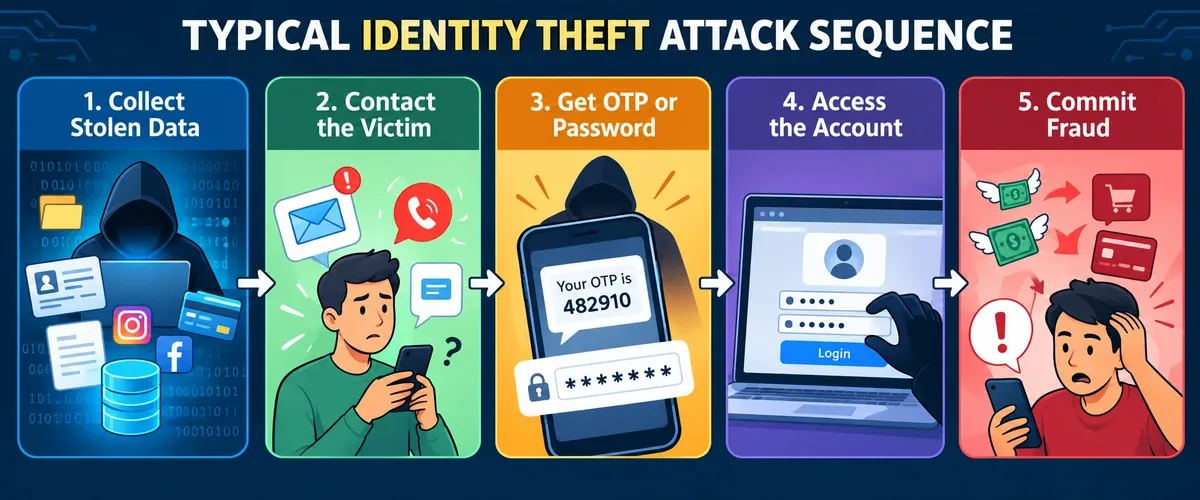
Since every step depends on the success of the previous one, it is possible to break the chain at any point and stop the fraud from becoming a success.
Types of Identity Theft
Identity theft occurs in multiple forms, but the common thing among all the types is that they target different aspects of your personal, financial, or digital identity. Understanding these variations can help you focus on identity theft prevention efforts where they matter most.
-
Financial Identity Theft: Criminals use your personal information to open bank accounts, apply for credit cards, loans, make online purchases, or access financial services in your name.
-
Account Takeover: Attackers gain control of your existing accounts such as online banking, UPI, email, or social media accounts, often through stolen credentials, phishing attacks, or compromised OTPs.
Read this guide to understand how account takeover happens.
-
Synthetic Identity Theft: Fraudsters often combine real information, such as a PAN or Aadhaar number, with fabricated details. They use this information to create a new identity and easily bypass traditional onboarding and verification checks.
-
Tax and Benefit Identity Theft: Stolen identity information is often used to file fraudulent tax returns, claim refunds, or divert government benefits and subsidies intended for legitimate users.
-
Medical Identity Theft: Scammers use your identity to obtain medical treatment, prescription drugs, or insurance benefits. Since the inaccurate medical records are under a genuine user’s name, they appear legitimate.
-
Criminal Identity Theft: Scammers use your name falsely when they are dealing with law enforcement or doing things using services (such as SIM cards or accounts) that are associated with your name.
While the methods and consequences vary, all forms of identity theft rely on the misuse of genuine personal information. Even a small amount of exposed data can be enough for fraudsters to develop a false identity, access digital accounts, or commit financial fraud.
How Can Banks and Financial Institutions Help Protect Customers from Identity Theft
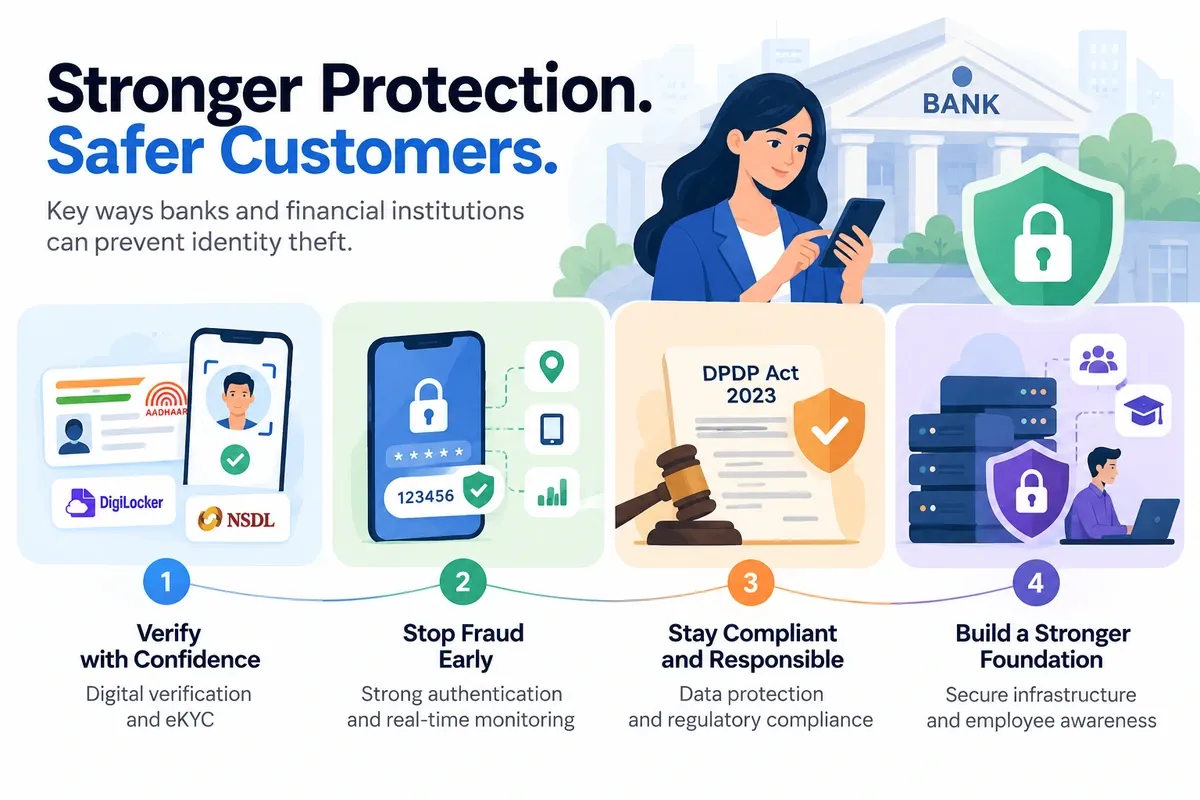
Indian banks and financial institutions can lower identity theft risk by getting four things right: verification at onboarding, secure logins, regulatory compliance, and careful data handling across the customer lifecycle.
1. Digital Verification and eKYC
Protection should always begin at onboarding. Aadhaar-based eKYC through the UIDAI ecosystem lets businesses verify a customer’s genuine identity instantly through paperless, biometric, or OTP-based authentication. Documents and credentials can also be validated \through official platforms like DigiLocker and NSDL. This means any kind of forged documents and fake identities can be detected even before an account is opened.
2. Strong Authentication and Fraud Monitoring
Multi-factor authentication (MFA) adds another strong verification step, such as an OTP or an authenticator app code, for account logins and high-risk transactions. AI and machine learning tools work further by monitoring a user’s behaviour in real time, flagging unusual login locations. This approach can also detect sudden device switches and unusual transaction patterns before the fraud actually takes place.
3. Compliance with Data Protection Regulations
Businesses should follow the Digital Personal Data Protection (DPDP) Act, 2023. According to the data, banks and financial institutions can only collect the personal data they need, but only after obtaining explicit consent and following strict data minimisation and storage limits.
Under the IT Act, 2000, banks and fintechs should also maintain proper security measures and must perform audit trails for all digital customer records. Once data is no longer legally required or needed for financial operations, customer files and archives should be permanently erased or encrypted.
4. Secure Infrastructure and Employee Awareness
Sensitive customer databases should always be encrypted, and access to that information must be handled carefully. Employees who actually need that data should get access. Regular cybersecurity training helps employees recognise social engineering, phishing attempts, and fake data requests.
Together, these steps help businesses catch threats early, build customer trust, and keep identity theft risk low.
Strengthen Your Identity Theft Protection with Sign3
Identity theft prevention begins with the identification of suspicious activity prior to financial losses occurring. We, at Sign3, help banks, financial institutions and NBFCs identify identity fraud during digital onboarding. Our Device Intelligence solution identifies suspicious devices, emulators and devices associated with multiple accounts, helping fraud detection teams flag potential identity misuse and account takeover attempts sooner.
Businesses can improve onboarding security and provide a better experience for legitimate customers by identifying risks at the device level. If you want to improve digital onboarding, schedule a demo and learn how we can help your identity fraud prevention strategy.
FAQs
What is identity theft?
Identity theft is one of the most common financial crimes, wherein fraudsters illegally access your personal or financial information such as your name, PAN, Aadhaar, account credentials, etc., and use it to commit financial fraud. The information is used mainly for illegal purposes, such as obtaining money, credit, goods, or services.
How can I protect myself from identity theft?
To protect yourself from identity theft, start using strong passwords, activate MFA, and share Aadhaar and PAN details only when required. Do not share OTPs and ensure that you update your devices and regularly check your statements and credit report.
What are the warning signs of identity theft?
OTP or password-reset messages you didn't request, inquiries on your credit report that you don't recognise, or loan approvals that you didn't apply for are some of the warning signs of identity theft. This is where looking at your bank statements frequently, or even monthly, helps you to detect them sooner.
How does identity theft happen?
Identity theft usually begins with phishing, data breaches, fake websites or apps, malware or social engineering. The attacker then collects enough information to impersonate you and then applies for credit or gets into your accounts.
How to prevent identity theft online?
When using the internet, it is very important to avoid clicking on unknown links and use strong passwords and different passwords for different sites; also, enabling MFA is a must. Also avoid using public Wi-Fi for banking. Always install apps only from official stores, and be careful what you post on social media.
What should I do if my identity is stolen?
Change your passwords, call your bank and block cards, report it on cybercrime.gov.in or 1930, keep evidence, alert the credit bureaus, and watch your accounts for several months.


