

Smishing is a form of SMS-based phishing in which fraudsters impersonate banks, courier services or government agencies to trick recipients into clicking malicious links, sharing OTPs or revealing sensitive information. Once attackers obtain these details, they can attempt account takeovers, initiate unauthorised transactions and misuse compromised accounts for further financial fraud.
For banks, NBFCs, and financial institutions, the challenge typically extends beyond the initial message. They must identify the suspicious activity that may follow a successful smishing attempt, often without direct visibility into the original SMS. In this guide, you will learn what smishing is and how SMS phishing scams (smishing) work. You can also learn common smishing tactics, the risks smishing creates, and how Sign3 helps financial institutions identify potential fraud through layered intelligence.
Key Takeaways
- Smishing uses SMS-based phishing to steal sensitive information: Fraudsters exploit the cases of urgency, trust and brand impersonation to obtain OTPs, passwords and banking details.
- Multiple techniques enable smishing attacks: Common methods include fake bank alerts, KYC updates, delivery fee requests, payment failure notifications and e-challan scams.
- Stolen credentials can lead to account takeover: Fraudsters can misuse stolen OTPs and passwords to access customer accounts and initiate unauthorised transactions.
- Detecting smishing-related fraud requires continuous monitoring: Unfamiliar devices, unusual login locations, abnormal user behaviour and suspicious transaction patterns can indicate potential account compromise.
- Layered fraud intelligence helps reduce smishing risks: Risk-based authentication, device intelligence, behavioural biometrics and customer education help businesses strengthen fraud prevention.
What Is Smishing? Definition and Examples
Smishing meaning can be understood simply as SMS based phishing, a form of phishing that is carried out through SMS (Short Message Service). The term combines “SMS” and “phishing”, and together these describe fraudulent text messages that are particularly designed to trick recipients into sharing some sensitive information or taking actions that compromise their security.
Attackers often impersonate trusted organisations, such as banks, government agencies and delivery companies. This helps create urgency and allows them to gain victims' trust. They may target passwords, UPI PINs, card details, PAN and Aadhaar information, and one-time passwords (OTPs).
One of the most common smishing examples is a message claiming, “Your bank account will be blocked today. Update your KYC details using the link below.” The link also redirects the recipient to a fake banking website designed to capture the information they enter. Fraudsters can then misuse these stolen credentials to attempt unauthorised account access and financial transactions.
Read the guide to gather detailed insights on the Types of Phishing Attacks and How to Prevent Phishing
Realistic Smishing Examples: 4 Fraudulent Text Messages
Smishing attacks often use convincing messages that appear to come from trusted organisations. The following smishing examples illustrate some common SMS phishing tactics.
Note: These are fictional examples that are created for awareness and do not represent genuine messages from any financial institution.
1. Incomplete address
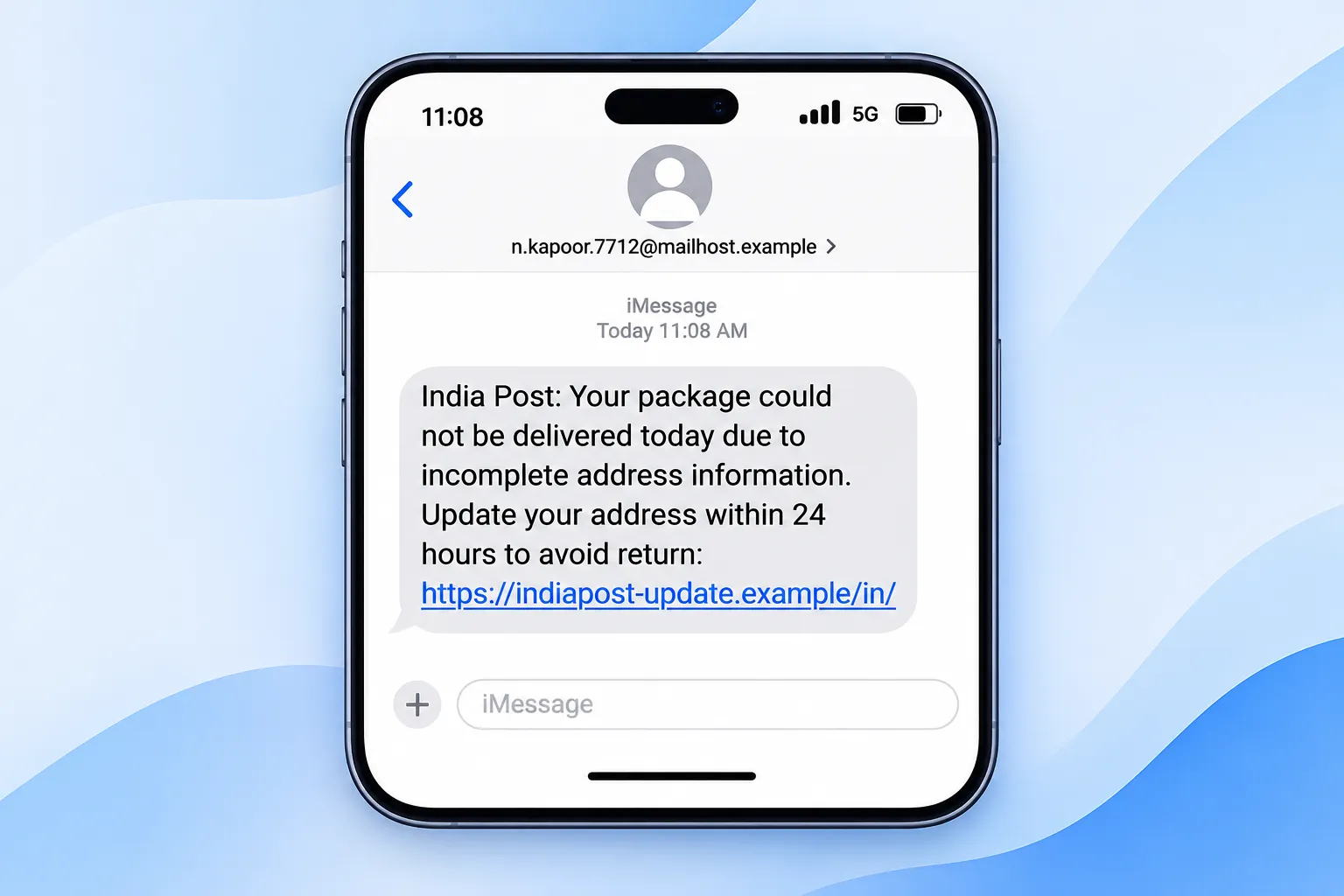
- Example SMS: India Post: Your package could not be delivered today due to incomplete address information. Update your address within 24 hours to avoid return: https://indiapost-update.example/in/
- Information targeted: Full name, detailed address (street, building, apartment), ZIP code, phone number, email ID.
- Why it works: Sounds like a routine logistics problem, and the 24-hour deadline pushes people to act before thinking.
- Warning signs: A postal service asking you to fix an address through a link, and a sender that is a personal email address instead of a short code or official number.
2. Redelivery fee
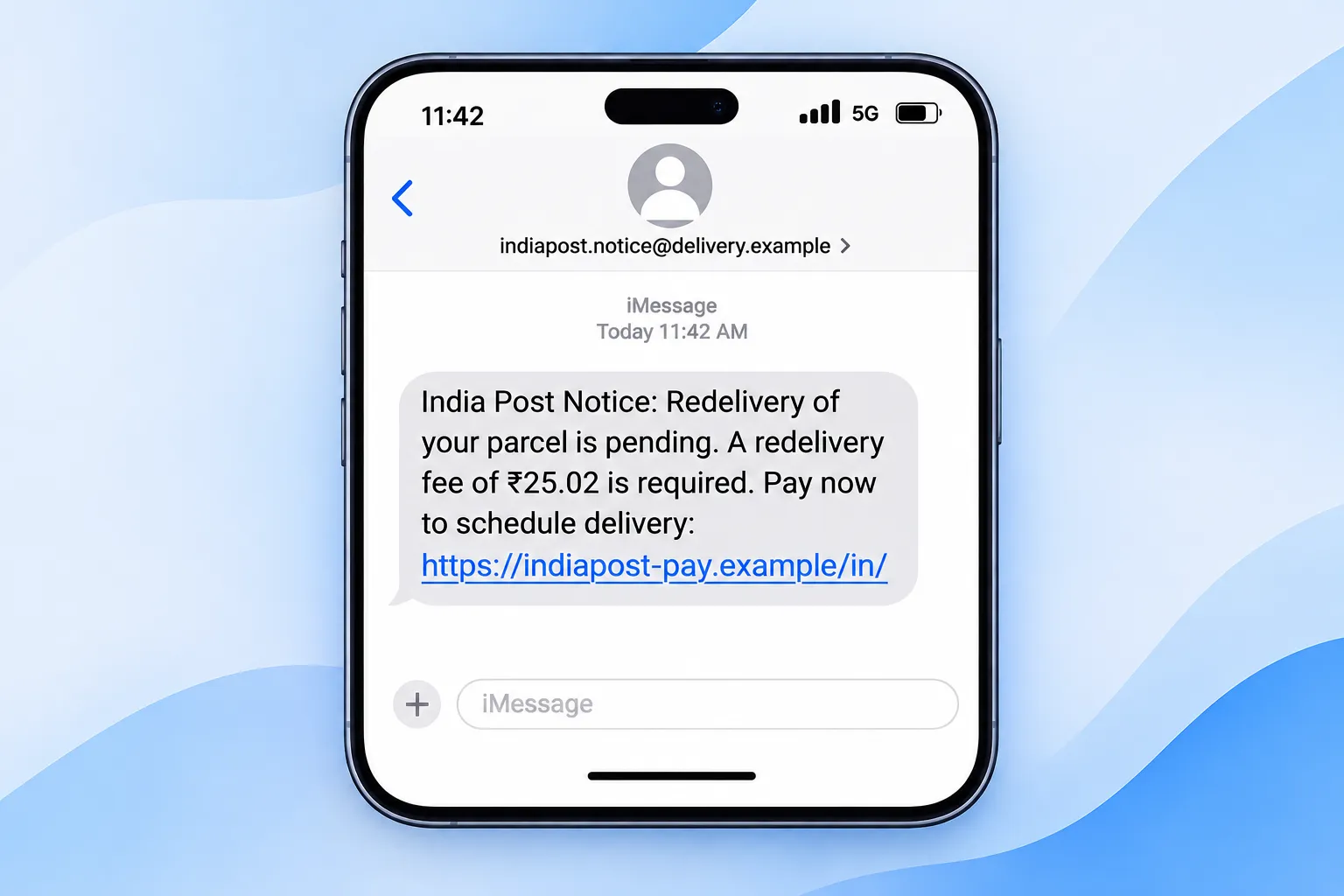
- Example SMS: India Post Notice - Redelivery of your parcel is pending. A redelivery fee of ₹25.02 is required. Pay now to schedule delivery: https://indiapost-pay.example/in/
- Information targeted: Debit/credit card number, expiry, CVV, OTP.
- Why it works: The amount is so small that it feels harmless, which lowers suspicion. The real goal is the card details typed into the payment form.
- Warning signs: An unexpected fee, a payment link, and a lookalike domain that is not the official India Post website.
3. Package held at warehouse
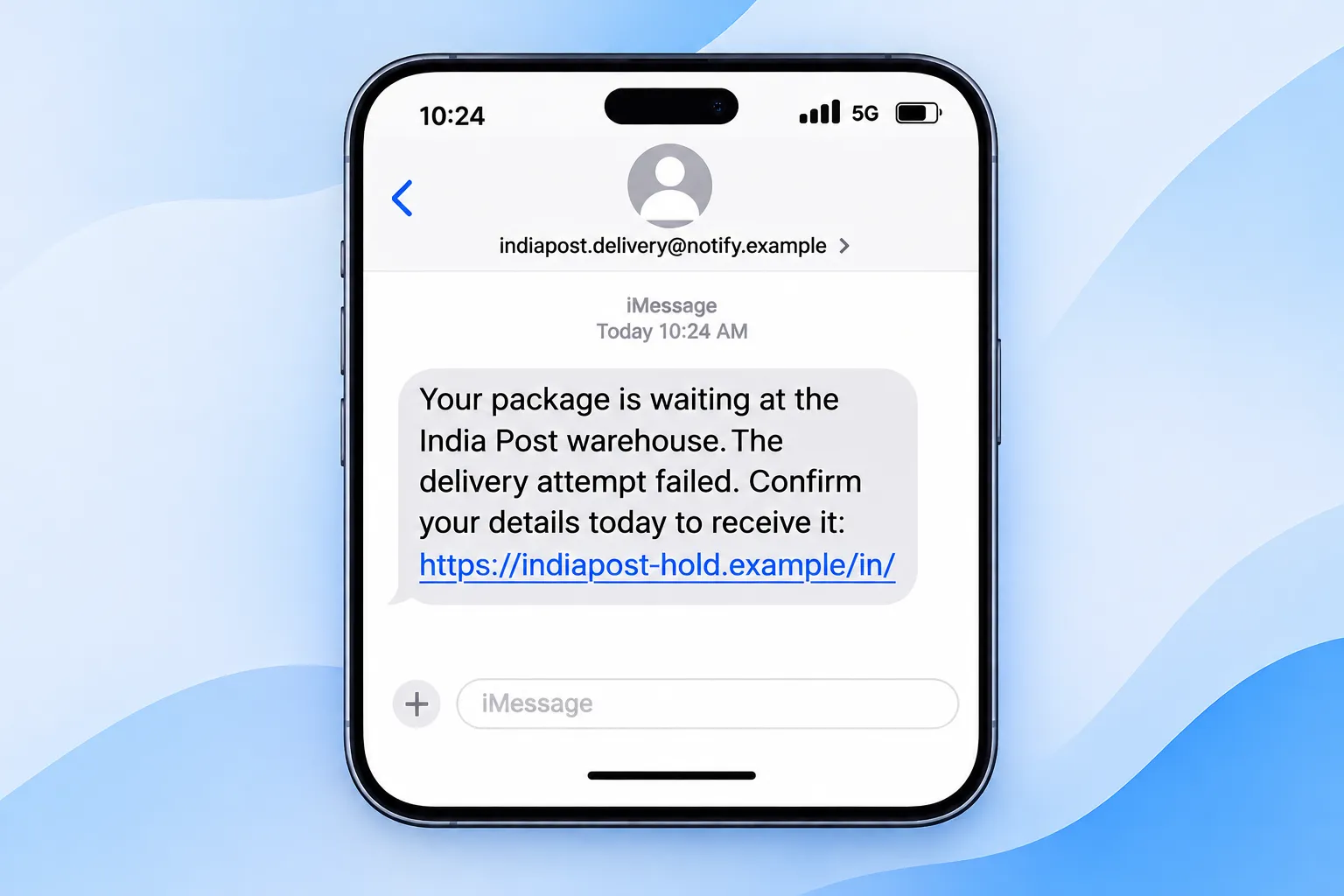
- Example SMS: Your package is waiting at the India Post warehouse. The delivery attempt failed. Confirm your details today to receive it: https://indiapost-hold.example/in/
- Information targeted: Name, address, email ID, phone number.
- Why it works: Targets anyone expecting a parcel, and the message names no sender, item or tracking number, so it fits almost any recipient.
- Warning signs: Vague wording, no consignment number, and a demand to “confirm details” that a genuine delivery would already have.
4. Fake tracking update
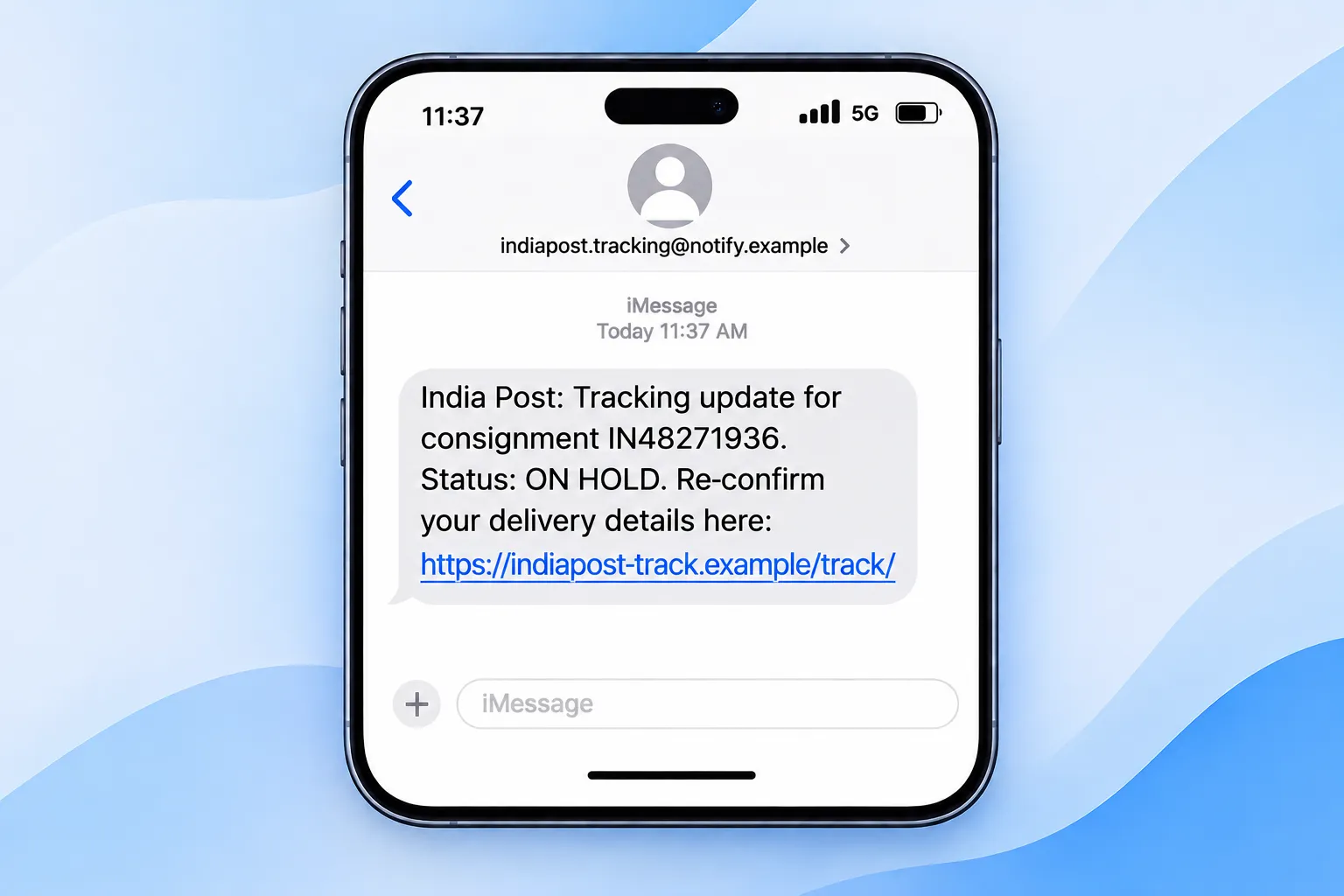
- Example SMS: India Post - Tracking update for consignment IN48271936. Status: ON HOLD. Re-confirm your delivery details here: https://indiapost-track.example/track/
- Information targeted: Contact details first, then card details on a follow-up page.
- Why it works: A consignment number and status label make the message look system-generated.
- Warning signs: Tracking numbers you cannot match to any order, capital-letter status labels, and a “track” link that asks for personal information instead of showing a status.
These smishing examples show how the fraudsters use urgency, impersonation and attractive offers to encourage immediate action. Recipients should avoid clicking unexpected links and verify requests through an organisation's official website, application or customer support channel.
Note: For further insights into real-world smishing tactics, explore the examples in Fortinet's investigation.
How Do Smishing Attacks Work?
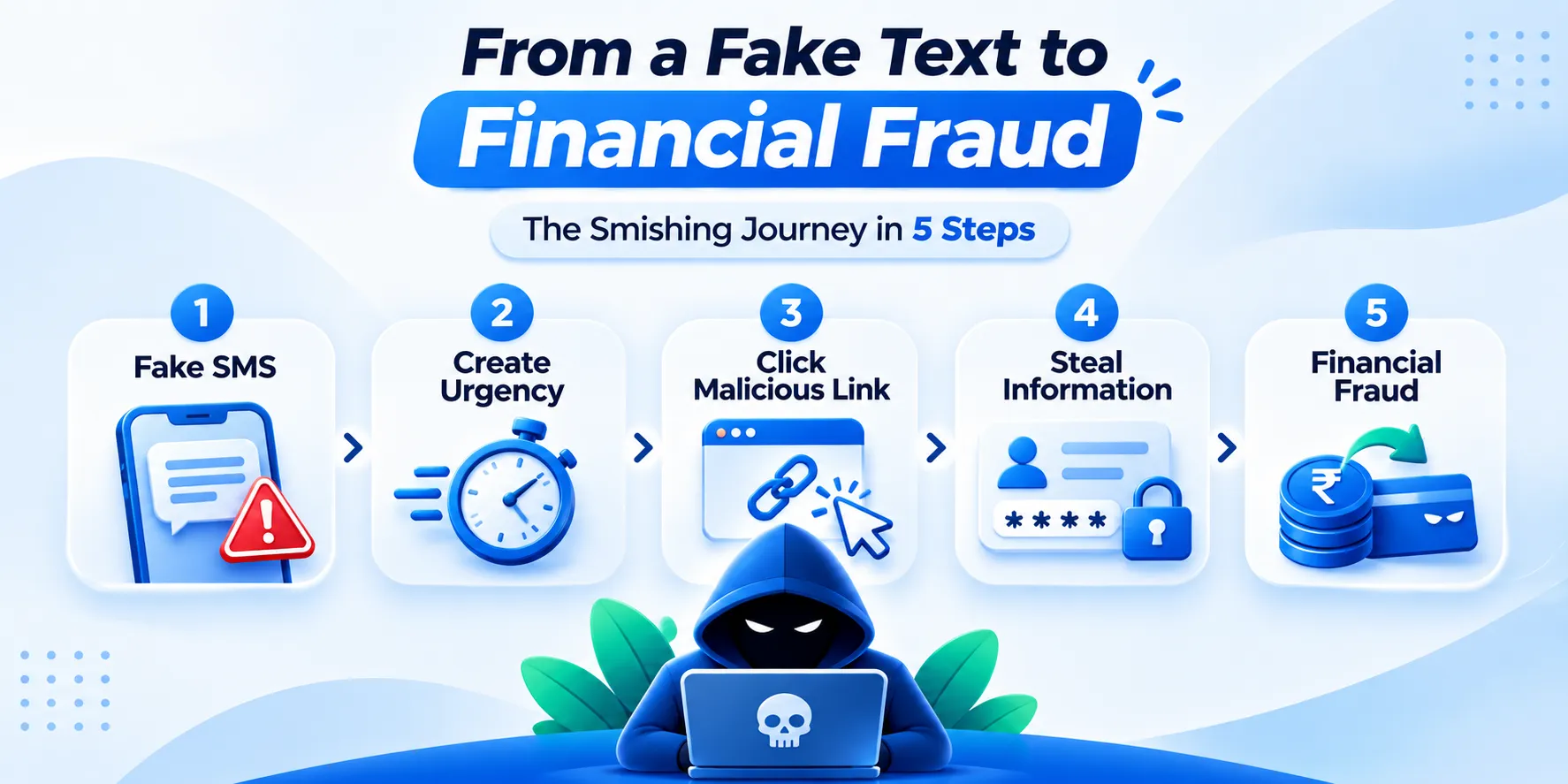
Smishing attacks often use fraudulent text messages, and these often trick recipients into sharing sensitive information, clicking malicious links, or installing harmful applications. Attackers often impersonate banks, courier companies, government departments or trusted service providers to make their messages appear genuine. A typical smishing attack unfolds in five steps:
- Sending a Fake SMS: The attacker typically sends a fraudulent message impersonating a trusted organisation. This creates a sense of panic and urgency through warnings about blocked bank accounts, pending deliveries, or expiring services.
- Creating a Sense of Urgency: False messages create additional pressure on the recipients to act immediately by threatening account suspension, failed payments, or service disruptions.
- Tricking Users into Clicking Links: The SMS contains a malicious link that redirects recipients to a fake website or even prompts them to download a fraudulent application.
- Stealing Sensitive Information: The fake website or application collects confidential information such as banking credentials, card details, passwords or OTPs entered by the victim.
- Committing Financial Fraud: Attackers use the stolen information to access accounts, initiate unauthorised transactions, take over accounts or transfer funds through mule accounts.
The attack can also involve some malicious applications that capture OTPs or collect sensitive information directly from compromised devices. For businesses that detect any suspicious account access, unusual transactions, and mule activity, these become critical once a victim interacts with a fraudulent message.
8 Common Types of Smishing Attacks
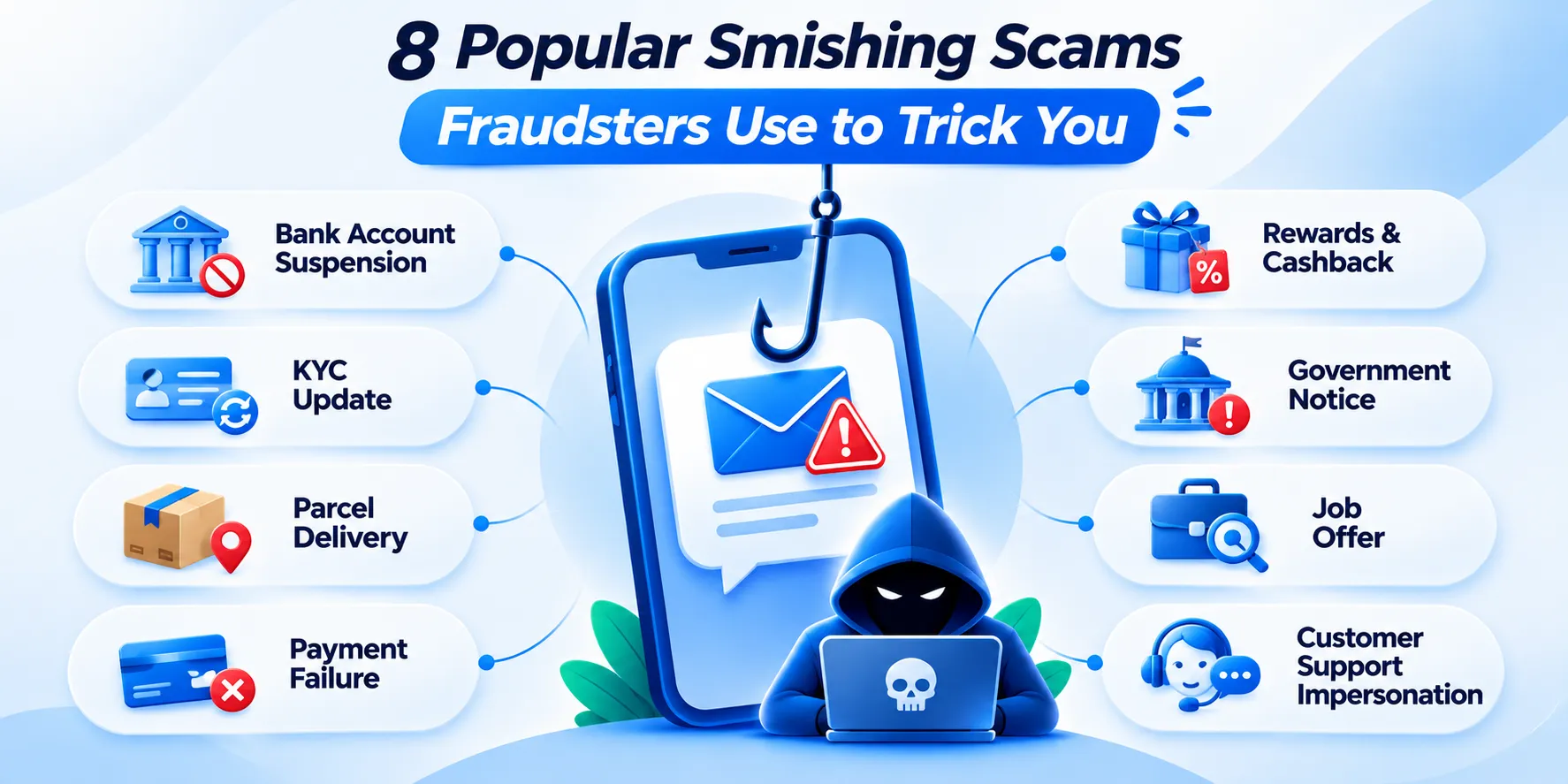
Smishing attacks often use different tactics to exploit people's trust in familiar organisations and services. Fraudsters often impersonate banks, government agencies, delivery companies and other trusted entities to trick recipients into sharing sensitive information or clicking malicious links. Some common types of smishing attacks include:
- Bank Account Suspension Scams: Fraudsters send messages claiming that a bank account will be blocked unless the recipient verifies their details. They are asked to click on a suspicious link that seems legitimate.
- KYC Update Scams: Attackers often pose as bank representatives and demand urgent KYC updates through fake websites or malicious applications.
- Parcel Delivery Scams: Victims suddenly receive fake delivery notifications asking them to pay a small redelivery fee through a fraudulent payment link. This may expose their card details.
- Payment Failure Scams: Fraudulent messages claim that a transaction has failed and direct recipients to fake payment pages to retry the transaction or enter banking credentials.
- Reward and Cashback Scams: Fraudsters promise attractive rewards, cashback or prizes to persuade recipients to share personal and financial information.
- Government Notice Scams: Attackers impersonate government departments through fake tax, subsidy or e-challan notifications. CERT-In has also warned about fraudulent e-challan messages containing malicious Android application (APK) files.
- Job Offer Scams: Fake recruitment messages promise employment opportunities but ask the recipients to pay a registration fee or share sensitive personal documents.
- Customer Support Impersonation Scams: Fraudsters pose as customer service representatives and manipulate victims into revealing passwords, banking details or OTPs.
Although SMS phishing tactics may change, most smishing attacks rely on impersonation, urgency and deceptive links or attachments. Businesses should therefore educate their customers to verify unexpected requests and directly contact the banks through official channels. This allows them to prevent fraud without relying solely on familiar smishing examples.
7 Warning Signs of a Smishing Message
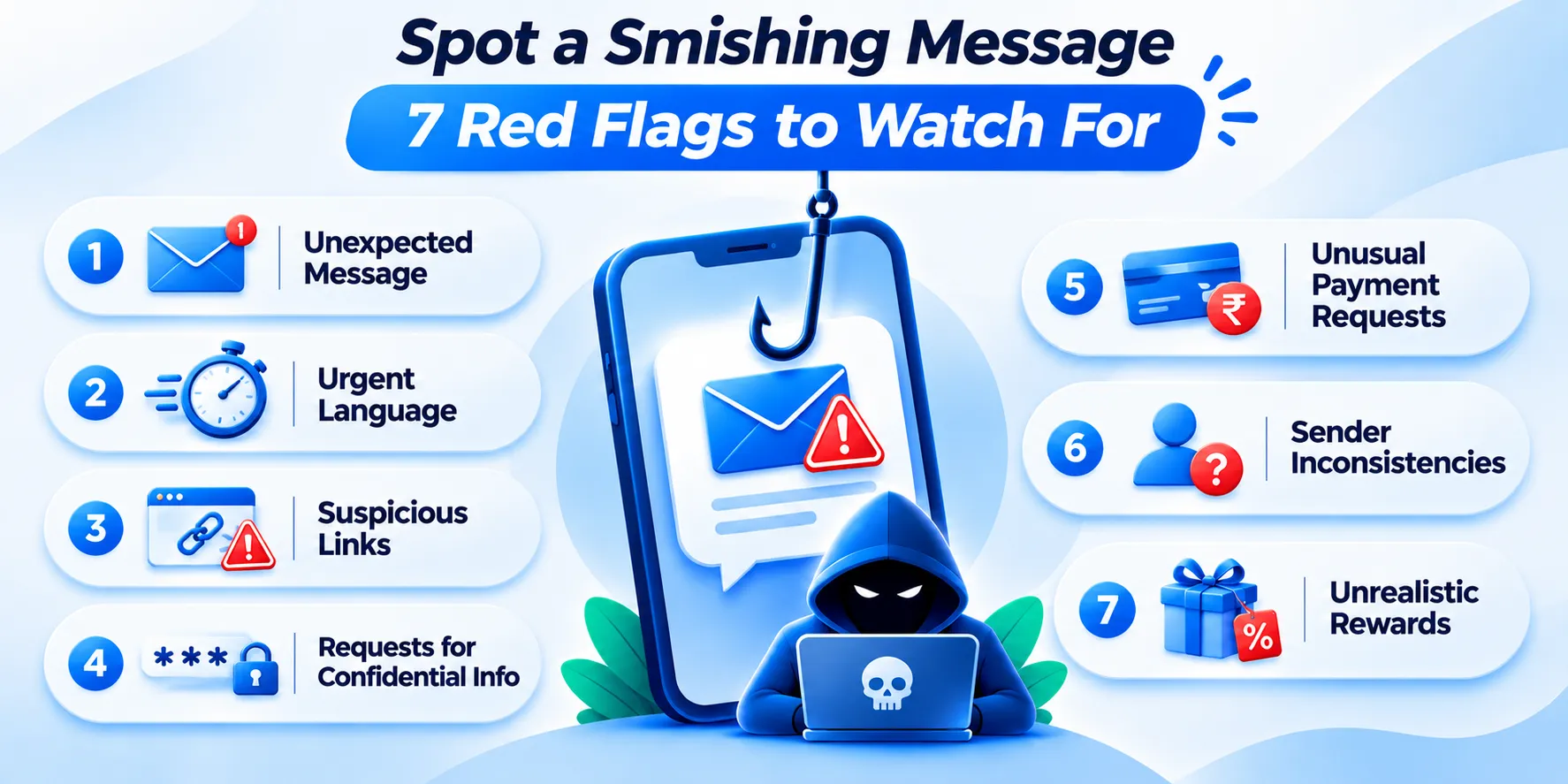
Smishing messages don’t always originate from unknown numbers or contain bad grammar. Some can closely resemble real bank alerts or even show up in existing message threads. You can’t just check the spelling and sender; you need to look for these seven warning signs in the message request.
| Warning Signs | What to Look For |
|---|---|
| Unexpected message | Unrequested account, payment or delivery notifications. |
| Urgent language | Threats of account suspension or demands for immediate action. |
| Suspicious links | Unfamiliar, shortened or misspelt URLs. |
| Requests for confidential information | Messages asking for OTPs, PINs, passwords or banking credentials. |
| Unusual payment requests | Unexpected fees, transfers or requests to make payments through unfamiliar links. |
| Sender inconsistencies | Unrecognised or misleading sender identities that cannot be verified through official channels. |
| Unrealistic rewards | Unexpected prizes, cashback offers or guaranteed benefits that require immediate action. |
Swipe the table
Always verify unexpected requests through an organisation's official website, application or customer support channel before sharing information or making payments.
What Should You Do After Clicking a Smishing Link?
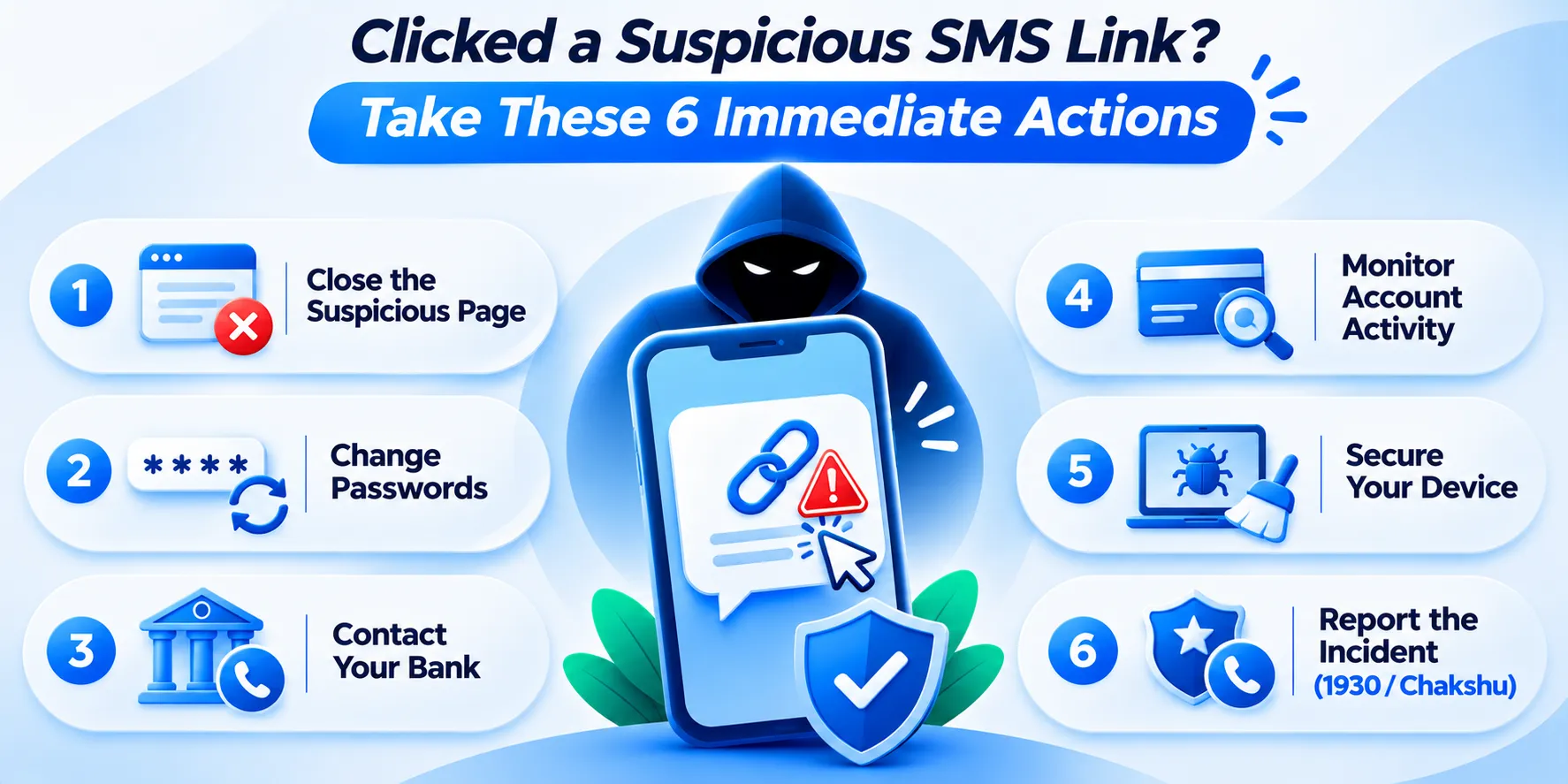
If you click a suspicious SMS link, stop interacting with the page and avoid sharing any further information. If you have exposed financial details, contact your bank immediately to limit potential losses. Take the following steps:
- Close the Suspicious Page: Do not enter confidential passwords, OTPs, PINs or card details. If a file downloads automatically, avoid opening or installing the apps.
- Change Compromised Passwords: If you have entered the login credentials, change your passwords through the bank's official website or application, preferably using a different, secure device.
- Contact Your Bank: Call the official helpline listed on your bank's website or payment card. Request appropriate security measures, such as blocking compromised cards, UPI services or net banking access.
- Monitor Account Activity: Review the recent transactions, registered beneficiaries and linked devices. Report if you find any unfamiliar activity or unauthorised transactions immediately.
- Secure Your Device: If you installed a suspicious application, disconnect the device from the internet and seek help to remove the application and revoke its permissions. Preserve screenshots of the message and other relevant evidence.
- Report the Incident in India: If you lose money due to phishing scams, immediately call the national cybercrime helpline at 1930 and register a complaint at the National Cyber Crime Reporting Portal. If you receive a suspicious communication without losing money, report it through the Chakshu facility on Sanchar Saathi.
Read the guide on How to Report Cyber Fraud in India
How Can Banks and Businesses Detect Smishing-Related Fraud?
Banks and financial institutions may not always see the original fraudulent SMS. However, they can monitor suspicious activity when victims click malicious links and then access their accounts. Detecting smishing-related fraud requires analysing multiple risk signals across devices, user behaviour, digital identity and transactions.
Device and behavioural intelligence do not directly identify fraudulent SMS messages. Instead, they help businesses detect unusual activity that may indicate compromised credentials or potential account takeover.
1. URL and Brand Impersonation Monitoring
Monitor for lookalike domains, suspicious URLs reported by customers and recurring impersonation patterns. These insights can assist the security teams to identify fraudulent websites, investigate threats and support takedown efforts.
2. Device Intelligence
Identify unfamiliar devices, sudden device changes and suspicious device characteristics, including signs of tampering or emulation. A login from an unfamiliar device, particularly when it differs from the customer's established usage patterns, may indicate potential account compromise.
3. Behavioural Biometrics
Analyse for different typing patterns, touch interactions and navigation behaviour to identify deviations from a customer's usual activity. Unusual interaction patterns during login or transactions may indicate that someone other than the legitimate account holder is accessing the account.
4. Digital Footprint and Location Intelligence
Assess for the digital identity signals that are associated with phone numbers, email addresses and devices. Monitor for unusual location changes, unexpected access patterns and suspicious network connections that may indicate potential identity misuse.
5. Transaction and Account Monitoring
Monitor unusual activities such as new beneficiary additions, changes to transaction limits, profile modifications and rapid fund transfers following suspicious login attempts. Analysing these activities alongside device and behavioural signals helps financial institutions assess potential account takeover risks.
How Can Businesses and Users Prevent Smishing Attacks?
Preventing the chances of smishing requires a combined approach. Businesses need to strengthen their authentication and fraud monitoring, while individuals must recognise suspicious messages and avoid sharing sensitive information.
Prevention Measures for Businesses
- Implement risk-based authentication: Apply for further verification if any login activity is found from unfamiliar devices. Also, consider frequent new beneficiary additions and high-value transactions.
- Monitor login and transaction activity: Identify unusual access patterns and suspicious transactions that may indicate compromised accounts.
- Filter malicious URLs: Detect suspicious links and take action against fake domains that impersonate legitimate organisations, helping protect consumers from phishing attacks, financial fraud and loss of trust.
- Follow RBI guidelines: Implement the RBI's January 2025 circular on designated number series for service and promotional calls, SMS header registration under TRAI rules, and customer awareness initiatives covering DND, Chakshu and the 1930 helpline.
- Educate customers: Educate customers through clear warnings. Ensure official communications state that organisations never ask customers to share OTPs or install applications through unsolicited links.
- Establish fraud reporting procedures: Provide accessible channels for customers to report suspicious messages and enable security teams to investigate potential fraud quickly.
Authentication alone won’t stop different types of SMS phishing attacks. If the OTP is entered on a malicious website or intercepted by malware, it can still be misused by attackers and fraudsters. Businesses should implement authentication controls together with continuous risk monitoring and, where possible, phishing-resistant authentication methods.
Prevention Measures for Individuals
Smishing attacks use deceptive text messages, impersonation and malicious links to trick individuals into revealing sensitive information or downloading harmful applications. Following basic security practices, such as verifying messages, protecting login credentials and monitoring account activity, can help reduce the risk of falling victim to these scams.
- Avoid unexpected SMS links: Access the banking services through official applications or by manually entering the organisation's website address.
- Never share confidential information: It is also advisable not to disclose OTPs, PINs or passwords, even to someone claiming to represent your bank.
- Avoid installing unknown applications: Never download APK files that could be received through SMS or messaging platforms. That’s why it is necessary to use the official application stores.
- Review application permissions: Avoid granting SMS or accessibility permissions to applications that do not require them.
- Enable transaction alerts: Monitor the right account activity and set the UPI transaction limits according to your requirements.
- Report suspicious messages: Inform your bank about fraudulent communications and use the Chakshu facility on India's Sanchar Saathi portal to report suspected fraud messages.
Detect Smishing-Related Fraud Effectively with Sign3
Smishing attacks can lead to account takeover when fraudsters use stolen credentials to access customer accounts. Sign3’s Cortex helps banks, lenders and digital payment providers identify potential account compromise through continuous monitoring of devices, user behaviour and network signals.
Its dynamic risk-scoring engine combines these signals to identify suspicious sessions and support risk-based decisions, such as allowing access, triggering additional authentication or blocking potentially fraudulent activity. By monitoring account activity beyond the initial phishing interaction, Cortex adds an intelligence layer to existing fraud prevention systems.
Ready to strengthen your fraud detection capabilities? Book a demo with Sign3 to explore how Cortex helps identify suspicious activity and detect smishing-related account takeover risks.
Frequently Asked Questions About Smishing
1. What is the meaning of smishing?
Smishing is a form of phishing conducted through SMS (Short Message Service). Fraudsters send deceptive text messages that impersonate trusted organisations, such as banks, government agencies, or delivery companies. They use these messages to trick recipients into clicking malicious links or sharing sensitive information, including passwords, OTPs, and banking details.
2. Can clicking a fraudulent text link hack your phone?
Clicking a suspicious SMS link can redirect users to fake websites designed to steal login credentials or access personal information. Some links may also trigger malicious downloads.
3. Can fraudsters steal OTPs through SMS phishing?
Yes. Fraudsters can steal OTPs through SMS phishing by directing victims to fake websites or persuading them to share authentication codes. They may also distribute malicious applications that access incoming SMS messages and forward the OTPs to external servers. This potentially enables unauthorised account access and financial transactions.
4. What should you do after receiving a suspicious SMS?
After receiving a suspicious SMS, do not click any links, download attachments, or reply to suspicious messages. Verify the information through the organisation's official website or application. Never share OTPs, passwords or banking details. You should also block the sender and report the suspicious communication through the appropriate cybercrime reporting channels.
5. How can you report an SMS phishing scam in India?
If you lose money due to an SMS phishing scam, it is necessary to immediately call the national cybercrime helpline at 1930 and register a complaint at the National Cyber Crime Reporting Portal. Suspicious messages can also be reported through Chakshu on the Sanchar Saathi portal.
6. How can banks detect account takeover after SMS phishing?
Banks can monitor unfamiliar devices, unusual login locations, deviations in customer behaviour and suspicious transaction patterns to identify potential account takeover. Analysing multiple risk signals together helps financial institutions detect compromised sessions, trigger additional authentication and investigate potentially fraudulent account activity.
7. How can financial institutions identify suspicious sessions after smishing attacks?
Financial institutions can analyse multiple aspects such as device characteristics, user behaviour, network signals and location inconsistencies. These help to identify potentially compromised sessions. Sign3 Cortex supports this process through continuous session monitoring and dynamic risk scoring. With this, banks and payment providers can assess suspicious activity and make informed security decisions.
8. How does risk scoring help identify smishing-related fraud?
Risk scoring combines multiple signals, including device characteristics, behavioural patterns and network activity. All these together help to assess potential fraud risks. Sign3’s Cortex uses dynamic risk scoring while helping financial institutions evaluate suspicious sessions and decide whether to allow access. This approach additionally triggers the need for further authentication or blocking potentially fraudulent activity.


