
Based on the Global Fraud Index measuring exposure and lack of digital safeguards, the top 10 most vulnerable nations are:
- Pakistan (Highest exposure score)
- Indonesia
- Nigeria
- Tanzania
- India
- Bangladesh
- Uganda
- Rwanda
- Azerbaijan
- Sri Lanka
Pakistan, Indonesia, Nigeria, India, and Tanzania ranked among the world's most fraud-vulnerable countries according to Sumsub's Global Fraud Index 2025. Pakistan remained among the top 10 fraud countries in the world for the second consecutive year from the bottom.
No new edition of the index has been released since 2026, so the 2025 report is the latest benchmark that most searches for a “Global Fraud Index 2026” use as the ultimate reference.The index also revealed that fraud vulnerability is not something fixed. Countries can become more or less vulnerable to fraud as regulations, enforcement capabilities, digital infrastructure, and fraud-prevention measures change over time.
In the sections below, we discuss why these scores shift every year, what the rankings mean for businesses that operate in multiple markets, and the limitations of country-level fraud data as a decision-making tool.
At a Glance: What the 2026 Global Fraud Index Shows
The most recent release remains the second edition of the fraud report, published in October 2025 in partnership with Statista, CryptoUK, the Digital Assets Association, Vixio Regulatory Intelligence, and the MENA Fintech Association.
According to the report, the coverage expanded from 103 countries to 112, adding the Philippines, Vietnam, Kenya, Uganda, and Nigeria. However, the comparison against the first edition is what makes this year's data much more useful, not just because of the updated list and ranking but because of a measurable movement of the countries' fraud sector, summarised below.
- Singapore dropped from number one in 2024 to number ten in 2025, despite still ranking highest globally on Government Intervention.
- Greece climbed 17 places, from 40th to 23rd.
- The United States fell 36 positions, from 55th to 91st, even while remaining the global leader in AI readiness.
- Malaysia declined 52 positions, from 34th to 86th.
The rankings illustrate how fraud risks continue to evolve across global markets, exposing businesses, consumers, and institutions to increasingly sophisticated threats.
What Is the Global Fraud Index?
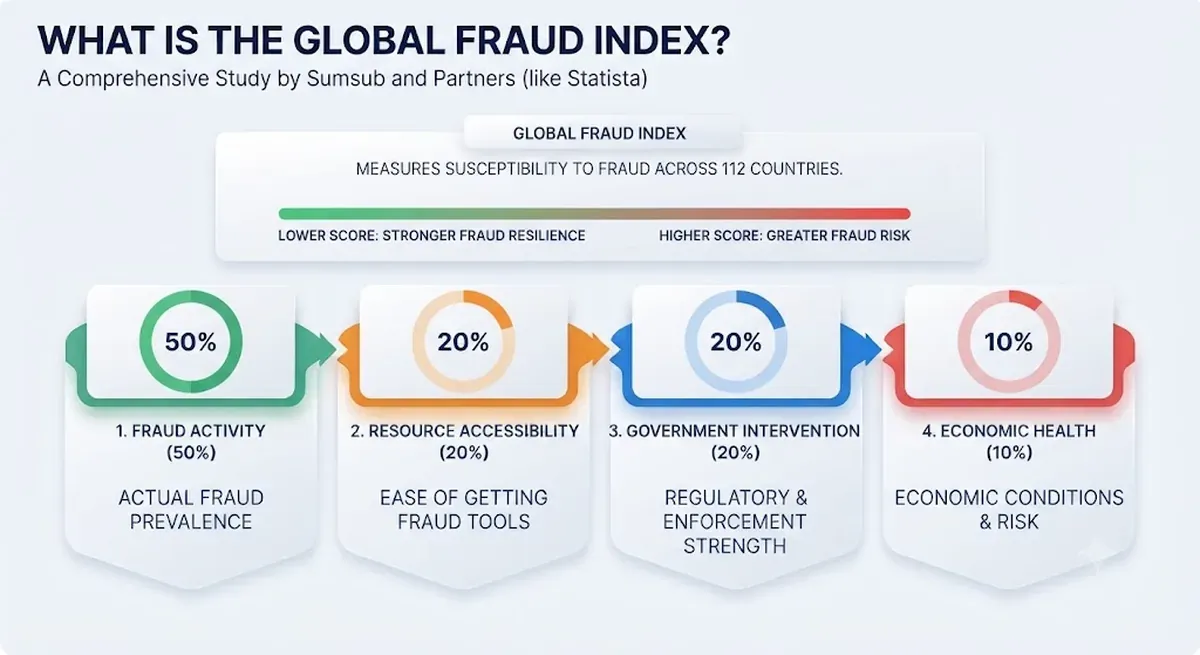
The Global Fraud Index is a comprehensive study by the verification platform Sumsub and other partners like Statista. The platform’s annual composite score stands on four core foundations and measures how susceptible each of the 112 countries is to fraud. A lower score signals stronger fraud resilience, whereas a higher score signals greater fraud risk:
- Fraud Activity (50 per cent): This measures actual fraud prevalence, recorded across Sumsub's verification platform and outside data sources. These are weighted most heavily because they reflect what is happening on the ground right now.
- Resource Accessibility (20 per cent): This shows how easily fraud-enabling tools, stolen data, and fraud-as-a-service infrastructure can be obtained within a country.
- Government Intervention (20 per cent): This pillar reveals the strength of regulation, enforcement, and public-private coordination between agencies and the financial industry.
- Economic Health (10 per cent): This pillar measures economic conditions, including inflation and unemployment. It assesses how these factors can create both incentives and opportunities for fraud within a country.
The index pairs Sumsub's internal verification data, drawn from more than a million checks conducted daily, with external sources including the World Bank, Transparency International, and Oxford Insights.
A side-by-side comparison shows how the scoring actually works. Singapore, ranked 10th overall, scored 1.78 on Fraud Activity, 0.33 on Resource Accessibility, 0.08 on Government Intervention, and 0.31 on Economic Health, for a composite score of 1.36, well below the global average. Argentina, used here as a higher-risk reference point, scored 4.22, 1.56, 0.72, and 0.51 across the same four pillars, for a composite score of 4.05.
The global average score across all four pillars breaks down as follows:
| Metric | Global Fraud Index | Fraud Activity | Resource Access | Govt. Intervention | Health |
|---|---|---|---|---|---|
| Global Average | 2.79 | 2.07 | 1.38 | 0.65 | 0.46 |
| Singapore (Rank #10) | 1.36 | 1.78 | 0.33 | 0.08 | 0.31 |
| Argentina (reference) | 4.05 | 4.22 | 1.56 | 0.72 | 0.51 |
Swipe the table
Because this is a second edition rather than a single snapshot, the score carries more weight than a one-time ranking would. It shows direction, not just position, which is what most searches for global fraud index 2026 are actually after: not where a country sits today, but which way it is headed.
Country Rankings: Most Protected to Most Exposed
Every fraud report eventually gets reduced to a single top 10 fraud country list, and this one is no exception. Here is how the current rankings break down:
| Most Protected Countries (Top 15) | Least Protected (Bottom 10) |
|---|---|
| 1. Luxembourg | 1. Pakistan |
| 2. Denmark | 2. Indonesia |
| 3. Finland | 3. Nigeria |
| 4. Norway | 4. India |
| 5. Netherlands | 5. Tanzania |
| 6. Switzerland | 6. Uganda |
| 7. New Zealand | 7. Bangladesh |
| 8. Sweden | 8. Rwanda |
| 9. Austria | 9. Azerbaijan |
| 10. Singapore | 10. Sri Lanka |
| 11. Slovenia | |
| 12. Israel | |
| 13. Malta | |
| 14. Lithuania | |
| 15. Australia |
Swipe the table
Anyone looking specifically for the top 10 fraud country in the world list will find Pakistan, Indonesia, Nigeria, India, and Tanzania anchoring that group, followed by Uganda, Bangladesh, Rwanda, Azerbaijan, and Sri Lanka. Nigeria, Uganda, and Kenya are new additions to the index this year.
Their low rankings highlight the complex relationship between rapid digitalisation, fraud exposure, regulatory effectiveness, and institutional readiness. However, the index measures a country's vulnerability to fraud, not its population's fraudulent intent.
Why the Rankings Move
Four countries illustrate the four distinct ways a score can shift, and none of them come down to geography alone:
| Country | Movement | What Moved the Ranking | Key Lesson |
|---|---|---|---|
| Singapore | Rank #1 to #10 | Still leads the world in Government Intervention, with best-in-class regulation, compliance culture, and digital infrastructure. But its Resource Accessibility and Fraud Activity scores pulled the overall position down. | Strong governance alone cannot offset weaker performance elsewhere; resilience is multidimensional. |
| Greece | 40th to 23rd | Measurable improvement in fraud controls and enforcement, with tighter coordination between banks and regulators. | A stronger ranking is achievable through deliberate governance investment, not economic luck. |
| United States | 55th to 91st | Remains the global leader in AI readiness, yet fell largely on weaker Resource Accessibility and Economic Health scores. | Leading on one pillar does not guarantee overall resilience. |
| Malaysia | 34th to 86th | Declined alongside deteriorating resource-accessibility and economic conditions. | A strong prior score offers no permanent protection once underlying conditions shift. |
| Senegal | Lowest globally for Resource Accessibility | Fraud-enabling tools and infrastructure remain comparatively easy to access, regardless of the Fraud Activity score alone. | A single weak pillar can anchor a country's risk profile even where fraud activity itself looks moderate. |
Swipe the table
The takeaway for a business expecting a simple geography lesson: resilience depends on multiple systems working together, and a country can lead on one pillar while sliding on the rest.Country intelligence is directional. It shows where structural pressure is building. It does not show which specific transaction, account, or user in front of a business right now is safe.
Fraud's Identity Crisis: The Shift Country Data Cannot Show
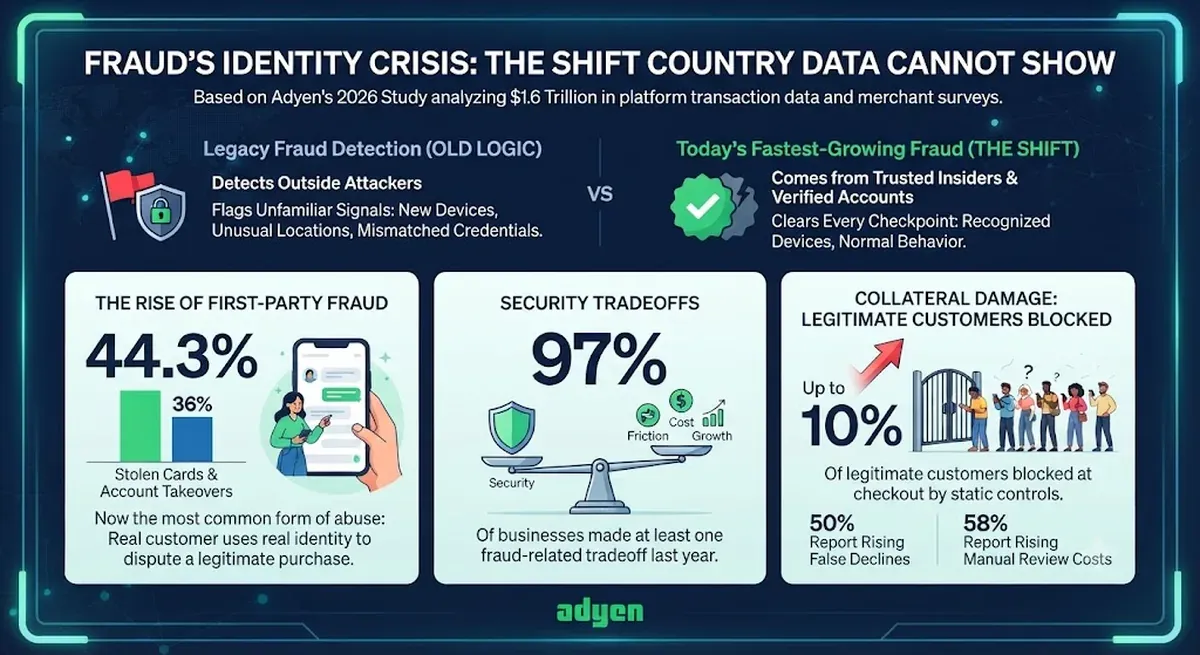
Adyen's 2026 study, Fraud's Identity Crisis, analysed $1.6 trillion in platform transaction data alongside a survey of enterprise merchants, and it points to a shift no country-level index can capture on its own.
For most of the past decade, fraud detection worked on a simple premise: it flags what looks unfamiliar, such as new devices, unusual locations, or mismatched credentials. That logic still detects outside attackers. Today's fastest-growing fraud doesn't trip any of those signals because it comes from verified accounts, recognised devices, and behaviour that clears every checkpoint.
Three figures make the shift concrete:
- 44.3% of businesses now report first-party fraud, where a real customer uses a real identity to dispute a real transaction after the fact, as one of the most common forms of abuse they face, ahead of stolen cards and account takeovers at 36%.
- 97% of businesses made at least one fraud-related tradeoff last year, balancing security against friction, cost, or growth.
- Up to 10% of legitimate customers are now blocked at checkout by static controls, while 50% of businesses report rising false declines and 58% report rising manual review costs.
First-party fraud is not identity theft. The account is real, the user is real, and the transaction is genuine at the point of sale. Mainly, the abuse happens afterwards, through false chargebacks, refund abuse, or promotion abuse. Traditional KYC checks, designed to detect fake identities, cannot flag this pattern because no fake identity is involved. Adyen's platform data shows that just 5% of identities drive 41% of fraud incidents and 58% of total fraud value, exposure concentrated among a small group of repeat abusers rather than spread evenly across a customer base.
The Global Fraud Index explains where fraud resilience is structurally strongest at a national level. Adyen's research explains why that resilience no longer guarantees safety at the transaction level. A country can lead on governance, regulation, and economic stability, but a business inside that same country can still face digital abuse hiding behind trusted identities.
The Organised Crime Layer: What the 2026 Global Fraud Summit Added
The $442 billion figure comes from the Global Anti-Scam Alliance (GASA) Global State of Scams 2025 Report, which surveyed approximately 46,000 adults across 42 countries and extrapolated the results to estimate global scam losses. Later in March 2026, the United Nations Office on Drugs and Crime and INTERPOL convened the first Global Fraud Summit in Vienna, bringing governments, law enforcement, financial institutions, and technology companies together to coordinate a joint response. The summit's findings explain why country-level indices only go so far:
- Organised scam centres: much of today's large-scale fraud runs through operations concentrated across Southeast Asia, particularly the Philippines and Cambodia.
- Multi-crime operations: these same centres also launder money, build malware, and deploy AI-generated deepfakes and cloned voices to impersonate trusted contacts.
- Borders do not contain them: when authorities raid one compound, the network typically relocates rather than disbands, so the criminal infrastructure behind cross-border scams can stay largely intact even while a country's position on a fraud report shifts.
- Two coordinated outcomes: the summit produced a Call to Action on Combating Fraud and a Global Public-Private Partnership Framework against Fraud, both open for governments and businesses to endorse.
- The shared goal: turning political commitments into joint cross-border operations, coordinated prosecutions, and real-time intelligence sharing.
For businesses, the takeaway is clear: fraud evolves faster than regulatory frameworks can adapt. This makes continuous, behaviour-based monitoring essential, enabling organisations to assess risk in real time and respond to emerging threats before they cause significant damage.
What The Shift Means for Businesses
For companies that want to turn these findings into an effective fraud prevention and detection strategy, the shift carries six practical implications:
- Move from geography-based risk to precision-based fraud strategy: Country-level scores set baseline risk, but they do not clear individual transactions. A user from a country near the top of the rankings can still be a fraud risk, and a user from a lower-ranked top 10 fraud country in the world can still be entirely legitimate.
- Shift from one-time verification to continuous identity monitoring: The traditional fraud-detection model may fail at continuous monitoring. But to prevent fraud, modern businesses need continuous signals, scoring behaviour, device, and network relationships throughout a user’s digital lifecycle, not just at onboarding.
- Balance friction against conversion deliberately: With static rules already blocking up to 10% of legitimate customers, businesses need behavioural and device intelligence that distinguishes a suspicious new user from a trusted returning one. This reduces the chances of false flagging.
- Prepare for automated and agentic fraud: Automation and AI have lowered the barriers to entry for fraudsters, enabling fraudulent tactics to be scripted, tested and replicated at scale across coordinated networks. So, fraud losses are increasingly moving to lower-value, high-frequency schemes that can be operated repeatedly, rather than solely on isolated high-value attacks.
- Combine both layers of intelligence: Every top 10 fraud country framework should be seen as a starting point. Combining both the behavioural and device intelligence is more effective at detecting fraud than one approach in isolation. This is particularly the case for businesses that operate across multiple markets with differing regulatory maturity.
- Account for cross-border organised fraud: As highlighted at the 2026 Global Fraud Summit, a significant share of large-scale fraud is driven by organised networks operating across multiple jurisdictions rather than by isolated individuals. This makes network and device intelligence increasingly important, as it can identify connections between accounts, devices, and identities, enabling businesses to detect coordinated fraud activity at a much earlier stage.
Conclusion
Fraud resilience increasingly depends on governance, oversight, and detection precision rather than a country’s geography alone. National indices remain valuable because they highlight emerging structural vulnerabilities and which markets may warrant greater baseline scrutiny.
However, the main intent behind the global fraud index 2026 is to develop a safe list, a high-risk list, or a top 10 fraud country in the world ranking to guide genuine decision-making related to fraud detection and prevention.
A national fraud index provides a valuable view of certain conditions related to the broader risk environment. However, it cannot identify which specific accounts, devices, or identities can pose a threat to a business. Addressing that gap requires combining country-level risk intelligence, continuous identity verification, behavioural analysis, and transaction monitoring that are capable of detecting suspicious and fraudulent activities.
At Sign3, we turn country-level signals and transaction-level behaviour into one continuously updated risk view instead of two separate reports. If you want to see how this works against your own transaction patterns, you can book a demo with us.
Frequently Asked Questions
What are the top 10 least fraud-protected countries in the world?
Pakistan, Indonesia, Nigeria, India, Tanzania, Uganda, Bangladesh, Rwanda, Azerbaijan, and Sri Lanka rank as the ten least fraud-protected countries in the world according to the 2025 Global Fraud Index. Pakistan is currently holding the last place in this list for the second consecutive year.
Has the Global Fraud Index 2026 been released?
No. The most recent edition remains the 2025 Global Fraud Index, published in October 2025 and covering 112 countries. A 2026 edition has not been released officially til the date.
Which country has the most fraud-protection in the world?
Luxembourg ranks first as the country with the strongest fraud protection in the world according to the 2025 Global Fraud Index, followed by Denmark and Finland. Europe has the largest list of countries in the global top 15.
What is first-party fraud?
First-party fraud occurs when a genuine customer uses their own identity to obtain a product, service, or benefit and then falsely denies, disputes, or abuses the transaction for financial gain. Adyen reported it in 44.3% of businesses surveyed, making it the most common form of fraud abuse today.
Why did Singapore's fraud ranking drop despite strong government controls?
Singapore still leads the world in Government Intervention, but its overall position fell because Resource Accessibility and Fraud Activity scores declined.
Does a low Global Fraud Index ranking mean a country's businesses face more fraud?
Not directly. The index is responsible for measuring structural conditions across an entire country, not the fraud exposure of any single business. A highly ranked country can still have many businesses facing significant first-party fraud.


