

Positive Pay is a fraud detection system banks use to identify fraudulent or altered cheques before they clear. Businesses submit lists of issued cheques, including the amount, cheque number, and payee, and the bank automatically matches each incoming cheque to the list through automated cheque verification and transaction matching. The bank flags any mismatch for review rather than clearing it automatically. Positive pay is a simple but proactive layer of protection that moves fraud detection from “after the loss” to “before the payment,” giving businesses real control over what actually leaves their account.
In this guide, we’ll explain how positive pay works, why it matters, and how businesses can use it to stop cheque fraud before it hits their account.
What Is a Positive Pay System?
Positive Pay system is a fraud-prevention service that authenticates a cheque before releasing payment. When a business or individual issues a cheque, they give details of the cheque number, date, amount, and often the payee name to their bank in advance.
When that cheque is presented for payment, the bank's system matches it against the submitted record. If all the details match, the bank clears the cheque. A mismatch gets flagged as an exception item before any money moves.
So what is a positive pay system meant to fix? It closes the window between when a cheque is issued and when it's presented. Fraudsters use this gap to alter, forge, or counterfeit a cheque, creating risks such as cheque alteration fraud, cheque forgery, and unauthorised payment.
How Positive Pay Differs From Manual Reconciliation
Manual reconciliation detects fraud after the cheque clears, when someone reviews the bank statement days or weeks later. By that time, the funds are already gone, and recovery depends on the bank's investigation. Positive Pay moves that verification ahead of settlement. The account holder decides what counts as a match, and the bank enforces that decision automatically, on every cheque, without a human reviewing each one after the fact.
In simple terms
- Positive Pay = Prevent suspicious cheques from being paid.
- Manual Reconciliation = Review and match transactions to confirm the records are accurate.
Having said that, let’s take a look at the differences between the two:
| Feature | Positive Pay | Manual Reconciliation |
|---|---|---|
| Primary purpose | Cheque fraud prevention and payment verification | Bank account reconciliation and transaction review |
| Timing | Before or during cheque clearing, while payment is being presented | Usually after transactions are posted to the account |
| Process | Automated transaction matching against a submitted cheque issue file | Manual transaction matching between bank statements, accounting records, and issued cheques |
| Fraud detection | Flags mismatched cheques as exception items before payment is authorised or released | Identifies discrepancies after reviewing recorded transactions |
| Payment control | Can support a Pay/Return decision on exception items | Does not inherently stop a cheque from being paid |
| Human involvement | Staff review exceptions and approve or return them | Staff perform matching, investigate discrepancies, and resolve differences |
| Main risk addressed | Cheque fraud, cheque alteration, and unauthorised payments | Accounting errors, missing transactions, duplicate entries, and discrepancies |
Swipe the table
The key difference between these two lies in when the verification takes place. Positive Pay mainly acts as a preventive control by validating cheque details before funds are released. Thus, it helps businesses stop fraudulent or altered payments before they are processed. Manual reconciliation, on the other hand, is a detective control that identifies discrepancies after transactions have already been completed. Although both play an important role in financial oversight, Positive Pay adds an extra layer of protection by reducing fraud risk before money leaves the account.
How Does a Positive Pay System Work
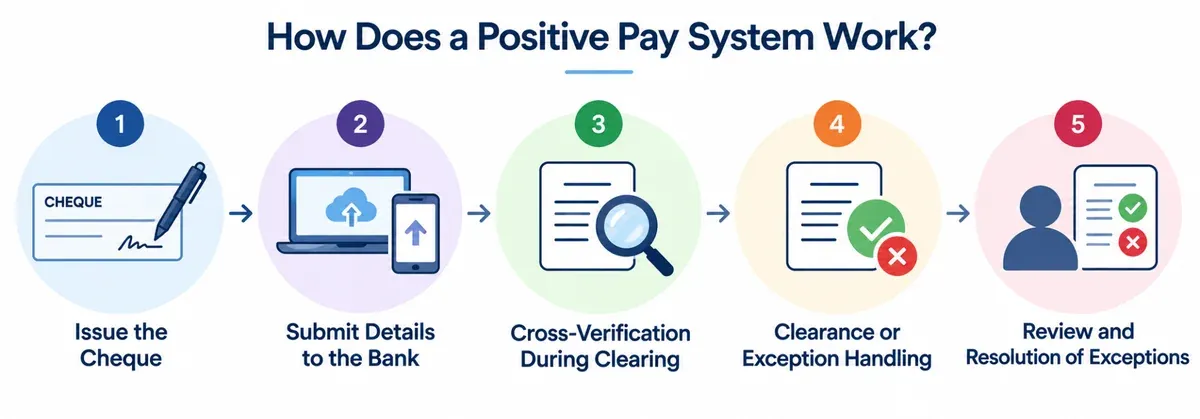
Positive Pay follows a straightforward verification process. Before a cheque clears, the bank compares the cheque details submitted by the issuer with the details on the presented cheque, helping identify discrepancies and reduce fraud risk.
Step 1: Issue the Cheque
The account holder first issues a cheque to the intended beneficiary and records the relevant details, including the cheque number, date, payee name, and amount. These details will later be used for verification during the cheque clearing process.
Step 2: Submit Details to the Bank
Before the cheque is presented for payment, the issuer submits its details to the bank through internet banking, mobile banking, SMS, or another approved channel. This creates a reference record against which the cheque can be verified before further processing.
Step 3: Cross-Verification During Clearing
When the beneficiary deposits the cheque, it enters into the bank’s clearing system. The bank automatically compares the details on the presented cheque with the information that was submitted earlier by the account holder.
Step 4: Clearance or Exception Handling
If all the details completely match after cross-verification, the cheque is cleared, and payment is then processed to the depositor’s account from the issuer’s account. If the bank identifies any discrepancy, such as a mismatch in the cheque number, amount, date, or payee name, the transaction is flagged as an exception, and it may be placed on hold for further verification before funds are released.
Step 5: Review and Resolution of Exceptions
For flagged transactions, the account holder may be asked to review the exception and confirm whether the cheque should be honoured or returned. This additional verification step helps prevent fraudulent, altered, or unauthorised cheque payments.
In simple terms, Positive Pay works by comparing a presented cheque against details submitted in advance by the issuer. By verifying the information before payment is released, the system helps banks detect discrepancies early and reduce the risk of cheque fraud.
Types of Positive Pay
The three main types are standard positive pay, payee positive pay, and reverse positive pay. Depending on the bank's infrastructure, customer requirements, and transaction volume, the verification process can use different models.
Understanding these variations helps businesses choose the level of cheque security and fraud prevention that best aligns with their payment operations and risk profile.
| Type | What It Verifies | Best Suited For |
|---|---|---|
| Standard Positive Pay | Cheque number, amount, and date against the issued-cheque file. Does not verify payee name. | Small and medium-sized businesses that issue cheques regularly and need basic protection against cheque alteration and duplicate presentment without additional verification requirements. |
| Payee Positive Pay | Everything Standard verifies, plus the payee name on the presented cheque against the name on record. | Businesses handling high-value cheque payments, corporate treasury teams, and organisations that require stronger controls to prevent payee-name manipulation and payment fraud. |
| Reverse Positive Pay | The bank sends a daily list of presented cheques; the account holder reviews and approves or rejects each one. No issued-cheque file needed. | Businesses with low to moderate cheque volumes, limited automation capabilities, or those that prefer manual oversight before authorising cheque payments. |
Swipe the table
The right Positive Pay model will depend on the volume of cheques, exposure to fraud, operational resources and level of payment control required by the business. Standard Positive Pay offers basic protection. Payee Positive Pay offers stronger verification. Reverse Positive Pay gives account holders more manual oversight of approval.
How Positive Pay System Detects Cheque Fraud in India
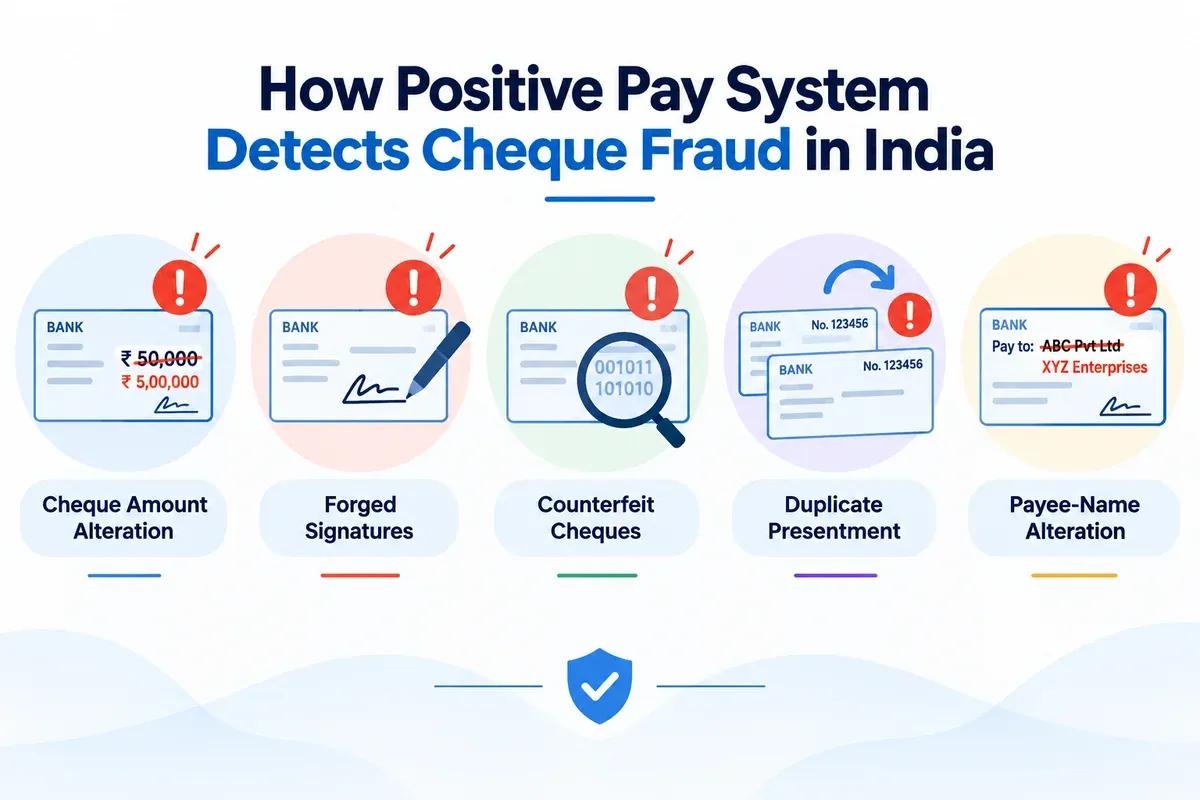
Under the Reserve Bank of India’s (RBI) Positive Pay System (PPS), banks match the details of a presented cheque with the details provided in advance by the account holder. Any mismatch in the cheque number, date, amount or payee details can be identified as an exception. It is put on hold for further verification before funds are released as part of the Cheque Truncation System (CTS) clearing process. It helps Indian banks to detect common types of cheque frauds before fraudulent payments are made.
- Cheque amount alteration: A fraudster intercepts a cheque and alters the amount before depositing it for payment. Since the modified amount does not match the details submitted under the Positive Pay System, the bank can flag the cheque as an exception during the verification process.
- Forged signatures: Positive Pay does not authenticate signatures. However, forged cheques are often accompanied by certain discrepancies in details such as the cheque number, date, amount, or payee name, which can be identified through the matching process.
- Counterfeit cheques: A counterfeit cheque created on the basis of stolen or publicly available account information will not match any valid entry in the issued-cheque record submitted by the account holder. As a result, it can be flagged as a no-match exception during the clearing process.
- Duplicate presentment: If the same cheque is presented more than once, whether due to fraud, operational error, or duplicate deposit attempts, the bank can identify the repeated cheque number and flag the transaction for review.
- Payee-name alteration: A cheque that was initially issued to one payee may be altered to pay another or any other entity. This type of fraud can be detected only when the payee name is included in the verification process, such as under Payee Positive Pay.
What Positive Pay Can Not Detect On Its Own
Positive Pay cannot detect fraud that occurs before a cheque is issued, such as insider fraud or business email compromise (BEC) schemes that trick a company into issuing a legitimate cheque to a fraudulent payee.
Businesses handling large volumes of electronic payments typically complement cheque-based controls with additional ACH Positive Pay, debit-blocking, debit-filtering, and exception-reporting controls for ACH/NACH transactions. These measures apply pre-authorisation, filtering, and exception-based review mechanisms to electronic debits, extending the same preventive philosophy beyond paper cheques.
While Positive Pay helps prevent fraudulent cheques from being cleared, it is only one part of a broader fraud-control framework. Businesses also need timely visibility into cheque mismatches, payment exceptions, and suspicious transaction activity.
At Sign3, we provide real-time risk signals, anomaly detection, and instant alerts, enabling fraud and operations teams to investigate suspicious activity and take action before losses occur.
What Are the Benefits of a Positive Pay System for Businesses
Positive Pay helps businesses reduce cheque fraud risk without adding significant operational overhead. By verifying cheque details before releasing payment, it strengthens payment controls, improves efficiency, and gives finance teams greater confidence in their cheque-processing workflows.
- Reduced exposure to cheque fraud: Positive Pay helps identify discrepancies before funds are released, reducing the risk of losses arising from altered, counterfeit, duplicate, or unauthorised cheque transactions.
- Save time on manual reconciliation: The bank's system does the line-by-line matching. Finance teams review only the exceptions that need a decision.
- Improved fraud-control and audit readiness: Positive Pay demonstrates that a business has implemented certain reasonable payment controls to prevent cheque fraud. By reviewing exceptions promptly and maintaining verification records, organisations can strengthen internal controls, improve audit trails, and reduce the likelihood of approving fraudulent payments.
- Greater efficiency in high-volume cheque environments With the speed and automation of cheque clearing in India’s CTS framework, Positive Pay enables banks and businesses to focus on real exceptions and not manually scrutinising every transaction. This in turn increases efficiency and fraud detection.
How to Implement a Positive Pay System: Step-by-Step Process
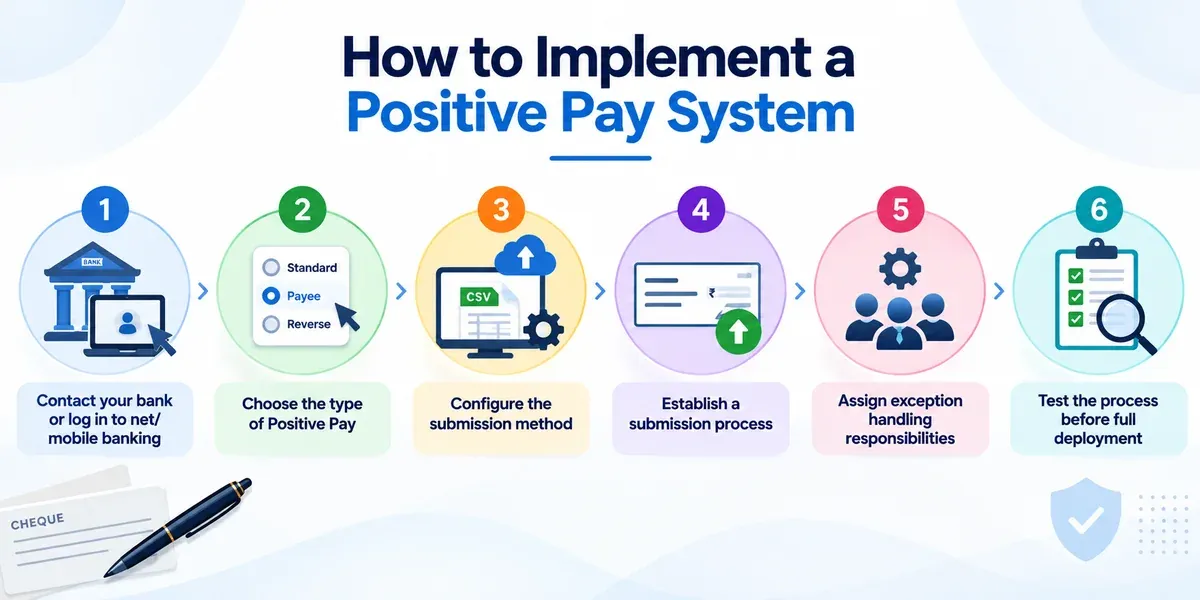
Implementing Positive Pay is usually a simple process, particularly for businesses that currently process cheque payments through online banking or treasury platforms. The exact process will vary from bank to bank, but the basic setup steps are very similar.
Step 1: Contact your bank or log in to net/mobile banking. Positive Pay is typically available through business banking, treasury management, or cash management services.
Step 2: Choose the type of Positive Pay. Select Standard, Payee, or Reverse Positive Pay based on your cheque volume, fraud risk, and operational requirements.
Step 3: Configure the submission method. Depending on the bank, you may upload cheque details via a CSV file, accounting software integration, ERP connection, or a manual entry portal.
Step 4: Establish a submission process. Submit cheque details before presenting the instruments for clearing. Many businesses automate this step through their finance systems.
Step 5: Assign exception handling responsibilities. Designate a team member to review and respond to any flagged mismatches or exceptions within the bank's specified timelines.
Step 6: Test the process before full deployment. Running a small batch of cheques through the system helps identify formatting, workflow, or integration issues early.
Scenario of Positive Pay in India
The Reserve Bank of India (RBI) introduced the Positive Pay System (PPS) in India on January 1, 2021, and the National Payments Corporation of India (NPCI) administers it under the Cheque Truncation System (CTS) architecture. PPS provides the account holder’s bank with vital cheque information, such as the cheque number, date, payee name, and amount, before the cheque is sent for clearing.
Banks must offer the facility for cheques of Rs. 50,000 and above, but many make it mandatory for higher-value cheques, often Rs. 5 lakh and above. When a cheque is presented, the instrument is verified against the submitted details. Any mismatch is flagged as an exception for verification before the cheque continues through the clearing process, helping to reduce the risk of cheque fraud and unauthorised changes.
Limitations of Positive Pay Systems & How Identity Intelligence Helps
Positive Pay is highly effective at detecting altered, counterfeit, duplicate and unauthorised cheques by matching details of cheques presented with records provided by the cheque issuer. However, its scope is limited to cheque verification and does not fully verify and address each stage of the fraud lifecycle.
- Limited visibility over cheque verification. Positive Pay confirms that the cheque details match the record provided, but cannot verify the authenticity of the recipient account or detect suspicious activity that may take place after the cheque is cleared.
- No insight into the deposit side of the transaction. Even if a cheque is verified through Positive Pay, it can still be deposited into an account used for fraud.
- Unable to detect mule-account activity. Mule accounts are often opened with genuine identity documents and used by fraudsters. Positive Pay cannot tell if an account, subject to standard KYC verification, is being used to receive and quickly transfer illicit funds.
- Can’t detect bigger fraud patterns. Positive Pay examines each cheque on a stand-alone basis and does not take into account relationships between accounts, devices or transaction networks that could point to organised fraud.
- Protection against fraud from above is limited. If the business is socially engineered through Business Email Compromise (BEC) or Invoice Fraud to issue a legitimate cheque, then Positive Pay may not perceive the risk, as the details on the cheque itself are valid.
How Identity Intelligence Helps Address These Gaps
While Positive Pay focuses on cheque-level verification, identity intelligence adds much stronger visibility into the people, devices, and accounts involved in a bank cheque transaction.
- Device and behavioural signals fill that gap Device intelligence and behavioural intelligence identify suspicious account activity. Mule accounts frequently show patterns that traditional cheque controls cannot identify, such as multiple accounts opened from the same device or anomalous behavioural signals during onboarding.
- Graph-based analysis uncovers hidden connections By examining relationships between accounts, devices, and transaction activity, graph analytics can reveal patterns that may indicate coordinated fraud networks, mule-account activity, or other forms of organised financial crime.
- Early-stage risk assessment helps detect potential fraud earlier. Analysing identity, device, and behavioural biometric signals during account onboarding or customer interactions can help financial institutions identify higher-risk accounts before fraudulent transactions occur.
Positive Pay is very effective at identifying altered, counterfeit, duplicate and unauthorised cheques, but it only confirms that the cheque matches the details submitted originally. That's why modern fraud prevention strategies combine transaction-level controls such as Positive Pay with stronger identity verification, risk monitoring, and real-time alerting.
At Sign3, we help financial institutions and banks to bridge these gaps through device intelligence, behavioural biometrics, graph analytics, and real-time risk monitoring, enabling teams to identify suspicious activity beyond cheque verification alone.
The Bottom Line
Cheques remain widely used, and therefore, they are highly targeted. Without a control like a positive pay system, this largely remains unverified until the money is already gone. That's what a Positive Pay system is for: moving cheque verification ahead of payment settlement, matching every presented cheque against the issued cheque, flagging mismatched transactions as exception items before funds are released, and giving the account holder the final Pay/Return decision.
Combining Positive Pay with identity intelligence, behavioural analytics, and real-time risk monitoring enables organisations to detect suspicious accounts, identify mule-account activity, and uncover fraud patterns that may otherwise go unnoticed.
If you're evaluating fraud controls for account opening alongside your Positive Pay setup, Sign3's exactly the layer built to strengthen it. Connect with us and see how device, digital-footprint, and behavioural intelligence fit into your existing fraud stack.
Frequently Asked Questions
Is Positive Pay free?
It depends on the bank. Many banks offer basic Positive Pay at no charge for business accounts, while some charge a monthly or per-item fee, especially for Payee Positive Pay. In India, the RBI-mandated Positive Pay System is generally free.
Does a positive pay system stop ACH or NACH fraud too?
No, not on its own. Cheque Positive Pay doesn't cover electronic debits. Businesses handling ACH or NACH volume typically add a separate ACH Positive Pay service that applies the same before-you-pay logic using approved-payee lists and transaction filters.
Who needs Positive Pay?
Any business issuing a meaningful volume of cheques is a reasonable candidate, and the case gets stronger with higher cheque values, limited reconciliation staff, or a prior fraud incident. In India, it's close to a necessity once cheque values regularly cross the Rs. 50,000 to Rs. 5 lakh range, where most banks require it.
What happens if an exception isn't reviewed in time?
Most banks default to returning an unreviewed exception unpaid rather than clearing it. That protects against fraud but can bounce a legitimate cheque if nobody reviews the exception report before the daily cutoff, which is why ownership of that review step matters as much as enrolling in the first place.
Can a fraudulent cheque still get through a Positive Pay system?
Yes, in specific cases. If a fraudster obtains details that exactly match a legitimately issued cheque, for instance, through business email compromise that results in a real cheque being issued to a fraudulent payee, the matching logic won't flag it since every detail genuinely matches. This is why Positive Pay works as one layer of defence, not a complete one.


