

Credit Card Fraud Detection is the process of identifying and preventing any unauthorized use of a card, fraudulent transactions, attempts to take over an account, and other payment fraud activities before they cause financial loss. With the proliferation of digital payments, fraud has gone beyond stolen cards to include identity theft, phishing, and card-not-present attacks.
According to the Reserve Bank of India (RBI), digital payment channels accounted for the highest volume of fraud incidents, constituting 56.5 per cent of the total reported banking fraud cases in FY 2024-25.
Banks and financial institutions need to proactively detect fraud across the life cycle and not just apply rules to users at the time of payment to prevent such incidents. This guide covers the types of credit card fraud, detection signals, methods, and prevention steps that businesses need to have in place in 2026.
Key Takeaways
- No single signal is enough to detect sophisticated fraud tactics. Reliable fraud detection combines device, identity, network, behavioural, and transaction data, not one indicator alone.
- Static rules can catch known fraud; AI-powered fraud detection can catch it at an advanced level. Rule-based systems are fast and auditable but often miss evolving fraud tactics. This is where AI models adapt to new behaviour, but need good data and careful tuning to avoid false declines.
- Fraud may occur even before the transaction takes place. Risk is often triggered during account creation or device enrollment, not just during payment. Systems that only look at payment-time rules may fail to detect fraud at an early stage.
- Each stage of the lifecycle needs its own defense mechanism. Onboarding, login, transaction, payment, and payout each carry different risks, so you can’t apply a single generic rule to cover them all.
- Fraud detection is a risk tolerance decision, not just a technical decision. Too aggressive controls can result in false declines of legitimate customers, loss of trust, and impact on revenue.
What Is Credit Card Fraud?
Credit card fraud is the unauthorised use of a credit card or credit card account to make purchases and obtain money or goods. Today, attacks often start long before the transaction actually happens. These attacks can slip through the cracks during account creation, device enrollment, or login or payment testing, until a chargeback or account takeover forces the business to notice.
A stolen card number is often the last step of a longer trail. Fraud often starts with a fake account, a compromised login, or low-value transactions used to test which cards are still active. That is why effective detection methods now need to work at an advanced level, where the system follows a user from signup through every transaction, not just checks them at checkout.
This shift also reflects how stolen card data is increasingly used in multiple ways. Rather than using a compromised card for a single fraudulent purchase, cybercriminals often test card validity, trade payment credentials through criminal marketplaces, and use coordinated networks to monetise stolen financial information while attempting to evade detection.
What Is Credit Card Fraud Detection?
Credit card fraud detection is the method by which financial institutions, merchants, and payment providers identify transactions, accounts, or activity that show specific signs of fraud before, during, or after a payment is authorized. Credit card fraud detection is one aspect of a broader fraud programme that includes identity verification and control of access.
Modern fraud detection uses real-time transaction monitoring, behavioral analytics, machine learning, device intelligence, and risk-based authentication, rather than a single check, to identify suspicious activity across digital payment channels. This risk assessment helps banks and fintechs to react quickly to fraud and make better decisions.
Impact of Credit Card Fraud On Businesses
Credit card fraud costs a business far more than the money stolen in a single transaction. Here are the impacts of credit card fraud on businesses.
- Direct financial losses: Direct financial losses occur when fraudulent transactions result in chargebacks, refunds, lost inventory, and payment reversal fees. Merchants are frequently liable for fraud-related chargebacks, particularly in card-not-present transactions.
- Higher operational costs: Higher operational costs are another major consequence. Fraud investigations, dispute management, compliance requirements, customer support, and fraud-prevention systems require significant staff time and resources.
- Customer trust and brand reputation: Affecting customer trust and brand reputation can have long-term consequences. Customers who experience fraudulent activity linked to a merchant may become less likely to transact with that business again, affecting retention and lifetime value.
Moreover, credit card fraud is not merely a payment problem; it is a business risk that can erode revenue, increase operating costs, weaken customer trust, and constrain growth if left unchecked.
How Does Credit Card Fraud Detection Work?
Credit card fraud detection works by analysing transaction, device, behavioural, identity, and network signals to estimate risk before approving a payment. Instead of checking a transaction against a single rule, modern systems combine dozens of weak signals into a risk score, then route that score into an automated decision. However, the process itself follows a consistent flow from the moment a transaction is initiated to the final decision:
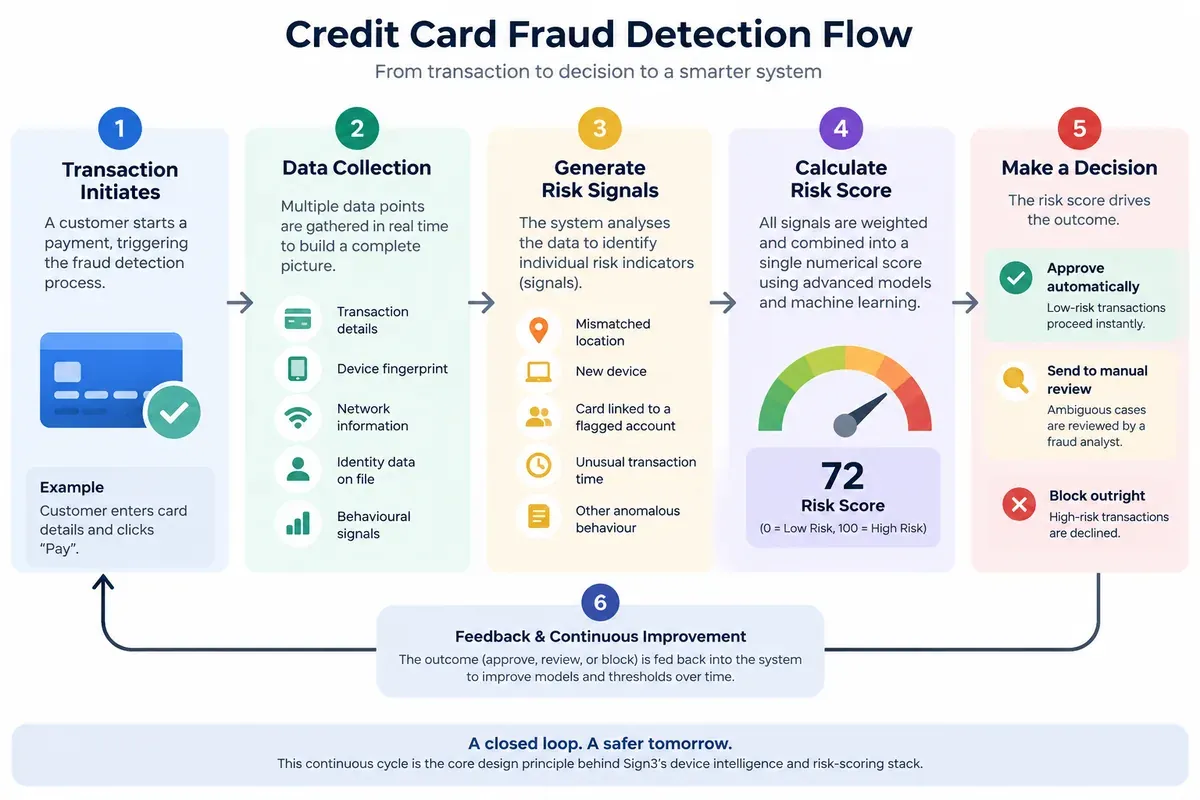
A transaction initiates the process, triggering data collection such as transaction details, device fingerprint, network information, identity data on file, and behavioural signals gathered during the session.
That raw data shows risk signals, such as a mismatched location, a new device, or a card previously linked to a flagged account. The system combines these signals into a risk score that measures fraud risk.
Once calculated, the score helps determine whether to approve, review, or block the transaction. The final score is sent back into the system, so fraud detection models set certain thresholds that adapt over time rather than relying on static rules.
This closed loop, from transaction to decision to feedback, is the same design principle behind our device intelligence and risk-scoring stack.
Types of Credit Card Fraud
Card-not-present, Account takeover, card skimming, and identity theft are multiple types of credit card fraud. RBI reported 13,516 card/internet fraud cases in FY 2024–25, highlighting the continued scale of fraud targeting digital payment channels. However, the actual fraud type a business faces depends on its industry, sales channel, and onboarding flow. Below, we explain the categories to consider.
1. Card-Not-Present (CNP) Fraud
CNP fraud is a stolen card number used for an online or phone purchase without the physical card present. With no chip or PIN to verify, detection relies on data signals: billing address match, device history, IP reputation, and checkout behaviour.
For example, a fraudster runs twenty stolen card numbers through checkout using one-dollar transactions to find which cards are still active before attempting larger purchases elsewhere; the exact pattern of transaction velocity and device signals is built to expose it.
Because CNP fraud produces no physical evidence, merchants must bear chargeback liability in most disputes, which is why detection at this stage carries a direct financial burden for organisations.
2. Account Takeover (ATO)
Account takeover (ATO) occurs when a fraudster gains access to a legitimate account, usually through credential stuffing, phishing, or a data breach, and then makes purchases with stored payment methods or changes account details to redirect funds.
Example: a returning customer's account logs in from a new country through a TOR exit node, immediately followed by an attempt to add a new shipping address and place a large order. A new login location alone isn't unusual; the combination, anonymising network, device change, and account edit in one session is what makes it much more flag-worthy.
ATO is also harder for a customer to notice quickly, since the fraudster is operating inside a trusted account rather than presenting a new one.
3. Card Skimming
Skimming captures card data at the point of physical use, such as compromised ATMs, gas pumps, or POS terminals. Criminals may then use the stolen information to create counterfeit cards or sell it through marketplaces, where it can support additional fraudulent activity, including card-not-present (CNP) transactions.
As a result, the same fraud ring may be linked to both card skimming and online fraud, even months after the original theft.
4. Identity Theft
Identity theft uses a real person's stolen personal information such as name, date of birth, and government ID to open new credit lines or take over existing accounts. It's often the upstream source of both application fraud and account takeover, which is why identity verification at onboarding matters.
Effective identity verification helps stop fraudulent accounts before they are created.
5. Application Fraud
Application fraud uses stolen or fabricated identity data to open a new card account. This includes true-name fraud, where a real person's identity is used without their knowledge, and synthetic identity fraud, where fabricated elements are combined with a real, often stolen, identifier such as a Social Security number.
Synthetic identities are typically built to pass basic verification checks on the first attempt, which is why they tend to surface later, once linkage signals connect them to other flagged accounts.
6. Phishing
Phishing is the social engineering step that often precedes other fraud types. Fraudsters impersonate banks, merchants, or delivery services to extract card numbers, one-time passwords, or login credentials, which then feed directly into account takeover or CNP fraud.
Because phishing exploits trust rather than a technical gap, no detection signal on the business side can prevent the initial compromise, but device and behavioural signals can still flag the fraudulent activity that follows it.
7. Transaction Fraud
Transaction fraud is the broad category covering any unauthorised use of card credentials to complete a purchase or transfer, regardless of how the credentials were obtained. While it is the stage where financial loss becomes visible, the underlying compromise often occurs much earlier through methods such as phishing, account takeover, credential theft, or card skimming.
Credit Card Fraud Detection Methods
Credit card fraud detection methods include multiple models, such as rule-based detection, velocity checks, device intelligence, geolocation analysis, AI models, etc., that feed into a decision. Most modern systems use several methods together rather than relying on any one.
1. Rule-Based Detection
Rule-based systems flag transactions violating predefined conditions: a purchase above a set amount, a transaction from an unusual country, or a card used more than a set number of times per hour. The detection method requires regular manual updates as new fraud tactics emerge.
2. Velocity Checks
Velocity monitoring tracks how often a card, device or account is used in a period of time. Aggressive velocity rules can cut losses but may also turn away legitimate customers during high-volume times like holiday shopping, when the typical behavior might look like fraud for a short period of time.
3. Device Intelligence
Device intelligence also tracks devices across sessions and accounts, meaning a single device working multiple fraudulent accounts can be identified. Device intelligence links activity across devices and accounts, uncovering fraud patterns you might not see with single transaction checks.
4. Geo-location analysis
Geolocation checks compare the location of a transaction with the cardholder’s normal location and billing address, flagging any mismatches that suggest the card is being used somewhere the holder is unlikely to be, especially when combined with a mismatched shipping address.
5. Behavioural Analytics
Behavioural analytics builds a baseline of how a genuine user typically interacts with an account, then flags sessions that deviate from it, even when every individual data point, such as card number, address, and device, looks technically valid when assessed in isolation.
6. Risk Scoring
Risk scoring combines device, identity, network, behavioural, and transaction signals into a single numerical score that drives an automated decision. This mechanism turns dozens of weak individual signals into one actionable output that a system, rather than a person, can act on in real time.
7. AI Models
AI-based fraud detection models learn patterns from historical fraud data and adapt as tactics change, rather than depending on a fixed rule set a ring can eventually learn to evade.
Rule-based and AI-based methods are often framed as competitors, but the more useful question is where each fits.
| Factor | Rule-based detection | AI-based detection |
|---|---|---|
| Setup speed | Fast to configure | Requires historical data and training |
| Adaptability | Static; needs manual updates | Learns and adjusts to new fraud patterns |
| Explainability | Easy to audit and explain | Harder to explain individual decisions |
| False positives | Higher, especially at scale | Lower once properly tuned |
| Best suited for | Known, well-defined fraud patterns | Evolving, high-volume fraud environments |
Swipe the table
The most sophisticated fraud detection strategies combine rules-based controls with machine learning algorithms. Rules give quick decisions on known fraud patterns, and models find relevant relationships and anomalies that rules would miss or flag as a false positive.
Common Credit Card Fraud Indicators & Red Flags
Common credit card fraud indicators and red flags include unusual transaction patterns, multiple failed payment attempts, new devices, shipping and billing mismatches, suspicious login activity, and behavioural signals that may indicate account takeover, card testing, or stolen card use. However, they don't justify an automatic decline on their own, but raise a session's risk score.
| Indicators | What It Often Signals |
|---|---|
| New device plus new shipping address | Possible account takeover |
| Multiple failed card attempts in quick succession | Card testing |
| Billing and shipping address in different countries | Elevated CNP fraud risk |
| Account created and transacting within minutes | Bot-driven or synthetic account |
| Sudden change in typical purchase amount | Compromised account or stolen card |
| Login from a network previously linked to fraud | Credential stuffing or ATO attempt |
Swipe the table
No single indicator should result in an automatic decline on its own. When combined together, the indicators develop the risk score and drive the final decision in most effective fraud detection systems.
Beyond these behavioural red flags, certain individual signals point directly to a specific fraud type, which helps prioritise which category of defence to invest in first.
| Signal | Fraud Type Detected |
|---|---|
| VPN or proxy usage | Location spoofing, geo-restriction evasion |
| Emulator or rooted device | Bot-driven account creation, automated card testing |
| Shared device across accounts | Multi-accounting, synthetic identity rings |
| Device and billing location mismatch | Account takeover, stolen card use |
| Scripted, uniform session behaviour | Bot activity, credential stuffing |
| Rapid low-value transactions across merchants | Card testing |
Swipe the table
Shared-device signals deserve particular attention: they connect data points across accounts, devices, payment methods, or identity fragments that otherwise appear unrelated. For example, multiple accounts may be linked to the same device fingerprint despite using different names, addresses, or payment details. While each account may appear legitimate on its own, the shared device connection can reveal coordinated fraud activity.
How AI & Machine Learning Detect Credit Card Fraud
Machine learning and artificial intelligence detect credit card fraud by analyzing previous transaction and fraud data. Machine learning and artificial intelligence help identify fraud patterns that rules and manual review often miss, improving real-time detection accuracy. Let’s take a look at how they work.
- Traditional rules trigger a fraud alert when a condition is met, but machine learning algorithms look at dozens of variables simultaneously. These include transaction amount, location, device attributes, account age, spending behavior, and login patterns. These data combine to produce a real-time fraud risk score.
- The AI models learn from both good and bad transactions, and can spot unusual activity and new fraud trends that the pre-set rules have not yet caught up with.
- It is capable of processing large volumes of transactions in milliseconds. This enables real-time fraud prevention to a scale that manual review teams simply cannot provide.
However, AI and machine learning should not operate as the sole decision-maker. An overly permissive fraud detection model may approve fraudulent activities, while an overly sensitive model can incorrectly decline legitimate customers and reduce conversion rates. For this reason, mature fraud prevention programmes combine machine learning with explainable rules, device intelligence, identity verification, and human review workflows where necessary.
Read more: AI Fraud Detection: The Complete Guide for Banks & Fintechs in 2026
Role of Device Intelligence in Card Fraud Detection
The role of device intelligence in credit card fraud detection is not just identifying who is transacting, but what they are transacting from, and whether that device has behaved unusually before.
- It starts with device fingerprinting, collecting hardware, operating system, browser, and configuration attributes into a signature that persists even if a fraudster clears cookies or switches networks.
- A device's reputation builds over time. A phone or browser fingerprint tied to three prior chargebacks carries risk into every new account it touches, regardless of what name or card number is attached this time.
- Pairing that with IP intelligence that flags proxies, VPNs, and known data-centre ranges closes a gap identity checks alone cannot: a stolen identity can pass a document check, but a device with a fraud history is harder to cover.
- Device velocity adds another layer, tracking how many accounts or cards a single device has touched within a given window. One device opening twelve accounts in an hour is a stronger fraud indicator than any single account looking suspicious on its own. It is exactly the kind of cross-account pattern that isolated, per-transaction rules were never designed to detect.
As fraud becomes more coordinated, analysing relationships across accounts and devices is increasingly important for effective detection.
How Behavioural Biometrics Helps Detect Card Fraud
Behavioural biometrics helps detect credit card fraud by checking certain signals or patterns that genuine users develop due to habit. It is next to impossible for fraudsters to replicate someone else's habits convincingly, even with a stolen card and a clean device.
- A behavioural model builds a baseline for how a specific user typically logs in, types, scrolls, and moves through checkout, then flags sessions that drift from it.
- Login behaviour is the first layer: typing speed, the sequence of screens visited before entering payment details, and how quickly a user moves from login to checkout.
- A session that jumps straight to the payment page in under three seconds, skipping the browsing pattern a real returning customer usually shows, is a signal worth weighing even if the card and address both check out.
- Transaction timing matters too. A cardholder who has never made a purchase after midnight suddenly placing three orders at 2 a.m. does not automatically mean fraud, but it raises the risk score enough to warrant a closer look alongside other signals.
Behavioural biometrics is valuable because it detects patterns of user behaviour that static data cannot. A stolen card number, valid billing address, and recognised device may appear legitimate, but the user's behaviour can differ noticeably from that of the genuine account holder.
Credit Card Fraud Detection for Banks, Fintechs & Merchants
Credit card fraud detection for banks, fintechs and merchants is not a one-size-fits-all discipline. Banks, fintechs, and merchants face different fraud risks, operate with different levels of visibility into customer behaviour, and make decisions at different stages of the payment lifecycle.
| Segment | Main Challenge | Detection Focus | Why It Matters |
|---|---|---|---|
| Banks & Card Issuers | Fraud across the customer lifecycle. | Onboarding, login, transaction monitoring, and behavioural analysis. | Banks need broad visibility and must often justify why a transaction was flagged for compliance and regulatory requirements. |
| Fintechs | Limited history for new users. | Device intelligence, identity verification, and onboarding risk checks. | Behavioural and transaction-based patterns may not yet exist, making early-stage signals more important. |
| Payment Processors & Gateways | Fraud spread across multiple merchants. | Cross-merchant monitoring and fraud-ring detection. | Processors can identify coordinated fraud activity that individual merchants may not see. |
| E-commerce & Marketplaces | Card-not-present fraud and chargebacks. | Checkout screening, device checks, address verification, and velocity monitoring. | Fraud decisions often need to be made instantly at checkout to prevent losses and chargebacks. |
Swipe the table
Effective fraud detection depends on context. The same signals can produce different outcomes depending on the business model, customer journey, and fraud risks involved.
Credit Card Fraud Detection vs Credit Card Fraud Prevention
Although the terms are often used interchangeably, fraud detection and fraud prevention serve different purposes. Prevention focuses on stopping fraudulent activity before it occurs, while detection identifies suspicious activity that has already happened or is in progress. Most effective fraud strategies combine both approaches to reduce losses and respond quickly to emerging threats.
The table below highlights the key differences between credit card fraud detection and credit card fraud prevention.
| Factor | Fraud Detection | Fraud Prevention |
|---|---|---|
| Timing | Identifies fraud as or after it happens | Stops fraud before it can occur |
| Primary tools | Risk scoring, anomaly detection, monitoring | Identity verification, access controls, policy design |
| Focus | Reactive, transaction and account level | Proactive, systemic and process level |
| Example | Flagging a suspicious login for review | Requiring device binding at account creation |
Swipe the table
The two are complementary and work together across the entire payment lifecycle rather than at a single point. Strong detection tells a business what is happening in real time while strong prevention reduces how often detection needs to intervene in the first place.
How to Prevent Credit Card Fraud
Prevention reduces the attack surface before detection has to make a decision. The steps below reduce exposure most directly, in the order a business should implement them.
- Verify identities during onboarding: Strong identity checks help prevent application fraud and synthetic identities before accounts are created.
- Link accounts to trusted devices: Device intelligence can detect suspicious account activity and expose coordinated fraud attempts.
- Use step-up verification for high-risk actions: Require additional authentication only when risk is elevated, such as during password resets or payment method changes.
- Apply risk-based friction: Introduce verification selectively to reduce fraud without disrupting legitimate users.
- Monitor activity continuously: Review onboarding, login, account changes, and transactions rather than focusing only on payments.
- Use risk scoring: Combine device, identity, behavioural, network, and transaction signals to make more accurate fraud decisions.
As fraud tactics continue to evolve, businesses that combine proactive prevention with continuous monitoring are better positioned to reduce losses and protect customer trust.
Credit Card Fraud Detection Challenges in 2026
Credit card fraud detection challenges in 2026 have become increasingly complex as fraudsters use more sophisticated tactics, including deepfakes, AI-powered attacks, synthetic identities, and organised fraud rings. These evolving threats are making traditional rules less effective, and convincing banks and financial institutions to adapt fraud intelligence network.
- Deepfakes: AI-generated video and audio can bypass identity verification processes that rely on liveness checks or video authentication.
- Synthetic identities: Fraudsters combine real and fabricated information to create identities that pass basic verification but do not belong to a real person.
- Fraud rings: Organised groups use automation to create accounts, test stolen card data, and coordinate activity across mule accounts, making fraud harder to trace and disrupt.
- AI-powered attacks: Fraudsters increasingly use AI to generate fake documents, automate attacks, and identify weaknesses in fraud controls.
- Rising false positives: Stricter controls can block legitimate customers, creating friction, lost revenue, and poor user experiences.
- Evolving fraud tactics: Fraud patterns change quickly, requiring continuous monitoring, model updates, and rule optimisation.
As fraud becomes more sophisticated, organisations need fraud detection systems that can analyse device, identity, behavioural, network, and transaction signals together rather than relying on static rules alone.
Credit Card Fraud Detection Best Practices
Credit card fraud detection best practices include multiple steps. From combining certain signals like device, behaviourial, and network data to investing in linked accounts detection, the best practices involve reducing fraud losses and achieving the right balance between security and a seamless customer experience.
- Combine multiple signals such as device intelligence, behavioural biometrics, and network data, instead of relying on one. No single data point, including transaction amount, is reliable enough on its own to justify a block.
- Applying risk assessment logic at each lifecycle stage is necessary. Onboarding, login, transaction, and payout need logic tuned to that stage, not one generic rule set applied everywhere.
- Use rules for known patterns, models for the rest. Rules handle clear, well-understood patterns efficiently; models handle the ambiguous cases rules can't anticipate.
- Track false positives as closely as losses. A programme that only measures fraud caught, without also measuring legitimate customers declined, will eventually optimise itself into a conversion problem.
- Reassess velocity thresholds periodically. Static rules that are tuned for a normal month may not deliver the same results during peak events.
- Invest in account linkage detection. A system evaluating every account in isolation will miss the pattern connecting them.
How Businesses Can Build a Credit Card Fraud Detection Strategy
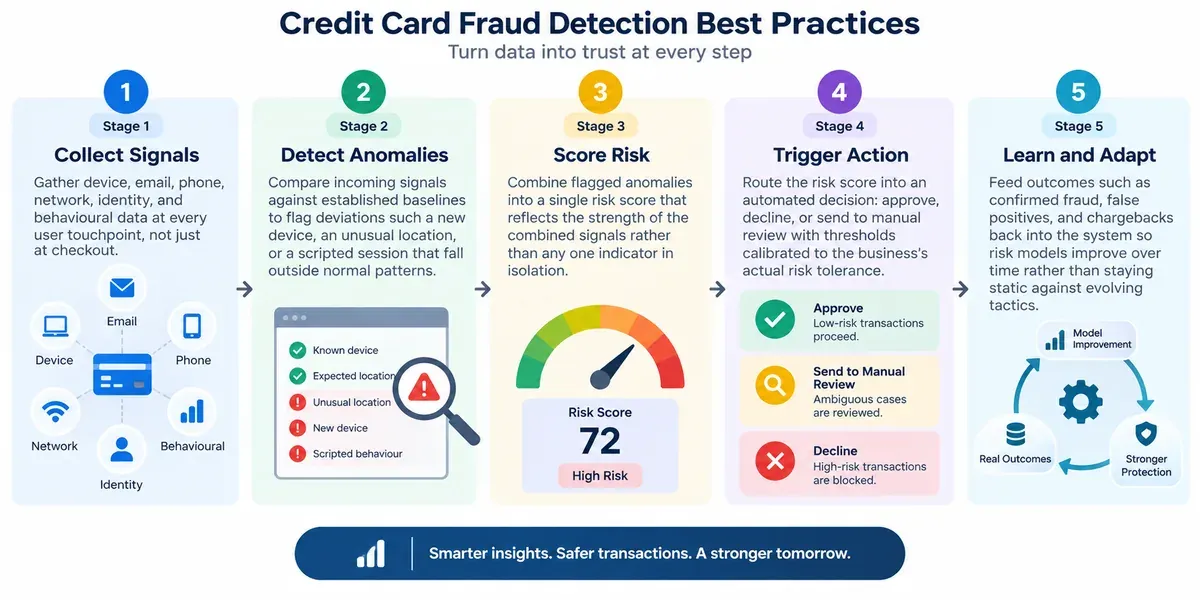
A structured framework is necessary to build a credit card fraud detection strategy. Below are the five stages that a business can follow to assess whether a fraud programme covers the full lifecycle or only reacts at the payment stage.
Stage 1: Collect Signals
Gather device, email, phone, network, identity, and behavioural data at every user touchpoint, not just at checkout.
Stage 2: Detect Anomalies
Then compare incoming signals to established baselines and flag deviations such as a new device, an unusual location, or a scripted session outside normal patterns.
Stage 3: Risk Score
Flagged anomalies are combined into a single risk score that reflects the strength of the combined signals rather than any single indicator alone.
Stage 4: Trigger Action
Feed the risk score into an automated decision (approve, decline, or send to manual review) with thresholds tuned to the business's real risk appetite.
Stage 5: Learn and Adapt
Reflect outcomes like confirmed fraud, false positives, and chargebacks back into the system so risk models improve over time instead of being static against evolving tactics.
Conclusion
Credit card fraud has become sophisticated enough that a single rule set at checkout is not enough. Fraud rings now operate across the entire customer journey, testing weaknesses at onboarding, exploiting stolen credentials at login, and structuring transactions to look ordinary at the payment stage.
Modern fraud detection requires continuous monitoring and thorough assessment across the customer lifecycle. This works by combining device, identity, behavioural, network, and transaction signals to identify risks early and reduce false positives.
Sign3 helps banks, fintechs, and merchants detect fraud across onboarding, login, and transactions through device intelligence, behavioural analytics, and real-time risk scoring, helping stop fraud before it becomes a chargeback. Book a demo with us and see how our fraud intelligence platform works in action.
FAQ
What is credit card fraud detection?
Credit card fraud detection is the process of analysing transaction, device, behavioural, identity, and network signals to identify and stop fraudulent activity before, during, or after a payment is authorised.
What is credit fraud detection?
Credit fraud detection is the broader approach that is used to identify fraudulent use of credit accounts and card data, spanning application fraud, account takeover, and transaction-level fraud.
What is the difference between fraud detection and fraud prevention?
The difference between fraud detection and fraud prevention lies in how they work. Detection helps catch fraud after it happens using a risk score, while prevention stops fraud before it happens through identity verification and access controls.
How does AI improve fraud detection?
AI models learn from historical fraud data and adapt as tactics evolve, allowing them to spot subtle or fast-changing patterns that static rules may miss, but they require ongoing tuning to prevent false declines.
What is card-not-present fraud?
Card-not-present fraud occurs when stolen card data is used for an online or phone transaction without the physical card present, relying on device, behavioural, and address signals for detection instead of a chip or PIN.
How do fraud rings evade basic detection systems?
Fraud rings spread activity across many accounts and devices, so systems that review each account individually may fail to flag the account for review. The fraud rings deliberately make individual transactions and accounts appear normal. Linkage signals map shared devices, phone numbers, or emails that link the accounts together to show the connection pattern.
Why do legitimate customers sometimes get declined?
Overly aggressive rules or poorly tuned models can flag normal but unusual behaviour; a first-time large purchase or a trip abroad is considered fraudulent activity. This is why false-positive rates matter as much as detection rates.
What is the fraud lifecycle?
The fraud lifecycle describes the stages a fraudulent user or transaction moves through: onboarding, login, transaction, payment, and payout, each carrying a different risk profile and requiring different logic.


