

1. When '94% Accurate' Isn't Good Enough
A major bank's AI model flags 12,000 transactions as suspicious. Accuracy: 94%. But when the compliance team asks why transaction #7,401 was blocked, the model goes silent. The risk officer can't justify the decision. The regulator is unsatisfied. The customer is furious.
This is not a hypothetical. It plays out across Indian banks, NBFCs, and fintech platforms every single day. The industry optimised for accuracy and forgot about explainability.
"A fraud model that cannot explain itself cannot be trusted, audited, or improved. Explainability is not a luxury, it is infrastructure.".
At Sign3.ai, we believe powerful fraud detection and transparent decision-making are not mutually exclusive, they are the same thing, done right. This article explains why explainable AI in fraud detection is now a regulatory imperative, a risk management necessity, and a competitive edge for every institution operating in India's digital financial ecosystem.
2. The Fraud Landscape in 2025: Why AI Is Non-Negotiable
Financial fraud has outgrown rule-based systems. The scale is staggering and accelerating. Sign3.ai's platform processes over 50 million risk signals monthly across UPI, lending, BNPL, and account onboarding.
These numbers show why AI is no longer optional:
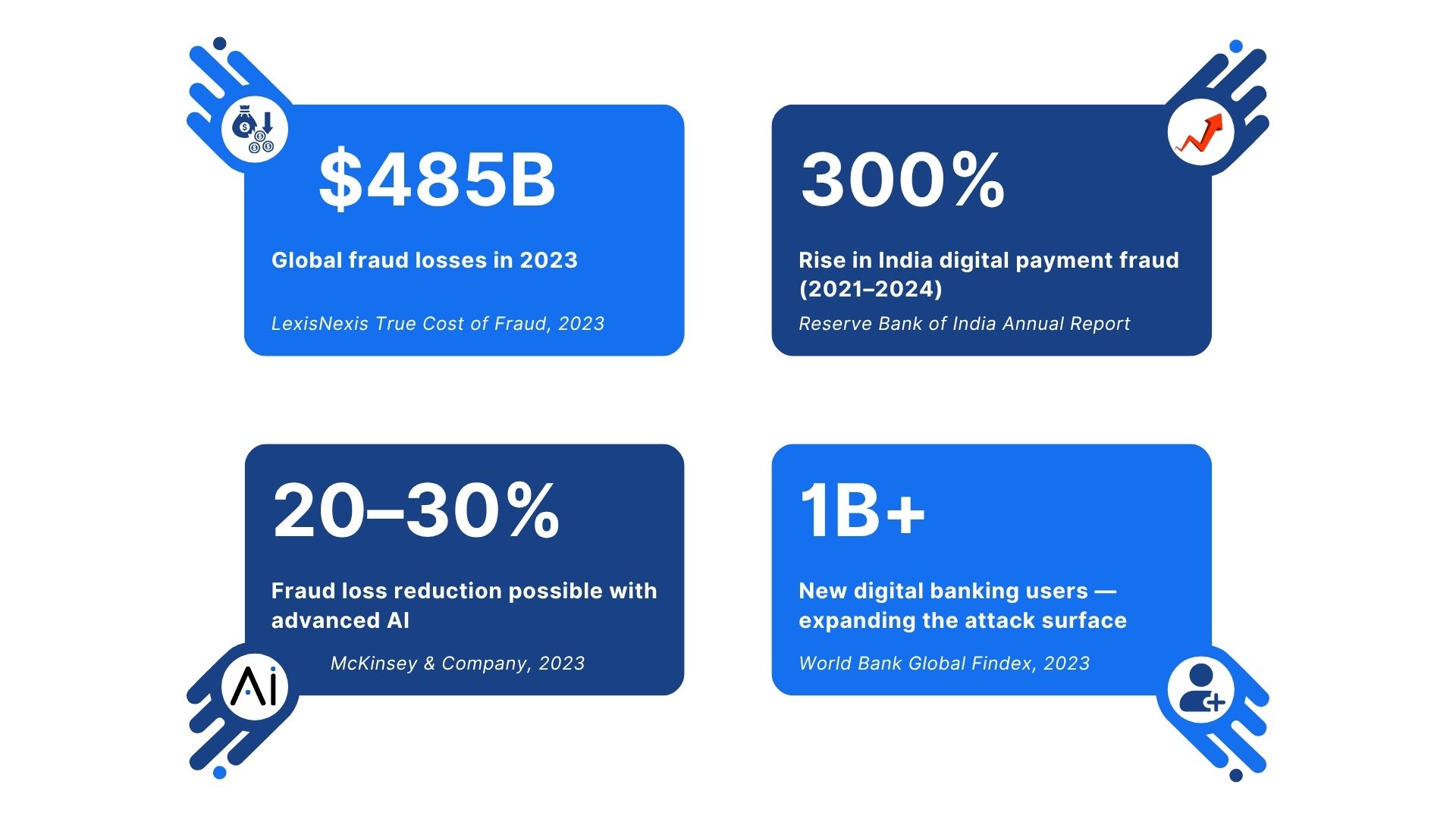
AI fraud detection models — trained on behavioural signals, device fingerprints, transaction velocity, and network graphs — catch patterns invisible to human analysts. But speed and accuracy alone are not enough. The next question regulators and boards are asking is: can your AI explain itself?.
3. The Black-Box Problem in Banking AI
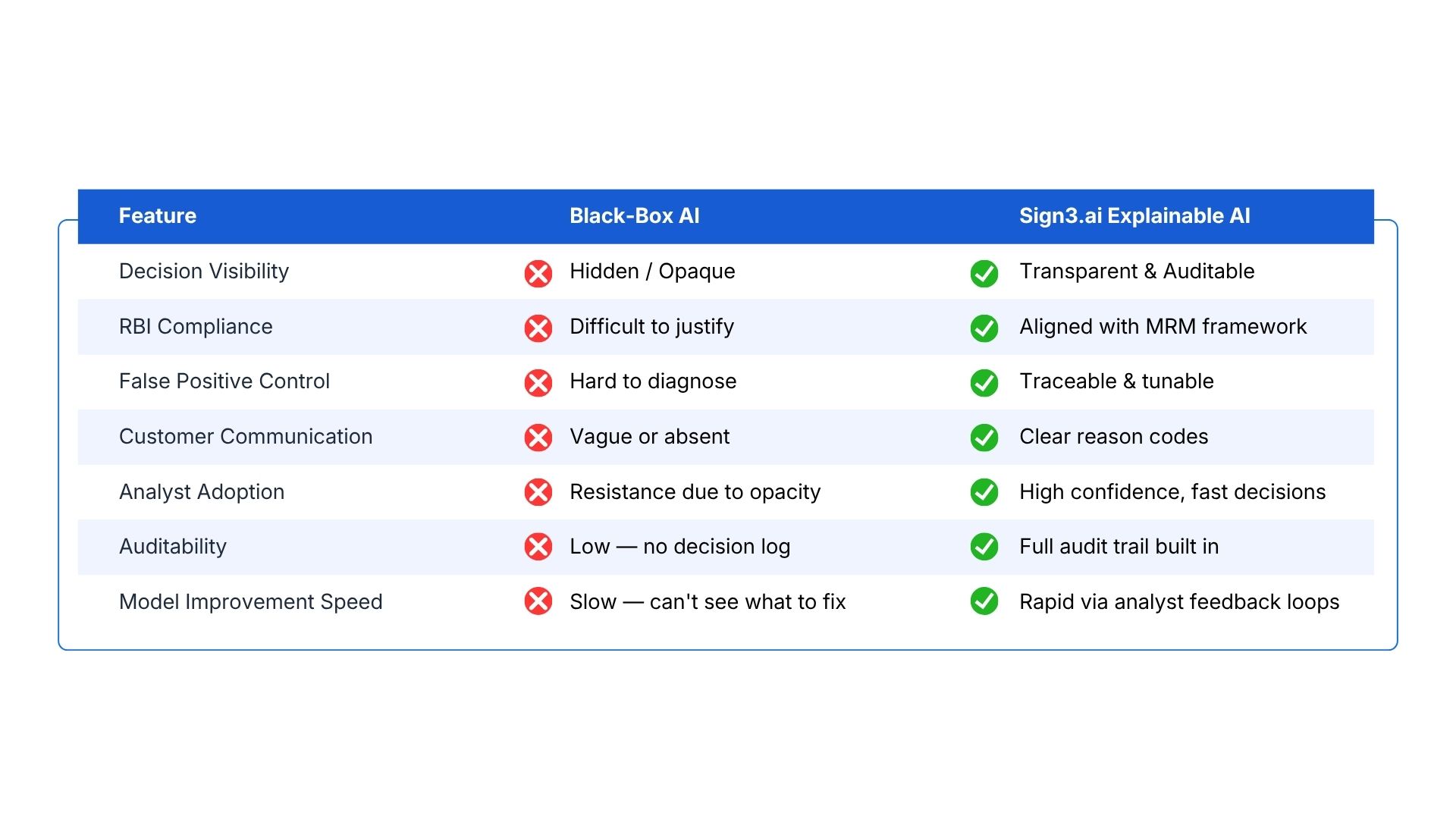
Most first-generation fraud AI relied on deep neural networks, powerful pattern matchers, completely opaque. A risk score emerges. No one knows why.
This creates three critical institutional failures:
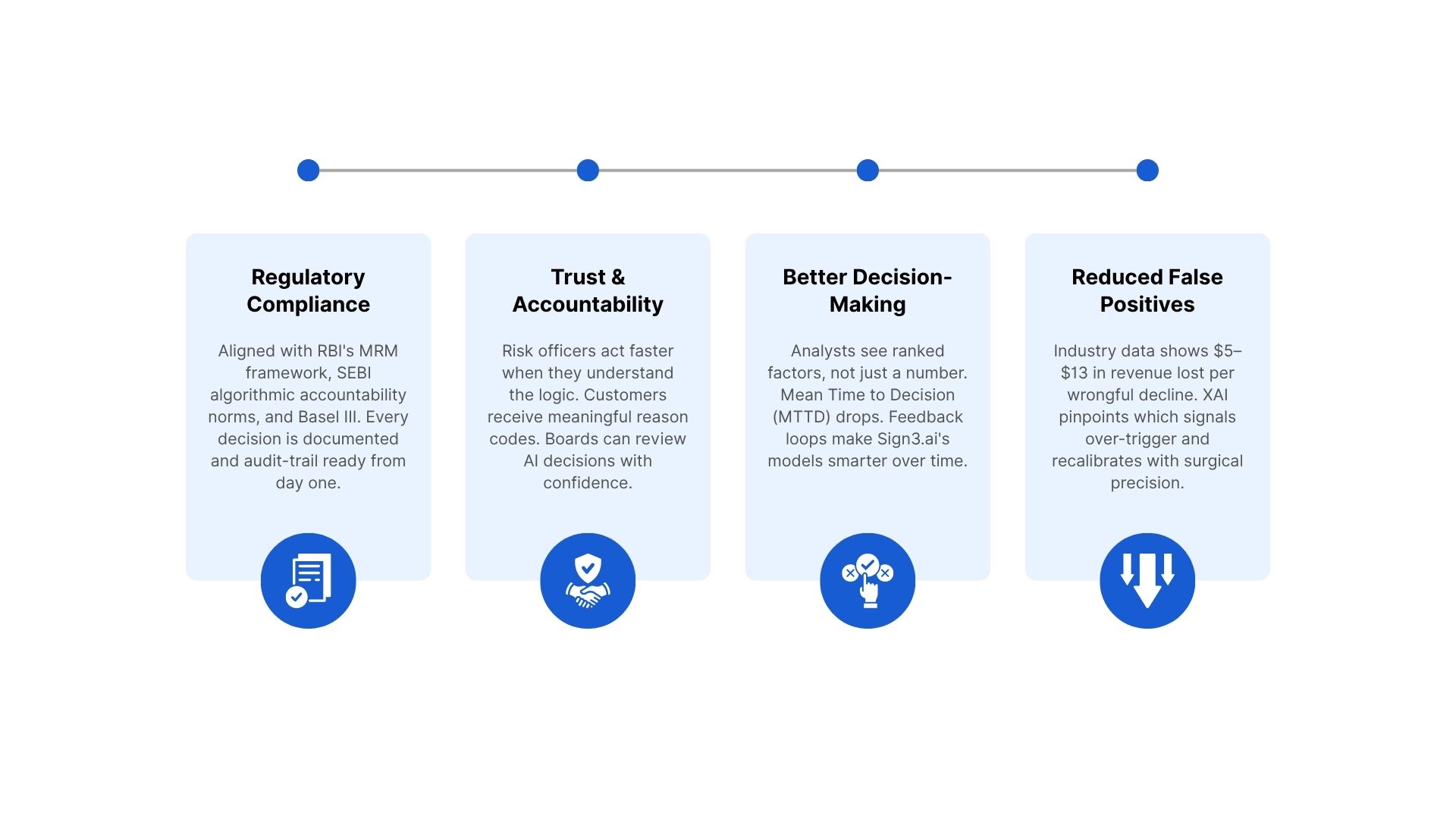
Regulatory Non-Compliance: RBI's Model Risk Management (MRM) framework, SEBI's algorithmic accountability norms, and Basel III all require institutions to document and justify automated decisions. A model that cannot explain itself cannot be compliant.
Operational Blind Spots: When a model spikes false positives — blocking legitimate customers — risk teams have no way to diagnose the root cause. Each unexplained error erodes customer trust and operational efficiency.
Adversarial Vulnerability: Fraudsters continuously probe and adapt. A model its own operators cannot understand is impossible to harden against novel attack patterns — a dangerous asymmetry between defenders and attackers.
4. What Is Explainable AI (XAI)? A Plain-Language Definition
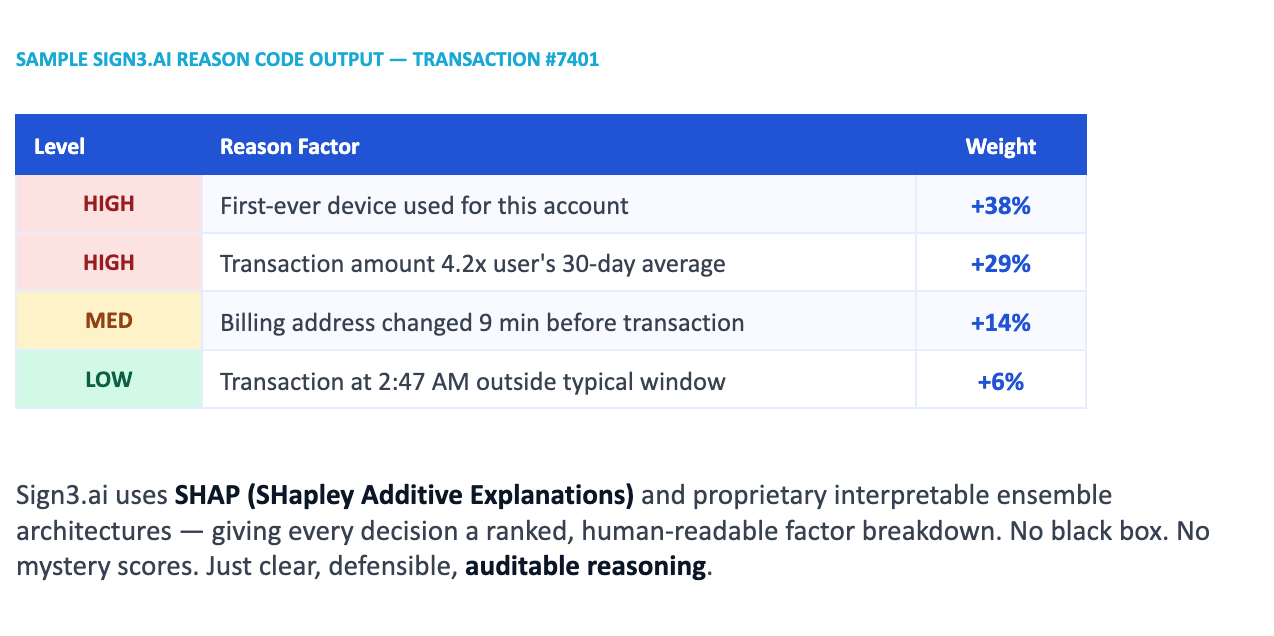
Explainable AI (XAI) doesn't just give you a score — it tells you why. In practice, a Sign3.ai XAI fraud model doesn't just say 'Risk: 87.' It says:
HOW SIGN3.AI XAI PRODUCES A DECISION — STEP BY STEP
Step 1: Device Signals → Step 2: Behaviour Engine → Step 3: Network Graph → Step 4: SHAP Scoring → Step 5: Reason Codes
5. Key Benefits for Banks, NBFCs & Fintechs
6. Black-Box AI vs. Sign3.ai Explainable AI — Head to Head
7. Real-World Use Cases: Sign3.ai in Action
Account Takeover — Private Sector Bank.
Sign3.ai's SHAP outputs identified that unusual login geography combined with a password reset within 10 minutes was the strongest ATO predictor, invisible to the prior rule engine. After deployment, analyst review time dropped significantly and true positive rate improved by 22% within 60 days.
Result: ↑ Detection accuracy +22% in 60 days of deployment
Synthetic Identity Fraud — NBFC
Sign3.ai's interpretable lending fraud model revealed that specific device fingerprint anomalies — masked in the previous black-box model — were generating 60% of false positives. After targeted feature recalibration, genuine customer approval rates improved by 18%.
Result: ↓ False positives by 60% | ↑ Genuine approval rate +18%
UPI / Real-Time Payment Fraud — Fintech.
Real-time reason codes surfaced to customer-facing agents and IVR during a fraud event enabled faster account freezes and precise customer communication — reducing exposure window and chargeback rates.
Result: ↓ Fraud exposure window by 40%.
8. How Sign3.ai Delivers Explainable Fraud Detection
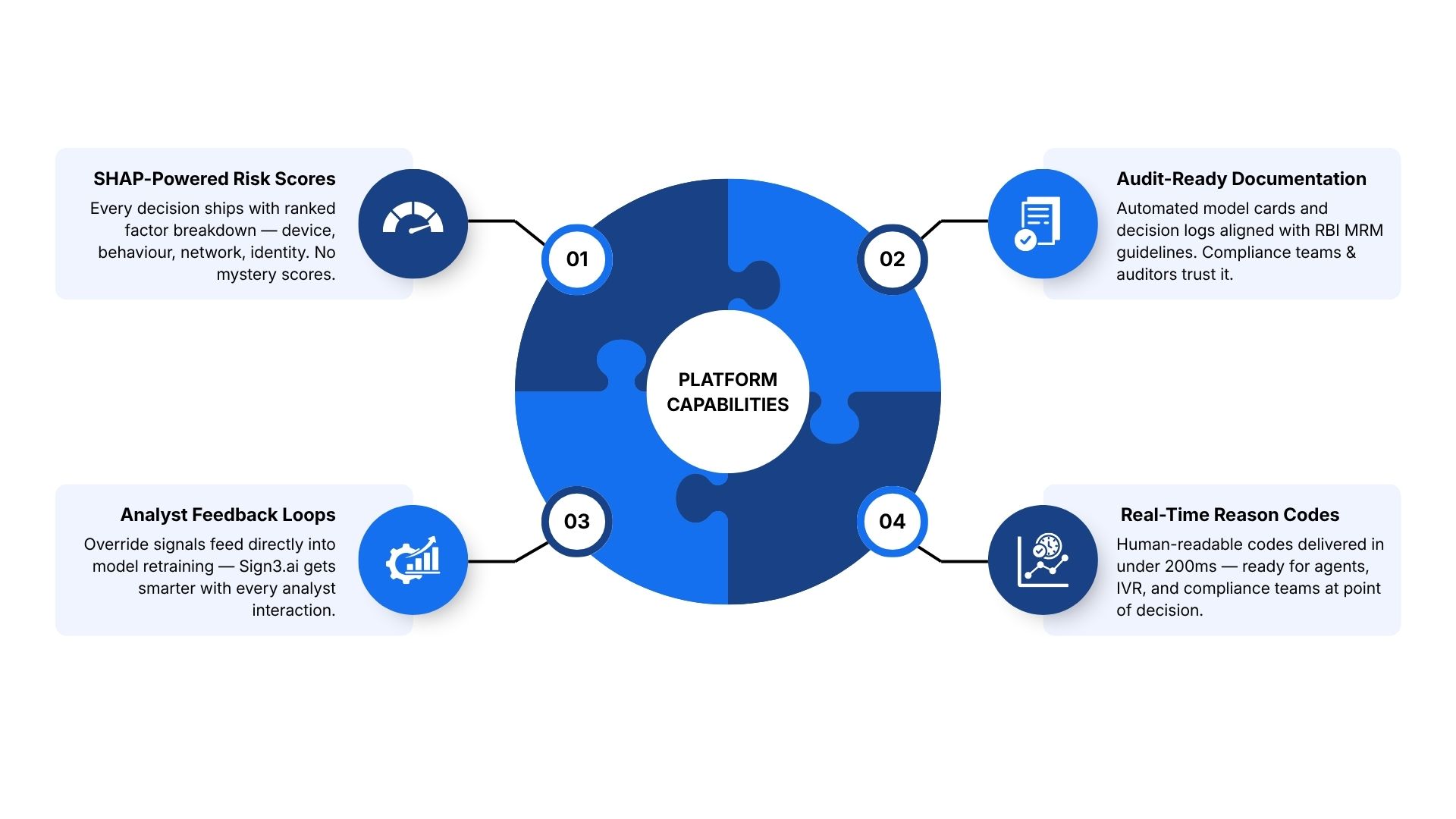
Built for Indian financial institutions — interpretable by design, not as an afterthought. Sign3.ai's risk intelligence platform processes device intelligence, behavioural biometrics, transaction patterns, and network graphs — all with full XAI transparency.
9. The Future: Transparency Becomes the Standard
Several converging forces are making explainability not just preferred, but mandatory:
2025 — Regulatory Mandates Land: India's Digital India Act and RBI's AI/ML governance circular formalise explainability requirements for automated financial decisions. Early movers have a structural advantage.
2026 — GenAI-Powered Fraud Escalates: Synthetic identities, deepfake voice fraud, and LLM-assisted social engineering make interpretable models essential for rapid adaptation — you can only fight what you can see and explain.
2027+ — XAI Becomes a Procurement Criterion: Enterprise buyers, large banks, insurance firms, regulated NBFCs — will require explainability certifications from AI vendors as standard in RFPs. Non-compliant vendors lose the deal.
10. Conclusion: The Era of the Explainable Fraud Model Is Here.
The question is no longer whether AI should power fraud detection. It should, and it does. The real question is: can your AI explain itself to your compliance team, your regulator, your customer, and ultimately to you?
Explainable AI in fraud detection is the bridge between high performance and high accountability. It turns a black box into a trusted partner — one that makes sharp decisions and shows its work.
For banks, NBFCs, and fintech companies navigating an increasingly complex fraud landscape, the move to interpretable machine learning is not a future consideration. It is a present necessity.
Sign3.ai exists to make that transition seamless — with fraud intelligence that is fast, accurate, and above all, explainable..
About The Author

Arvinder Singla is the Co-founder & CEO of Sign3. With extensive experience in the gaming and fintech industries, he has been at the forefront of innovating fraud prevention solutions. His expertise drives Sign3's mission to deliver cutting-edge technology that safeguards businesses from evolving fraud threats.