

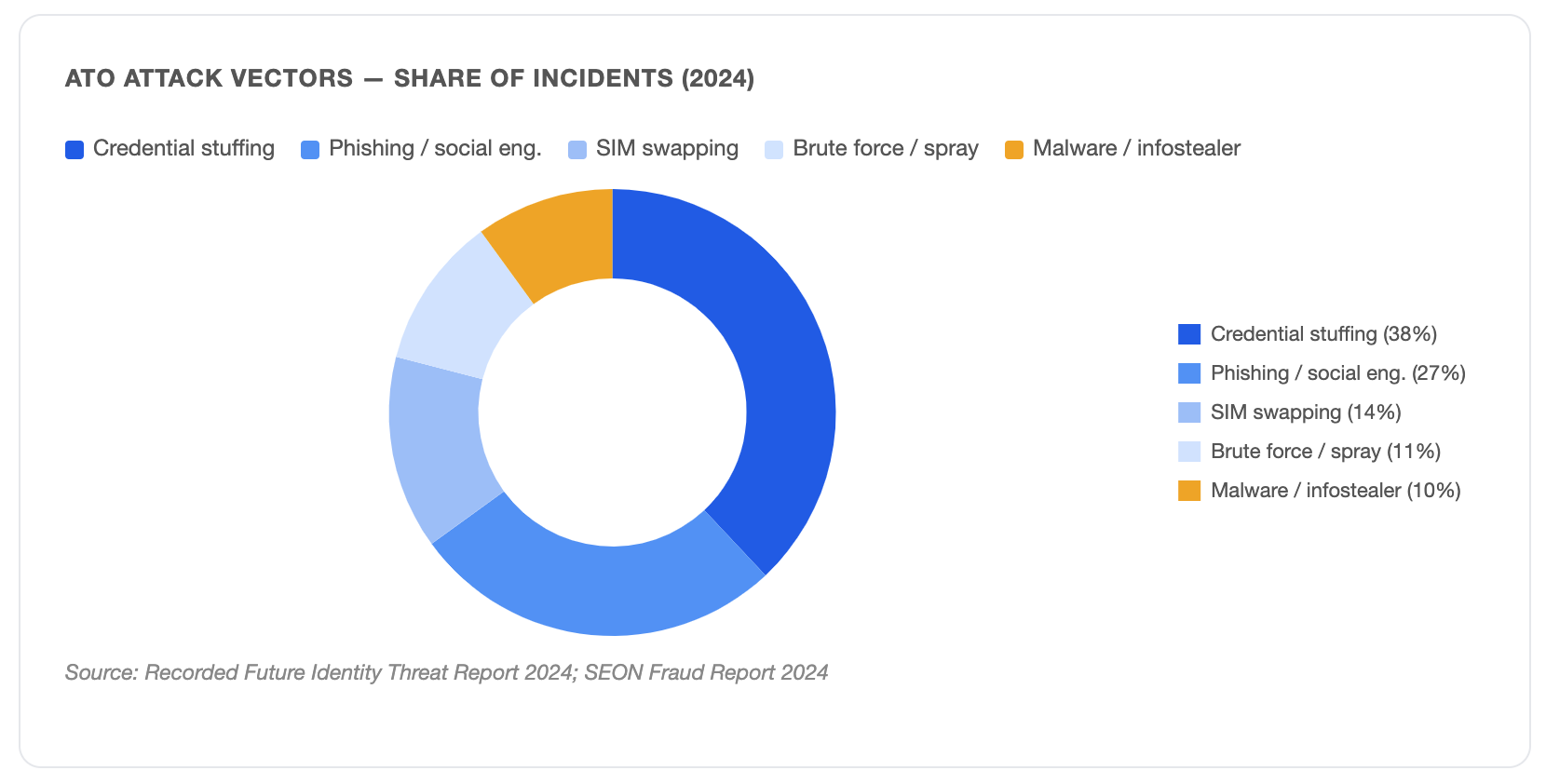
Account takeover (ATO) fraud has evolved from opportunistic credential stuffing into a sophisticated, AI-augmented enterprise. Legacy rule-based defences — IP blocklists, rate limiters, static device fingerprints are no longer enough. The threat actors of 2025 don't just steal passwords; they mimic legitimate user behaviour with startling precision. The question is no longer who logged in, it's how they logged in, and whether that behaviour matches the person who owns the account.
At Sign3.ai, we believe the answer lies in behavioural AI: a continuous, context-aware intelligence layer that stops attackers not at the gate, but mid-stride.

Why rule-based systems are failing
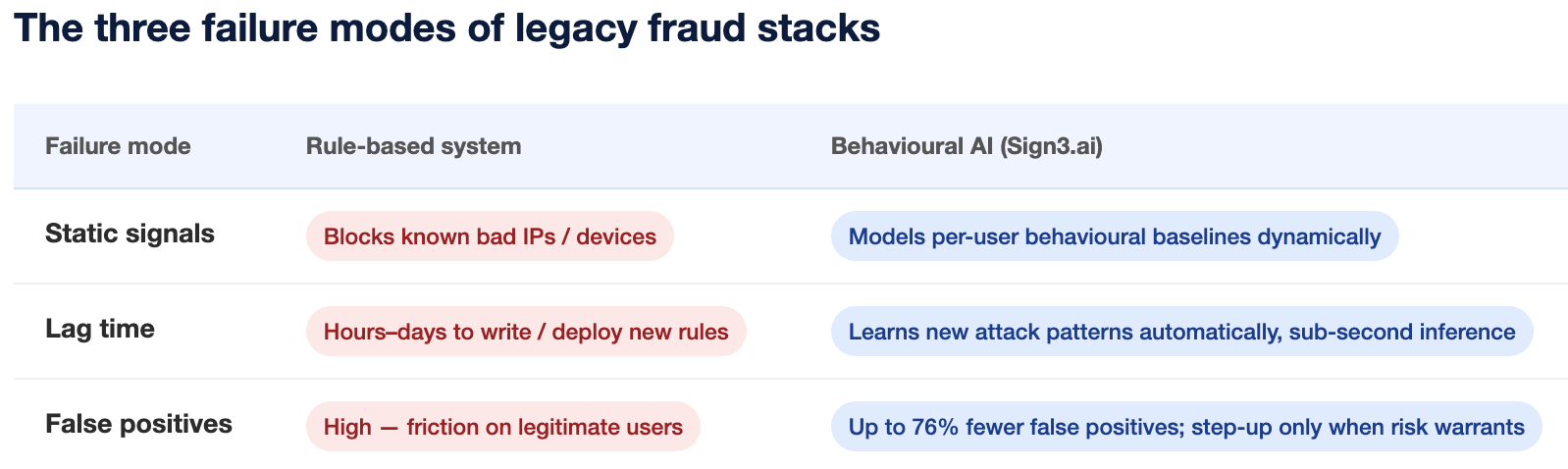
Traditional defences operate on a simple logic: define what bad looks like, block it. The problem is that attackers have reverse-engineered the rules. Modern ATO kits rotate IPs automatically, spoof device headers, simulate realistic typing cadences, and even solve CAPTCHAs using human-powered farms. A rule that blocked yesterday's attack misses today's.
"Rule-based fraud systems flag what attackers did yesterday. Behavioural AI detects what they're doing right now even when, they've never been seen before." — Sign3.ai Threat Research
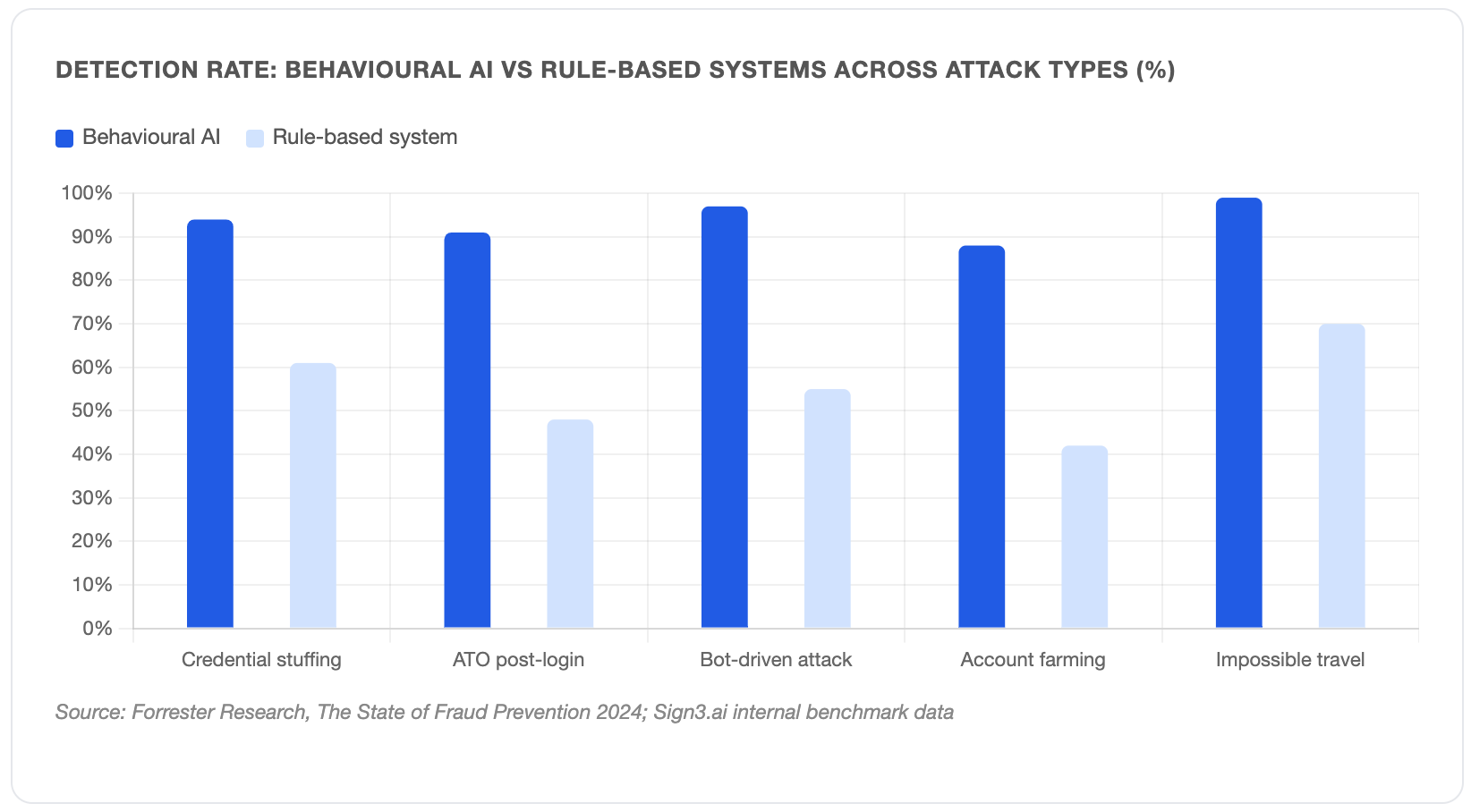
The deeper problem is asymmetry. Building and maintaining a rule library takes security teams days or weeks per threat vector. An attacker can mutate their approach in hours. Behavioural AI closes this gap by learning what normal looks like for each user, each device, and each session, then flagging deviations in real time.
What behavioural AI actually detects
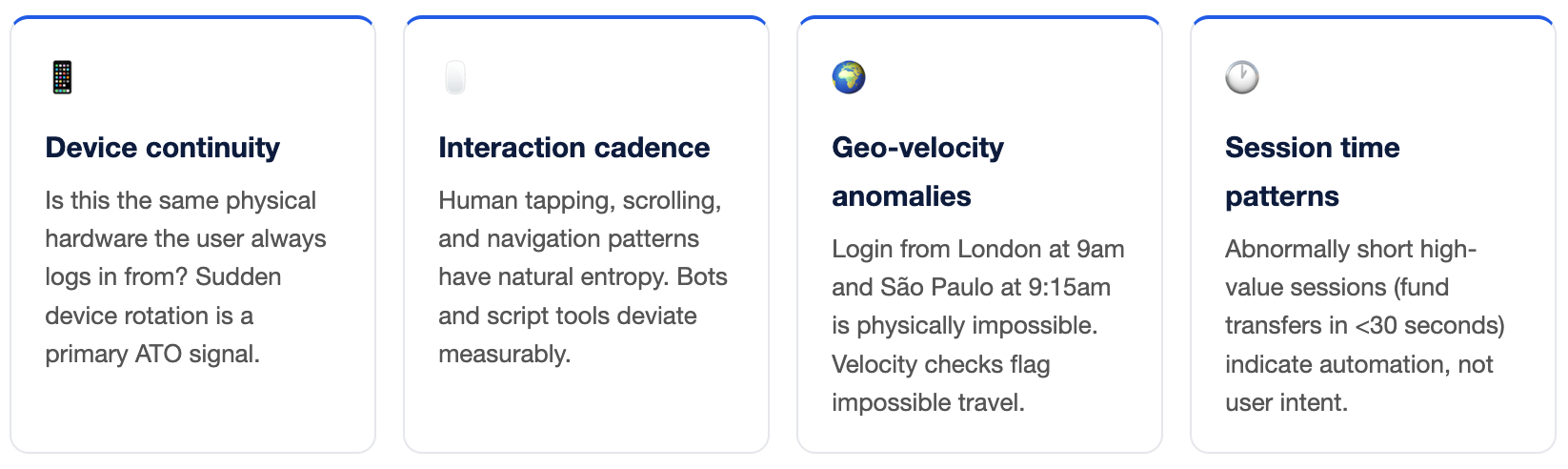
Behavioural AI doesn't replace device intelligence — it amplifies it. At Sign3.ai, our platform fuses device-level signals (hardware attestation, emulator detection, GPS spoofing flags) with session-level behavioural features to build a composite risk score that evolves through a user's journey, not just at login.
The real cost of a false positive
Security teams often think of the cost of fraud in terms of losses prevented. But the cost of friction is equally real. A study by Ping Identity found that 63% of consumers will abandon a transaction if they encounter unexpected authentication friction, and 38% will switch to a competitor. In mobile-first markets, where Sign3.ai operates, this conversion drain is existential for fintechs, lending apps, and e-commerce platforms
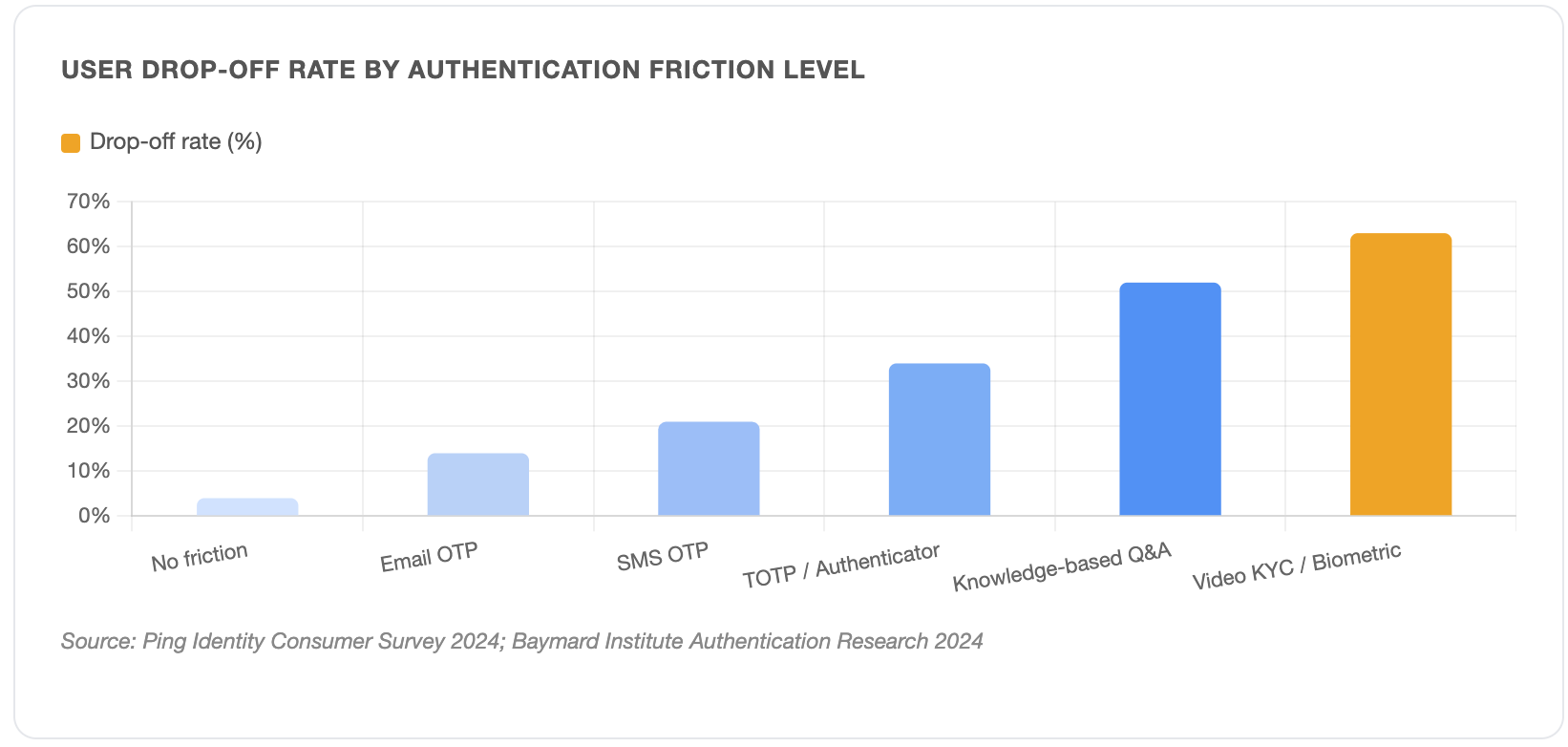
Behavioural AI solves this by enabling risk-adaptive authentication: invisible by default, escalating only when signals warrant it. A trusted device, consistent behaviour, and a familiar location means a user sails through. An unfamiliar device accessing a high-value endpoint from an anomalous location gets stepped up — TOTP, biometric, or call-back, without every user bearing that cost.
Sign3.ai's approach: device intelligence meets behavioural AI
Sign3.ai's device intelligence SDK is purpose-built for mobile-first environments across South and Southeast Asian markets characterised by high device diversity, SIM-swap fraud, and app-cloning attacks. Our behavioural AI layer sits on top of device fingerprinting to provide a continuous risk signal throughout the user lifecycle, not just at onboarding.
Key capabilities include real-time emulator and root detection, GPS spoofing identification, app integrity attestation, and cross-session behavioural profiling. Our models are trained on hundreds of millions of mobile sessions, enabling them to distinguish between a returning customer and a fraudster who has simply acquired that customer's credentials.
In a 2024 deployment with a Tier-1 Indian digital lending platform, Sign3.ai's behavioural layer reduced ATO-related fraud losses by 61% within 90 days, while reducing step-up authentication triggers by 43% improving both security and user experience simultaneously.
What to look for in a behavioural AI fraud platform
Not all behavioural AI solutions are equal. When evaluating platforms, security and product teams should assess the following dimensions: the freshness and breadth of training data (models trained on narrow or outdated datasets degrade quickly), latency (sub-100ms scoring is essential for mobile flows), explainability (a risk score you cannot explain to regulators or customers creates liability), and the quality of device-layer signals underpinning the behaviour models.
A behavioural model is only as good as the device truth it sits on. If the underlying device intelligence can be spoofed, the behavioural layer is building a profile of the attacker's emulated device, not the user's real one. Sign3.ai addresses this by anchoring behavioural profiling to hardware-attested device identifiers that survive app reinstalls, factory resets, and device cloning attempts.
The road ahead: AI versus AI
The fraud landscape of 2025 and beyond will be defined by an arms race between generative AI attack tools and adaptive AI defences. Deepfake-assisted onboarding fraud, LLM-powered social engineering, and AI-driven credential harvesting are already emerging threats. The organisations that win this race will not be those with the most rules, but those with the most adaptive, continuously learning behavioural intelligence infrastructure.
Rule engines are archives of past battles. Behavioural AI is a forward-looking radar. As attackers shift from breaking doors to walking through them with stolen keys, the only viable defence is understanding not just who holds the key but whether the way they're using it makes any sense at all.


